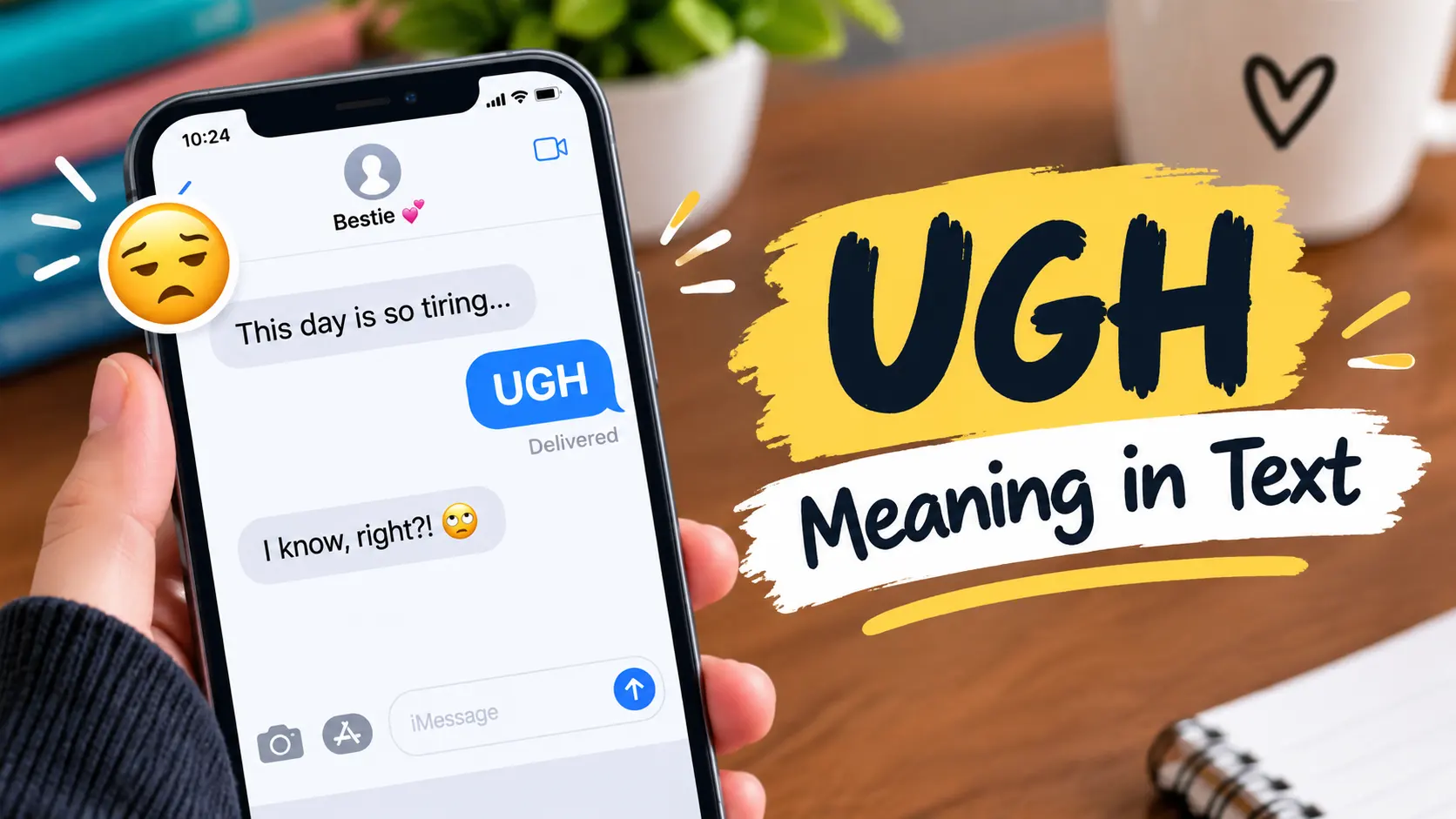
You get a text that says, “Ugh. Monday again.”
Is your friend mad? Tired? Just being dramatic? Most likely, a little of all three.
“Ugh” is a sound of annoyance. People type it when something is boring, gross, hard, or just plain unfair. It shows up in texts, comments, game chats, and even quick work messages.
It looks small. But it tells you a lot about how a person feels. That is why it matters. If you read it wrong, you might tease someone who needs help. Or you might worry when they are only joking.
This guide explains what “ugh” means, where it came from, and how to reply. You will also learn when to use it and when to skip it. Let’s begin.
Definition & Meaning
“Ugh” is an interjection. That is a word that shows a feeling instead of sharing a fact. It stands for annoyance, disgust, frustration, or tiredness.
The longer phrase does not appear here. It is simply a sound represented in text.
You can almost hear someone groan when they type it.
Here are the main ways people use it.
1. Annoyance
Something small bugs the person.
Mia: My neighbor is playing loud music again. Ugh.
Leo: That’s the worst. Want to come over here?
2. Disgust
Something is gross or unpleasant.
Sam: I just found old milk in my bag. Ugh.
Ana: Nope. Throw the whole bag out.
3. Tiredness or dread
The person does not want to do something.
Kai: Ugh, I have to clean the house today.
Zoe: Put on music. It helps.
4. Frustration
Things are not going the right way.
Dev: My laptop froze again. Ugh!
Rita: Did you save your work?
5. Playful drama
Sometimes it is just a joke. The person is not truly upset.
Jo: Ugh, my cat sat on my keyboard. Again.
Cam: She runs your life now.
6. Fake annoyance with love
People also use it to tease people they like.
Nina: Ugh, you are so funny. I hate it.
Omar: You love it.
The key rule: read the words around “ugh.” They tell you how big the feeling is.
Background & History
“Ugh” is old. It began as a spoken sound, long before texting.
Writers used “ugh” in English as early as the 1800s. It first showed up as a way to write a sound of horror or disgust. Think of someone seeing something gross and making a noise. Writers needed a way to show that noise on paper. So they spelled it “ugh.”
For a long time, it stayed in books, comics, and plays. Comic strips loved it. A cartoon character who steps in mud might say “ugh” in a speech bubble.
Later, the word moved into everyday speech. People said it out loud when they felt annoyed or grossed out.
Then came texting and the internet. In chat rooms and early text messages, people needed a way to show tone. They could not sigh or roll their eyes. So they typed “ugh.” It did the job in three letters.
Over time, people started stretching the word to show more feeling:
- Ughhh
- Uggghhh
- UGH
- Ughhhh why
More letters mean more annoyance. All caps mean loud annoyance.
Social media made it even bigger. On X, TikTok, and Instagram, “ugh” is common in captions and comments. It often shows a mix of frustration and humor.
Today, “ugh” is used by all age groups. Teens use it. Adults use it. Even people who say they hate slang still say “ugh.” That is because it is simple and clear.
Its meaning has stayed the same for a long time: a small groan of dislike. What has changed is how people use it. Now it can also be playful, dramatic, or even flirty.
Usage in Various Contexts
“Ugh” can show up almost anywhere. Here is how it works in common places.
Texting
In private texts, “ugh” is a quick way to share a mood.
Dana: Ugh, stuck in traffic.
Eli: Sorry! I’ll save you a seat.
Social media
On social media, people use “ugh” in captions, posts, and comments.
Post: Ugh, another rainy weekend.
Comment: Same. Time for movies.
Sometimes it is used in a funny or dramatic way.
Post: Ugh, why are these cookies so good?
Comment: Send some my way.
Gaming
Gamers use “ugh” when things go wrong.
Player 1: Ugh, I got knocked out again.
Player 2: Shake it off. Next round.
It can also show annoyance at a teammate. Tone matters here.
Player A: Ugh, we lost because of that one move.
Player B: Not cool. Let’s just try again.
Casual talk with friends
Friends use it to complain and bond.
Jo: Ugh, I have three tests this week.
Max: Same. Let’s study together.
Reacting to news
People also use it to show dislike about news or events.
Lena: They raised the price of coffee. Ugh.
Tom: Time to make it at home.
Quick tip
- Short and plain “ugh” usually means mild annoyance.
- “Ughhhh” or “UGH” means a bigger feeling.
- “Ugh” with a laugh or joke is often playful.
- “Ugh” on its own with no reason may need a check in.
Common Misconceptions & Clarifications
“Ugh” seems easy. But people still mix it up. Here are common mistakes.
Misconception 1: “Ugh always means anger.”
Not true. It often means tiredness or a small complaint. The person may not be angry at all.
Ben: Ugh, I need coffee.
Ivy: Are you mad at me?
Ben: No! Just sleepy.
Misconception 2: “It’s aimed at you.”
Most of the time, “ugh” is about a situation, not a person. It is a groan in the world.
Misconception 3: “It’s rude.”
In most cases, it is not rude. It is just a feeling. But it can sound rude if it is aimed at someone.
Misconception 4: “It only shows negative feelings.”
It can also be playful or loving. Someone might say “ugh, you’re so cute” as a joke.
Ella: Ugh, you remembered my birthday. I love you.
Fay: Of course I did.
Misconception 5: “It’s the same as ‘ew.'”
They are close, but “ew” is mainly disgusting. “Ugh” is wider. It can show disgust, tiredness, or frustration.
Misconception 6: “It’s the same as ‘uh.'”
“Uh” is a pause word, like “um.” It shows hesitation. “Ugh” shows a feeling. They look alike but do different jobs.
When it can be misread
- If someone says “ugh” right after your message, it may sound like a reaction to you.
- A lone “ugh” can seem cold or boring.
- In a serious talk, it can look like you don’t care.
Quick fix: Add a few words. “Ugh, this traffic is awful” is much clearer than “ugh.”
Similar Terms & Alternatives
People have many ways to say what “ugh” says. Some are words. Some are emojis.
Word alternatives
- Ew: Disgust. Best for gross things.
- Argh: Frustration or anger. Louder than “ugh.”
- Sigh: Tired or sad. Softer than “ugh.”
- Bleh: Dislike or boredom.
- Blah: Dull or unexciting.
- Meh: Not good, not bad. No strong feeling.
- Yikes: Shock or awkward feeling.
- Ugh, seriously? Annoyed and surprised.
- Smh: “Shaking my head.” Disappointed.
Emoji alternatives
- 😩 Weary Face: Tired and done.
- 😫 Tired Face: Stressed out.
- 🙄 Rolling Eyes: Annoyed or bored.
- 😤 Face with Steam: Frustrated.
- 🤦 Facepalm: “I can’t believe this.”
- 😒 Unamused Face: Not impressed.
- 🤢 Nauseated Face: Gross.
Quick comparison table
| Term | Main Feeling | Best Used For |
| Ugh | Annoyance, dread | Everyday complaints |
| Ew | Disgust | Gross things |
| Argh | Strong frustration | Big problems |
| Sigh | Tired, sad | Quiet moods |
| Meh | No interest | Boring things |
| 🙄 | Annoyed or bored | Eye roll moments |
Tip: Pick the word that matches the size of your feeling. Use “ugh” for medium. Use “argh” for big.
How to Respond to This Term
How you reply depends on what “ugh” means and who sent it. Here are four styles.
1. Casual replies
Good for friends.
Friend: Ugh, I have to work all weekend.
You: That’s rough. Want to grab food after?
2. Funny replies
Match the mood. Keep it light.
Friend: Ugh, my alarm didn’t go off.
You: Your alarm is on strike.
3. Supportive replies
Use these if the person seems truly upset.
Friend: Ugh, today was the worst.
You: I’m sorry. Do you want to talk about it, or should I just send memes?
4. Professional replies
Use these at work.
Coworker: Ugh, the system is down again.
You: Thanks for the heads up. I’ll check with IT.
5. Privacy conscious replies
Use these when you don’t want to share much.
Acquaintance: Ugh, what’s wrong with you today?
You: Just a long day. Thanks for asking.
When you’re not sure
Ask a simple question.
Friend: Ugh.
You: Uh oh. Is this a small ugh or a big ugh?
Golden rule: Check the mood first. Then match it.
Regional or Cultural Differences
“Ugh” is common in English. But other places have their own sounds.
English speaking countries
In the US, UK, Canada, and Australia, “ugh” is widely used and understood. It is common in speech and in text.
Spanish speaking regions
People often use “ay” or “uf” for the same feeling.
Carla: Uf, qué calor. (Ugh, soy hot.)
Diego: Sí, no aguanto.
French speaking regions
French speakers say “pff” or “bof” for boredom, and “berk” for disgust.
South Asia
In India and Pakistan, people mix English with local words. “Ugh” is common in English chats. Some also use “uff” or “ufff.”
Sana: Ufff, bijli phir chali gayi. Ugh.
Ayesha: Every single day.
German speaking regions
People say “igitt” for disgust and “puh” for tiredness.
East Asia
In Japan, people may use “ugee” or “uwa.” Chinese chat users may say “aiya” for frustration.
Slang variations in English
- US: “Ugh,” “Ughhh,” “Ugh, gross”
- UK: “Ugh,” “Urgh,” “Bleurgh”
- Australia: “Ugh,” “Yuck,” “Bit rough”
Why differences happen
Every language has sounds of annoyance. The idea is the same. The spelling is not.
Simple tip: If you chat with people from other places, “ugh” is usually safe. But a short explanation can help.
Comparison with Similar Terms
Here is how “ugh” differs from its close cousins.
| Term | Main Meaning | Intensity | Common Mix Up |
| Ugh | Annoyance, dread, mild disgust | Medium | Thought to be anger |
| Ew | Disgust | Medium | Used for non gross things |
| Argh | Strong frustration | High | Seen as the same as “ugh” |
| Sigh | Tired or sad | Low | Mistaken for boredom |
| Meh | Indifference | Low | Read as negative |
| Bleh | Dislike | Low to medium | Confused with “ew” |
| Smh | Disappointment | Medium | Seen as angry |
Key differences in plain words
- Ugh vs ew: “Ew” is about gross things. “Ugh” is wider. It covers annoyance too.
- Ugh vs argh: “Argh” is louder and angrier. “Ugh” is more of a groan.
- Ugh vs sigh: A sigh is soft and tired. “Ugh” has more of an attitude.
- Ugh vs meh: “Meh” means you don’t care. “Ugh” means you do, and you’re not happy.
- Ugh vs smh: “Smh” shows disappointment in people. “Ugh” shows annoyance at anything.
Example in dialogue
Kim: Ugh, my flight is delayed.
Dan: Argh, that’s the worst.
Kim: And the food here is bleh.
Dan: Meh, at least you have a seat.
Takeaway: “Ugh” is your all purpose groan. Other words add a bit more color.
Usage in Online Communities & Dating Apps
Every online space has its own style. Here is how “ugh” fits.
X (Twitter) and TikTok
People use “ugh” to share mood and humor.
Post: Ugh, why is Monday so long?
Reply: It’s a scam.
Instagram and Facebook
It shows up in captions and stories. People post it with photos of bad weather, long lines, or messy rooms.
Reddit and forums
Users often write “ugh” at the start of a post about a problem.
Post: Ugh, my code won’t run.
Reply: Share the error message and we’ll help.
Gaming communities
On Discord, Twitch, or in game chat, “ugh” shows up after a loss or lag.
Player: Ugh, lag again.
Teammate: Restart the router.
Dating apps like Tinder and Bumble
Here, “ugh” can be playful or flirty. It can also be a real complaint.
Match: Ugh, my day has been so long.
You: Sorry to hear that. Want to tell me the best part?
It can also be used in friendly teasing.
Match: Ugh, you’re too funny. Stop it.
You: Never.
Tips for responding on dating apps
- Check the tone. Is it a joke or a really bad day?
- Be kind first. A warm reply builds trust.
- Ask for a follow up. It keeps the chat going.
- Don’t overreact. One “ugh” is usually light.
- Watch for patterns. If every message is negative, the vibe may not fit you.
- Avoid rude “ugh.” Saying it about their looks or words can hurt.
Community tips
- Read the room first.
- Don’t use “ugh” to mock others.
- Add a reason so people don’t guess.
- In serious threads, use full sentences.
Hidden or Offensive Meanings
Good news: “ugh” has no secret or offensive meaning. It is not a code word. It has no hidden message.
Still, it can cause trouble in a few ways.
1. Sounding dismissive
If someone shares a story and you reply “ugh,” they may think you are bored.
Sara: I finally finished my big project.
Dan: Ugh.
Sara: Um, what does that mean?
Dan may have meant, “Ugh, I’m jealous.” But it looked cold.
2. Aimed at a person
Saying “ugh” about someone can feel insulting.
Chris: Ugh, you again.
Pat: Wow. Okay.
Among friends, this may be a joke. With others, it can hurt.
3. Sarcasm
People sometimes use “ugh” in a sarcastic way. If the reader misses the joke, it can sting.
4. Mocking someone’s interest
“Ugh, why do you like that?” can make a person feel judged.
5. Mixing with insults
If “ugh” comes with harsh words, the whole message becomes rude. The word itself is not the issue. The words around it are.
Why tone and context matter
Text has no voice. You can’t hear a laugh or see a smile. So “ugh” can feel:
- Friendly in a joke
- Cold on its own
- Rude when aimed at someone
Simple safety tips
- Say why. “Ugh, this weather” is clear.
- Know your audience. Friends may get the joke. Strangers may not.
- Be kind with news. Don’t reply to good or sad news with a lone “ugh.”
- Ask if unsure. A quick question saves the day.
The word is not the problem. Misreading it is.
Suitability for Professional Communication
Short answer: “ugh” is best avoided in formal work messages.
Where it may be okay
- A friendly team chat
- A quick note to a close coworker
- A joking thread after work
Even then, keep it rare.
Coworker: Ugh, the meeting ran long.
You: Yes. Let’s send a quick recap.
Where it is not a good fit
- Emails to clients
- Messages to your boss
- Reports and proposals
- Job applications and interviews
- Anything shared with a large group
Why it can be risky
- It can look unprofessional.
- It can seem like you are complaining.
- It may sound negative or rude.
- Others may take it personally.
Professional alternatives
| Instead of… | Try… |
| “Ugh, another meeting.” | “My schedule is full today. Can we shorten this?” |
| “Ugh, the system is down.” | “The system appears to be down. I’m checking now.” |
| “Ugh, new rules.” | “These changes will take some adjustment.” |
| “Ugh, this deadline.” | “This deadline is tight. Let’s plan the steps.” |
Other gentle options
- “That’s frustrating.”
- “That’s unfortunate.”
- “I understand the concern.”
- “That’s a challenge.”
Rule of thumb: If you would not groan out loud in a meeting, don’t type it in writing. When unsure, use calm, clear words.
FAQs
1. What does “ugh” mean in text?
It shows annoyance, disgust, tiredness, or frustration. It is a written groan. The words around it show the exact feeling.
2. Is “ugh” rude?
Usually no. It is a simple sound of dislike. But it can feel rude if it is aimed at a person or used in a serious moment.
3. What is the difference between “ugh” and “ew”?
“Ew” is mainly for gross things. “Ugh” is wider. It covers annoyance, dread, and frustration too.
4. How should I reply if someone says “ugh”?
Read the mood first.If it feels minor, respond with a joke. If it feels serious, show some support. When you’re unsure, ask, “Is it a small ugh or a big ugh?”
5. Can I use “ugh” at work?
Only in casual chats with people you know well. For emails and formal notes, use full sentences like “That’s frustrating.”
6. Why do people write “ughhh” with extra letters?
More letters show more feeling. “Ughhhh” is a bigger groan than “ugh.”
7. Does “ugh” have a hidden meaning?
No. It has no secret or offensive meaning. But tone can change how it feels, so add a few words when needed.
Conclusion
“Ugh” is a tiny word with a big job. It shows annoyance, disgust, tiredness, or frustration in just three letters. Its meaning depends on the words around it, the person who sends it, and the place where it appears.
Here are the key points to remember:
- Read the context before you decide what it means.
- Look at the length. More letters mean more feeling.
- Match the mood when you reply.
- Add words so your message is clear.
- Skip it in formal work messages.
- Ask if you’re not sure.

Noman Hassan is a content creator and writer focused on text meanings, slang, abbreviations, acronyms, and internet expressions. Through Orvexale.com, he provides clear and simple explanations to help readers understand modern texting language. His goal is to make confusing terms easy to understand with practical examples and everyday context.