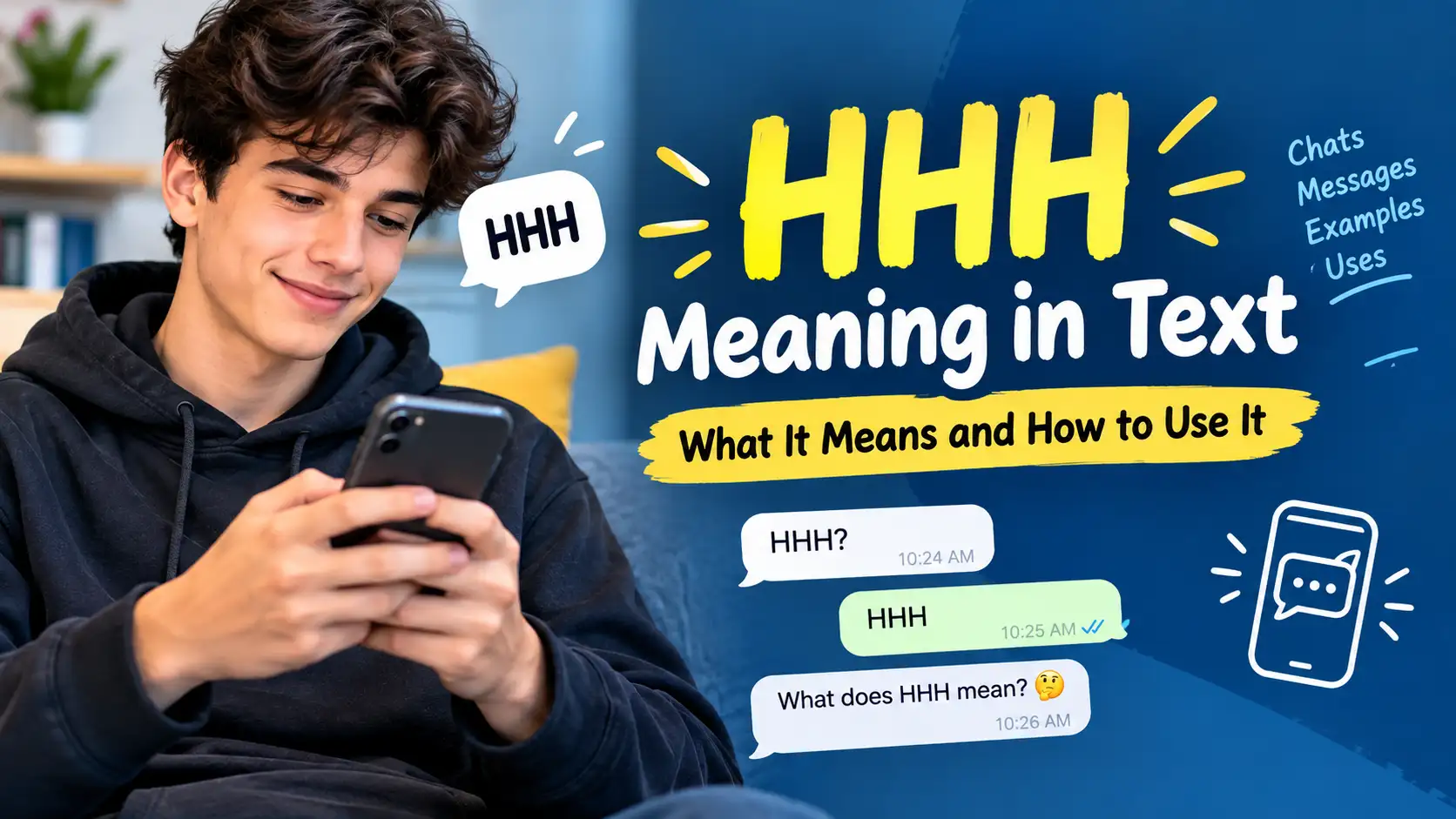
You get a text. It says “hhh.” Nothing else. You stare at it. Is your friend laughing? Are they sad? Did their cat walk on the keyboard?
Don’t worry. Many people ask this. Short texts can be tricky. “HHH” is usually a quick way to type laughter. It is a short form of “hahaha.”
You will see it in texting, social media, gaming chats, and even work chats. It shows up fast and it shows up often.
Why does it matter? Because a small text can change the mood of a chat. If you miss the meaning, you may reply the wrong way. You could sound rude. You could sound cold. Or you could just feel lost.
This guide keeps it simple. You will learn what HHH means, where it came from, and how to use it. You will also learn how to reply. Let’s dive in.
Definition & Meaning
HHH most often means “hahaha.” It is a laugh typed in a short way.
Think of it like this. “Hahaha” takes time to type. “HHH” takes one second. It says the same thing: “That’s funny.”
Here is the simple breakdown:
- HHH = hahaha (the most common meaning)
- hhhh = a long laugh, or a soft sigh
- HHH = sometimes “hugs, hugs, hugs” (rare, and depends on the chat)
The number of H’s can change the feel. Three H’s is a light laugh. Six or seven H’s is a big laugh. Just one “h” is often a tiny, quiet laugh.
Real life examples:
Sara: I wore two different shoes to work today.
Ali: hhh that is so you
Mia: My dog just ate my homework. For real.
Leo: hhhhh I’m sorry, but that’s funny
Tom: You forgot the tickets?
Nina: yes hhh, I’m the worst
Notice something. In each chat, the person is not mean. They are laughing with the other person. That is the heart of HHH. It is warm and light. It says, “I find this funny, and I’m relaxed.”
Sometimes HHH also covers a nervous laugh. A person may type it when they feel shy or a bit awkward. For example: “I failed the test hhh.” They are not always happy. They may be hiding a small sting behind a laugh.
So the base meaning is easy: HHH is laughter. The rest comes from the mood of the chat.
Background & History
Nobody can point to the exact day HHH was born. Slang grows in the wild. It spreads from person to person.
But we know why it grew.
Typing laughter is old. In early chat rooms, people typed “lol,” “haha,” and “hehe.” Each one was a way to add a sound to plain text.
Over time, people got faster. They wanted shorter ways to laugh. So “haha” became “hah,” then “hh,” then “hhh.”
Other languages helped a lot. In many Chinese chats, the laugh “哈哈哈” (hā hā hā) is often typed as “hhh” because it uses the first letters of the sounds. In Arabic chats, the laugh “هههه” uses one letter, which looks like “h” on a Latin keyboard. So “hhh” feels natural there too.
Because of this, HHH spread across the web. It rode along on social media apps, messaging apps, and gaming chats. People who speak different languages met online and shared their habits.
How it changed:
- It began as a plain laugh.
- It grew into a soft, friendly laugh that feels less loud than “LOL.”
- It became a mood tool. The length and case now hint at feelings.
Today, you will see HHH most on messaging apps, comments, group chats, and in game chat. Younger users lean on it. But many adults use it too.
Slang moves fast. A term can shift in a few years. Still, HHH has stayed steady because it is so simple. It does one job, and it does it well.
Usage in Various Contexts
HHH pops up in many places. Its meaning stays close to “laughing.” But the flavor can change.
Texting
In private texts, HHH is casual and friendly.
Zara: Guess who fell in the pool with their phone?
Omar: hhh no way
Zara: Yes way. It’s dead now.
Social media
On Instagram, X (Twitter), or TikTok, people drop HHH in comments. It says, “This made me smile.”
Comment: This cat’s face when the door opens 😭
Reply: hhh he knows he’s in trouble
Gaming
In games, chat moves fast. Players do not want to type long words. HHH is perfect.
Player 1: Did you just run into the wall?
Player 2: hhh my controller slipped
Player 1: GG anyway
Casual talk with friends
With close friends, HHH is a soft laugh. It can also soften a hard message.
Sam: I can’t come tonight, hhh, I’m so tired
Jo: No worries. Sleep well!
Here, “hhh” cushions the news. It says, “I’m sorry, but I’m okay with it.”
Work chats
In work chat apps, HHH shows up between close teammates. It is fine in a friendly team. It may feel too casual with a boss or a client.
The key idea: HHH is a mood word. It helps text feel more human.
Common Misconceptions & Clarifications
Short slang breeds confusion. Here are the top mix ups.
Misconception 1: “HHH is always about being happy.”
Not always. People type it when they feel nervous, shy, or awkward, too. A message like “I lost my job hhh” may hide pain. Look at the full text. Read the mood.
Misconception 2: “HHH is the same as LOL.”
Close, but not the same. LOL can feel bigger and more public. HHH feels softer and more personal. It is like a small giggle.
Misconception 3: “HHH always means laughing.”
Mostly, yes. But here are other meanings you may see:
- Triple H: the nickname of a famous wrestler, often written “HHH.”
- Hash House Harriers: a social running club, known as “HHH” or “H3.”
- Hot hot hot: used in fun or food talk.
- hhhh (long): a sigh or a breath, like “hhhh, what a day.”
Misconception 4: “HHH is rude.”
Almost never. It is a friendly term. But tone matters. If someone types “hhh” after you share sad news, it may feel cold. In that case, the person may not know how to react. Or they may be laughing at you. Check the context.
How to avoid confusion:
- Look at the whole message.
- Look at the person. Do they laugh a lot?
- Look at the topic. Is it funny or serious?
- If you are unsure, ask. A quick “are you laughing or sighing?” is fine.
Clear chats build strong bonds. Don’t be shy about asking.
Similar Terms & Alternatives
Many words do the same job as HHH. Some are loud. Some are soft. Here are the main ones.
- Haha / Hahaha: the classic laugh.
- LOL: “laughing out loud.” Very common.
- LMAO: “laughing my a** off.” Stronger and more casual.
- Hehe: a cute or sly giggle.
- XD: a laughing face made from letters.
- 😂 / 🤣: emoji laughs.
- Kkk: a laugh used in Korean and Portuguese chats.
- 555: a laugh used in Thai chats (the word for “five” sounds like “ha”).
Quick comparison table:
| Term | Feels like | Best for |
| HHH | Soft, quick laugh | Friends, chats, comments |
| Haha | Plain, clear laugh | Almost anywhere |
| LOL | Bigger, common | Casual chat |
| LMAO | Very strong laugh | Close friends only |
| Hehe | Cute, teasing | Flirty or playful chat |
| 😂 | Loud, visual laugh | Social media |
How to pick: Ask yourself what you want to say.
- Want to sound calm and warm? Use HHH or haha.
- Want to sound very amused? Use LOL or 😂.
- Want to sound playful? Use hehe.
- Want to sound professional? Skip all of them, or use a plain smile like “That’s great :)”.
Small word choices shape how people read you. Pick the one that fits.
How to Respond to This Term
When someone sends HHH, they want a small, friendly reply. You do not need to think hard. Match their mood.
Casual replies
- “hhh glad you liked it”
- “haha right?”
- “I know, it was wild”
Ben: Your cooking smoke alarm went off again hhh
You: Every single time 😅
Funny replies
- “Stop, I’m crying 😂”
- “Don’t laugh at my pain hhh”
- “Wait, it gets worse…”
Lily: You wore socks with sandals hhh
You: It’s called fashion, Lily.
Professional replies
At work, keep it light but clean.
- “Glad that landed well.”
- “Thanks! Happy to help.”
- “Good one. Now, back to the report :)”
Coworker: That meeting could’ve been an email hhh
You: Agreed. Let’s keep the next one short.
Privacy conscious replies
Sometimes a person uses HHH to push you to share more. You can stay polite and keep your info safe.
- “hhh let’s talk about something else”
- “Ha, I’d rather not say.”
- “That’s a story for another time.”
Stranger: Where do you live hhh?
You: Ha, I keep that private. What games do you play?
If you are unsure
Just ask: “Is that a good laugh or a nervous one?” That small check can save a lot of mix ups.
Regional or Cultural Differences
Laughing in text looks different around the world. HHH is one small piece of a bigger map.
In Chinese speaking chats: “hhh” is a very common way to type “哈哈哈.” People use it all day, in friendly and casual talk. It is as normal as “haha” is in English.
In Arabic speaking chats: People type “هههه” with repeating letters. When they switch to a Latin keyboard, it often turns into “hhhh.” The number of letters shows how hard they laugh.
In English speaking chats: People use “haha,” “LOL,” and “lmao” more. HHH is less common, but it is growing thanks to global apps.
Other regional laughs:
| Region / Language | Laugh in text | Notes |
| Thai | 555 | “Five” sounds like “ha” |
| Korean | ㅋㅋㅋ (kkk) | Sounds like a giggle |
| Portuguese / Brazilian | kkkk or rsrs | Very common |
| Spanish | jajaja | “J” sounds like “H” |
| Japanese | www | “笑 (warai)” means laugh |
| Chinese | hhh / 哈哈哈 | Common in chat apps |
Notice the pattern. Most languages repeat a letter or a number to fake a laugh.
A cultural tip: In some cultures, more repeated letters means more respect or warmth. In others, it can feel too loud. When you chat across cultures, watch how the other person types. Mirror their style to keep things smooth.
The world laughs in many ways. HHH is one friendly bridge between them.
Comparison with Similar Terms
Let’s put HHH side by side with its closest cousins. This helps you pick the right one.
| Term | Volume | Formality | Common Age Group | Risk of Misread |
| HHH | Low–medium | Casual | Teens–adults | Medium (can be sigh or laugh) |
| Haha | Medium | Casual–neutral | All ages | Low |
| LOL | Medium–high | Casual | All ages | Low |
| LMAO | High | Very casual | Teens–young adults | Low |
| Hehe | Low | Casual | Teens–adults | Medium (can feel teasing) |
| 😂 | High | Casual | All ages | Low |
Key differences, in plain words:
- HHH vs. Haha: Both are laughs. “Haha” is clearer. HHH is shorter and can be more personal.
- HHH vs. LOL: LOL is bigger and sounds like a big reaction. HHH sounds calm.
- HHH vs. LMAO: LMAO is loud and crude. HHH is gentle. Don’t use LMAO with your boss.
- HHH vs. Hehe: “Hehe” can sound a little sly or cute. HHH is more neutral.
- HHH vs. emoji: Emoji show feelings with pictures. HHH does it with letters. Some people like both together: “hhh 😂”.
Example in dialogue:
Ana: I locked myself out again.
1st Kim (haha): haha again?
Kim (LOL): LOL again??
Kim (HHH): hhh again, oh no
All three are friendly. But the last one feels the softest, like a gentle tease.
Quick rule: If you want the safest choice, use “haha.” If you want a relaxed, personal feel, use HHH.
Usage in Online Communities & Dating Apps
Where people chat changes how HHH lands. Here is how it works in a few places.
Dating apps (Tinder, Bumble, Hinge)
On dating apps, HHH is a friendly, low pressure laugh. It shows you enjoy the chat.
Match: I still sleep with a night light hhh
You: That’s actually adorable
A few things to know:
- HHH is a green light, but a small one. It shows interest, not a big spark.
- If it’s in every reply, it may mean the person is shy or keeping things light.
- If it’s followed by nothing, the chat may be fading. Try a new question.
Tip: Answer with a joke or a question. Keep the mood going. For example: “hhh okay, now I need the full story.”
X (Twitter), Instagram, TikTok
In the comments, HHH says, “I saw this and smiled.” It is quick and low effort. It is fine to use, and it fits the fast pace.
Tip: If you reply to a joke post, “hhh” is enough. No need to write more.
Gaming communities
In games like Valorant, Genshin Impact, or Minecraft, chat moves at lightning speed. HHH is perfect there.
Tip: Stay kind. In-game chat can get rough. A light “hhh” can calm things down after a mistake.
Safety tips for all platforms
- Be careful with strangers. A friendly “hhh” does not mean someone is safe.
- Don’t share private info, such as your address or school.
- Trust your gut. If a chat feels off, stop replying.
HHH is a small word. But in online spaces, the person behind it matters most.
Hidden or Offensive Meanings
Is HHH ever bad? Rarely. But context can change things. Let’s look at the ways it could go wrong.
1. Laughing at someone.
HHH is friendly on its own. But if you type it after someone shares bad news, it can hurt.
Dan: My grandma is in the hospital.
Chris: hhh
(Ouch. That reads as cold, even if Chris meant something else.)
2. Sarcasm.
Some people use HHH to mock. For example: “You think you can win? hhh.” Here, it feels like a put down. Tone shows up in the words around it.
3. Passive aggressive use.
A short “hhh” after a serious talk can feel dismissive. It can seem like the person is brushing off your feelings.
4. Name overlaps.
“HHH” is also linked to a wrestling star and to a running club. In those talks, it has nothing to do with laughing.
5. Slang shifts.
Online slang changes fast. A term can pick up new twists in small groups. If a group you’re in uses HHH in a strange way, just ask.
Why tone matters:
Text has no voice. There is no smile, no eye contact. So small words carry big weight. The same “hhh” can feel warm, nervous, or cold based on what came before it.
How to stay safe:
- Read the room. Is the chat light or heavy?
- Skip HHH in serious talks. Use real words instead: “I’m sorry to hear that.”
- Ask if unsure. “Did you mean that as a joke?” clears the air fast.
The good news? HHH is not a rude word. It is only as kind as the person who sends it.
Suitability for Professional Communication
Should you use HHH at work? Usually, no. At least not with people you do not know well.
Why?
Formal work talk needs clear, respectful words. HHH is slang. It can feel too relaxed for emails, client chats, or notes to a boss. It can also be misread, since it has more than one meaning.
When it might be okay:
- In a friendly team chat where everyone uses casual talk.
- With close coworkers who joke with you.
- In quick, non serious side messages.
When to avoid it:
- Emails to clients or managers.
- Job applications or interviews.
- Serious topics, like deadlines, mistakes, or complaints.
- Cross cultural teams, where slang may not be clear.
Professional alternatives:
| Instead of HHH | Try this |
| hhh, nice one | “That’s a good one!” |
| hhh, true | “Ha, very true.” |
| hhh, oops | “Oops, my mistake. I’ll fix it.” |
| hhh, same | “I feel the same way.” |
| hhh, love it | “Love it. Nice work.” |
Examples in dialogue:
Manager: The printer jammed again.
You (too casual): hhh classic
You (better): Ha, classic. I’ll call IT.
Client: Your team was quick on that.
You (better): Thank you! We’re glad it worked out.
Simple rule: If you would not say it out loud in a meeting, don’t type it. A smile emoji or a plain “Ha!” is a safer choice in most work chats.
Clear words show respect. And respect builds trust at work.
FAQs
1. What does HHH mean in text?
Most of the time, HHH means “hahaha.” It is a short way to type laughter. It can also show a nervous laugh or a soft sigh.
2. Is HHH the same as LOL?
Not exactly. Both show laughter. But HHH is softer and more personal. LOL feels bigger and more open.
3. Is HHH rude or offensive?
No, not by itself. It is a friendly term. But it can feel rude if you use it after sad news or in a mocking way.
4. Can I use HHH at work?
Only with close, casual coworkers. In formal emails or with clients, skip it. Use plain, polite words instead.
5. Why do some people type HHH instead of haha?
It is faster. Also, in Chinese and Arabic chats, typing “hhh” matches how their local laugh looks or sounds. So it feels natural.
6. Does HHH ever mean something else?
Yes. It can mean a sigh (hhhh), the wrestler “Triple H,” the Hash House Harriers running club, or “hot hot hot.” Always check the context.
7. How should I reply to HHH?
Match the mood. Use “haha,” a joke, or an emoji for casual chats. Use a polite, short reply at work. If you are unsure of the mood, just ask.
Conclusion
HHH may look small, but it packs a lot of meaning. In most chats, it simply means laughter. It is a quick, soft, friendly way to say, “That’s funny.”
Remember these key points:
- HHH usually means “hahaha.”
- It can also show a nervous laugh or a sigh.
- It grew from online chat habits and from Chinese and Arabic typing styles.
- It works well in texts, comments, gaming, and dating apps.
- Tone and context decide how it feels.
- At work, use clearer words instead.

Noman Hassan is a content creator and writer focused on text meanings, slang, abbreviations, acronyms, and internet expressions. Through Orvexale.com, he provides clear and simple explanations to help readers understand modern texting language. His goal is to make confusing terms easy to understand with practical examples and everyday context.