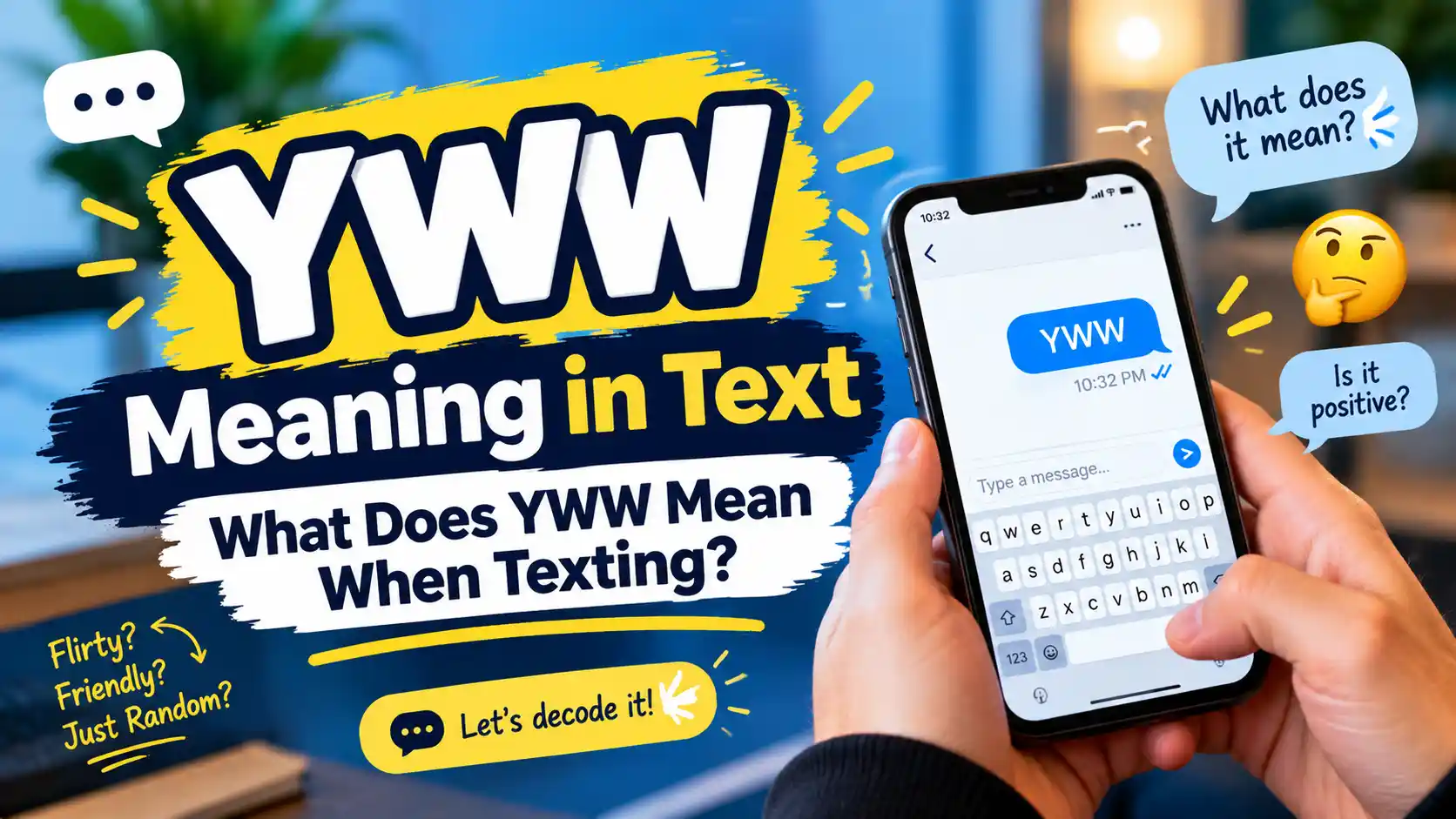
You thank a friend for a favor, and instead of the usual “yw,” they reply “yww! 😊” Same basic idea, just with a little extra warmth stretched into it.
YWW has become a small but noticeable variation on one of the most common texting responses out there. It shows up in casual chats, Snapchat replies, Instagram DMs, and group texts, always doing the same basic job as “you’re welcome” just with a bit more personality attached.
Understanding YWW matters because that one extra letter genuinely changes the feel of a message. Knowing what it means, and why people bother adding the extra “w,” helps you read the warmth behind a reply instead of just assuming it’s a typo. This guide breaks down exactly what YWW stands for, where this kind of stylistic stretching comes from, and how to use it naturally.
Definition & Meaning
YWW is an extended, warmer version of “YW,” which itself stands for “You’re Welcome.”
It’s used as a friendly, slightly more expressive response to someone saying “thanks” or “ty,” adding a bit of extra warmth compared to the plain, standard version.
Example:
Friend 1: thanks so much for helping me move that couch Friend 2: yww! anytime 😊
Here, YWW reads noticeably friendlier than a flat “yw” would, almost like stretching out the word “thanks” into “thank youuu” to add feeling.
Another example:
Text: appreciate you covering my shift today Reply: yww, don’t even worry about it
YWW doesn’t carry multiple unrelated meanings the way some abbreviations do. Nearly every source describing it agrees on the same basic idea:
- “You’re (Very) Welcome” a warmer, friendlier stretch of the standard “YW,” adding emotional emphasis rather than changing the core meaning.
A much rarer, playful variation sometimes mentioned is:
- “You Were Warned” / “You Were Wrong” an occasional, teasing use in a completely different context, typically after a disagreement or an “I told you so” moment, rather than as a response to thanks.
More real life examples:
Text: ty for the recommendation, that restaurant was amazing Reply: yww!! so glad you liked it
Group chat: thanks everyone for coming today Reply: yww, always fun getting together
DM: thank you so much for your advice Reply: yww anytime, happy to help
Context makes it easy to tell which meaning applies. Following a “thank you,” YWW almost always means an extra warm “you’re welcome.” Following a disagreement or a moment where someone got proven wrong, it might occasionally lean toward the much rarer “you were warned” meaning, though this is far less common.
The short version: YWW is simply “you’re welcome” with a little more warmth baked in the texting equivalent of smiling while you say it.
Background & History
YWW builds directly on “YW,” one of the earliest and most standard texting abbreviations, itself a shortened form of “you’re welcome.” As SMS texting spread in the early 2000s, with its character limits and small keypads, shortening common courtesy phrases like “you’re welcome” became a natural, practical habit, following the same logic that produced abbreviations like LOL and BRB.
YWW developed as a stylistic variation on that already established shorthand. Doubling the final letter of an abbreviation is a common texting technique used to add emotional emphasis without needing extra words similar to how stretching “hi” into “hiii” or “no” into “nooo” conveys extra feeling through repetition. Applying that same trick to “YW” gave people a quick way to sound warmer and more genuine than the plain, sometimes slightly flat feeling standard version.
This kind of small, expressive tweak became especially natural as texting shifted from a purely practical tool into a space for personality and tone, particularly as platforms like Snapchat, Instagram, and group messaging apps made casual, expressive replies the norm rather than the exception.
Because YWW is a relatively minor, informal variation rather than a widely standardized term, it doesn’t have one single, documented point of origin. It appears to have developed gradually and informally, growing alongside general texting culture’s broader tendency to stretch, repeat, or otherwise stylize familiar words and abbreviations for extra warmth or emphasis.
Today, YWW commonly appears in:
- Texting between friends, especially after being thanked for a favor
- Snapchat and Instagram DMs, where fast, casual, expressive replies are common
- Group chats, responding warmly to collective thanks
- WhatsApp and similar messaging apps, particularly among younger users and close friend groups
Usage in Various Contexts
In texting between friends:
Friend 1: thank you for listening to me vent earlier Friend 2: yww, that’s what I’m here for 💛
Here, YWW adds genuine warmth to what could otherwise be a flat, routine reply.
On Snapchat or Instagram DMs:
DM: try for the following! Reply: yww, love your content
In group chats:
Friend 1: thanks for organizing everything today, you’re the best Friend 2: yww!! it was fun putting it together
Responding to a bigger favor:
Text: seriously, thank you for covering my shift last minute Reply: yww, anytime you need it
In a more casual, playful tone:
Friend: ty for the birthday shoutout 🥹 You: yww bestie, you deserve it
The rarer “you were warned” use (uncommon, context dependent):
Friend 1: ugh, I should’ve listened when you said not to trust him Friend 2: yww 😅
Across the vast majority of these contexts, YWW simply signals a warmer, more enthusiastic version of “you’re welcome.” One helpful pattern worth noting: for a small, casual favor, YWW feels natural and light, while for a genuinely big favor, some people intentionally switch to the full, spelled out “you’re welcome” instead, since the moment can feel like it deserves more than casual slang.
Common Misconceptions & Clarifications
Misconception 1: YWW is just a typo of “YW.” It isn’t. The extra “w” is a deliberate stylistic choice meant to add warmth and emphasis, not an accidental extra keystroke.
Misconception 2: YWW has a completely different meaning from “you’re welcome.” For the overwhelming majority of everyday use, it doesn’t; it’s simply a warmer, more expressive version of the same phrase, not a different one.
Misconception 3: YWW always means “you were warned.” This is a rare, much less common usage that depends heavily on context, typically following a disagreement rather than a “thank you.” In everyday texting, YWW almost always relates to gratitude.
Misconception 4: YWW is flirty or has romantic undertones. It generally isn’t. Even when sent to a crush, YWW is usually just a friendly, warm response to thanks, not a hint of romantic interest on its own.
Misconception 5: YWW is only used by teenagers. While it’s especially popular among younger, Gen Z texters, older users increasingly encounter and adopt it too, particularly through platforms like Instagram and group texting.
Clarification on tone: because YWW is meant to sound warmer than the plain “yw,” it’s usually a safe, positive reply. Some people intentionally reserve the fuller phrase “you’re welcome” (or “you’re very welcome”) for bigger, more meaningful favors, using YWW for smaller, everyday moments instead.
Similar Terms & Alternatives
| Term | Meaning | Typical Use |
| YWW | You’re (Very) Welcome, with extra warmth | Casual, friendly reply to thanks |
| YW | You’re Welcome | Standard, neutral reply to thanks |
| NP | No Problem | Casual acknowledgment of thanks |
| OFC | Of Course | Reassuring, casual response |
| ANYTIME | Open ended reassurance | Following up a thank you warmly |
| YWWW | Extra emphasis version of YWW | Even more exaggerated warmth |
Examples in use:
Friend: thanks for the ride! You: np, anytime!
Friend: appreciate you helping me study You: ofc! we did great
Friend: thank you so much You: anytime, seriously
These related terms all serve a similar purpose to YWW: casually and warmly acknowledging someone’s thanks.
How to Respond to This Term
Responding to “yww” is straightforward, since it’s already a warm, positive reply rather than something requiring further clarification.
Casual response:
“aw, you’re the sweetest, thank you!”
Funny response:
“yww, I do what I can 😂”
Professional response (if it somehow shows up in a lightly casual work chat):
“Glad I could help!”
Privacy conscious response (if you’d rather keep things brief):
“Thanks again! 😊”
General tips for responding:
- Since YWW is already a friendly closing remark, a short, warm acknowledgment is usually all that’s needed.
- Adding an emoji, like 😊 or 💛, keeps the tone consistent with YWW’s friendly feel.
- In professional settings, spelling out “you’re welcome” fully reads as more polished.
Regional or Cultural Differences
YWW is an English language texting variation, most common in casual digital communication across English speaking countries like the US, UK, Canada, and Australia, where texting abbreviations are widely accepted and understood.
Because it’s built on the already standard “YW,” which is broadly recognized wherever English texting culture exists, YWW’s warmer variation tends to spread just as easily, particularly among younger, Gen Z users across these regions.
Some notes worth considering:
- Younger internet users across many different countries tend to adopt this kind of expressive, letter doubling texting style, regardless of their first language, especially when texting in English on international platforms.
- Because YWW is a fairly minor, informal variation rather than a fully standardized term, its recognition can vary depending on someone’s age and how much time they spend in casual, youth driven digital spaces.
Comparison with Similar Terms
| Term | Core Meaning | Emotional Tone | Best Used When |
| YWW | You’re (very) welcome | Warm, friendly, expressive | Casual replies to thanks, especially among younger texters |
| YW | You’re welcome | Neutral, standard | General, everyday acknowledgment |
| NP | No problem | Casual, neutral | Downplaying a small favor |
| OFC | Of course | Reassuring, warm | Confirming willingness to help |
| ANYTIME | Open reassurance | Warm, generous | Signaling ongoing willingness to help |
The clearest distinction between YWW and the standard YW is warmth. YWW intentionally adds emotional emphasis through its extra letter, while YW stays neutral and functional both mean the same core thing, but YWW simply feels friendlier.
Usage in Online Communities & Dating Apps
On Snapchat and Instagram, YWW frequently appears in DMs and quick replies, especially among younger users who favor fast, casual, and expressive texting styles.
On Tinder and other dating apps, YWW commonly shows up as a warm, low pressure response to thanks:
Match: thanks for the restaurant recommendation, it was perfect You: yww! glad you enjoyed it
Even when sent to a crush or match, YWW is generally just a friendly acknowledgment rather than a hint of deeper romantic interest on its own.
In gaming communities, YWW is less common than in general texting or social media, though it could occasionally appear in casual chat after helping a teammate.
Tips for responding appropriately:
- On dating apps, treat YWW as friendly warmth rather than reading too much romantic meaning into it by itself.
- In casual texting, a short, warm reply matches its tone well.
- If a genuinely big favor is involved, some people prefer switching to the fuller phrase “you’re welcome” to match the moment’s significance.
Hidden or Offensive Meanings
YWW does not carry any offensive or hidden negative meaning. Nearly every source describing it agrees it’s a purely positive, friendly acknowledgment, with no controversial or inappropriate connotation.
A few points are worth understanding about context:
- Its rare alternate meaning (“you were warned”) depends entirely on context, typically showing up after a disagreement rather than as a response to thanks, and is easy to distinguish once you consider what came before it.
- It carries no flirtatious implication by default, even when used between people who might be romantically interested in each other it remains, first and foremost, a warm acknowledgment of gratitude.
- No other hidden or inappropriate meaning exists. YWW remains one of the safer, more universally positive pieces of texting slang.
In short, YWW is considered friendly, safe, and appropriate for virtually any casual audience or conversation.
Suitability for Professional Communication
YWW is not suitable for professional or formal communication. As an informal, stylized variation of “you’re welcome,” it doesn’t fit the clear, polished language expected in workplace emails or official messages.
Why it doesn’t fit well:
- It relies on the reader already understanding casual texting style.
- Formal writing benefits from the complete, standard phrase rather than a stylized abbreviation.
Professional alternatives:
| Instead of “yww” | Use |
| Acknowledging thanks warmly | “You’re very welcome.” / “Happy to help!” |
| Responding to a bigger favor | “Of course, I’m glad I could help with this.” |
Example rewrite:
Casual: “yww! anytime you need help” Professional: “You’re very welcome and happy to help anytime.”
FAQs
1. What does YWW mean in a text message? It’s a warmer, more expressive version of “YW,” which stands for “You’re Welcome.”
2. Is YWW just a typo of YW? No, the extra “w” is intentional, meant to add warmth and enthusiasm to the reply.
3. Does YWW ever mean something other than “you’re welcome”? Rarely, it can mean “you were warned” in a playful, teasing context after a disagreement, though this is much less common than its main meaning.
4. Is YWW flirty? Not inherently. Even sent to a crush, it’s usually just a friendly, warm acknowledgment rather than a romantic signal.
5. Can I use YWW in professional messages? No, it’s too informal for professional communication. Spelling out “you’re welcome” fully is more appropriate.
6. Is YWW only used by younger people? It’s especially popular among Gen Z texters, though it’s increasingly recognized and used across a wider range of ages.
7. When should I use the full phrase instead of YWW? For bigger, more meaningful favors, some people prefer switching to the complete “you’re welcome” to match the significance of the moment.
Conclusion
YWW is a warm, friendly variation of “You’re Welcome,” building on the standard “YW” by adding an extra letter for emphasis and personality. Rather than changing the core meaning, it simply makes the reply feel a little more genuine and expressive, similar to how stretching out a word conveys extra feeling in casual speech.
It fits naturally into texting, Snapchat, Instagram DMs, and group chats, especially among younger users who favor fast, warm, casual communication. In professional or formal settings, though, spelling out the complete phrase remains the clearer, more polished choice.

Noman Hassan is a content creator and writer focused on text meanings, slang, abbreviations, acronyms, and internet expressions. Through Orvexale.com, he provides clear and simple explanations to help readers understand modern texting language. His goal is to make confusing terms easy to understand with practical examples and everyday context.