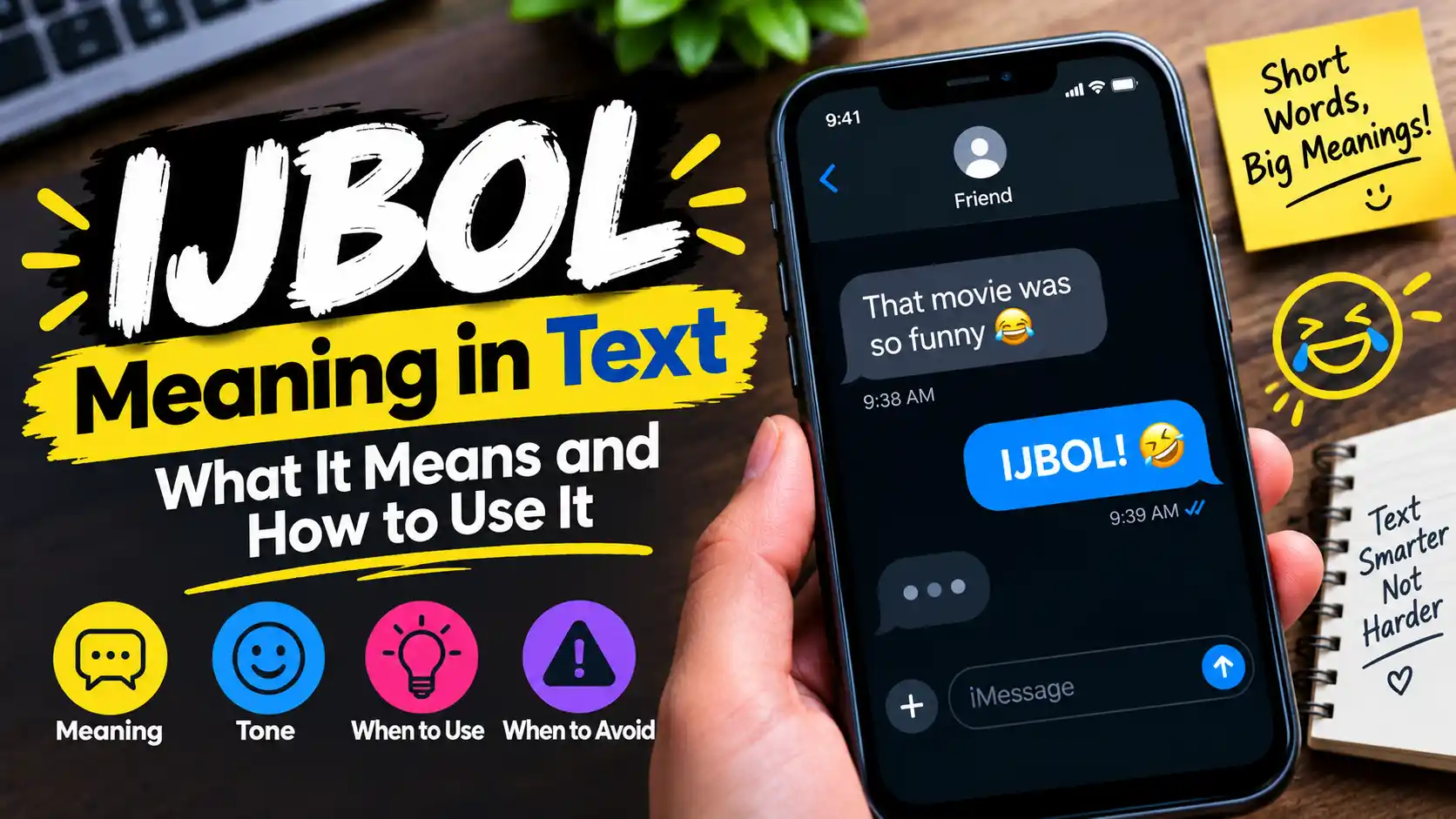
You send a friend a funny video, and instead of the usual “lol,” they reply with “ijbol.” It looks unfamiliar at first almost like it could be a K pop group name or a typo. It’s neither.
IJBOL has become one of the trendier replacements for LOL, especially among younger texters on TikTok and Twitter/X. It shows up in captions, comment sections, and casual texting, always doing the same basic job: signaling genuine, uncontrollable laughter.
Understanding IJBOL matters mostly because it’s actively replacing more familiar laughter abbreviations for a lot of younger users, and it has an unexpectedly interesting backstory involving K pop fandom. Knowing what it means, and where it came from, helps you keep up with how casual texting slang keeps evolving. This guide breaks down exactly what IJBOL stands for, its surprising history, and how to use it naturally.
Definition & Meaning
IJBOL stands for “I Just Burst Out Laughing.”
People use it just like “LOL” or “LMAO” to express genuine amusement or uncontrollable laughter at something funny.
Example:
Friend 1: just watched the cat fall off the couch again Friend 2: ijbol, why is that so funny every single time
Here, IJBOL signals real, immediate laughter, the same way LOL traditionally has.
Another example:
Comment: ijbol this video is sending me 😭
IJBOL has a fairly consistent, singular meaning, unlike many abbreviations covered in guides like this one. It doesn’t carry multiple competing definitions:
- “I Just Burst Out Laughing” is the confirmed, dominant, and essentially only meaning in modern usage.
People sometimes type it with slight variations, but the meaning stays the same:
- “I just bust out laughing” is a casual, alternate phrasing some people use instead of “burst.”
More real life examples:
Text: ijbol she really said that with a straight face
Tweet: ijbol the way this whole thread derailed
Group chat: ijbol I can’t stop replaying this clip
The short version: IJBOL is a newer, trendier way of saying “I just burst out laughing” functioning as a direct, modern alternative to LOL, LMAO, and ROFL.
Background & History
IJBOL has a surprisingly well documented origin story compared to a lot of internet slang. According to Know Your Meme and Wiktionary, the term first appeared in a 2009 Twitter conversation. This phrase helped inspire the abbreviation, which later appeared on Urban Dictionary that same year.
For over a decade after that, IJBOL remained a fairly obscure, rarely used term. It didn’t gain real traction until 2021, when it was picked up and popularized by the K pop fan community on Twitter (now X). K pop fandom spaces are known for being highly active, fast moving, and prone to developing their own shared slang, and IJBOL fit naturally into that environment as a fresh, distinctive alternative to more traditional laughter abbreviations.
Because of this connection, many people encountering IJBOL for the first time assumed it might be a Korean word or phrase, given how strongly it was associated with K pop Twitter. Dictionary references have specifically noted, however, that IJBOL is not derived from Korean at all; it’s simply an English language abbreviation that happened to spread widely through that particular online community.
From K pop fandom spaces, IJBOL spread further into mainstream social media, particularly TikTok and X, and by 2023, multiple major outlets reported it gaining significant popularity, especially among Generation Z users looking for a fresher alternative to LOL and LMAO, both of which had started to feel a bit dated or overused to younger texters.
Today, IJBOL is commonly used in:
- TikTok captions and comments, reacting to funny videos or moments
- Twitter/X posts and replies, especially within fandom and pop culture spaces
- Texting between younger users, as a trendier stand in for LOL
- Casual group chats, reacting to something genuinely funny
Its meaning has remained completely stable since it was first coined; it has simply taken over a decade to find its moment of widespread popularity.
Usage in Various Contexts
In texting between friends:
Friend 1: he tripped over absolutely nothing just now Friend 2: ijbol I saw the whole thing happen
On social media (TikTok/X):
Comment: ijbol this edit is too accurate 😭
In gaming chat:
Teammate: did you see that fail just now You: ijbol yes, replaying it in my head already
In casual group chats:
Friend 1: sending you the screenshot, brace yourself Friend 2: ijbol why did I open this at work
As a caption introducing something funny:
Post: ijbol the cast of this show is genuinely hilarious
Reacting to something relatable or chaotic:
Comment: ijbol the way this entire fanwar started over nothing
Across these settings, IJBOL consistently signals genuine, immediate amusement, functioning as a direct, modern swap for LOL or LMAO. It’s most heavily concentrated among younger users and on platforms like TikTok and X, though its use has been spreading into broader, more general texting as well.
Common Misconceptions & Clarifications
Misconception 1: IJBOL is a Korean word or phrase. It isn’t. Despite its strong association with K pop fandom, dictionary sources confirm IJBOL is an English language abbreviation, not derived from Korean at all.
Misconception 2: IJBOL is brand new slang. It’s actually been around since 2009, though it remained rarely used for over a decade before gaining real popularity starting around 2021.
Misconception 3: IJBOL has multiple competing meanings. Unlike a lot of slang, IJBOL is consistently defined across every major source as “I just burst out laughing,” with no significant alternate meanings.
Misconception 4: IJBOL is replacing LOL and LMAO completely. According to Merriam Webster, this isn’t quite accurate. While IJBOL has grown in popularity, it hasn’t overtaken the dominance of more established terms like LOL and LMAO; it’s more of a trendy alternative than a full replacement.
Misconception 5: Only K pop fans use IJBOL. While it grew significantly within K pop Twitter, it has since spread well beyond that specific community into general Gen Z texting and social media use.
Clarification on tone: because IJBOL functions almost identically to LOL, its tone is generally light and genuinely amused, without the layers of ambiguity or sarcasm that some other slang terms carry.
Similar Terms & Alternatives
| Term | Meaning | Typical Use |
| IJBOL | I Just Burst Out Laughing | Trendy, Gen Z favored laughter expression |
| LOL | Laugh Out Loud | Classic, widely recognized laughter abbreviation |
| LMAO | Laughing My A** Off | Stronger laughter expression |
| ROFL | Rolling On the Floor Laughing | Intense, classic laughter abbreviation |
| DEAD / IM DECEASED | Exaggerated “died laughing” | Dramatic expression of amusement |
| 💀 | Skull emoji, “I’m dead” | Visual stand in for extreme laughter |
Examples in use:
Comment: lol this is too good
Friend: lmao I can’t believe that actually happened
Text: I’m deceased 😭 this is hilarious
These related terms all serve the same basic function as IJBOL: expressing genuine amusement, with slight differences in intensity and generational association.
How to Respond to This Term
Responding to “ijbol” is usually simple, since it clearly signals genuine amusement.
Casual response:
“right?? I couldn’t stop laughing either”
Funny response:
“glad my suffering is entertaining to you 😭”
Professional response (rare, but possible in a lightly casual work chat):
“Ha, that is pretty funny!”
Privacy conscious response (if you’d rather not elaborate further):
“Glad you enjoyed it! 😄”
General tips for responding:
- A short, matching reaction (another laugh, an emoji, or “ijbol” back) fits naturally.
- If you’re less familiar with the term yourself, responding with a more traditional “lol” or “lmao” works just as well and won’t feel out of place.
- In professional settings, this term is best skipped entirely in favor of plain language.
Regional or Cultural Differences
IJBOL is an English language abbreviation, but its rise to popularity is closely tied to specific online communities rather than any particular country or region. It gained its initial traction within K pop fandom spaces on Twitter, which include participants from many different countries who share a common interest rather than a shared nationality.
Because of this, IJBOL’s recognition tends to depend more on someone’s involvement in fandom or Gen Z driven social media spaces than on their specific geographic location. It has since spread more broadly, particularly among younger users on TikTok and X across English speaking countries like the US, UK, Canada, and Australia.
Merriam Webster specifically notes an amusing point of potential confusion: in British English, “spag bol” is a completely unrelated, informal term for spaghetti with Bolognese sauce, which has occasionally led to some lighthearted mix ups given the visual similarity to “IJBOL.”
Because the term is still actively spreading and gaining recognition, familiarity with IJBOL varies significantly depending on age group and how connected someone is to platforms like TikTok and X, more so than by country or region specifically.
Comparison with Similar Terms
| Term | Core Meaning | Generational Association | Best Used When |
| IJBOL | I just burst out laughing | Strongly Gen Z, fandom driven | Trendy, casual laughter reactions |
| LOL | Laugh out loud | Widely used across generations | General, all purpose laughter |
| LMAO | Laughing my a** off | Widely used, slightly stronger | Bigger laughs |
| ROFL | Rolling on the floor laughing | Older, classic internet slang | Intense laughter, now less common |
The clearest distinction between IJBOL and older terms like LOL is generational branding. IJBOL carries a specific, trendy, Gen Z association tied to its K pop fandom origins, while LOL remains a more neutral, universally understood term across nearly every age group.
Usage in Online Communities & Dating Apps
On Twitter/X, IJBOL remains especially common within fandom spaces, particularly K pop communities, though its use has spread into general pop culture commentary and everyday posting as well.
On Tinder and other dating apps, IJBOL occasionally shows up among younger users reacting to something funny in conversation:
Match: I once introduced myself with the wrong name at a party You: ijbol, okay that’s amazing, tell me more
Here, it signals genuine amusement in a trendy, casual way.
In gaming communities, IJBOL is less established than terms like LOL or LMAO, though it could appear among younger, TikTok active players reacting to a funny moment.
Tips for responding appropriately:
- On dating apps, using IJBOL signals familiarity with current slang, which can read as playful and current, especially with younger matches.
- On social media, particularly fandom spaces, it fits naturally into fast paced, reaction heavy conversation.
- If you’re unsure whether someone will recognize the term, a more universally understood alternative like “lol” or “lmao” works just as well.
Hidden or Offensive Meanings
IJBOL does not carry any offensive or hidden meaning. It is a straightforward, positive expression of laughter and amusement, with no ties to inappropriate or aggressive language.
A few points are worth understanding about context:
- Its only real point of confusion is coincidental, not offensive. The resemblance to “spag bol” in British English is a lighthearted mix up rather than anything meaningful.
- No alternate negative definition exists. Every major dictionary and slang source consistently defines IJBOL the same way, with no secondary or inappropriate meaning.
- Its main “risk” is simply being unfamiliar to some readers, particularly those less connected to K pop fandom or Gen Z social media trends, rather than causing any offense.
In short, IJBOL is completely safe, friendly, and appropriate for virtually any casual audience.
Suitability for Professional Communication
IJBOL is not suitable for professional or formal communication. Like most laughter abbreviations, it’s far too casual and trend specific for workplace emails, client messages, or official writing.
Why it doesn’t fit well:
- It’s a very recently popularized, trend driven term that not everyone will recognize.
- Formal communication benefits from plain, universally understood language.
Professional alternatives:
| Instead of “ijbol” | Use |
| Expressing amusement | “That’s really funny.” / “I couldn’t help but laugh at that.” |
Example rewrite:
Casual: “ijbol that email typo was priceless” Professional: “That was a pretty amusing typo!”
In relaxed workplace chats among younger, casual colleagues, IJBOL might occasionally slip in without issue. For anything client facing or written formally, plain language remains the safer, more universally understood choice.
FAQs
1. What does IJBOL mean in a text message? It stands for “I Just Burst Out Laughing,” used the same way as LOL or LMAO to express genuine amusement.
2. Is IJBOL a Korean word? No, despite its strong association with K pop fandom, it’s confirmed to be an English language abbreviation, not derived from Korean.
3. When did IJBOL first appear? It dates back to at least 2009, though it didn’t become widely popular until around 2021, when it spread through K pop fandom on Twitter.
4. Is IJBOL replacing LOL completely? Not entirely. While it has grown significantly in popularity, especially among Gen Z, it hasn’t fully replaced more established terms like LOL and LMAO.
5. Is IJBOL only used by K pop fans? No, while it originated and grew within that community, it has since spread into broader, mainstream texting and social media use.
6. Is IJBOL appropriate for work chats? No, it’s too casual and trend specific for professional communication.
7. Is IJBOL considered offensive? No, it’s a completely neutral, positive expression of laughter with no offensive connotations.
Conclusion
IJBOL stands for “I Just Burst Out Laughing,” a trendier, newer alternative to classics like LOL and LMAO. Despite feeling like a brand new term to many people, it actually dates back to 2009, only gaining widespread popularity after K pop fandom on Twitter embraced it starting around 2021.
It fits naturally into texting, social media captions, and comment sections, especially among younger, Gen Z users active on platforms like TikTok and X. While it hasn’t replaced older laughter abbreviations entirely, it remains a fun, current way to express genuine amusement, just not one suited for professional or formal writing.

Noman Hassan is a content creator and writer focused on text meanings, slang, abbreviations, acronyms, and internet expressions. Through Orvexale.com, he provides clear and simple explanations to help readers understand modern texting language. His goal is to make confusing terms easy to understand with practical examples and everyday context.