Your phone buzzes. A message pops up. It says, “IMYT.” Nothing else.
You stop and think. Might it be a typo? Could it serve as a code? Could it also mean something sweet?
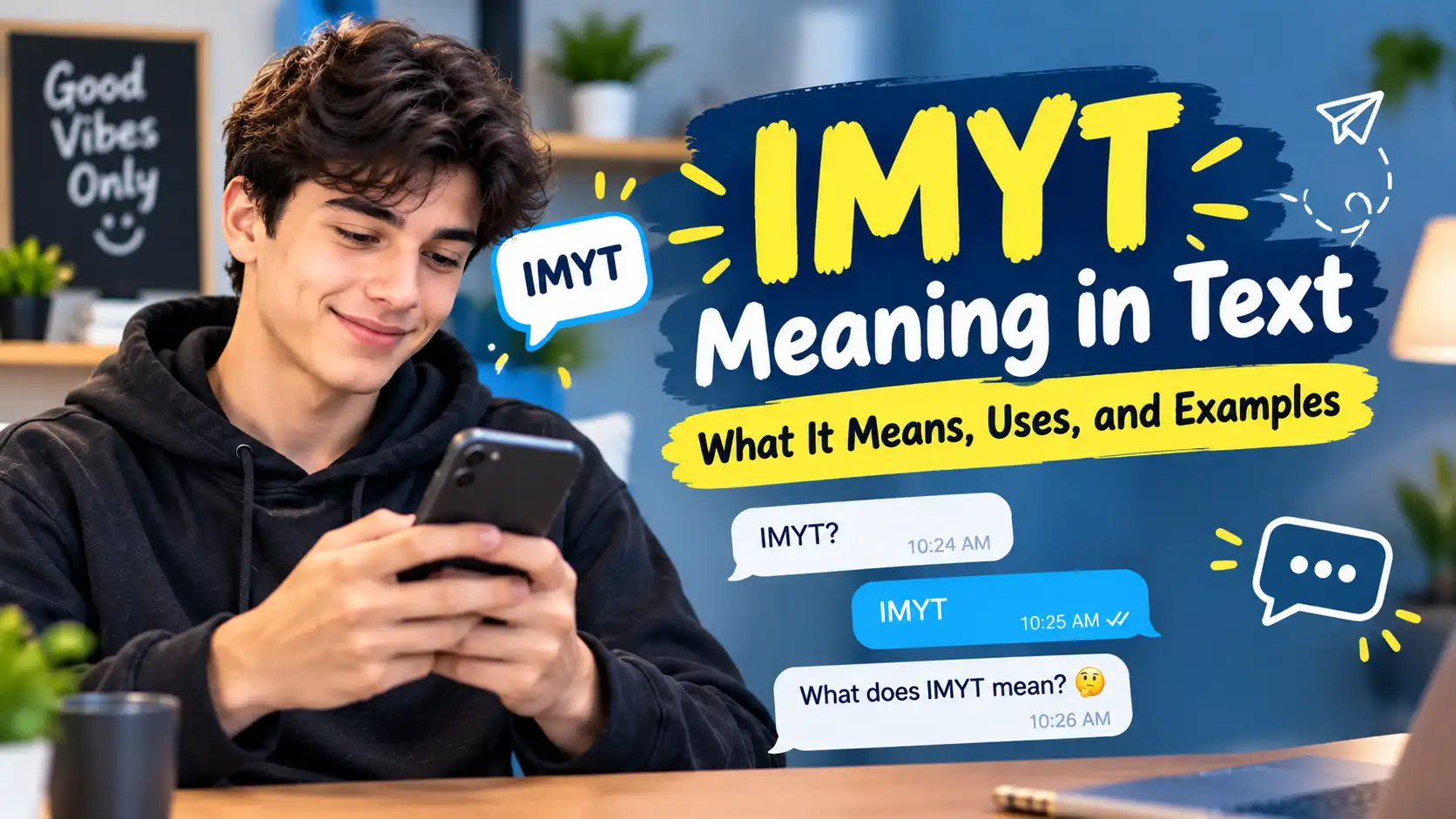
Good news. IMYT means “I miss you too.” It is a fast, warm way to answer someone who just said they miss you.
You will see it in texts, social media DMs, gaming chats, and even long distance love notes. It pops up when people care about each other and want to speak so fast.
Why does it matter? Because tiny texts carry big feelings. If you get the meaning wrong, you may reply in a strange way. You may even hurt someone by accident.
This guide keeps things simple. You will learn what IMYT means, where it comes from, and how to use it. You will also learn how to reply. Let’s start.
Definition & Meaning
IMYT stands for “I miss you too.”
Break it down letter by letter:
- I = I
- M = miss
- Y = you
- T = too
It is the answer to another short text: IMY, which means “I miss you.” Someone sends IMY. You send IMYT. Many texters use IMYT as the matching reply, and it means “I miss you too.”
So IMYT is almost always a reply. It shows that the feeling goes both ways. It says, “You are not alone. I feel it too.”
There is also a twin spelling. Some people write “IMY2,” with the number 2 in place of “too,” and it means the same thing.
Real life examples:
Maya: IMY! It’s been so long.
Zoe: IMYT!! Let’s meet this weekend.
Dad: Miss you, kiddo. The house is quiet.
Ella: imyt dad. Call me tonight?
Jake: IMY so much
Lena: IMYT. Two more days and I’m home.
Notice the mood. It is soft, kind, and personal. Nobody is joking. Nobody is upset. They are sharing a small, warm moment.
Some more tips on reading it:
- Lowercase (imyt) feels casual and easy.
- Capitals (IMYT) can feel a bit stronger.
- Extra punctuation (IMYT!!) shows more excitement.
- A heart or emoji adds more love.
The base meaning stays the same: I miss you too.
Background & History
Text shorthand is old. When people first sent texts on cell phones, each message had a small limit. Typing was slow, too. So people cut words down.
“See you later” became “CUL8R.” “Be right back” became “BRB.” “I love you” became “ILY.” And “I miss you” became IMY.
Once IMY spread, people needed a quick reply. They wanted to say “me too” in the same style. So they added a “T” for “too.” And IMYT was born.
Nobody can point to one person or one day. Slang grows in the wild. It moves from friend to friend, and then across apps.
How it changed over time:
- Early days: People typed the full phrase, “I miss you too.”
- Texting age: Shorter forms like IMY and IMYT took over.
- Social media age: Snapchat, Instagram, and WhatsApp made them even more common.
- Today: IMYT lives in DMs, group chats, comments, and voice chat text boxes.
Younger users lean on it the most. But many adults use it too, especially with family far away.
Today, you will most often see IMYT:
- In private texts between friends and partners
- In long distance relationships
- After a trip, a move, or a busy season apart
- In replies on social media
The term has stayed steady because it does one simple job. It says “me too” in four letters. That is hard to beat.
Usage in Various Contexts
IMYT always keeps its meaning. But the mood can shift a bit based on where it shows up.
Texting
In private texts, IMYT is warm and personal.
Sam: Just saw our old photos. IMY.
Ria: IMYT. Those were good days.
Social media
On Instagram, Snapchat, or TikTok, people use IMYT in DMs or comments. It can be sweet or playful.
Story reply: IMY, come back to town!
You: IMYT 🥺 soon, I promise.
Gaming
Gamers make friends across the world. When someone leaves for a while, friends say so.
Player 1: Bro, where have you been? IMY, the squad’s not the same.
Player 2: IMYT. The exams were brutal. I’m back now.
Casual talk with friends
Between close friends, IMYT can feel like a warm hug in text form.
Nora: Haven’t seen you in weeks. IMY.
Tia: IMYT! Coffee on Friday?
Family chats
Parents, kids, and cousins use it too.
Mom: IMY, sweetheart. Eat well.
You: imyt mom. I’ll visit soon.
Work chats
With close coworkers, it may be fine. With most coworkers, it is too personal. More on that later.
The key idea: IMYT is a feeling word. It turns plain text into something human.
Common Misconceptions & Clarifications
Short slang can confuse people. Here are the most common mix ups.
Misconception 1: “IMYT means I miss you a lot.”
Not exactly. The “T” stands for “too,” not “totally” or “tons.” If you want to say “a lot,” use IMYSM (“I miss you so much”).
Misconception 2: “IMYT is romantic only.”
No. Friends, siblings, parents, and cousins use it. It fits any close bond.
Misconception 3: “IMYT starts a chat.”
Usually not. It is a reply. If you want to start, send IMY.
Misconception 4: “IMYT means I want to date you.”
No. It only means you miss the person. On its own, it does not say more. If a friend sends IMYT, they likely just miss your company.
Misconception 5: “IMYT has hidden slang meanings.”
It is rare. The meaning is almost always “I miss you too.” If you see it in a strange spot, it may be a typo or a made up short form inside a private group. In that case, ask.
Can it be misread? Yes, in a few cases:
- Someone sends it to an ex, and it stirs up old feelings.
- Someone sends it to a new crush too soon, and it feels heavy.
- Someone sends it while not really meaning it.
How to avoid confusion:
- Check what came before it. Did the other person say IMY first?
- Check your bond. Is the person close to you?
- Check your heart. Do you really miss them?
- If unsure, ask. “Do you mean ‘I miss you too’?” is fine.
Clear chats keep friendships strong.
Similar Terms & Alternatives
Many phrases say something close to IMYT. Some are softer. Some are stronger.
- IMY: I miss you. The starter text.
- IMYT / IMY2: I miss you too. The reply.
- IMYSM: I miss you so much. More intense.
- ILY: I love you. A bigger step.
- ILYT: I love you too. The reply to ILY.
- MYT: Miss you too. Even shorter.
- Me too: Simple and clear.
- Same: Very casual.
- 🥺 / ❤️ / 🫂: Emoji ways to show longing.
- Thinking of you (TOY): A softer way to show care.
Quick comparison table:
| Term | Meaning | Feels like |
| IMYT | I miss you too | Warm, balanced |
| IMY | I miss you | Sweet, gentle |
| IMYSM | I miss you so much | Deep, emotional |
| ILYT | I love you too | Very strong |
| Me too | Same feeling | Simple, clear |
| TOY | Thinking of you | Light, caring |
How to pick:
- Want to be sweet and simple? Use IMYT.
- Want to show more feelings? Use IMYSM.
- Want to say love? Use ILYT, but only if you mean it.
- Want to be safe at work? Use plain words: “Good to hear from you.”
Words shape how people feel. Pick the one that fits your heart and your bond.
How to Respond to This Term
Sometimes you get an IMYT. Maybe you sent IMY first, and they answered. Or maybe they used it to keep a chat warm. Here is how to reply in different styles.
Casual replies
- “Aww, so glad!”
- “Can’t wait to see you.”
- “Let’s fix that soon 😊”
Ben: IMYT!
You: Then let’s plan a call tonight.
Funny replies
- “Good. Now we’re both sad, hhh.”
- “IMYT more than I miss pizza.”
- “Great, now I’m crying at my desk.”
Ana: IMYT
You: Okay, but I miss you more. Fight me. 😂
Professional replies
If a coworker or client sends IMYT (rare), stay kind and clear.
- “That’s kind of you. Good to be in touch.”
- “Thank you! We enjoyed working with you too.”
- “Appreciate the note. Let’s catch up soon.”
Old colleague: IMYT! Great working with you.
You: Thank you! It was a good team. Let’s stay in touch.
Privacy conscious replies
Sometimes you don’t feel ready to share. Or you don’t know the person well. You can stay polite and keep your space.
- “That’s kind. How have you been?”
- “Thanks for the message.”
- “Let’s talk about something lighter.”
Acquaintance: IMYT
You: Thanks! Hope things are going well for you.
If you are unsure
Just ask: “Do you mean you miss me too?” A short check beats a long mix up.
Regional or Cultural Differences
Missing someone is a feeling everyone knows. But each language says it in its own way.
English: IMY and IMYT are common in the US, UK, Canada, and Australia. Text slang like this started mostly in English.
Spanish: People often write “te extraño” or “te echo de menos” (I miss you). The reply is “yo también” (me too). Short forms vary by country.
French: “Tu me manques” means “I miss you.” The reply “toi aussi” means “you too.”
Arabic and Urdu chats: People often use the full phrase in their own script, or mix it with English. Short English forms like IMY show up in mixed language chats.
Global chats: On apps like WhatsApp and Snapchat, people from many countries chat in English mixed with local words. In these spaces, IMYT is easy to understand.
Regional slang variations:
| Language / Region | Common phrase | Notes |
| English | IMYT / IMY2 | Widely used online |
| Spanish | Yo también te extraño | Often typed in full |
| French | Toi aussi (tu me manques) | Often typed in full |
| Mixed chats | IMYT + emoji | Common in DMs |
A cultural tip: Some cultures share feelings out loud. Others are more private. If you chat across cultures, watch how the other person writes. Match their style. Don’t push them to share more than they want to.
Feelings are universal. The short forms are just the outfit they wear.
Comparison with Similar Terms
Let’s set IMYT next to its close cousins. This shows how small changes shift the mood.
| Term | Feeling level | Best used when | Risk of misread |
| IMYT | Medium | Someone said IMY first | Low |
| IMY | Medium | You want to start the talk | Low |
| IMYSM | High | You miss someone a lot | Medium (can feel heavy) |
| ILYT | Very high | Someone said “ILY” first | Medium–high |
| Me too | Medium | Any time, any relation | Very low |
| TOY | Light | You care but don’t want to say “miss” | Low |
Key differences in plain words:
- IMYT vs. IMY: IMY starts. IMYT answers.
- IMYT vs. IMYSM: IMYSM is stronger. IMYT matches the level the other person gave.
- IMYT vs. ILYT: “Miss” and “love” are different. Use ILYT only for love.
- IMYT vs. “me too”: “Me too” is neutral and safe. IMYT feels more specific and warm.
- IMYT vs. TOY: TOY is softer and less emotional.
Example in dialogue:
Cara: IMY.
1st Dan (IMYT): IMYT.
Dan (IMYSM): IMYSM.
Dan (ILYT): ILYT.
Same start, three very different vibes. The first is balanced. The second is deeper. The third is very big.
Quick rule: Match the size of the message you got. If they say IMY, reply IMYT. Don’t jump to big words too fast.
Usage in Online Communities & Dating Apps
Where you chat changes how IMYT feels. Here is how it works in a few places.
Dating apps (Tinder, Bumble, Hinge)
On dating apps, IMYT is strong. It shows real feelings. Most people don’t use it until they know each other well.
Match: Haven’t heard from you all day. IMY.
You: IMYT. Long shift. Call me later?
A few things to know:
- Early chats: IMYT may feel too fast. Save it for later.
- Long distance chats: It is very common and very sweet.
- After a fade out: It can feel like a reopening. Be honest about how you feel.
Tip: If you’re not sure, use a lighter reply like “Aww, thinking of you too.”
X (Twitter), Instagram, TikTok
Here, IMYT usually shows up in replies to friends or creators you follow closely. It can also be used playfully with fans or mutuals.
Creator: Been offline a week. IMY all!
Fan: IMYT!! Welcome back 💛
Gaming communities
In Discord servers or game chats, IMYT is a friendly welcome back. It says, “The team missed you.”
Guildmate: I’m back after a break!
You: IMYT, we need you for the raid.
Safety tips for all platforms
- Be careful with strangers. A sweet word does not mean a safe person.
- Never share private info like your address, school, or bank details.
- Watch for pressure. If someone uses “IMY” to push you to send photos or money, stop and block them.
- Trust your gut. If it feels off, it probably is.
Kind words are great. But your safety comes first.
Hidden or Offensive Meanings
Is IMYT ever rude? Almost never. It is a gentle term. But context can change how it feels.
1. Insincere use.
If someone sends IMYT but does not mean it, it can feel fake. People can often tell.
2. Guilt tripping.
Sometimes IMY or IMYT is used to make someone feel bad.
Jo: IMY. You never text me anymore.
Lee: IMYT… but you never text either.
Here, the words are kind but the mood is tense. Tone carries the message.
3. Mixed signals.
Sending IMYT to an ex or a crush can confuse them. They may think you want more than you do.
4. Crude variations.
Some people add swear words to the base phrase, like the “IMYSFM” form. These are stronger and more casual. They are not fit for kids, family, or work.
5. Private code.
Some friend groups twist slang into inside jokes. If IMYT seems odd in a group, ask.
Why tone and context matter:
Text has no voice. No face. No smile. So four letters can feel warm, awkward, or heavy depending on what came before and who sent it.
How to stay safe:
- Know your bond. Would you say “I miss you” out loud to this person?
- Be honest. Only send it when you mean it.
- Skip it in tense chats. Use real words: “I’m sorry we’re fighting. I do miss you.”
- Ask if unsure. “What did you mean by that?” is always okay.
The good news? IMYT is not an offensive term. It is only as kind as the person sending it.
Suitability for Professional Communication
Should you use IMYT at work? Usually, no.
Why?
Work talk should be clear and respectful. IMYT is slang and it is personal. It can feel too close for a boss, a client, or a new coworker. It can also be misread.
When it might be okay:
- With a close work friend you talk to daily
- In a casual team chat where everyone jokes
- When a former teammate says they miss you
When to avoid it:
- Emails to clients or managers
- Job applications and interviews
- Serious topics like deadlines, complaints, or reviews
- Cross cultural teams where slang may not land well
Professional alternatives:
| Instead of IMYT | Try this |
| IMYT | “It was great working with you too.” |
| IMYT! | “Good to hear from you. We should catch up.” |
| imyt, come back | “We’d love to have you on the team again.” |
| IMYT so much | “Your work is truly missed.” |
| imyt lol | “Thanks! I appreciate that.” |
Examples in dialogue:
Old teammate: We all miss you here!
You (too casual): IMYT lol
You (better): That means a lot. I miss the team too.
Client: It’s been quiet without you.
You (better): Thank you! It was a pleasure working together.
Simple rule: If you would not say it in a meeting, don’t type it. Use plain, warm words instead.
FAQs
1. What does IMYT mean in text?
IMYT means “I miss you too.” It is a short reply to “I miss you” (IMY).
2. What is the difference between IMY and IMYT?
IMY is “I miss you.” It starts the message. IMYT is “I miss you too.” It answers it.
3. Is IMY2 the same as IMYT?
Yes. IMY2 uses the number 2 in place of “too” and has the same meaning. It is just a different style.
4. Is IMYT only for couples?
No. Friends, family, and close teammates use it too. It works for any close bond.
5. Is IMYT rude or inappropriate?
No. It is a kind and gentle term. It can feel awkward if it is not sincere or if you send it to the wrong person.
6. Can I use IMYT at work?
Only with close coworkers in casual chats. Skip it in formal emails or with clients. Use plain polite words.
7. How do I reply to IMYT?
Match the mood. Try “Aww, glad you feel it too,” a fun joke, or an emoji. At work, use a short, polite reply. If you’re unsure what they mean, just ask.
Conclusion
IMYT is small, but it says a lot. It means “I miss you too.” It is a quick, warm way to show that a feeling goes both ways.
Remember these key points:
- IMYT = “I miss you too.”
- It is usually a reply to IMY.
- IMY2 means the same thing.
- It works with friends, family, and partners.
- Tone and context decide how it feels.
- At work, use plain, polite words instead.

Asfan Wahab is a content creator and writer focused on text meanings, slang, abbreviations, acronyms, and internet expressions. Through Orvexale.com, he provides clear and simple explanations to help readers understand modern texting language. His goal is to make confusing terms easy to understand with practical examples and everyday context.