You get a text. It says, “I just tripped in front of my whole class 😭.”
Is your friend sad? Is your friend laughing? Both can be true.
The 😭 emoji is one of the most used emojis online. It shows up in texts, comments, games, and even work chats. But its meaning is not always clear. The same tiny face can mean grief in one message and pure joy in the next.
Why does this matter? If you guess wrong, you might send a sad reply to a joke. Or you might laugh at someone who is truly hurting.
In this guide, you will learn what 😭 means, where it came from, and how people use it. You will also learn how to reply and when to avoid it at work. Let’s start.
Definition & Meaning
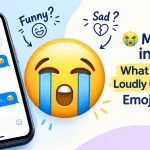
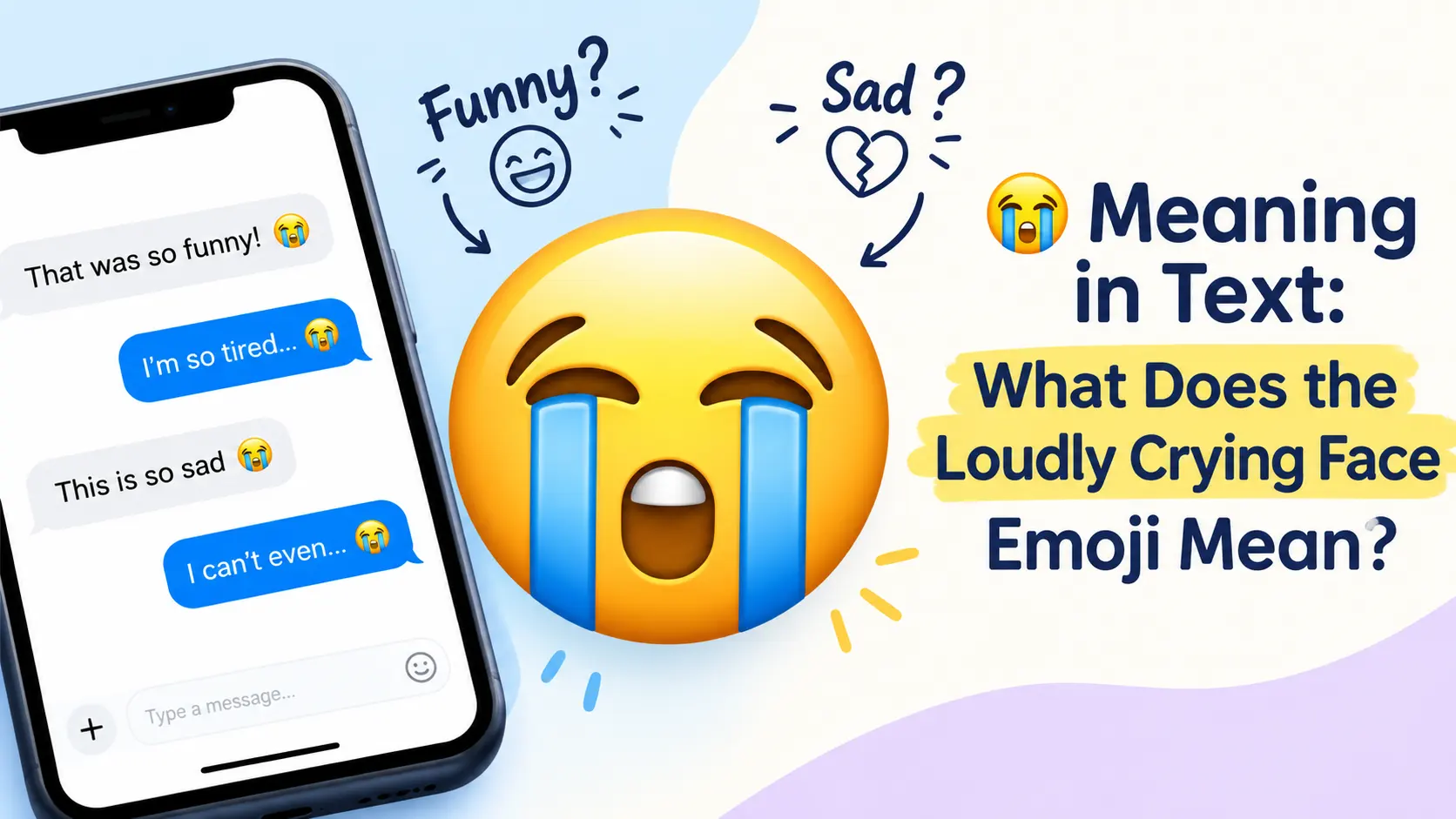
The 😭 emoji is called Loudly Crying Face. It shows a yellow face with closed eyes. Two streams of tears pour down. The mouth is wide open, as if the person is wailing.
The face looks sad. But online, its meaning is much wider. Here are the main ways people use it.
1. Real sadness
This is the original meaning. The person is upset, hurt, or grieving.
Ava: My dog is sick. 😭
Ben: Oh no. I’m so sorry. Do you need anything?
2. Laughing very hard
Many people now use 😭 to say, “This is so funny I can’t breathe.” It is very common with younger users.
Maya: Did you see his dance video?
Zoe: I’m crying 😭😭 I can’t stop watching it.
3. Being touched or moved
Sometimes the tears are happy tears. A sweet moment can trigger it.
Leo: My sister just got into her dream school!
Sam: Stop, I’m crying 😭 That’s amazing!
4. Cute overload
When something is too adorable, people use 😭.
Nina: Look at this baby penguin 😭
Omar: I need one. Right now.
5. Dramatic joking
People also use it for small “problems” they don’t take seriously.
Kai: I have to wake up at 6 a.m. tomorrow 😭
Rita: Same. Send help.
The key rule: read the words around the emoji. They tell you which meaning is in play.
Background & History
The 😭 emoji is old. It comes from Japan. Japanese phone companies created the first emoji in the late 1990s. Faces that showed feelings were a big part of them.
In 2010, the Unicode group added this crying face to the standard list of characters. That step let phones from different brands share the same emoji. Apple added it to iPhones soon after. Apps like Twitter and Facebook followed. By the mid 2010s, almost everyone could send it.
At first, people used it the way it looks. It meant deep sadness. You would send it after bad news.
Then things changed. Around 2015, the 😂 emoji (Face with Tears of Joy) was hugely popular. It was the go to laughing emoji. But as years passed, many younger users felt 😂 was overused. Some said it felt “old.” They started using 😭 to show laughter instead.
Social media sped this up. On TikTok, Twitter (X), and Instagram, people wrote things like “I’m sobbing” or “I’m crying” after funny videos. The 😭 emoji became the picture for those words. It stood for “this is too much, I can’t handle it.”
Over time, the emoji took on more shades:
- Sad (the original)
- Funny (the big shift)
- Cute (a newer twist)
- Ironic (a joking way to fake complain)
Today, 😭 is used in many places. You will see it in group chats, gaming lobbies, comment sections, and dating apps. Its meaning keeps growing. That is normal for language. Words and emojis change as people use them.
Meanings also differ by age group. Older users may still read 😭 as pure sadness. Younger users may read it as laughter first. This gap causes many mix ups.
Usage in Various Contexts
The same emoji can act differently depending on where it appears. Here is how it works in common settings.
Texting
In private texts, 😭 often shows strong feelings about something small.
Dana: I forgot my lunch again 😭
Eli: Classic you. I’ll share mine.
Social media
On platforms like TikTok and Instagram, 😭 in a comment usually means “this is hilarious” or “this is so cute.” Sometimes people stack it: 😭😭😭. More emojis mean more feeling.
Comment: The cat’s face at the end 😭😭😭
Reply: I’ve watched it ten times.
Gaming
Gamers use 😭 for funny fails or painful losses. It can be friendly teasing.
Player 1: I fell off the map in the first ten seconds.
Player 2: 😭😭 Legendary.
It can also be used to poke fun at a bad play. Tone matters here. Among friends, it is light. With strangers, it can feel rude.
Casual talk with friends
Friends use it to exaggerate for fun.
Jo: I have three tests this week 😭
Cam: Let’s study together. I’ll bring snacks.
Sharing sad news
It still works for real pain. Words usually back it up.
Lena: I didn’t get the job. 😭 I really wanted it.
Max: I’m sorry. Want to talk about it?
Quick tip
If the message has jokes, slang, or a laughing tone, the emoji likely means funny. If the message has plain, serious words, it likely means sad. When unsure, ask.
Common Misconceptions & Clarifications
Many people think 😭 always means someone is sad. That is the biggest myth. Here are a few others.
Misconception 1: “It always means sadness.”
Not anymore. In many chats, it means laughter or love. If you reply with comfort to a joke, it may feel awkward.
Tom: My brother wore socks with sandals to a wedding 😭
Ivy: Oh no, are you okay?
Tom: LOL I’m fine. It was just funny.
Misconception 2: “It’s the same as 😂.”
They are close but not identical. 😂 is pure laughter. 😭 can be laughter, but it often adds extra drama, cuteness, or feeling.
Misconception 3: “Only teens use it.”
Teens made it popular, but many adults use it now. Still, older users may mean it in the classic sad way.
Misconception 4: “It’s rude or mean.”
Usually it is not. But it can be misread. If you send 😭 after a friend shares bad news, they may think you are laughing at them.
Misconception 5: “More emojis always means more sadness.”
Repeating 😭😭😭 often means more laughing, not more grief.
When it can be inappropriate
Be careful in these cases:
- Serious topics like illness, loss, or crisis
- Work emails or messages to your boss
- Chats with people from other age groups or cultures who may read it differently
Quick fix: If the moment is serious, add words. “I’m so sorry to hear that” is safer than a lone emoji.
Similar Terms & Alternatives
People have many ways to say what 😭 says. Some are emojis. Some are words.
Emoji alternatives
- 😂 (Face with Tears of Joy): Pure laughter.
- 🤣 (Rolling on the Floor Laughing): Very big laughter.
- 😢 (Crying Face): Softer sadness.
- 🥲 (Smiling Face with Tear): Bittersweet, or holding back tears.
- 🥹 (Face Holding Back Tears): Touched, moved, or grateful.
- 💀 (Skull): “I’m dead” from laughing. Very popular with young users.
- 🙃 (Upside Down Face): Awkward, ironic, or “this is fine.”
Word alternatives
- “I’m sobbing.”
- “I’m crying.”
- “I can’t.”
- “I’m dead.”
- “I’m weak.”
- “Help.”
Quick comparison table
| Term | Main Feeling | Best Used For |
| 😭 | Big feeling (sad, funny, cute) | Strong reactions |
| 😂 | Laughter | Funny jokes |
| 💀 | “This killed me” | Very funny moments |
| 🥹 | Touched, grateful | Sweet moments |
| 😢 | Mild sadness | Gentle sad news |
| 🥲 | Bittersweet | Happy sad moments |
Tip: Pick the emoji that matches the size of your feeling. Use 😢 for small sadness. Use 😭 when it is big.
How to Respond to This Term
How you reply depends on what the emoji means and who sent it. Here are four styles.
1. Casual replies
Good for friends and group chats.
Friend: I burned the toast again 😭
You: Bro, how? It’s toast 😭
2. Funny replies
Match their energy. Keep it light.
Friend: My phone died at 1% while I was texting you 😭
You: The phone said “not today.” 😭
3. Supportive replies
Use these if you think the pain is real.
Friend: I failed my driving test 😭
You: Aw, I’m sorry. You’ll get it next time. Want to grab food?
4. Professional or privacy conscious replies
Use these at work or when you don’t want to share much.
Coworker: The meeting got moved again 😭
You: Yes, it’s a lot of changes. Let me know if the new time works for you.
Acquaintance: I’m having such a bad week 😭 Can we talk?
You: I’m here to listen. Let me know when you’re free.
When you’re not sure
Ask a simple question. It saves time and avoids awkward moments.
Friend: I can’t believe this happened 😭
You: Wait, is this a funny 😭 or a sad 😭?
Golden rule: Check the mood first. Then match it.
Regional or Cultural Differences
The 😭 emoji is used around the world. But it does not always carry the same tone.
English speaking countries
In the US, UK, Canada, and Australia, younger users often use 😭 for laughter and drama. Older users may still read it as sadness.
Spanish speaking regions
People use it to show strong feelings, often with humor. You might see phrases like “me muero” (“I’m dying”) next to it.
Portuguese and Brazilian usage
It is common in jokes and memes. Brazilians often pair it with “kkkk” (laughter) to show that it is a funny 😭.
Arabic speaking and South Asian communities
Many users apply it for both humor and emotion. In Pakistan and India, you may see it mixed with Urdu or Hindi phrases in casual chats. It can show dramatic complaints, like “Exams again 😭.”
East Asian usage
Emoji started in Japan, so faces are popular there. Crying emojis can show cuteness or overwhelmed feelings. Text based faces (called kaomoji) are also common.
Slang variations
Different places have their own phrases:
- US: “I’m crying,” “I’m dead,” “I can’t.”
- UK: “I’m screaming,” “I’m done.”
- Australia: “I’m cactus” (very tired or finished).
- Global online slang: “Sobbing,” “Bruh.”
Why differences happen
Culture, age, and online habits shape how people read emojis. A face that means “funny” to one group may mean “sad” to another.
Simple tip: When chatting across cultures or age groups, add a few words. It cuts confusion.
Comparison with Similar Terms
Here is a closer look at how 😭 differs from its cousins.
| Emoji | Main Meaning | Intensity | Common Mix Up |
| 😭 | Sad, funny, cute, or dramatic | Very high | Mistaken for pure sadness |
| 😢 | Sad or sorry | Medium | Seen as “too soft” for jokes |
| 😂 | Laughing | High | Thought of as “old” by some |
| 💀 | Dead from laughing | High | Mistaken for something dark |
| 🥹 | Touched, grateful | Medium | Confused with sadness |
| 🥲 | Happy sad | Medium | Seen as forced smiling |
Key differences in plain words
- 😭 vs 😂: 😂 is just laughter. 😭 adds a big feeling.
- 😭 vs 😢: 😢 is a quiet tear. 😭 is a loud cry.
- 😭 vs 💀: Both can mean “so funny.” 💀 is drier and jokier. 😭 is more emotional.
- 😭 vs 🥹: 🥹 is soft and sweet. 😭 is bold and loud.
- 😭 vs 🥲: 🥲 shows mixed feelings, like being proud but sad.
Example in dialogue
Ella: He proposed at the grocery store.
Fay: 😭 That’s so sweet!
Ella: He dropped the ring in the cereal aisle.
Fay: 💀 Okay now I’m laughing.
Takeaway: Pick the emoji that fits the exact mood. 😭 is your “turn it up” button.
Usage in Online Communities & Dating Apps
Every online space has its own style. Here is how 😭 fits into a few of them.
Twitter (X) and TikTok
Users add 😭 to jokes, replies, and video comments. It often means “I relate too much” or “this is too funny.”
Post: Me pretending to be fine at 8 a.m.
Comment: Not me doing the same 😭
In comments, 😭 shows love for a post. It often appears on pet photos, baby pictures, and funny memes.
Gaming communities
On Discord, Twitch, or in game chat, 😭 is used for funny losses, lucky wins, and teasing.
Player: I missed the easiest shot.
Teammate: 😭😭 We believe in you.
Dating apps like Tinder and Bumble
Here, 😭 can show playful humor or flirty drama. It can also mean “you’re funny.”
Match: I tried cooking pasta and set off the alarm 😭
You: Okay, I need to see this kitchen disaster 😭
Tips for responding on dating apps
- Match the vibe. If they joke, joke back.
- Don’t overthink it. One 😭 is usually friendly.
- Ask for a follow up. It keeps the chat going.
- Watch for real sadness. If they share something heavy, be kind and use words.
- Avoid using it to mock. Teasing can feel mean early on.
Community tips
- Read the room before using it.
- Notice how others in the group use it.
- Don’t spam it in serious threads.
- When in doubt, add a short sentence for clarity.
Hidden or Offensive Meanings
Good news: 😭 has no widely known hidden or offensive meaning. It is not a code word like some other emojis. It does not carry a secret sexual or hateful message.
Still, it can cause harm in a few ways.
1. Mocking someone
If a person shares a painful story and you reply with 😭, they may think you are making fun of them.
Sara: My grandmother is in the hospital.
Dan: 😭
Sara: Are you laughing at me?
Dan may have meant sympathy. But with no words, it felt cold.
2. Sarcasm
People sometimes use 😭 to fake complaints or to tease. If the other person doesn’t get the joke, it can sting.
3. Trivializing real problems
Saying “I have a mental breakdown 😭” as a joke can feel odd to people who face real struggles. Use care.
4. Cultural or age gaps
A young user may mean something funny. An older reader may think you are truly sobbing. Both may respond in the wrong way.
Why tone and context matter
Emojis have no voice. You can’t hear a laugh or see a face. So the words around the emoji, your bond with the person, and the topic all matter.
Simple safety tips
- Serious news? Use words first. Add an emoji only if it fits.
- New friend or stranger? Keep it light and clear.
- Not sure how they’ll read it? Skip it, or ask.
- Joking about tough topics? Make sure the other person is okay with it.
The emoji is not the problem. Misreading is.
Suitability for Professional Communication
Short answer: it depends on your workplace, but it’s usually best to avoid 😭 in formal settings.
Where it may be okay
- A casual team chat with friendly coworkers
- A relaxed startup culture
- A joking thread after work
Even then, keep it rare.
Coworker: Server crashed again 😭
You: Ugh, I’m on it. Will update you soon.
Where it is not a good fit
- Emails to clients
- Messages to a boss or senior leader
- Official reports
- Job applications and interviews
- Anything that may be shared widely
Why it can be risky
The emoji can look unserious or overly emotional. It may also be read in different ways. A boss might see it as real distress. Or as a joke at the wrong time.
Professional alternatives
Swap it for clear words. Here are easy examples.
| Instead of… | Try… |
| “Deadline moved 😭” | “The new deadline is a challenge. Let’s plan how to meet it.” |
| “Too many meetings 😭” | “My schedule is very full this week.” |
| “I messed up 😭” | “I made a mistake and I’m fixing it now.” |
| “Thanks so much 😭” | “Thank you. I really appreciate your help.” |
Milder emoji options
If you want warmth at work, try:
- 🙂 (a small smile)
- 👍 (agreement)
- 🙏 (thanks)
Rule of thumb: If you would not say it in a meeting, don’t send it in writing. And when you are unsure, leave the emoji out.
FAQs
1. What does 😭 mean in text?
It means strong emotion. That can be sadness, laughter, joy, or cuteness. The words around it show which one.
2. Does 😭 always mean someone is sad?
No. Many people, especially younger users, use it to show laughter or love. Always check the message.
3. What’s the difference between 😭 and 😂?
😂 shows laughing. 😭 shows laughing plus extra feeling or drama. It can also show sadness.
4. How should I reply if someone sends 😭?
Read the mood first.If the message feels funny, joke back. When it feels sad, offer support. When the meaning is unclear, ask, “Is this a funny cry or a sad cry?”
5. Is it okay to use 😭 at work?
Only in very casual chats, and only sometimes. For emails and formal messages, use clear words instead.
6. Does 😭 have a hidden or rude meaning?
No. It has no known secret meaning. But it can be misread as mocking if used at the wrong time.
7. Why do people send several 😭 in a row?
More emojis usually mean stronger feelings, often laughter. “😭😭😭” is more like “I’m dying!” then “I’m very sad.”
Conclusion
The 😭 emoji looks simple, but it does a lot of work. It can show sadness, laughter, joy, or cuteness. Its meaning changes with the words around it, the person sending it, and the place it appears.
Here are the main points to remember:
- Read the context before you decide what it means.
- Match the mood when you reply.
- Add words when the topic is serious.
- Skip it at work unless the culture is very relaxed.
- Ask if you’re not sure. A quick question beats a big mix up.

Asfan Wahab is a content creator and writer focused on text meanings, slang, abbreviations, acronyms, and internet expressions. Through Orvexale.com, he provides clear and simple explanations to help readers understand modern texting language. His goal is to make confusing terms easy to understand with practical examples and everyday context.