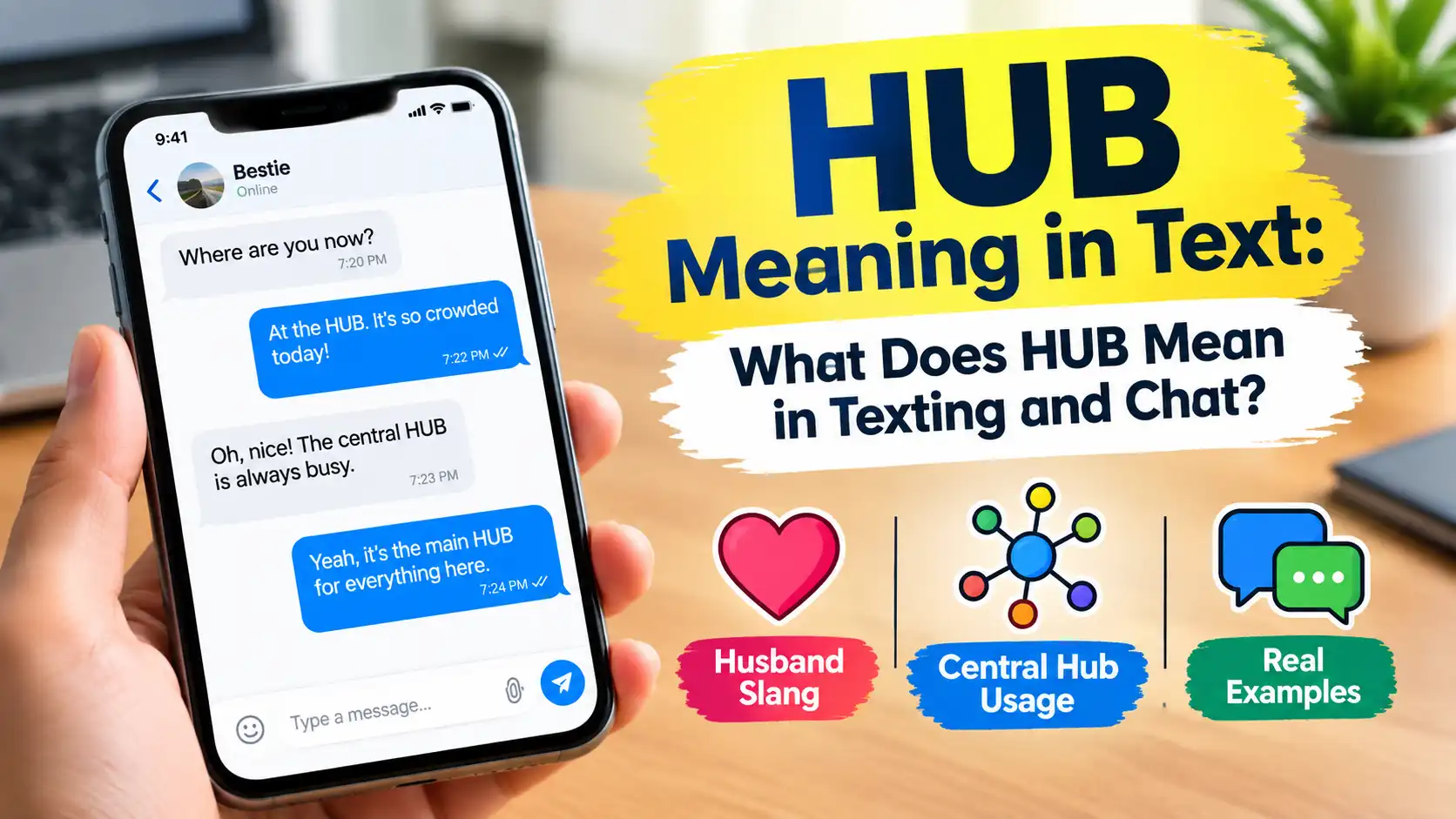
Someone texts, “just cooking dinner with my hub tonight,” and a completely different message says, “check the community hub for updates.” Same word, two very different meanings.
“Hub” is a good example of how an ordinary English word can pick up extra slang meaning once it moves into texting and social media. It’s not a flashy new acronym, it’s a familiar word that’s simply been stretched to cover a couple of specific, common ideas online.
You’ll run into it in casual texting between partners, in social media captions, in gaming communities, and in everyday phrases like “content hub” or “family hub.” Because it isn’t a strict abbreviation, its meaning depends heavily on the sentence around it.
Understanding both common uses of “hub” matters because mixing them up can lead to a confusing, or even slightly funny, misread. This guide breaks down exactly what “hub” means in each setting, where the usage came from, and how to read it correctly every time.
Definition & Meaning
“Hub” has two common meanings in texting and online conversation.
1. A casual, affectionate short form of “husband.”
Some people shorten “husband” to “hub” or “hubs” as a quick, warm way to refer to their partner, especially in social media captions or casual texting.
Example:
Friend: what are you up to this weekend? You: nothing much, just relaxing with my hub
Here, “hub” simply refers to the person’s husband, in a light, affectionate tone.
2. A central point where people, content, or activity comes together.
This is closer to the word’s original, literal meaning: a hub as the center of a wheel extended into digital spaces to describe a main gathering point, page, or resource center.
Example:
Text: all the event details are posted in the group hub
Another example:
Comment: this account is basically the hub for all the fan theories
More real life examples:
Caption: date night with the hub 🥰
Text: check the family hub for the shared calendar
Group chat: the announcements channel is our main hub for updates
Context makes the difference almost instantly. If “hub” is describing a person, especially alongside affectionate language or a relationship reference, it means “husband.” If it’s describing a place, page, channel, or resource, it means a central gathering point.
It’s worth noting that “hub” is not a strict, standardized abbreviation the way many texting acronyms are; it’s a regular English word being used in slightly extended, informal ways. Because of this, its meaning stays fairly easy to figure out just by reading the full sentence, rather than needing to memorize a fixed definition.
Background & History
The word “hub” has a long history in the English language, originally referring to the center of a wheel, the fixed point that everything else rotates around. Over time, this literal meaning naturally extended into a broader metaphor: any central point where activity, people, or resources gather.
This metaphorical use became especially common in technology and business language. Early computer networking used “hub” to describe a device that connects multiple devices together, acting as a central point for data. Around the same time, early websites experimented with “hub” as a term for a central page linking out to lots of other content, an idea that later evolved into what we now call a “portal.” Even today, terms like “content hub,” “help hub,” or “community hub” carry this same central gathering point meaning.
The second usage of “hub” as slang for “husband” developed separately, growing out of a much older, informal pattern in English: shortening close relationship terms into cozy, casual nicknames. Just as “hubby” has long been a warm, familiar way to refer to a husband, “hub” (and its plural sounding cousin “hubs”) emerged as an even shorter version of the same idea, especially useful in quick texting and social media captions where brevity matters.
This affectionate use of “hub” grew alongside similar shortened relationship terms in texting and social media culture, fitting into a broader pattern where people compress warm, familiar words into quick, casual shorthand similar to how “bestie” or “hubby” function.
Today, both meanings of “hub” continue to exist side by side:
- “Hub” as husband shows up mostly in personal texting, social media captions, and casual conversations about relationships.
- “Hub” as a central point remains common in tech, business, gaming communities, and any context describing a main gathering place for information or activity.
Neither meaning has significantly changed over time; they’ve simply continued running in parallel, each staying popular within its own type of conversation.
Usage in Various Contexts
In texting between friends (husband meaning):
Friend 1: how was your anniversary? Friend 2: so sweet, my hub planned the whole thing
On social media captions (husband meaning):
Caption: grateful for my hub every single day 🥹
In gaming or community chat (central point meaning):
Player 1: where do we find the tournament schedule? Player 2: it’s all in the Discord hub
In casual group chats (central point meaning):
Friend 1: where should we post trip photos? Friend 2: let’s just use the shared album as our hub
In everyday texting (central point meaning):
Text: the family hub has all our appointments listed now
In personal, relationship focused conversations (husband meaning):
Friend: Did you guys decide on dinner? You: yeah, my hub’s cooking tonight actually
In tech or workplace adjacent chat (central point meaning):
Coworker: all the project files are in the shared hub now, no more scattered folders
Across these settings, the pattern is straightforward: when “hub” refers to a person, it almost always means husband, usually appearing alongside warm, personal language. When “hub” refers to a place, page, or resource, it keeps its more literal meaning as a central gathering point. The surrounding words make the intended meaning clear almost immediately.
Common Misconceptions & Clarifications
Misconception 1: “Hub” is a fixed texting acronym with one specific hidden meaning. It isn’t. Unlike strict abbreviations like “BRB” or “LOL,” “hub” is a regular English word being used in two extended, informal ways; it doesn’t stand for a hidden phrase.
Misconception 2: “Hub” only ever refers to a husband. This is only one of its two common meanings. In many contexts, especially involving group chats, websites, or communities, “hub” simply refers to a central gathering point.
Misconception 3: “Hub” and “hubby” are completely different terms. They’re closely related. “Hub” (and “hubs”) function as an even shorter, casual version of the same affectionate idea behind “hubby.”
Misconception 4: Using “hub” to mean husband is disrespectful or dismissive. It isn’t. It’s simply a shortened, casual nickname, similar in tone to calling a close friend “bestie.” It reflects familiarity and warmth, not a lack of respect.
Misconception 5: The “central point” meaning is new internet slang. It’s actually one of the oldest metaphorical uses of the word, going back to early technology and networking terminology, long before social media existed.
Clarification on context: because “hub” isn’t a strict, standardized abbreviation, its meaning is almost always obvious from the sentence itself. If you ever see it and feel unsure, checking whether the word is describing a person or a place instantly clears things up.
Similar Terms & Alternatives
| Term | Meaning | Typical Use |
| HUB | Husband (casual) / Central point | Relationship references or shared resource spaces |
| HUBBY | Husband (casual) | Affectionate reference to a spouse |
| BAE | Significant other | Romantic partner, casual tone |
| WIFEY | Wife (casual) | Affectionate reference to a spouse |
| PORTAL | Central access point | Similar to “hub” in a tech or website context |
| HQ | Headquarters | Main base of operations, often used loosely online |
Examples in use:
Caption: happy birthday to my wifey 🎂
Friend: bae’s picking me up in ten minutes
Comment: this page is basically the HQ for all the updates
These related terms overlap closely with “hub,” especially “hubby” and “wifey” on the relationship side, and “portal” or “HQ” on the central gathering point side.
How to Respond to This Term
How you respond to “hub” depends on which meaning applies in the conversation.
If it means “husband” casual response:
“aw that’s so sweet, tell him I said hi!”
Funny response:
“your hub really outdid himself this time 😂”
Professional response (rare, but possible in a lightly casual workplace context):
“That sounds lovely, glad you both had a great time.”
Privacy conscious response (if you’d rather not discuss personal relationship details):
“Sounds nice! Anyway, back to what we were talking about…”
If it means “central point” casual response:
“got it, I’ll check the hub for the details”
Clarifying response (if the meaning is unclear):
“wait, do you mean your husband or the group page? lol”
General tips for responding:
- If “hub” appears near a personal or relationship related sentence, respond warmly, as you would to any mention of a partner.
- If “hub” appears near a request for information, treat it as a place to check, not a person.
- In professional settings, it’s best to spell out “husband” fully or refer to a “shared page” or “resource center” instead of using the informal term.
Regional or Cultural Differences
The word “hub” itself is a standard English word recognized globally wherever English is spoken or taught, since its literal meaning a central point has existed in the language for a very long time.
“Hub” as slang for husband is most common in casual English language texting and social media, particularly in the US, UK, Canada, and Australia, where shortened relationship nicknames like “hubby,” “wifey,” and “bae” are already widely used and understood.
“Hub” as a central gathering point carries even less regional variation, since this usage grew largely out of global technology and business terminology, which tends to spread evenly across English speaking countries and beyond, especially in workplace and gaming contexts.
Some regional differences show up in related, similar terms:
- In British slang, people might say “other half” instead of “hub” when referring to a spouse.
- In some American casual slang, “hubby” remains more common in everyday speech than the shorter “hub.”
- Non-English speaking online communities sometimes adopt English relationship slang like “hub” and “hubby” directly, especially on international social media platforms.
Because “hub” isn’t tied to one specific internet trend or platform, its use tends to feel more evenly spread across English speaking regions compared to newer, more localized slang terms.
Comparison with Similar Terms
| Term | Core Meaning | Emotional Tone | Best Used When |
| HUB (husband) | Husband | Warm, affectionate | Casual references to a spouse |
| HUBBY | Husband | Warm, slightly more traditional | Same as “hub,” slightly more common |
| HUB (central point) | Main gathering place | Neutral, functional | Referring to shared pages, communities, or resources |
| PORTAL | Central access point | Neutral, technical | Websites, apps, workplace systems |
| BAE | Significant other | Casual, romantic | Referring to a partner, not necessarily a spouse |
The clearest distinction is subject matter. “Hub” as husband and “hubby” both refer to a person, while “hub” as central point and “portal” both refer to a place or resource. Confusing the two is rare once you notice whether the sentence is about a person or a location.
Usage in Online Communities & Dating Apps
On Twitter/X and Instagram, “hub” (husband meaning) frequently appears in captions celebrating anniversaries, date nights, or everyday relationship moments.
On Tinder and other dating apps, the husband’s meaning of “hub” is uncommon early in a conversation, since it typically applies to people already married. It might appear later, in conversations where someone mentions their relationship history:
Match: I’m recently divorced, my ex hub and I just weren’t compatible You: thanks for sharing that, I appreciate the honesty
Here, “hub” is used casually to reference a past spouse.
In gaming communities, “hub” almost exclusively refers to a central point often a lobby, main menu, or shared server space where players gather before starting a match:
Player 1: meet everyone in the hub before we queue up Player 2: got it, heading there now
Tips for responding appropriately:
- On social media, warm, supportive responses fit naturally when “hub” refers to someone’s husband.
- On dating apps, if “hub” comes up referring to a past relationship, respond with care and without judgment.
- In gaming communities, treat “hub” as a functional term for a shared space, not a person.
Hidden or Offensive Meanings
“Hub” does not carry any widely recognized offensive or explicit meaning in either of its common uses. It is not linked to slurs, adult content, or aggressive language in mainstream usage.
A few things are worth keeping in mind about tone and context:
- The husband’s meaning is affectionate, not diminishing. Shortening “husband” to “hub” reflects familiarity and warmth, similar to using any other casual nickname for a partner.
- The central point meaning is entirely neutral. It’s a functional, everyday word used across technology, business, and gaming without any hidden connotation.
- Confusion, not offense, is the main risk. Because “hub” isn’t a strict slang acronym, the biggest challenge is simply figuring out whether someone means a person or a place without any inappropriate undertone.
In short, “hub” is considered safe and appropriate for nearly all casual audiences, with no hidden or offensive meaning attached to either of its common uses.
Suitability for Professional Communication
“Hub” as slang for husband is not suitable for professional communication. It’s a personal, casual nickname, and using it in workplace emails or official messages would feel out of place, regardless of how normal it feels in personal texting.
“Hub” as a central point, however, is entirely appropriate for professional use. In fact, this is one of the more business friendly meanings covered in this guide, commonly used in workplace software, project management tools, and internal documentation.
Professional alternatives (for the husband meaning):
| Instead of “hub” | Use |
| Referring to a spouse casually | “My husband” or “My partner” |
Example rewrite:
Casual: “date night with the hub tonight!” Professional: This phrase wouldn’t typically appear in professional writing at all, since personal relationship references are uncommon in formal communication.
Example of the central point meaning used correctly in a professional context:
“All project resources are available in the shared hub for easy access.”
This usage requires no adjustment, since it’s already considered standard, professional language.
FAQs
1. What does “hub” mean in a text message? It usually means one of two things: a casual, affectionate short form of “husband,” or a central gathering point for people, content, or information.
2. Is “hub” the same as “hubby”? They’re closely related. “Hub” functions as an even shorter version of “hubby,” both referring to a husband in a warm, casual way.
3. Is “hub” always about a relationship? No. It often refers to a central place, page, or resource, especially in gaming, tech, or workplace contexts.
4. Is “hub” considered disrespectful when referring to a husband? No, it’s simply a casual, affectionate nickname, not a disrespectful term.
5. Can I use “hub” in professional writing? It depends on the meaning. The husband meaning should be avoided in professional settings, while the central point meaning is completely appropriate and common in workplace language.
6. How do I know which meaning of “hub” someone intends? Check whether the word refers to a person or a place. Relationship related sentences point to “husband,” while references to pages, resources, or communities point to a central gathering spot.
7. Is “hub” a modern slang term? Only partly. Its central point meaning has existed for decades in technology and business language, while its husband meaning is a more recent, casual texting trend.
Conclusion
“Hub” is a flexible, everyday word that carries two distinct meanings in modern texting and online conversation. In personal, relationship focused messages, it often serves as a warm, casual short form of “husband.” In broader digital and workplace contexts, it typically refers to a central gathering point, a page, community, or shared resource where information comes together.
Because “hub” isn’t a strict slang acronym, context almost always makes its meaning obvious. While the husband meaning fits naturally into personal, casual conversations, the central point meaning works comfortably in both casual and professional settings.
Now that you understand both common meanings of “hub,” you’ll never have to guess which one someone means the next time it shows up in your messages.

Noman Hassan is a content creator and writer focused on text meanings, slang, abbreviations, acronyms, and internet expressions. Through Orvexale.com, he provides clear and simple explanations to help readers understand modern texting language. His goal is to make confusing terms easy to understand with practical examples and everyday context.