You send a photo, share a story, or drop a slightly bold comment and he replies with just “👀.” No words. Just two wide, wandering eyes.
The eyes emoji has become one of the most flexible little symbols in texting. It shows up in flirty exchanges, group chats, TikTok comments, and even casual workplace messages, always carrying some version of the same basic idea: I noticed that. But what “that” actually means attraction, curiosity, suspicion, or just amusement depends entirely on the conversation around it.
Understanding what 👀 means specifically from a guy matters because it’s one of those small, ambiguous signals that can genuinely shape how you read someone’s interest. Knowing the range of what it can mean, and how to spot the difference between flirty and simply curious, helps you respond with more confidence instead of overanalyzing three pixels. This guide breaks down exactly what 👀 tends to mean, where it came from, and how to read it in different situations.
Definition & Meaning
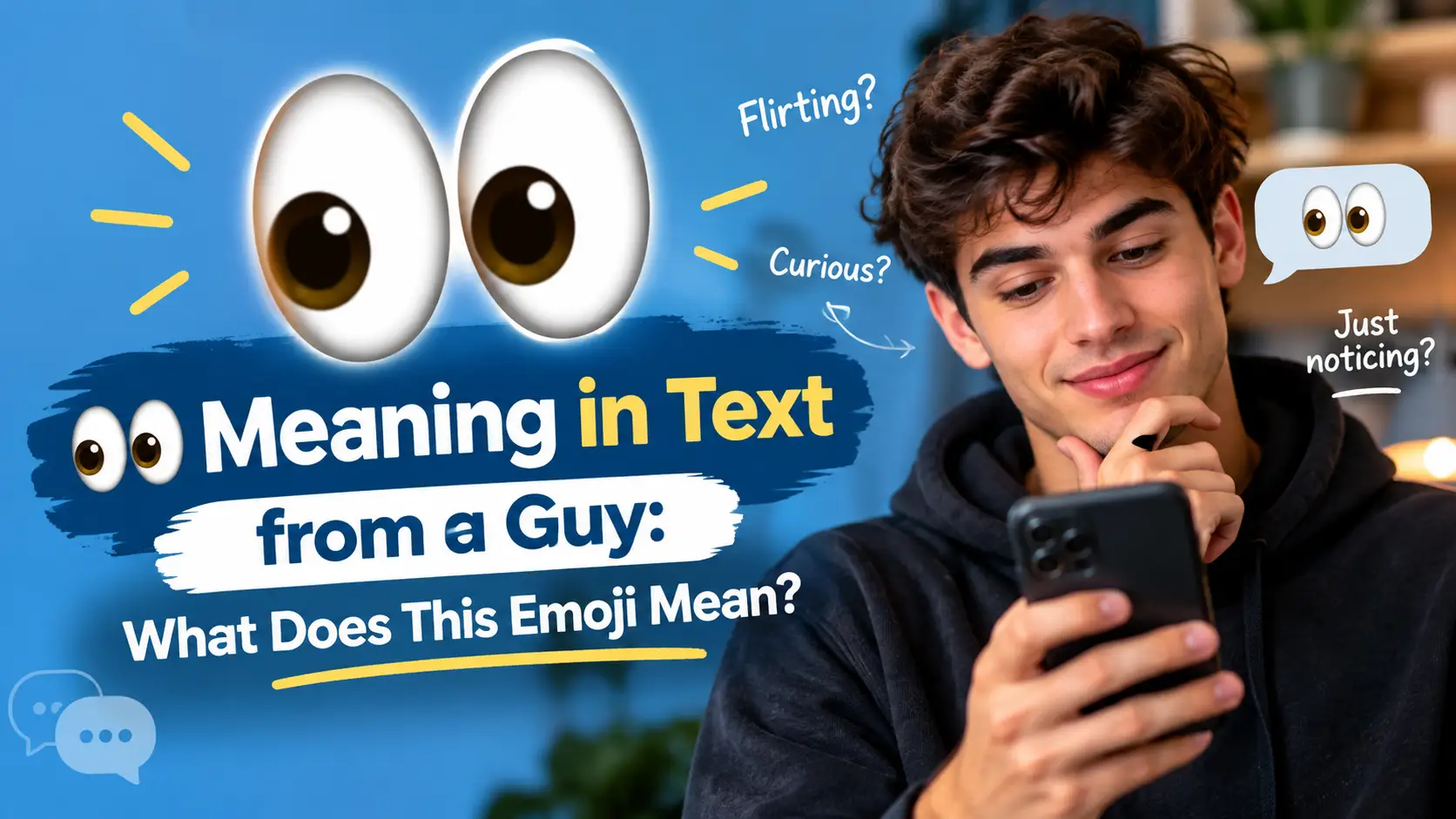
The 👀 emoji represents a pair of wide open eyes looking to the side, and it’s used to express attention, curiosity, surprise, suspicion, or flirtation, depending on context.
When a guy sends it, it most often signals one of these:
1. Genuine interest or attraction
You: [posts a photo] Him: 👀
Here, 👀 works as a quick, low effort way of saying “I like what I see” without needing to spell it out.
2. Curiosity or wanting more information
3. Playful suspicion or teasing
Friend group chat: guess who got asked out today Him: 👀👀 spill it
4. Simple attentiveness, especially in group settings
Group chat: movie night at my place Friday? Him: 👀 I’m in
In this last example, 👀 simply signals “I’m paying attention and interested in the plan” , nothing romantic implied at all.
More real life examples:
Text: you looked really good tonight 👀
Comment on a post: 👀👀👀 who is this
Text after a vague hint: wait what happened 👀
Context is everything with this emojiWhen a 👀 responds to a flattering photo or flirty comment, it leans toward attraction. Meanwhile, a 👀 reacting to gossip or a teaser leans toward curiosity. In a group chat, a 👀 about plans usually means attentive interest, with no romantic undertone at all.
The short version: 👀 almost always means “I noticed, and I want to know more” whether that “more” is romantic interest, gossip, or just genuine curiosity depends on what came right before it.
Background & History
The eyes emoji was introduced in 2010 as part of Unicode 6.0, the technical standard that governs which emoji are available across phones and platforms. Originally, it was a fairly literal symbol, simply representing the act of looking or watching something.
As emoji use exploded through the 2010s, particularly with the rise of smartphones and social media, 👀 quickly took on a life beyond its literal meaning. Internet culture and meme communities began using it to represent something closer to “look at this” or “I’m watching closely,” often applied to gossip, drama, or anything mildly intriguing happening online.
Snapchat played a notable role in shaping one specific meaning of the emoji: on that platform, 👀 became a built-in notification symbol, appearing when someone views your Story multiple times. This gave the emoji an added layer of meaning tied specifically to attention and being watched, which likely reinforced its later association with romantic or flirtatious interest, someone repeatedly checking in on your content in a way that feels a little more personal than casual.
From there, the emoji spread into everyday texting, comment sections, and casual conversation as a shorthand for noticing something interesting, whether that’s a flirty photo, a juicy piece of gossip, or a surprising comment. Because it visually represents eyes rather than spelling out words, it naturally lent itself to suggestive or playful use implying attention without directly stating what that attention means.
Today, 👀 remains especially common in:
- Flirty or romantic texting, signaling attraction or interest
- Group chats and gossip driven conversations, reacting to something intriguing
- Social media comments, especially TikTok and Instagram
- Casual planning conversations, simply expressing interest or attentiveness
- Workplace messaging platforms like Slack, occasionally used lightly to flag attention to a message
Usage in Various Contexts
In flirty texting:
You: just got back from the gym Him: 👀 pics or it didn’t happen
Here, the emoji clearly leans playful and flirtatious.
In response to a photo:
You: [new profile picture] Him: 👀👀
This is one of the most common flirty uses of a wordless way of showing he likes what he sees.
Reacting to gossip or a teaser:
You: something happened at work today, can’t even explain Him: 👀 okay you have to tell me now
In casual group chats (no romantic undertone):
Friend: anyone free for pizza tonight? Him: 👀 what time
In gaming or online chat:
As a lighthearted, suspicious reaction:
Friend: I may have talked to your crush today Him: 👀👀👀 what did you say
Across these settings, the emoji’s tone shifts based on what it’s responding to. After something flattering or personal, it usually reads as flirty. After a teaser or vague comment, it usually reads as curious. In group logistics, it’s simply a low effort way to show interest or attentiveness, without any romantic meaning attached.
Common Misconceptions & Clarifications
Misconception 1: 👀 always means flirting. This isn’t accurate. While it’s commonly used flirtatiously, it’s just as often used to express simple curiosity, group chat attentiveness, or reaction to gossip.
Misconception 2: One 👀 is a clear, definitive signal of romantic interest. A single emoji rarely tells the whole story. Looking at the broader pattern of someone’s texting, do they consistently show interest, ask follow up questions, initiate conversation gives a much clearer picture than one symbol alone.
Misconception 3: 👀 is always subtle or secretive. Sometimes it is, but it’s also used very openly and directly, especially paired with an explicit compliment (“you looked amazing tonight 👀”).
Misconception 4: The eyes emoji and the single eye emoji (👁️) mean the same thing. They don’t. 👀 tends to feel more playful and casual, while the single eye emoji carries a more serious, sometimes unsettling or intense connotation, closer to surveillance or literal anatomy than playful teasing.
Misconception 5: 👀 always requires a big, dramatic response. It doesn’t. Sometimes it’s just a low effort way of saying “I’m listening” or “go on,” not necessarily inviting an intense reaction.
Clarification on tone: because 👀 is so visually simple, its meaning depends almost entirely on what it’s replying to. The same two eyes can mean “I’m attracted to you,” “tell me everything,” or “I’m interested in these plans” all on the same day, from the same person.
Similar Terms & Alternatives
| Term/Emoji | Meaning | Typical Use |
| 👀 | Attention, curiosity, flirtation, suspicion | Flexible reaction to almost anything intriguing |
| 😏 | Smirk, suggestive or teasing | Flirtatious or knowing reactions |
| 🙈 | Shy, embarrassed reaction | Playful embarrassment, often flirty |
| 😍 | Strong attraction or admiration | Clear romantic or aesthetic appreciation |
| 🤔 | Curiosity or suspicion | Thoughtful or questioning reaction |
| 👁️ | Watching, more serious tone | Intense observation, sometimes unsettling |
Examples in use:
Text: you looked incredible tonight 😍
Comment: 🙈 stop, you’re making me blush
Text: wait, what happened? 🤔
These related emoji overlap with some of 👀’s functions, particularly around flirtation and curiosity, though each carries a slightly different emotional weight.
How to Respond to This Term
How you respond to “👀” depends on what prompted it and how you feel about the sender.
If it feels flirty and you’re interested casual response:
“Oh really? 👀 tell me more”
Flirty response:
“careful, that’s exactly the reaction I was hoping for 😏”
If it feels flirty and you’re not interested:
“haha thanks!” (keeping the reply light and moving the conversation elsewhere)
If it’s curiosity about gossip:
“Okay okay, here’s what happened…”
Professional response (if it appears in a workplace chat, used to flag attention):
“Noted, thanks for flagging that!”
Privacy conscious response (if you’d rather not share more):
“haha it’s a long story, I’ll tell you eventually 😄”
General tips for responding:
- If you’re unsure of the tone, responding with a light, open ended reply (“👀 at what exactly?”) often invites clarification naturally.
- Matching the energy playful for playful, casual for casual usually keeps the conversation comfortable.
- Pay attention to the pattern over time rather than reading too much into a single instance.
Regional or Cultural Differences
Emoji use, including 👀, is widespread and understood similarly across most English speaking countries and, increasingly, globally, since emoji function as visual symbols rather than language specific text. Its flirtatious and curious connotations tend to carry across cultures reasonably consistently.
That said, some cultural nuances are worth noting:
- In many East Asian digital cultures, particularly on platforms where emoji and stickers play a huge role in daily communication, similar “watching” or “noticing” symbols exist, though specific platform stickers often carry more detailed, exaggerated expressions than the simple 👀.
- Because flirting norms vary by culture, how directly someone uses 👀 to signal romantic interest can differ in more reserved communication cultures, it might be used more for curiosity or humor than overt flirtation.
- On Snapchat specifically, 👀 carries a very particular, universally recognized meaning among users as a notification for repeated Story views, regardless of region.
Overall, while the emoji itself is globally recognized, how boldly or subtly it’s used to signal romantic interest can vary depending on cultural communication styles.
Comparison with Similar Terms
| Emoji | Core Meaning | Emotional Range | Best Used When |
| 👀 | Attention, curiosity, flirtation | Very flexible | Reacting to almost anything intriguing |
| 😏 | Suggestive, teasing | Clearly flirtatious | Playful romantic or teasing moments |
| 😍 | Strong admiration | Clearly affectionate | Direct compliments or attraction |
| 🙈 | Shy or embarrassed | Playful, bashful | Reacting to flattery or awkwardness |
| 🤔 | Curiosity, suspicion | Thoughtful, questioning | Wanting more information |
The clearest distinction is 👀’s ambiguity compared to more direct emoji like 😍 or 😏. 👀 can mean almost anything intriguing, while 😍 and 😏 carry a much more specifically romantic or flirtatious tone on their own.
Usage in Online Communities & Dating Apps
On Twitter/X and TikTok, 👀 appears constantly in comments and captions, reacting to surprising, dramatic, or intriguing content without needing extra words.
On Tinder and other dating apps, 👀 commonly shows up as a flirty, low effort reaction:
Match: [sends a photo] Him: 👀👀 well hello
Here, it clearly signals attraction and interest, often opening the door for more playful conversation.
In gaming communities, 👀 is sometimes used to react to something surprising or impressive during gameplay, without any romantic connotation at all:
Teammate: just found a hidden shortcut Him: 👀 show me where
Tips for responding appropriately:
- On dating apps, a 👀 reaction to your photo or message is generally a positive, low pressure sign of interest responding with equal playfulness keeps things moving naturally.
- In gaming or group chats, don’t assume romantic intent just because 👀 appears context almost always clarifies this quickly.
- If you’re genuinely unsure of someone’s intent, especially on a dating app, a light, direct question (“👀 is that a good thing? 😄”) can clear things up without overthinking.
Hidden or Offensive Meanings
The 👀 emoji does not carry any offensive or inappropriate meaning on its own. It is a widely used, generally lighthearted symbol representing attention, curiosity, or playful interest.
A few points are worth understanding about tone and context:
- It can feel intense if overused or paired with an unwanted comment. While the emoji itself is harmless, repeated or overly persistent flirty use from someone whose attention isn’t welcome can feel uncomfortable, similar to any other unwanted flirtation.
- It’s rarely used with any negative or aggressive intent. Unlike some slang, 👀 doesn’t carry a hidden insult or hostile undertone.
- Context, not the emoji itself, determines appropriateness. A 👀 reacting to a friend’s exciting news is completely different from repeated, unsolicited reactions to someone’s appearance from someone they’ve asked to stop.
In short, 👀 is a safe, versatile emoji in the vast majority of casual contexts, with appropriateness depending far more on the relationship and consent between the people texting than on the symbol itself.
Suitability for Professional Communication
The 👀 emoji has a narrow, acceptable use in professional communication, but only in a specific, non flirtatious sense.
Where it can work professionally:
- In casual workplace chat tools like Slack or Teams, 👀 is sometimes used to signal “I’ve seen this and am paying attention,” especially reacting to a message or update.
Where it doesn’t work at all:
- Any flirtatious, suggestive, or ambiguous use has no place in professional communication and could easily be misread as inappropriate.
Professional alternatives:
| Instead of “👀” (flirty/curious meaning) | Use |
| Expressing interest in more details | “I’d love to hear more about this.” |
| Flagging attention to something | “Noted, I’ll take a look.” |
Example rewrite:
Casual/flirty: “you looked amazing today 👀” Professional: This type of comment has no appropriate professional equivalent and should be avoided in a workplace context entirely.
FAQs
1. What does 👀 mean in a text from a guy? It usually signals attention, curiosity, or flirtation, depending on what it’s responding to. It can mean he’s interested romantically, curious about something, or simply paying attention to a group conversation.
2. Does 👀 always mean he’s flirting? Not always. Context matters it can just as easily mean simple curiosity or attentiveness with no romantic intent.
3. How do I know if 👀 is flirty or just curious? Look at what it’s responding to. A reaction to a compliment or photo often leans flirty, while a reaction to gossip or a teaser often leans curious.
4. Where did the eyes emoji come from? It was introduced in 2010 as part of Unicode 6.0, originally representing the literal act of looking or watching.
5. What does 👀 mean on Snapchat specifically? On Snapchat, it often functions as a notification indicating someone has viewed your Story multiple times.
6. Is 👀 appropriate for professional messages? Only in a very limited, non flirtatious way, such as signaling attention to a message in casual workplace chat tools.
7. Should I read too much into a single 👀? Not really. It’s better to look at the overall pattern of someone’s texting behavior rather than interpreting one emoji in isolation.
Conclusion
The 👀 emoji is a flexible, widely used symbol that can mean attention, curiosity, flirtation, or playful suspicion, depending entirely on the conversation around it. From a guy, it often signals genuine interest or attraction, especially following a compliment or photo, but it’s just as commonly used simply to show curiosity or attentiveness in casual conversation.
It fits naturally into flirty texting, group chats, social media comments, and dating app conversations, adding intrigue without needing words. In professional settings, its use should stay limited to simple attentiveness, never flirtation. Reading the full context and the broader pattern of someone’s texting remains the best way to understand what 👀 really means each time it shows up.

Asfan Wahab is a content creator and writer focused on text meanings, slang, abbreviations, acronyms, and internet expressions. Through Orvexale.com, he provides clear and simple explanations to help readers understand modern texting language. His goal is to make confusing terms easy to understand with practical examples and everyday context.