Introduction
You get a text back: just “💀”. No words. Should you be worried?
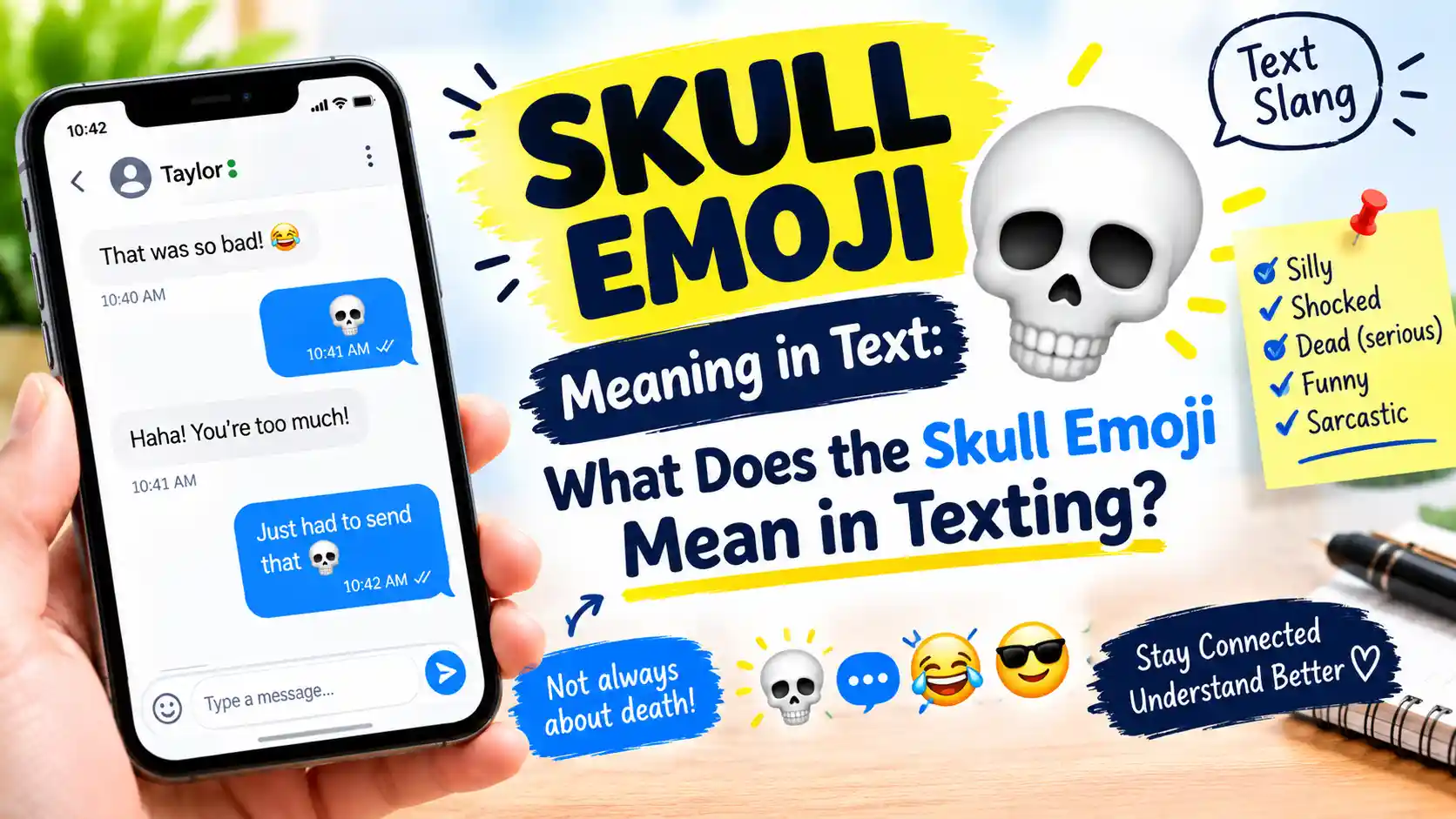
Probably not. The skull emoji has quietly become one of the most used reactions in texting and social media, and it almost never means what it looks like it means. Instead of death or danger, it usually says one thing: something was so funny it “killed” you.
You’ll see it in group chats, TikTok comments, gaming lobbies, and Twitter/X replies, often standing in for a whole sentence. For a generation raised on memes, it’s replaced the classic crying laughing face as the go to way to react to something hilarious, cringe, or unbelievable.
Knowing this matters because misreading 💀 can genuinely confuse a conversation. Read it literally, and a joke about your terrible cooking looks like a threat. Read it right, and it’s just someone telling you they’re dying laughing. This guide breaks down exactly what the skull means, where it came from, and how to use and respond to it correctly.
Definition & Meaning
At its core, the skull emoji (💀) has two very different meanings depending on who’s using it and where.
The literal meaning: a human skull, representing death, danger, or mortality. This is the original, dictionary level meaning, and it’s still used that way in contexts like Halloween posts, warning labels, memorial messages, or pirate and gothic imagery.
The slang meaning: “I’m dead” from laughter, embarrassment, or shock. This is now the dominant way most people under 30 use it in everyday texting. It functions almost exactly like 😂, but with a bit more edge you’re not just laughing, you’re “dead.”
Real examples of the slang use:
“He tripped in front of the whole class 💀” (Translation: that was hilariously embarrassing.)
“bro really wore socks with sandals to the interview 💀💀💀” (Translation: I can’t believe that, it’s so funny/cringe.)
“I studied for 6 hours and the exam got cancelled 💀” (Translation: I’m exasperated, this is absurdly frustrating.)
Notice that in every case, nobody is actually talking about death. The skull is doing emotional work signaling that a reaction is too big for words alone.
Background & History
The skull emoji was added to Unicode in 2010, originally intended for its literal meaning: death, danger, Halloween, or gothic themes. For most of the 2010s, that’s exactly how it was used. Wikipedia’s account of the emoji notes that it kept its original death and danger association for years, and a 2016 Wired report even found people using it to describe their phones dying a “socially dead” phone, not a literal one, suggesting the metaphorical stretch had already begun in a small way.
The real shift happened in the early 2020s. According to Wikipedia’s history of the emoji, Generation Z began popularizing the skull as a stand-in for phrases like “I’m dead” during this period, and multiple sources trace the transformation to platforms like Twitter and Tumblr, where users started reaching for it to express being “dead from laughter.” That usage then took off with meme culture, spreading heavily through TikTok, Instagram, and Discord.
Part of the reason for the shift: 😂 (face with tears of joy) started to feel overused, and some younger users saw it as dated or “millennial coded.” The skull offered something that felt fresher and, in a strange way, funnier if a joke is so good that crying laughing doesn’t cut it, “dying” is the natural next step.
Today, the skull sits in an odd but stable place: still literal in some settings (Halloween, warnings, goth aesthetics, memorials), but overwhelmingly used as a laughter/shock reaction everywhere else, especially among younger users on fast moving platforms.
Usage in Various Contexts
Texting between friends
Friend 1: “I accidentally called my teacher ‘mom’ today” Friend 2: “💀💀💀 no you didn’t”
Social media comments (TikTok, Instagram)
Comment on a fail video: “the way he just gave up mid jump 💀”
Twitter/X reactions
Reply to an absurd news headline: “this can’t be real 💀”
Gaming chat
In gaming spaces, the skull can carry a second layer of meaning tied to actual gameplay: many games use a skull icon or message to show a character has died. So in gaming chat, 💀 can mean either “that was hilarious” or literally “I just died in the game” context and tone decide which.
“bro clutched that 1v4 💀 unreal” vs. “💀 respawning, give me a sec”
Casual conversation about something awkward or absurd
“My mom found my search history 💀 I’m never recovering”
Across all these settings, the through line is the same: the skull marks a moment as too much too funny, too shocking, too embarrassing to respond to with plain words.
Common Misconceptions & Clarifications
Misconception 1: “It always means someone is upset or in danger.” This is the most common misreading, especially by older users unfamiliar with the slang shift. In the vast majority of casual texting and social media use, the skull is positive or humorous, not a distress signal.
Misconception 2: “It’s the same as a laughing emoji, so it doesn’t matter which one you use.” While functionally similar, the skull often signals a slightly bigger or more intense reaction than 😂 closer to “I can’t believe that” or “that finished me off” than a normal chuckle. Swapping them isn’t wrong, but it can undersell or oversell a reaction depending on tone.
Misconception 3: “Everyone interprets it the same way.” Not true. Age is the biggest factor here. Someone unfamiliar with the slang meaning may read 💀 as a literal warning or a sign something is seriously wrong, especially in a text with no other context. This can cause real confusion and a joke can look alarming out of context.
Clarification on appropriateness: the skull isn’t inherently inappropriate, but it can land badly if used in a genuinely serious conversation. Responding to someone’s bad news with 💀 meant as “wow, that’s rough” can easily be misread as mocking, since the emoji’s literal appearance still carries weight. When the topic is sensitive, plain words are safer than relying on a symbol with two very different meanings.
Similar Terms & Alternatives
Several other reactions overlap with the skull’s slang meaning, though each carries a slightly different flavor.
| Term/Emoji | Meaning | Vibe |
| 😂 | Laughing hard | Classic, slightly more “millennial” coded now |
| 💀 | “I’m dead” (from laughter/shock) | Edgier, more Gen Z, works for cringe too |
| “I’m dead” | Text version of the skull | Same meaning, spelled out |
| “deadass” | Emphasis on sincerity or seriousness | Different meaning means “for real,” not “funny” |
| 😭 | Crying (can mean sad OR laughing hysterically) | Ambiguous, context dependent like the skull |
| “LMAO” | Laughing hard | More neutral, less generational marking |
The key difference worth remembering: “deadass” is not the same as “I’m dead.” The first means “seriously” or “I’m not joking,” while the second (and the skull) means something was funny or overwhelming. Mixing these up is an easy mistake for anyone new to the slang.
How to Respond to This Term
How you respond to a 💀 depends on the tone you want to strike back.
Casual:
“💀💀💀 stop, I can’t”
Funny/escalating:
“you just KILLED me with that, I need a moment”
Professional (where emoji use is generally best avoided anyway):
“That’s a great point. I hadn’t considered that angle.” (Skip the emoji entirely in professional messaging; see the section below.)
Privacy conscious or simply unfamiliar with the slang:
“haha wait what does the skull mean here, are you okay? 😅” This is a perfectly reasonable response if you’re not sure whether someone means it literally or as a joke better to check than to misread the tone.
The general rule: match the energy. A single skull often just acknowledges something mildly funny; three or four in a row usually signals a much bigger reaction.
Regional or Cultural Differences
The skull’s slang meaning is strongest in English speaking, especially U.S. based, youth culture, where it grew out of Twitter, Tumblr, and TikTok trends. It has since spread more broadly through global meme culture, but its adoption isn’t universal.
Wikipedia notes that the skull emoji had limited popularity for years, ranking around 92nd among most used emojis, before climbing into the top 10 in the United States by 2019 while staying outside the top 50 in most other countries. That gap suggests the slang meaning took hold in American digital culture well before it caught on elsewhere.
In some cultures, particularly parts of Asia, the skull can retain a more serious or superstitious association tied to death or bad luck, making the casual “I’m dying laughing” usage less automatic or even a bit jarring. Older users almost everywhere are more likely to read it literally, regardless of region, simply because they weren’t around for the meme driven shift.
The practical takeaway: don’t assume everyone reads the skull the same way. With people outside your usual friend group or generation, a quick check in or a plainer response is safer than assuming shared slang.
Comparison with Similar Terms
| Symbol/Term | Literal Meaning | Common Slang Meaning | Best For |
| 💀 | Death, danger | “I’m dead” (dying laughing) | Funny, shocking, or cringe moments |
| 😂 | Laughing with tears | Laughing hard | General humor, slightly more universal |
| 😭 | Crying | Laughing hysterically OR genuine sadness | Ambiguous needs context |
| ☠️ | Skull and crossbones | Danger, poison, rarely used for humor | Warnings, pirate themes |
| 😵 | Dizzy face | Overwhelmed, confused | Being overloaded or shocked |
☠️ (skull and crossbones) is worth calling out separately: unlike 💀, it hasn’t picked up the same joking usage, and mostly still signals actual danger or a warning. Confusing the two is an easy mistake since they look similar at a glance.
Usage in Online Communities & Dating Apps
On platforms like TikTok and Twitter/X, the skull is everywhere in comment sections, almost always as the “this killed me” reaction to something funny, awkward, or absurd. It’s become such a strong signal of humor on these platforms that seeing it under a video is often treated as a mark of a genuinely good joke.
On dating apps like Tinder, the skull tends to show up in two ways: reacting to something funny the other person said, or self deprecating humor about an awkward moment (“I definitely just sent that to the wrong chat 💀”). It generally reads as playful and low stakes, a light way to react without needing a full sentence.
Tips for responding on these platforms:
- If someone sends 💀 after something you said, take it as a compliment you made them laugh.
- Don’t overanalyze it as a sign of disinterest; it’s usually the opposite, since people react this way to things that land well.
- If you’re not sure whether it’s genuine or sarcastic, a quick playful follow up (“glad I could kill you 😂”) keeps things light without misreading the tone.
In gaming communities, remember the dual meaning: it can mean humor or literal in-game death, so a quick glance at context (was something funny, or did a character just die?) usually clears up which one is meant.
Hidden or Offensive Meanings
The skull doesn’t carry a widely known secret or offensive meaning beyond its literal (death/danger) and slang (laughter/shock) uses. It’s not on the list of emojis with a well documented alternate, inappropriate interpretation.
That said, context and relationship still matter. Using 💀 in response to someone sharing genuinely bad news an injury, a loss, a real hardship can come across as callous or mocking, even if that’s not the intent, because the image itself still reads as “death” at a glance. The safest approach: save the skull for things that are clearly meant to be funny or absurd, and use plain, direct language when someone is sharing something serious.
Tone is doing almost all the work here. The same emoji that reads as “hilarious” in one message can read as “uncaring” in another, purely based on what it’s responding to.
Suitability for Professional Communication
Short answer: avoid it. Younger, casual audiences widely understand 💀, but avoid using it in formal or professional communication. It can look unprofessional or cause confusion, especially when colleagues or clients do not know the slang meaning and interpret it as a reference to death or danger.
Professional alternatives, depending on what you’re trying to convey:
- Instead of “💀 that’s hilarious” → “That’s genuinely funny, thanks for sharing.”
- Instead of “💀 I can’t believe that happened” → “That’s surprising I wasn’t expecting that outcome.”
- Instead of “💀 I’m exhausted” → “It’s been a long week; I could use a break.”
If you work in a casual, meme friendly workplace culture (some startups, creative teams, or informal Slack channels), you’ll see more flexibility but even then, it’s worth reading the room before using it with people outside your immediate team.
FAQs
Does the skull emoji mean someone is upset or in danger? Usually not. In casual texting and social media, it almost always means something was funny, shocking, or embarrassing, not literal danger.
Where did this meaning come from? It grew out of Twitter and Tumblr culture in the early to mid 2010s and exploded in popularity with Gen Z on TikTok and Twitter/X in the early 2020s, replacing “I’m dead” as a way to react to something hilarious.
Is it the same as the laughing crying emoji (😂)? Close, but not identical. Both emojis signal laughter, but 💀 often expresses a stronger or more intense reaction and feels more current among younger users.
Can it still mean literal death? Yes, context decides. In Halloween posts, warnings, memorials, or gaming death screens, it’s still used literally.
Is it okay to use at work? Generally no. It’s considered too casual and can be misread by people unfamiliar with the slang. Stick to plain language in professional messages.
Why do older people sometimes misunderstand it? Younger users helped spread the slang meaning through social media platforms and meme culture, so people outside that audience may be more likely to read it literally..
What’s the difference between 💀 and ☠️? 💀 has picked up the widespread “I’m dead laughing” slang meaning. ☠️ (skull and crossbones) has largely stayed tied to its literal meaning of danger or poison.
Conclusion
The skull emoji has quietly rewritten its own meaning. What started as a symbol of death and danger is now, for most casual texting and social media use, a way of saying “that was so funny (or awkward, or absurd) it killed me.”The literal meaning still appears around Halloween, in warnings, and in genuinely serious topics, but context usually makes the intended meaning clear.
The main thing to remember: read the room, not just the symbol. In a lighthearted exchange, 💀 is a compliment to a good joke. In a serious one, it’s better left unused. Get that distinction right, and you’ll never mistake a laugh for a warning again.

Asfan Wahab is a content creator and writer focused on text meanings, slang, abbreviations, acronyms, and internet expressions. Through Orvexale.com, he provides clear and simple explanations to help readers understand modern texting language. His goal is to make confusing terms easy to understand with practical examples and everyday context.