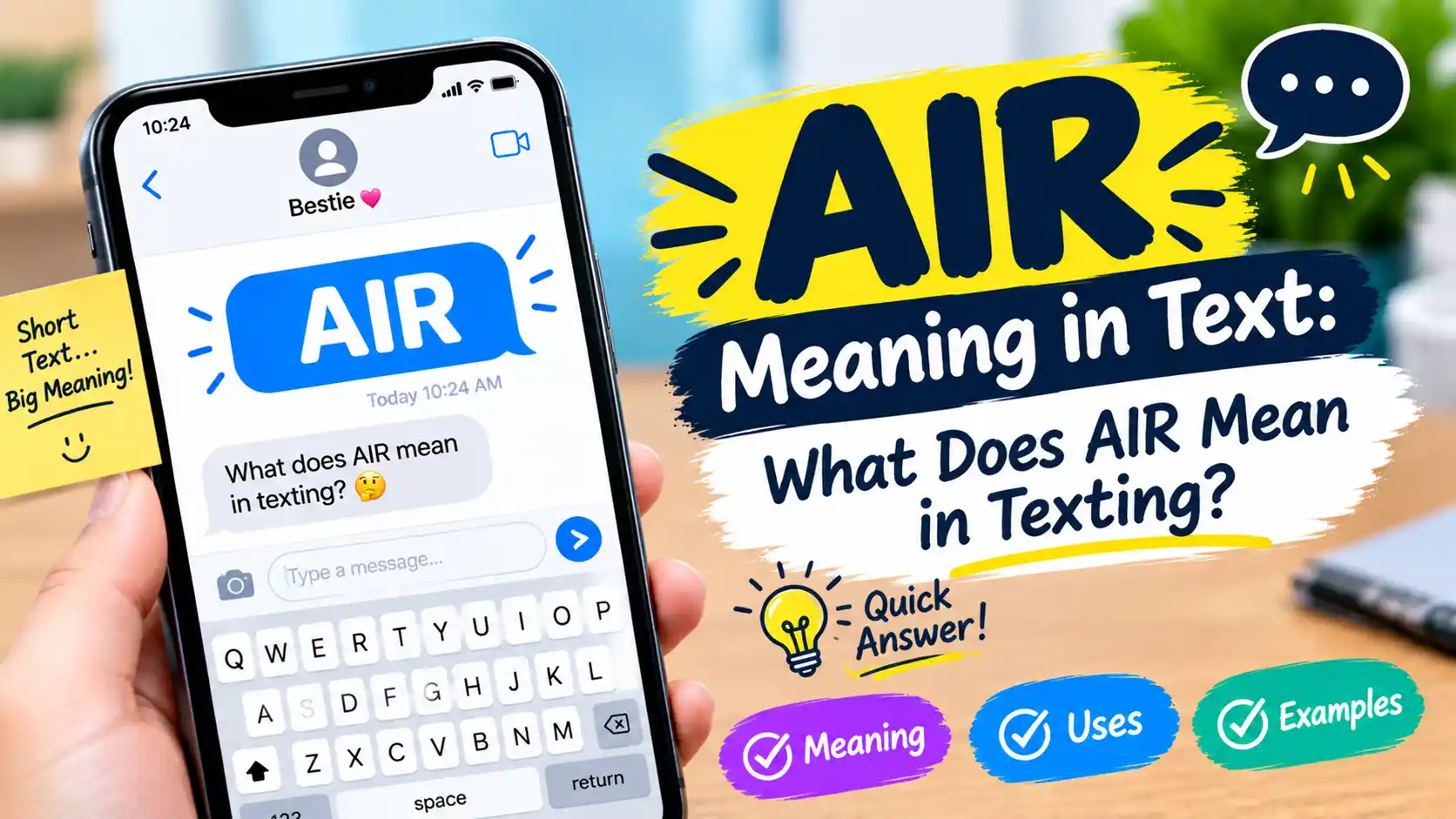
Have you ever seen someone say, “You aired me” in a text or social media post? In modern slang, “air” often means to ignore someone or leave them without a reply. If a person sends you a message and you never answer, they may say you “aired” them.
People use this word in daily chats, social media, dating apps, and casual conversations. It can describe a missed text, an ignored greeting, or a person who suddenly stops responding. The meaning usually depends on the situation and the relationship between the people involved.
Understanding AIR meaning in text can help you follow online conversations more easily. It also helps you understand whether someone feels ignored, is joking with you, or simply describes what happened. The word can sound serious or playful, so context matters.
Definition & Meaning
In texting and online slang, “air” commonly means to ignore someone or deliberately give them no response. When someone says, “You aired me,” they usually mean, “You ignored me” or “You left me without a reply.”
The term often appears in the past tense form “aired.” You may also see “airing” when someone describes the action as it happens.
For example:
Person 1: “I sent you three messages yesterday.”
Person 2: “Sorry, I was busy.”
Person 1: “You completely aired me!”
Here, “aired” means that Person 2 did not respond.
Someone can also use the term when another person ignores them in real life:
Sam: “I said hi to Jake at school.”
Ali: “Did he answer?”
Sam: “No. He aired me.”
The word can describe a single ignored message or a longer period of silence. It does not always mean that the person wanted to be rude. They may have been busy, distracted, or unable to respond.
People also use “air” in phrases such as:
- “He aired my message.”
- “She aired me all day.”
- “Why are you airing me?”
- “I think they aired me.”
- “Don’t air me.”
The exact meaning can change with context. In some conversations, “air” can have other meanings unrelated to ignoring someone. For example, the ordinary word air refers to the atmosphere around us. It can also appear in phrases connected to broadcasting or television.
When someone uses “air” as slang in a chat, however, the intended meaning often comes from the surrounding conversation.
Background & History
The slang use of “air” developed from the idea of treating someone as if they were not there. Instead of giving another person attention or a response, someone effectively leaves them with nothing.
The phrase became especially common in informal British and online slang. As texting and social media grew, people needed short ways to describe common social situations. Ignoring a message became one of those situations, and “airing someone” became a casual way to describe it.
The expression can refer to different types of social silence. Someone might ignore a direct message, fail to answer a question, or avoid acknowledging another person in person. In each case, the basic idea remains similar: one person expects some attention or response, but the other person gives none.
Online communication helped spread expressions like this because people often talk about their conversations publicly. A person might post that a friend “aired” them after receiving no reply. Others can then understand the situation without needing a long explanation.
The slang also appears in casual speech. Someone might say:
“Why did you air me yesterday?”
That sentence sounds natural in an informal conversation where both people understand the slang.
Over time, the term has become connected with several modern communication habits. Messaging apps, social platforms, dating apps, and group chats all create situations where people can notice whether someone responds.
The meaning remains flexible. “Aired” can describe playful teasing between friends or genuine frustration after someone ignores an important message.
Today, the expression is mainly useful in informal communication. Its meaning depends heavily on context, tone, and the relationship between the speakers.
Usage in Various Contexts
In Text Messages
In texting, “aired” usually means someone did not answer a message.
Alex: “Did you see my text?”
Ben: “Yeah, sorry.”
Alex: “You aired me for six hours!”
The speaker may feel annoyed, but the statement could also be playful.
On Social Media
People can use the term when someone ignores a direct message or comment.
“I replied to her post, sent a DM, and got aired both times.”
The sentence suggests that the person received no response.
In Casual Conversations
The term can also describe real life interactions.
“I waved at him, but he aired me.”
Here, the person did not acknowledge the greeting.
On Dating Apps
Dating conversations often involve short periods of silence. Someone may describe an unanswered conversation as being aired.
“We were talking every day, then she aired me.”
However, silence does not always mean deliberate rejection. People may become busy or lose interest without explaining why.
In Gaming Communities
Players may use the term when another player ignores a message or invitation.
Player 1: “I invited him to the game.”
Player 2: “Did he join?”
Player 1: “No, he aired me.”
The expression remains casual and depends on the group’s usual slang.
Common Misconceptions & Clarifications
Misconception 1: “Aired” always means someone is angry.
Not necessarily. Friends may use the word jokingly.
“Bro, you aired my message 😂.”
The laughing emoji can make the statement playful rather than serious.
Misconception 2: Being aired always means the relationship is over.
That is not true. Someone may ignore one message and reply later. Being aired can describe one moment of silence without meaning the entire relationship has ended.
Misconception 3: Airing always happens through texting.
No. People also use it for face to face situations.
Someone can say:
“I said hello, and he aired me.”
This describes being ignored in person.
Misconception 4: The word always has a negative meaning.
Usually, the speaker feels some level of frustration, but the tone can vary. Friends often use it as light teasing.
Misconception 5: Being “aired” is always dramatic or a big deal.
Not necessarily. People can use it lightly or jokingly among friends about small, low stakes moments. It does not always describe a serious social problem.
Similar Terms & Alternatives
Several expressions have meanings close to “air” in texting.
| Term | Common meaning |
| Aired | Ignored or left without a response |
| Left on read | A message was opened but not answered |
| Ghosted | Communication suddenly stops, often for a longer period |
| Ignored | Given no attention or response |
| Blanked | Ignored, especially in person |
| No response | Simply received no reply |
| Dodged | Avoided a question, request, or interaction |
These terms overlap, but they are not always interchangeable.
For example, “left on read” usually tells you that someone saw the message. “Aired” does not necessarily tell you whether the person saw it.
Similarly, “ghosted” often suggests a more complete or ongoing disappearance, while “aired” can describe one unanswered message.
How to Respond to This Term
Your response can depend on the tone and your relationship with the person.
Casual Response
If a friend says:
“You aired me!”
You could reply:
“Sorry! I got busy and forgot to reply.”
Funny Response
If the conversation is playful:
“I wasn’t airing you. My phone was fighting me 😂.”
Direct Response
If you want to explain yourself clearly:
“I saw your message but couldn’t answer at the time. Sorry about that.”
Professional Response
If someone uses the slang in a work related conversation, you can respond more clearly:
“Sorry for the delayed response. I was unavailable earlier.”
Privacy Conscious Response
You do not always need to explain everything.
“Sorry for the late reply. I wasn’t available.”
This gives a simple explanation without sharing personal details.
Regional or Cultural Differences
The slang use of “air” is strongly connected with informal English. You may hear it more often in some English speaking communities than others.
British slang has helped popularize expressions related to airing someone. Online communication has also allowed the phrase to travel beyond its original regional settings.
Different communities may use other expressions for the same situation.
For example, one person might say:
“He aired me.”
Another might say:
“He ignored me.”
Someone else might say:
“He left me on read.”
The meaning can also change slightly depending on local slang. Some communities may use “blanked” to describe ignoring someone in person.
Language continues to change online. Younger users may create new expressions or give existing words new meanings. Social media, gaming communities, and messaging apps can help slang spread quickly across countries.
If you are unsure what someone means, look at the surrounding conversation. Context is often more useful than the word alone.
Comparison with Similar Terms
| Expression | Main idea | Usually involves |
| Air someone | Ignore someone | Texting or real life interaction |
| Leave on read | Read a message without replying | Messaging apps |
| Ghost someone | Stop communicating | Dating or personal relationships |
| Ignore someone | Give no attention | Any setting |
| Blank someone | Act as if someone is not there | Often face to face |
| Dodge a message | Avoid responding | Text or online chat |
The biggest difference comes from the level of detail each expression gives.
“Aired” focuses on the act of ignoring someone. “Left on read” specifically suggests that the message was opened. “Ghosted” often suggests a longer pattern of disappearing.
For example:
“She aired me.”
You know she did not respond.
“She left me on read.”
You know she saw the message but did not reply.
“She ghosted me.”
You usually understand that communication stopped more broadly.
Usage in Online Communities & Dating Apps
Online communities create many situations where people can use “air.” Messaging, comments, group chats, and private conversations all involve expectations of replies.
On social platforms such as X, people may describe an unanswered direct message as being aired. Gaming communities can use the same expression when someone ignores an invitation or does not answer a chat message.
Dating apps create another common situation. A conversation may start strongly and then suddenly stop.
Person 1: “We talked all night.”
Person 2: “What happened?”
Person 1: “Nothing. I got aired the next morning.”
The speaker uses “aired” to describe the lack of response.
However, you should avoid assuming why someone stopped replying. Silence can happen for many reasons. Someone may be busy, distracted, uninterested, or simply unsure how to continue the conversation.
When someone says “you aired me,” respond according to the relationship and context. A simple explanation works well if you genuinely missed the message.
Hidden or Offensive Meanings
In ordinary texting slang, “aired” does not usually represent an offensive or explicit phrase. Its main slang meaning involves ignoring or failing to acknowledge someone.
Still, context matters.
The word “air” has many ordinary meanings. It can refer to the atmosphere, broadcasting, ventilation, or other concepts. Therefore, you should not automatically interpret every use of “air” as slang.
Tone also changes the meaning.
“Why did you air me? 😂”
This could be playful.
“You aired me when I needed an answer.”
This sounds more serious.
Some people may also use unusual abbreviations or private slang that differs from common usage. If the meaning does not fit the conversation, ask the person what they meant instead of assuming.
Suitability for Professional Communication
“Air” as slang is generally better suited to informal communication. It can sound too casual for emails, workplace reports, formal messages, or professional discussions.
Instead of writing:
“Sorry I aired your email.”
A professional alternative would be:
“Sorry for the delayed response.”
Other useful alternatives include:
- “Thank you for your patience.”
- “Apologies for the late reply.”
- “I was unable to respond earlier.”
- “I have now reviewed your message.”
- “Thank you for following up.”
Professional communication should focus on clarity. A person who does not know the slang may not understand “aired.”
Use the slang when you know the audience and the setting supports casual language. In formal situations, choose direct and clear wording.
FAQs
1. What does AIR mean in text?
In informal slang, “air” can mean to ignore someone or fail to respond to them. The past tense “aired” is especially common.
2. What does “you aired me” mean?
It usually means “you ignored me” or “you did not respond to me.”
3. Does “aired” mean ghosted?
Not always. “Aired” can describe one ignored message, while “ghosted” often suggests that communication stopped more completely.
4. Is “air” rude?
It can sound negative because it describes being ignored, but friends often use it jokingly.
5. Can I use “aired” at work?
It is better to avoid slang in formal workplace communication. Use phrases such as “delayed response” or “sorry for the late reply.”
6. Does “aired” mean left on read?
It can describe a similar situation, but “left on read” specifically suggests that someone opened the message without responding.
7. Can someone be aired in real life?
Yes. People can use the expression when someone ignores them or fails to acknowledge them in person.
Conclusion
AIR meaning in text usually refers to ignoring someone or failing to respond. When someone says “you aired me,” they often mean that you left their message unanswered or did not acknowledge them. The expression can describe texting, social media, dating apps, gaming, or even face to face situations.
The tone matters. Friends may use “aired” as a joke, while someone else may use it to express real frustration. It also differs from terms such as “left on read” and “ghosted,” which carry more specific meanings.
For formal communication, choose clear phrases such as “sorry for the delayed response.” In casual conversations, however, “air” can be a simple way to describe being ignored. Always check the context before deciding exactly what the speaker means.

Noman Hassan is a content creator and writer focused on text meanings, slang, abbreviations, acronyms, and internet expressions. Through Orvexale.com, he provides clear and simple explanations to help readers understand modern texting language. His goal is to make confusing terms easy to understand with practical examples and everyday context.