Someone comments on your post, then says “I’ll PM you the details.” A minute later, a completely different message says a meeting starts at “3 PM.”
Same two letters. Two totally different meanings.
PM is one of the most common abbreviations online, showing up in texting, social media comments, gaming chats, and even professional emails. It’s been around far longer than most modern slang, and it still holds its place today, even as newer terms try to replace it.
Understanding PM matters because it can shift meaning entirely depending on where you see it. Read it the wrong way, and you might miss an invitation to a private conversation or completely misread a scheduled time. This guide breaks down every common meaning of PM, where it came from, and how to use it naturally in any setting.
Definition & Meaning
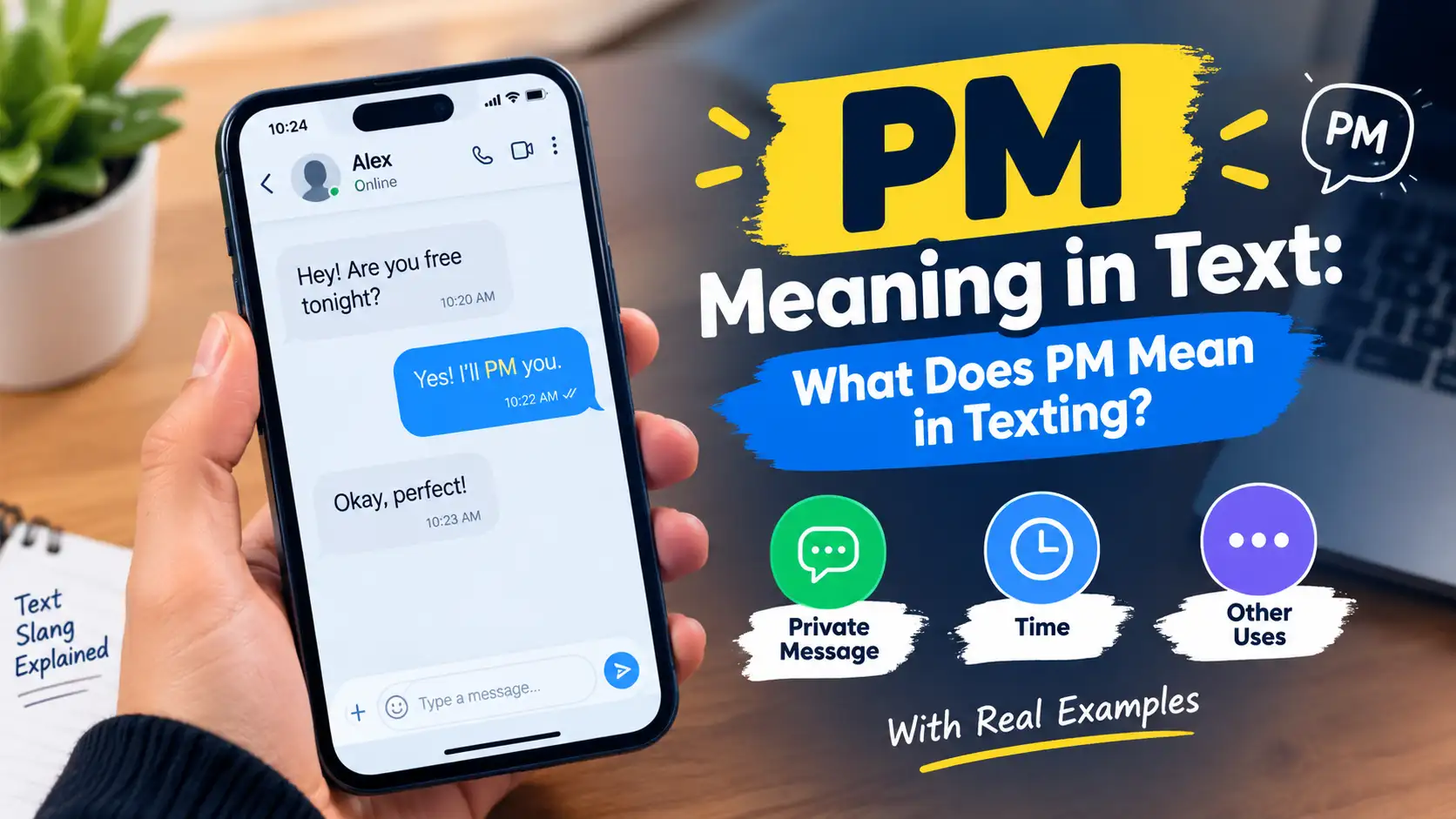
PM most commonly stands for “Private Message” in texting and social media slang.
It’s used when someone wants to move a conversation out of a public space like a comment section or group chat into a private, one on one exchange.
Example:
Comment: are those shoes still available? Seller: yes! send me your size in PM
Here, PM tells the buyer to continue the conversation privately rather than in public comments.
Another example:
Friend 1: I have some news but don’t want to post it here Friend 2: ooh, PM me!
PM does have other well established meanings, and context makes clear which one applies:
- “Private Message” the dominant meaning in texting, social media, forums, and gaming spaces.
- “Post Meridiem” the Latin based time marker for anything after noon (for example, 3 PM).
- “Project Manager” common in workplace and professional messaging.
- “Prime Minister” used in political or news related conversations.
More real life examples:
Text: call me at 6 PM tonight
Work chat: looping in our PM on this project for visibility
News headline: the PM addressed the announcement this morning
Forum comment: great post! PM me if you want to chat more about this
The short version: on social media, in texting, and in gaming or forum spaces, PM almost always means “private message.” In scheduling or professional contexts, it usually shifts to “Post Meridiem” or “Project Manager.” Reading the sentence around it makes the correct meaning clear almost instantly.
Background & History
PM has one of the longest histories of any abbreviation still in common use today. Its meaning as “Post Meridiem” comes from Latin, referring to time after midday, and has been used in clocks, schedules, and written communication for centuries long before the internet existed.
Its meaning as “Private Message” grew out of early internet forums and chat rooms in the late 1990s and early 2000s. Long before social media platforms existed, websites had built in messaging systems that let users send messages visible only to the recipient, separate from public posts or comment threads. “PM” became the standard shorthand for this kind of one on one communication, and it stuck.
As online communication evolved, PM remained the go to term across forums, gaming platforms, and early social networks. Even as newer platforms introduced the term “DM” (Direct Message) now the more common term on apps like Instagram and Twitter/X PM never fully disappeared. It has simply settled into specific spaces where it originally took hold.
Today, PM commonly appears in:
- Forums and community boards, like Reddit and specialized hobby sites
- Gaming platforms and Discord servers, especially in older or niche communities
- Online marketplaces, when sellers ask buyers to share details privately
- Everyday texting and social media, often interchangeably with DM
- Scheduling and time references, in its “Post Meridiem” sense
- Workplace communication, referring to a Project Manager
Its meaning has stayed remarkably stable over time. Rather than evolving into something new, PM has mostly just expanded across more platforms and contexts while keeping its original core meanings intact.
Usage in Various Contexts
In texting between friends:
Friend 1: don’t want to say this in the group chat Friend 2: PM me, I’m all ears
Here, PM signals a shift toward a more private, personal conversation.
On social media:
Comment: love this bag, where’s it from? Reply: PM me and I’ll send the link!
This is one of the most common uses of PM today moving product or personal details out of public comments.
In gaming chat:
Player 1: hey, can we talk strategy without the whole server seeing? Player 2: yeah, PM me and we’ll sort it out
In forums and community spaces:
Forum post: great advice, PM me if you want to go into more detail
In scheduling contexts (Post Meridiem):
Text: let’s meet at 5 PM outside the café
In workplace messages (Project Manager):
Coworker: loop in the PM before finalizing the timeline
In political or news contexts (Prime Minister):
Headline: the PM is expected to speak on the policy later today
Across these settings, one pattern stands out: when PM shows up mid conversation, especially involving privacy, it almost always means “private message.” When it shows up next to a number, a workplace title, or a political reference, it takes on one of its other established meanings. The surrounding words almost always make the intended meaning obvious.
Common Misconceptions & Clarifications
Misconception 1: PM always refers to time. This isn’t accurate in texting and social media contexts. While PM is well known as a time marker, in casual chat and comment sections, it overwhelmingly means “private message.”
Misconception 2: PM and DM mean completely different things. They’re essentially the same concept a private, one on one message just used on different platforms. DM tends to dominate on newer apps like Instagram and Twitter/X, while PM remains common on forums, gaming platforms, and marketplaces.
Misconception 3: PM is outdated slang that nobody uses anymore. Not true. Even as DM has become more popular in mainstream social media, PM remains widely used and understood, especially in gaming communities, Reddit, and online marketplaces.
Misconception 4: Saying “PM me” means something suspicious or secretive. In most everyday contexts, it simply means someone wants to continue a conversation privately for reasons as ordinary as sharing an address, a price, or personal advice. It isn’t inherently a red flag.
Misconception 5: PM always refers to Project Manager in a work setting. Not necessarily. In workplace chat apps, especially casual ones, PM can still mean “private message,” so context whether it’s about a person or a request to talk privately makes the difference.
Clarification on privacy: because PM literally means “private message,” it’s worth remembering that a private message is still just a message always exercise the same basic caution you would with any message from someone you don’t know well, especially around sharing personal information.
Similar Terms & Alternatives
| Term | Meaning | Typical Use |
| PM | Private Message / Post Meridiem / Project Manager | Private chats, time, or workplace roles |
| DM | Direct Message | Private messaging, mainly on newer social apps |
| IM | Instant Message | Real time private chat |
| MSG | Message | General shorthand for any message |
| INBOX | Private messaging area | Used as a verb: “inbox me” |
| AM | Ante Meridiem | Time before noon |
Examples in use:
Comment: DM me for prices!
Friend: just inbox me whenever you’re free to talk
Text: meeting moved to 10 AM instead
These terms overlap closely with PM, especially DM, which now functions as its near identical modern counterpart on most major social platforms.
How to Respond to This Term
How you respond to “PM me” or “I’ll PM you” depends on the platform and your comfort level sharing information privately.
Casual response:
“sure, sending it now!”
Funny response:
“ooh mysterious, sliding into your inbox now 😏”
Professional response:
“Sure, I’ll follow up with the details in a private message.”
Privacy conscious response (if you’d rather keep things public or aren’t comfortable sharing personal info):
“I’d rather keep this here if that’s okay, but happy to answer general questions!”
If PM refers to time, a simple confirmation works best:
“Got it, see you at 3 PM.”
If PM refers to a Project Manager in a work context:
“I’ll loop in our PM so they’re aware of the update.”
General tips for responding:
- On social media or forums, agreeing to “PM me” is usually low stakes, especially for simple details like prices or links.
- If a stranger requests a PM for something personal, it’s completely fine to ask why, or to decline if it feels unnecessary.
- In professional settings, spell out “private message” fully rather than using the abbreviation, to avoid confusion with other meanings like Project Manager.
Regional or Cultural Differences
PM as “Post Meridiem” is used globally wherever the 12 hour time format is common, particularly in the US, UK, Canada, Australia, and many other English speaking countries. Regions that use the 24 hour clock, common across much of Europe and Asia, rely less on AM/PM notation altogether.
PM as “Private Message” is widely recognized across English speaking online communities, though its popularity varies by platform rather than region. It remains especially common in:
- Reddit and other forum based platforms, regardless of the user’s location
- Gaming communities and Discord servers, particularly older or niche groups
- Online marketplaces, across many English speaking countries
Non English speaking online communities often adopt “PM” directly into their own texting and chat habits, especially on international gaming platforms and forums, since the abbreviation is short and easy to recognize regardless of language.
PM as “Prime Minister” is naturally most relevant in countries with a parliamentary system of government, including the UK, Canada, Australia, India, and many others, where it appears constantly in news and political conversation.
Because PM carries several well established meanings across time, politics, workplace roles, and messaging, regional differences mostly affect which meaning is most commonly encountered, rather than whether the abbreviation itself is recognized.
Comparison with Similar Terms
| Term | Core Meaning | Common Setting | Notes |
| PM | Private Message / Time / Project Manager / Prime Minister | Forums, gaming, texting, scheduling, work, politics | Multiple established meanings, context dependent |
| DM | Direct Message | Instagram, Twitter/X, modern social apps | Closest modern equivalent to PM’s messaging meaning |
| IM | Instant Message | Real time chat platforms | Emphasizes immediacy of the message |
| INBOX | Private messaging space | Facebook, forums | Often used as a verb (“inbox me”) |
The clearest distinction between PM and DM is platform habit, not meaning. Both refer to the same basic idea a private, one on one message but DM dominates newer social apps, while PM remains the preferred term on forums, gaming platforms, and marketplaces.
Usage in Online Communities & Dating Apps
On Reddit, PM remains a standard, widely used term, even though Reddit’s own private messaging feature is often referred to as “chat” or “messages” within the app itself. Long time users still commonly say “PM me” out of habit.
On Twitter/X, PM appears occasionally, though DM has become the dominant term for private messaging on that platform specifically.
On Tinder and other dating apps, PM is less commonly used as a direct term, since these apps are built entirely around private messaging by default. However, it may still appear in bios or conversation referencing moving a conversation to another platform:
Match: let’s keep chatting, PM me your number if you’re comfortable
In gaming communities, especially on platforms like Discord, PM remains extremely common for private, one on one conversations separate from public server channels.
Tips for responding appropriately:
- On forums and gaming platforms, treat “PM me” as a normal, low pressure request for private conversation.
- On dating apps, be thoughtful about sharing personal contact information, even when a match specifically asks for it.
- If a marketplace seller or buyer asks to move to PM, it’s a common and generally safe practice, though it’s still wise to stay cautious with payment details or personal information.
Hidden or Offensive Meanings
PM does not carry any offensive or explicit hidden meaning. It is considered a neutral, harmless abbreviation across all of its common uses private messaging, time, workplace titles, and political references.
A few points worth noting about context and tone:
- “PM me” can occasionally carry a flirty or suggestive undertone, depending on the situation and emojis used, but this comes from the surrounding conversation, not the term itself.
- Requests to move to PM aren’t inherently suspicious, though it’s always reasonable to stay cautious if a stranger asks to move a public conversation private, especially involving money or personal details.
- No slang dictionary or online community associates PM with any explicit or offensive meaning. It remains one of the most neutral, functional abbreviations in everyday use.
In short, PM is safe, common, and widely understood across nearly every online space, with no hidden meaning to worry about.
Suitability for Professional Communication
PM is appropriate for professional communication in some forms, but not others.
Where it works professionally:
- Referring to a Project Manager (“Let’s loop in the PM on this”).
- Indicating time (“The call is scheduled for 2 PM”).
Where it doesn’t work well:
- Using PM to mean “private message” in formal emails or official documents. In these settings, spelling out “private message” or “direct message” maintains a more professional tone.
Professional alternatives:
| Instead of “PM” (messaging sense) | Use |
| PM me the details | “Please send me a private message with the details.” |
| I’ll PM you later | “I’ll follow up with you directly afterward.” |
Example rewrite:
Casual: “PM me your availability” Professional: “Please send me a private message with your availability.”
In relaxed workplace chat platforms like Slack or Teams, using “PM” to mean private message is generally understood and acceptable among colleagues. In formal emails or official written communication, spelling it out fully is the safer choice.
FAQs
1. What does PM mean in a text message? It most commonly means “Private Message,” referring to a message sent directly and privately to one person.
2. Does PM always refer to messaging? No. Depending on context, PM can also mean “Post Meridiem” (afternoon/evening time), “Project Manager,” or “Prime Minister.”
3. Is PM the same as DM? They mean nearly the same thing. DM (Direct Message) is more common on newer platforms like Instagram and Twitter/X, while PM remains popular on forums, gaming platforms, and marketplaces.
4. Is it safe to PM a stranger online? It depends on the platform and situation. It’s generally fine for simple requests like prices or links, but it’s wise to stay cautious about sharing personal details or money related information.
5. Can PM be used in professional settings? Yes, especially to refer to a Project Manager or a scheduled time. Using it to mean “private message” is best reserved for casual workplace chat rather than formal communication.
6. Is PM outdated compared to DM? Not exactly. While DM dominates mainstream social media, PM remains widely used and understood, particularly in gaming communities, forums, and marketplaces.
7. What does “PM me 😉” usually mean? It typically suggests a private, possibly flirty or secretive conversation, though the tone always depends on context and the emojis used.
Conclusion
PM is a flexible, long standing abbreviation with several well established meanings. Most often in texting, social media, and gaming spaces, it means “Private Message,” inviting someone to continue a conversation privately. In other contexts, it can mean “Post Meridiem,” “Project Manager,” or “Prime Minister,” depending on the setting.
It remains especially common on forums, gaming platforms, and online marketplaces, even as “DM” has taken over on many mainstream social apps. While PM fits naturally into casual conversation, spelling it out fully is the safer choice in formal or professional writing.
Now that you know every common meaning of PM, you can read it and use it with confidence no matter where it shows up.

Asfan Wahab is a content creator and writer focused on text meanings, slang, abbreviations, acronyms, and internet expressions. Through Orvexale.com, he provides clear and simple explanations to help readers understand modern texting language. His goal is to make confusing terms easy to understand with practical examples and everyday context.