You send a message to the wrong group chat, or forget to reply to something important. A minute later, you type back: “omb!”
If you already text a lot, this probably feels familiar. If you’ve never seen it before, it might look like a typo at first glance. It isn’t. OMB is a small, casual abbreviation that shows up constantly in texting, Instagram comments, and group chats usually right after someone realizes they messed up.
Understanding OMB matters because it captures a very specific, everyday moment: the quick, low stakes “my bad” we all say dozens of times a week. Knowing exactly what it means, and how to respond to it, helps conversations move smoothly instead of leaving you wondering what someone meant.
This guide breaks down what OMB stands for, where it came from, and how to use it naturally in your own texting.
Definition & Meaning
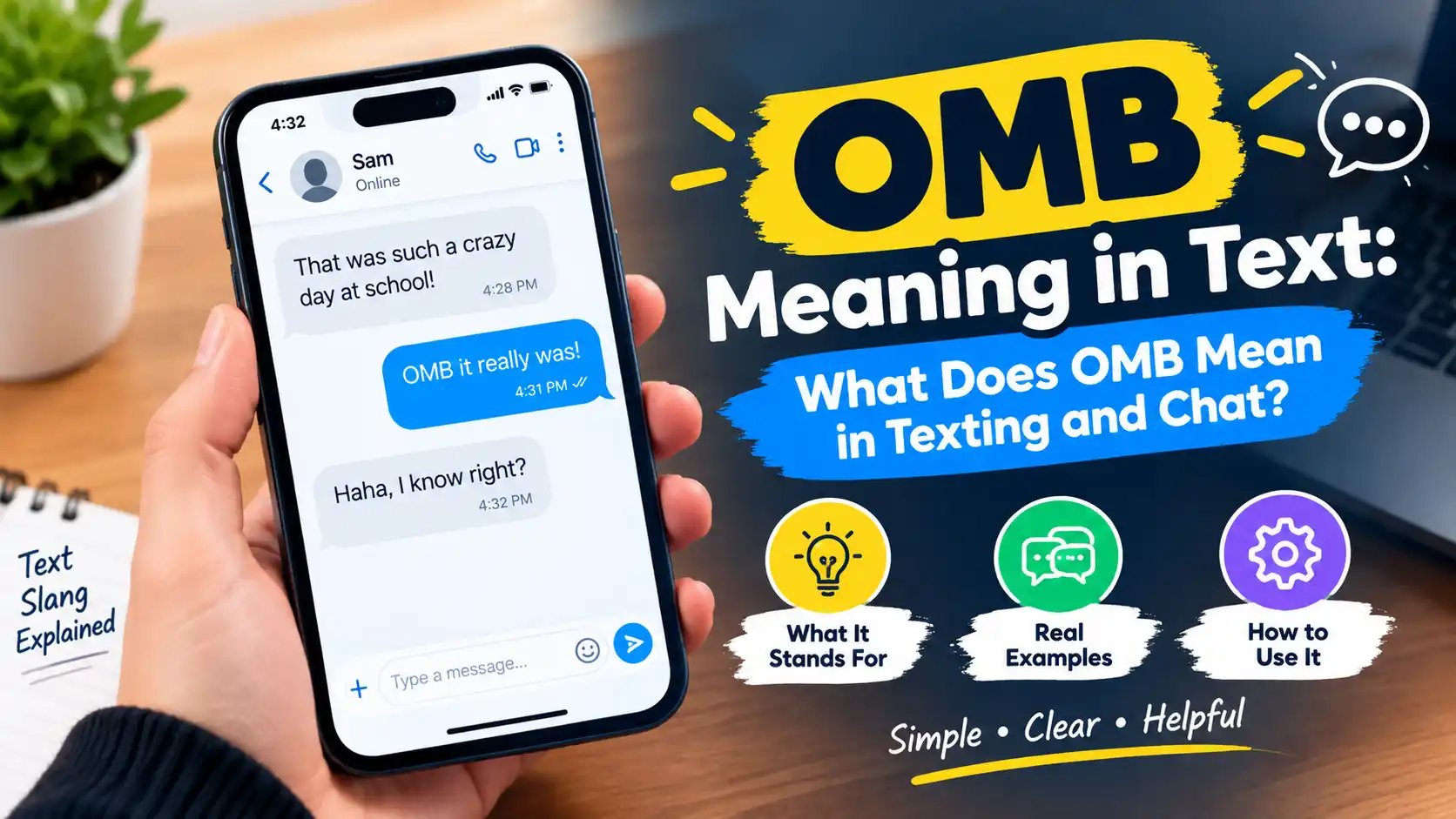
OMB most commonly stands for “Oh My Bad.”
It’s a casual, lighthearted way to admit a small mistake or misunderstanding, similar to saying “my bad” or “oops, sorry” out loud.
Example:
Friend 1: you left me on read for two days lol Friend 2: omb, I totally forgot to reply!
Here, OMB works as a quick, friendly apology for a small slip up.
Another example:
Person A: wait, that meeting was actually at 3, not 4 Person B: omb, let me fix my calendar
It’s worth knowing that OMB isn’t a strict, single definition term. Because slang shifts across different online spaces, a second, much less common meaning also exists:
- “Oh My Bad” the dominant, widely recognized meaning, used as a casual apology.
- “Oh My Buddha” an occasional, playful variant of “OMG,” used to express surprise or amazement in a lighthearted way.
Context makes the difference almost instantly. If OMB follows a mistake or mix up, it means “oh my bad.” If it follows something surprising or funny, it may lean toward the more playful “oh my Buddha” usage, though this is far less common.
More real life examples:
Group chat: omb wrong chat 😭 ignore that
Friend: you spelled my name wrong the whole time You: omb, I’m so sorry, autocorrect got me
Text: omb I completely blanked on your birthday, so sorry!
The short version: OMB is a quick, easygoing way to own a small mistake without making a big deal out of it, casual , friendly, and rarely serious.
Background & History
The phrase behind OMB “my bad” has roots that go back decades before texting existed. It became popular in American street and sports culture, where players would say “my bad” during a game to quickly acknowledge a small mistake without stopping play or making it a bigger issue than it needed to be.
As texting culture grew through the 2000s and 2010s, people began shortening common spoken phrases into fast, typable abbreviations. “Oh my bad” naturally followed the same pattern that gave us terms like OMG (“oh my god”) and BRB (“be right back”) blending a reaction (“oh”) with an apology (“my bad”) into one quick phrase.
OMB fits into a broader family of “oh my ” abbreviations, most famously OMG, which has been part of digital slang since the earliest days of texting and instant messaging. OMB works the same way structurally, just applied specifically to small mistakes rather than surprise or shock.
Because it blends an exclamation with an apology, OMB carries a slightly more expressive tone than a plain “my bad” or “sorry,” which likely helped it catch on in casual texting, especially on platforms like WhatsApp, Instagram, and TikTok, where quick, informal reactions are the norm.
Today, OMB commonly appears in:
- Texting between friends, especially after small errors like typos or late replies
- Group chats, often correcting a mistaken message or mix up
- Social media comments, reacting lightly to an oversight
- Gaming chat, admitting a small in game mistake
Its core meaning has stayed fairly consistent over time, a quick, informal way to own a minor slip up without much shift in tone or usage as it spread across platforms.
Usage in Various Contexts
In texting between friends:
Friend 1: Did you seriously forget we had plans? Friend 2: omb, totally slipped my mind, so sorry!
Here, OMB softens the apology and keeps the tone light.
On social media:
Comment: you tagged the wrong person 😂 Reply: omb, fixing it now
In gaming chat:
Teammate: why’d you go that way, we lost the point You: omb, misread the map
In casual group chats:
Friend 1: wrong chat lol, that message wasn’t for us Friend 2: omb 😭 ignore me
In slightly more personal conversations:
Friend: I waited outside for twenty minutes You: omb, I completely lost track of time, I’m so sorry
Occasional playful use (less common, “Oh My Buddha” sense):
Friend: guess who just got engaged?! You: omb no way, tell me everything
Across these settings, OMB almost always signals a small, non serious mistake: a late reply, a wrong chat, a minor mix up. The tone stays casual and self aware rather than heavy or overly formal, which is exactly why it fits so naturally into fast moving texting and group chats.
Common Misconceptions & Clarifications
Misconception 1: OMB is a formal or serious apology. It isn’t. OMB works best for small, low stakes mistakes. For anything serious, a full, sincere apology communicates much better than a quick abbreviation.
Misconception 2: OMB always means “oh my bad.” While this is by far the most common meaning, a much rarer usage “oh my Buddha” occasionally shows up as a playful stand-in for “oh my god.” Context makes it clear which one is meant.
Misconception 3: OMB and OMG mean the same thing. They don’t. OMG expresses surprise or shock, while OMB specifically expresses an apology for a mistake. The similar structure can cause mix ups for people newer to texting slang.
Misconception 4: OMB is only used by younger texters. While it’s especially common among younger, casual texters, the phrase “my bad” itself has been part of everyday English for decades, so people across different age groups tend to understand the sentiment even if they don’t use the abbreviation themselves.
Misconception 5: OMB is dismissive or insincere. It’s not meant to dismiss the other person’s feelings, it’s simply a quick, informal way to acknowledge a small error without turning it into a bigger conversation than necessary.
Clarification on tone: because OMB is casual by nature, it’s best suited for small, forgivable mistakes rather than situations where someone is genuinely upset or hurt. In those cases, a more thoughtful, complete apology fits the moment better.
Similar Terms & Alternatives
| Term | Meaning | Typical Use |
| OMB | Oh My Bad | Casual apology for a small mistake |
| MY B | My Bad | Same meaning, even shorter |
| OOPS | Mistake acknowledgment | Reacting to an error |
| OMG | Oh My God | Expressing surprise or shock |
| SRY | Sorry | Quick, informal apology |
| NP | No Problem | Responding to someone else’s apology |
| MB | My Bad | Another shortened version of the same phrase |
Examples in use:
Friends: you sent that to the wrong person 😂 You: oops, my b, ignore that
Friend: no worries, don’t stress about it You: thanks, sry again!
Friend: all good, np at all
These terms all serve a similar function to OMB: quickly acknowledging a small mistake without making it a bigger deal than it needs to be.
How to Respond to This Term
How you respond to “omb” depends on how serious the mistake actually was and your relationship with the sender.
Casual response:
“haha all good, no worries!”
Funny response:
“omb indeed 😂 you had ONE job”
Professional response (if it shows up in a casual work chat):
“No problem at all, thanks for flagging it.”
Privacy conscious response (if you’d rather move past it quickly):
“It’s fine, don’t worry about it!”
If the mistake was a bit more significant, a warmer, slightly more reassuring response helps:
“It’s okay, these things happen, let’s just fix it now.”
General tips for responding:
- For small mistakes, a light, easygoing reply matches the tone of “omb” well.
- If the mistake affected you more than expected, it’s okay to gently say so rather than brushing it off completely.
- In professional settings, respond with a full sentence rather than mirroring the abbreviation back.
- Adding an emoji can help keep the exchange feeling warm rather than awkward.
Regional or Cultural Differences
OMB is primarily an English language texting abbreviation, closely tied to the American phrase “my bad,” which originated in US sports and street culture before spreading into mainstream English slang.
Because “my bad” as a spoken phrase is now widely understood across English speaking countries, including the UK, Canada, and Australia, the sentiment behind OMB translates easily, even in regions where the exact abbreviation is less common.
Some regional variations show up in the phrases used instead:
- In British slang, people might say “soz” (a shortened form of “sorry”) instead of using OMB.
- In some American slang, “my b” is used interchangeably, often even more frequently than the fuller “omb.”
- Non-English speaking online communities sometimes adopt English apology slang like OMB directly, especially younger users active on international platforms like TikTok and Discord, where casual English phrases often blend into other languages.
Because OMB is a relatively minor, less universally recognized abbreviation compared to terms like OMG, its familiarity can vary more depending on age group and how much time someone spends in English language texting culture.
Comparison with Similar Terms
| Term | Core Meaning | Emotional Tone | Best Used When |
| OMB | Oh my bad | Light, apologetic | Small mistakes or mix ups |
| OMG | Oh my god | Surprised, shocked | Reacting to something unexpected |
| MY B | My bad | Light, apologetic | Same as OMB, even more casual |
| SRY | Sorry | Neutral, apologetic | General quick apologies |
| OOPS | Mistake acknowledgment | Light, self aware | Reacting to a small error |
The clearest distinction is function. OMB, MY B, and SRY all serve as apologies, while OMG and OOPS lean more toward general reactions, OOPS specifically toward noticing a mistake, and OMG toward surprise more broadly. OMB sits comfortably in the apology category, with a slightly more expressive tone than a plain “sorry.”
Usage in Online Communities & Dating Apps
On Twitter/X, OMB sometimes appears in reply threads when someone corrects a typo, misattributed comment, or small factual mistake in a lighthearted way.
On Tinder and other dating apps, OMB commonly shows up after small conversational missteps:
Match: wait, I think you replied to the wrong message You: omb, ignore that, meant to send it to my friend 😂
Here, it keeps the moment lighthearted rather than awkward, which can actually help a conversation feel more natural and human.
In gaming communities, OMB frequently shows up in text or voice chat after a small in game mistake:
Teammate: why’d you use that item now? You: omb, wrong button
Tips for responding appropriately:
- On dating apps, a lighthearted response to an “omb” moment can actually build rapport rather than create awkwardness.
- In gaming chat, a quick, easygoing reply keeps the mood positive during fast paced moments.
- On social media, matching the casual tone works best; there’s rarely a need for a lengthy response to a small, quickly corrected mistake.
Hidden or Offensive Meanings
OMB does not carry any widely recognized offensive or explicit meaning. It is not linked to slurs, adult content, or aggressive language in mainstream usage.
A few things are worth keeping in mind about tone and interpretation:
- It’s built for small mistakes, not serious ones. Using OMB for something that genuinely hurt or inconvenienced someone can come across as too casual or dismissive, simply because the phrase itself carries a lighthearted tone.
- Its secondary meaning is harmless. The occasional “oh my Buddha” usage is a playful variant of OMG and carries no religious or offensive intent in how it’s typically used online.
- Sarcastic use exists but is easy to read. Some people use OMB sarcastically to mock an obvious or exaggerated mistake, but this tone is usually clear from the surrounding conversation.
In short, OMB is considered safe, friendly, and appropriate for nearly all casual audiences. The only real consideration is making sure the mistake it’s responding to is actually minor enough to match its light tone.
Suitability for Professional Communication
OMB is not recommended for formal or professional communication. While the sentiment behind quickly owning a small mistake is a good professional habit, the abbreviation itself is too casual for workplace emails, official messages, or client communication.
Why it doesn’t fit well:
- It relies on the reader already knowing internet slang.
- It can come across as too informal for situations that call for a clear, sincere acknowledgment.
- Professional writing benefits from spelling out an apology fully, even for small mistakes.
Professional alternatives:
| Instead of “omb” | Use |
| Casual apology for a mistake | “Apologies for the oversight.” / “My mistake I’ll correct this now.” |
| Acknowledging a small error | “Thanks for catching that, I’ll fix it right away.” |
Example rewrite:
Casual: “omb, sent the wrong file” Professional: “Apologies, I sent the wrong file here’s the correct one.”
In relaxed workplace chats among close colleagues, a bit of casual language might slip in naturally. But for anything client facing or written formally, spelling out a clear, sincere acknowledgment is always the safer choice.
FAQs
1. What does OMB mean in a text message? It most commonly means “Oh My Bad,” a casual way to apologize for a small mistake or mix up.
2. Does OMB have another meaning? Yes, in rare cases, it’s used to mean “Oh My Buddha,” a playful variant of “oh my god” used to express surprise.
3. Is OMB the same as OMG? No. OMG expresses surprise or shock, while OMB specifically expresses a casual apology.
4. Is OMB rude or dismissive? No, it’s generally friendly and lighthearted. It’s best used for small, low stakes mistakes rather than serious situations.
5. Can I use OMB at work? It’s best avoided in professional writing. A full, clear acknowledgment works better in formal settings.
6. Is OMB the same as “my bad”? Yes, essentially. OMB is just a slightly more expressive version of the same phrase, adding “oh” to the front.
7. Is OMB appropriate for dating app conversations? Yes, it’s a common, natural way to smooth over small conversational mishaps in a lighthearted way.
Conclusion
OMB is a small, friendly abbreviation with a clear main role in everyday texting: “Oh My Bad.” It’s a quick, casual way to own a small mistake, a late reply, a wrong chat, a minor mix up without turning it into a bigger deal than it needs to be.
It fits naturally into texting, social media comments, group chats, and gaming conversations, thanks to its light, self aware tone. While it works well casually, it’s best avoided in professional writing, where a clear, sincere acknowledgment communicates more effectively.
Now that you know what OMB means and how it’s used, you can read it and respond to it with confidence the next time it shows up in your chats.

Asfan Wahab is a content creator and writer focused on text meanings, slang, abbreviations, acronyms, and internet expressions. Through Orvexale.com, he provides clear and simple explanations to help readers understand modern texting language. His goal is to make confusing terms easy to understand with practical examples and everyday context.