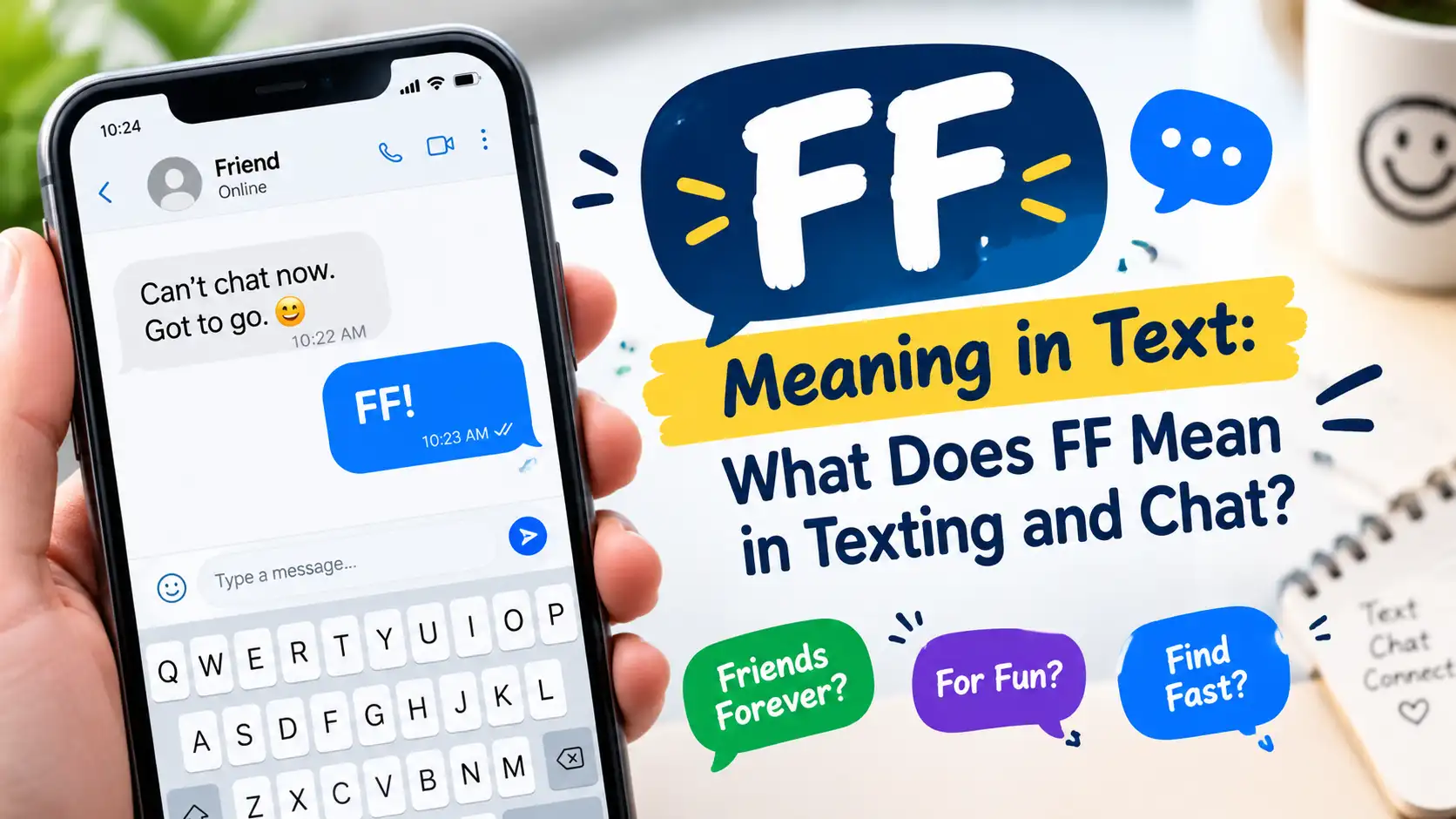
You just got a text that says “FF” and now you’re stuck. What does it mean? Is it good news or bad news?
FF is one of the most flexible short forms in texting. It can mean many things. The meaning changes based on where you see it. A gamer uses it one way. A Twitter user uses it another way. Your friend might use it a third way.
This small term shows up everywhere. You’ll see it in group chats, on Instagram, in online games, and even on dating apps. Knowing what it means saves you from confusion. It also helps you use it the right way yourself.
In this guide, we break down every meaning of FF. We cover its history, its uses, and how to respond when someone sends it to you.
Definition & Meaning
FF stands for a few different things depending on the context. There is no single fixed meaning. Here are the most common ones:
- Friend/Friends Used to call someone a friend or refer to a friend group.
- Forfeit Common in gaming when a team gives up a match.
- Fast Forward Used when talking about skipping ahead in a video or story.
- Following Friday A Twitter tradition where users tag accounts worth following.
- For Fun Used casually when something is done just for enjoyment.
Example texts:
“Hey, we’re going to the mall, you’re my FF so come along!” (Here, FF means friend.)
“This game is over, let’s FF.” (Here, FF means forfeit.)
“Can you FF to the good part of the video?” (Here, FF means fast forward.)
The meaning almost always depends on the platform and the sentence around it. Reading the full message, not just the two letters, is the key to understanding it.
Background & History
FF has roots in old school texting and gaming culture. Back when phones had limited characters per text, people shortened everything. Abbreviations like FF, LOL, and BRB became common because typing was slow on early phone keypads.
In gaming, “FF” as “forfeit” comes from multiplayer games like League of Legends and Dota. When a team knew they couldn’t win, they would type “FF” in chat to end the match early. This usage grew alongside online gaming in the 2000s and 2010s.
On VHS tapes and old media players, “FF” was printed on the fast forward button. This meaning carried over into text and chat naturally, since people were already used to seeing it on remote controls.
“Following Friday” started as a hashtag tradition on Twitter (now X). Users would tag friends or accounts they liked using #FF, encouraging others to follow them too. This was popular around 2009 to 2013.
Today, FF still carries all these meanings. Gaming communities use “forfeit” the most. Casual texters use “friend” often. Social media has moved away from “Following Friday,” but older users may still remember it.
The term has stayed short and simple because it works across many situations. That flexibility is why it never went out of style.
Usage in Various Contexts
Texting
Sam: “Are you coming to the party tonight?” Jess: “Yeah, bringing my FF too, hope that’s okay.”
Here, FF simply means “friend.”
Social Media
Comment: “Shoutout to all my FF’s for the support on this post! 🙌”
Users often use FF to thank their followers or close friends online.
Gaming
Player 1: “We lost two towers already.” Player 2: “Yeah, let’s just FF and go to the next game.”
In competitive games, this is a common way to end a losing match quickly.
Casual Conversation
Friend 1: “Why’d you skip that part of the movie?” Friend 2: “I hit FF, it was boring.”
This usage means “fast forward.”
Streaming and Video Content
Viewers may comment “FF to 5:00” on a video, meaning they want others to fast forward to a specific point.
Context is everything. A single text like “FF” without any other words can be confusing. But once you see the full sentence or the platform it’s used on, the meaning becomes clear almost instantly.
Common Misconceptions & Clarifications
Many people assume FF has just one meaning. This is not true. The biggest misconception is thinking FF always means “forfeit” or always means “friend.” It depends heavily on where the message comes from.
Another mix up happens with “FF” versus “F”. A single “F” alone is often used to “pay respects,” a meme that started from a video game scene. FF is not related to this meme at all, even though it looks similar.
Some people also confuse FF with “FFS,” which stands for “for f***’s sake.” This is a much more casual, sometimes rude expression, and it’s important not to mix the two up. FF alone is generally harmless. FFS carries a frustrated or annoyed tone.
In rare cases, people online use FF as shorthand for “Final Fantasy,” the video game series. If you’re chatting in a gaming forum and someone says “I’m playing FF7 tonight,” they mean Final Fantasy 7, not “forfeit” or “friend.”
Is it ever inappropriate? On its own, FF is not offensive. But like any abbreviation, tone matters. If used sarcastically or paired with negative words, it can come across as dismissive. For example, “just FF through his story, nobody cares” sounds rude because of the surrounding words, not because of FF itself.
When in doubt, ask for clarification. A simple “what do you mean by FF?” clears up any confusion quickly.
Similar Terms & Alternatives
Several other short forms overlap with FF depending on context. Here’s a quick comparison:
| Term | Meaning | Common Platform |
| FF | Friend / Forfeit / Fast Forward | Texting, Gaming, Twitter |
| BFF | Best Friends Forever | Texting, Social Media |
| GG | Good Game | Gaming |
| FR | For Real | Texting, TikTok |
| F | Pay Respects (meme) | Gaming, Memes |
| FYI | For Your Information | Texting, Email |
BFF is the closest cousin to FF’s “friend” meaning, but it’s more specific and emotional. GG is often used alongside FF in gaming, usually right after a match ends. FR is unrelated in meaning but appears in similar casual texting contexts.
Choosing between these terms depends on tone. For a casual and quick tone, FF works well. When you want to highlight a close friendship, BFF is a better choice. In gaming, players often use FF with GG (“FF, GG”) when ending a match respectfully.
How to Respond to This Term
How you respond to “FF” depends on the context and your relationship with the sender.
Casual response:
“Haha okay, see you there!”
Funny response:
“FF? Bold of you to assume I have other friends.”
Professional response (if seen in a work chat, referring to fast forward):
“Sure, I’ll skip ahead in the recording and get back to you.”
Privacy conscious response (if unsure of meaning):
“Just to confirm, what do you mean by FF here?”
In gaming, if a teammate types “FF,” a good response might be:
“Agreed, let’s forfeit and queue up again.”
or, if you disagree:
“Let’s not give up yet, we can still win this.”
Tone matching is important. If someone uses FF casually, match their energy. If it’s used in a serious or professional setting, respond with clarity instead of jokes.
Regional or Cultural Differences
FF is mostly an English language term, but its use spreads globally through gaming and social media. Gamers in Europe, Asia, and North America all commonly use “FF” to mean forfeit, since most competitive games use English commands and chat norms.
In some Asian gaming communities, especially in Southeast Asia, “FF” is also strongly linked to the mobile game Free Fire, a hugely popular battle royale title. In these regions, someone saying “let’s play FF” almost always means the game itself, not “forfeit” or “friend.”
Among Western social media users, particularly those familiar with early Twitter culture, “FF” may still bring to mind “Follow Friday,” although the trend has largely faded.
Younger texting culture across the U.S., U.K., and Australia tends to lean toward “friend” or “for fun” as the most common casual meaning.
There isn’t much variation in spelling or form. FF stays the same across regions, but its meaning shifts based on the dominant online culture in that area.
Comparison with Similar Terms
| Term | Primary Meaning | Tone | Best Used In |
| FF | Friend / Forfeit / Fast Forward | Neutral | Texting, Gaming |
| BFF | Best Friend Forever | Warm | Texting, Social Media |
| GG | Good Game | Respectful | Gaming |
| FR | For Real | Casual | TikTok, Texting |
| IMO | In My Opinion | Neutral | Debates, Discussions |
| NGL | Not Gonna Lie | Honest | Texting, Social Media |
The key difference is that FF changes meaning based on context, while terms like BFF or GG have a fixed, single meaning no matter where you see them. This makes FF more flexible but also more likely to cause confusion for newcomers.
Usage in Online Communities & Dating Apps
On Tinder and other dating apps, “FF” is less common but can appear when someone asks, “Are you looking for FF?” meaning “friends first,” a way of saying they want to build a friendship before anything romantic.
On Twitter/X, older users may still tag friends with #FF, though this trend has faded significantly since the mid 2010s.
In gaming communities like Discord servers, “FF” is used constantly, mostly to mean forfeit. A typical exchange looks like:
Player A: “This match is unwinnable, FF?” Player B: “Yeah, FF. GG everyone.”
Tips for responding appropriately:
- On dating apps, if someone says “FF,” ask them directly what they mean to avoid confusion.
- In gaming, agreeing with “FF” ends the match quickly, so only agree if you’re truly ready to give up.
- On social media, a simple “thanks for the FF!” works fine if someone tags you as a friend.
Understanding the platform helps you respond the right way without any awkward misunderstandings.
Hidden or Offensive Meanings
FF does not have a widely known offensive meaning on its own. However, tone and context can shift how it lands. If used sarcastically, it can sound dismissive, such as “just FF past that boring part,” which can come across as rude if directed at a person’s story or effort.
Some confuse FF with FFS (“for f*’s sake”)**, which does carry a frustrated or vulgar tone. Always check for the extra letter before assuming a negative meaning.
There’s no dark or offensive slang meaning tied specifically to “FF” in mainstream use. It remains one of the more harmless abbreviations in texting culture.
Why context matters: Two people can send the exact same “FF” and mean completely different things. A gamer ending a match, a friend tagging you, and someone asking you to skip a video all use the identical two letters. Reading the full sentence, checking the platform, and knowing your relationship with the sender all help you avoid misreading the tone.
Suitability for Professional Communication
FF is generally not recommended for formal or professional communication, since it can confuse colleagues or clients who aren’t familiar with texting slang.
Instead of FF, professionals should use:
- “Please fast forward to minute 5 in the recording.”
- “I’ll forward this to my colleague/friend for review.”
- “Let’s move forward and skip this section.”
If you’re referring to a coworker as a friend, it’s clearer to simply say “friend” or “colleague” in a work setting. If discussing a recording or video call, spelling out “fast forward” avoids any confusion.
When it might be acceptable: In casual internal team chats, especially among younger or more informal workplace cultures, using FF to mean “fast forward” a meeting recording might be understood. Still, it’s safer to write the full term the first time and let context establish shorthand later.
FAQs
1. What does FF mean in a text message? It most often means “friend,” “forfeit,” or “fast forward,” depending on context.
2. Is FF the same as F in gaming? No. “F” alone is usually a meme meaning “pay respects.” FF means forfeit.
3. What does FF mean on Twitter? It historically stood for “Follow Friday,” a trend where users recommended accounts to follow.
4. Is FF rude or offensive? No, FF is not offensive by itself. Tone and surrounding words determine how it feels.
5. What does FF mean on dating apps? It can mean “friends first,” suggesting the person wants friendship before romance.
6. Can FF mean “Final Fantasy”? Yes, in gaming communities, FF is a common shorthand for the Final Fantasy game series.
7. Should I use FF in professional emails? No, it’s better to spell out the full meaning in formal communication.
Conclusion
FF is a small term with a big range of meanings. It can mean friend, forfeit, fast forward, or even reference a popular video game series. The key to understanding FF is always checking the context, the platform, the conversation, and the people involved.
If you’re gaming with friends, texting a buddy, or scrolling through social media, FF adapts to fit the moment. Now that you know its many meanings, you’ll never be confused by a simple “FF” text again.

Noman Hassan is a content creator and writer focused on text meanings, slang, abbreviations, acronyms, and internet expressions. Through Orvexale.com, he provides clear and simple explanations to help readers understand modern texting language. His goal is to make confusing terms easy to understand with practical examples and everyday context.