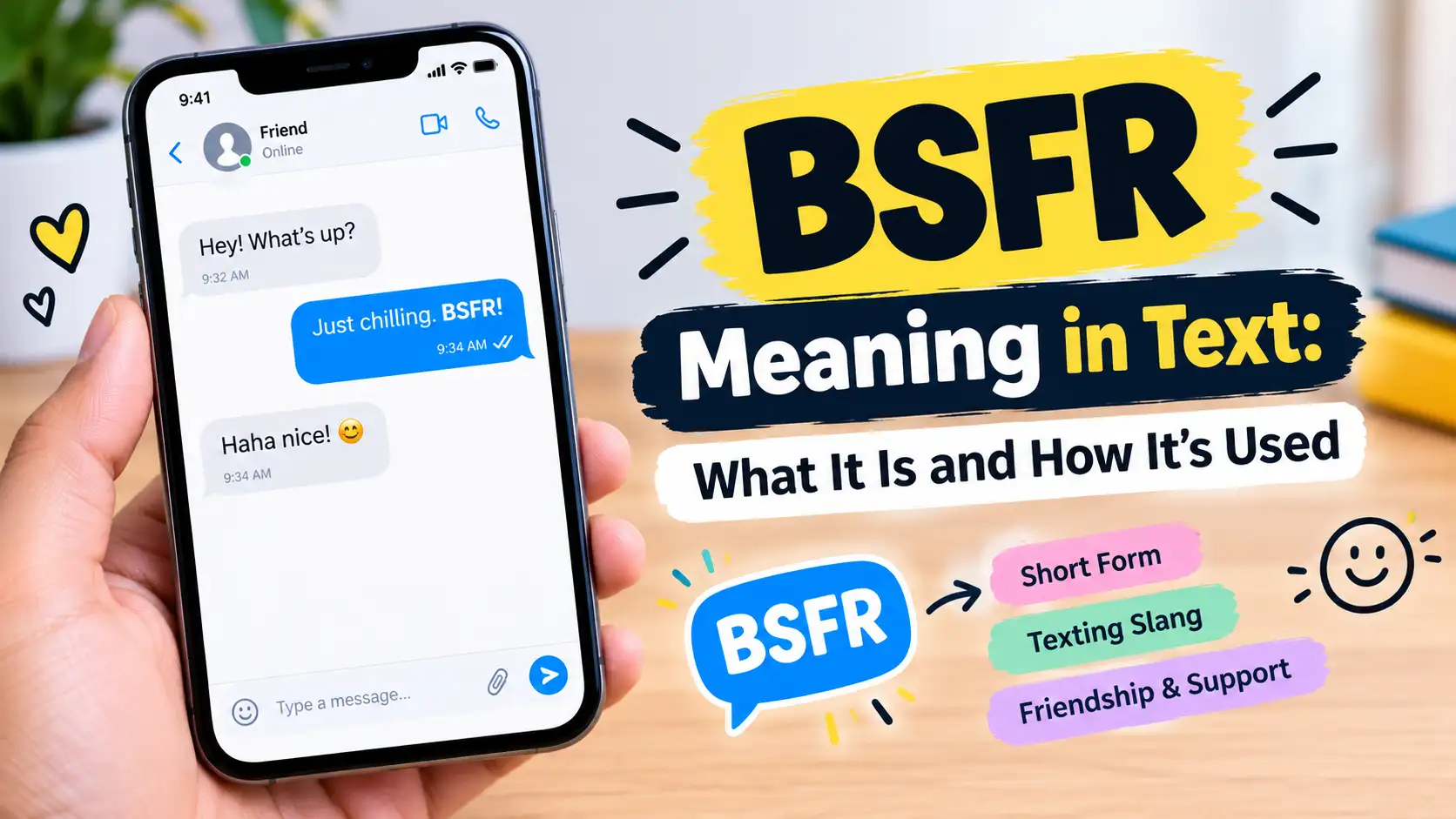
Scroll through TikTok comments or a group chat with Gen Z friends, and you’ll likely run into BSFR. It looks like just another random string of letters, but it carries a sharp, specific tone.
BSFR stands for “Be So Fking Real.”** It’s a blunt way of telling someone to stop exaggerating, stop lying, or just be honest. You’ll see it in texts, comment sections, and casual conversations, especially among younger internet users.
Understanding BSFR matters because tone can be easy to misread in text. It can land as playful teasing between friends, or as a sharp callout, depending on the situation. Knowing what it means, and how to read the tone behind it, helps you avoid confusion and respond the right way.
Definition & Meaning
BSFR means “Be So Fking Real.”** It’s used to call out something that sounds exaggerated, dishonest, delusional, or just hard to believe. It works as a blunt reality check.
Example:
Maya: I only spent like $20 at the mall today
Dana: bsfr, you came back with four bags
Here, Dana isn’t necessarily angry. She’s calling out an obvious exaggeration in a direct, slang heavy way.
Another example, more pointed:
Theo: I totally wasn’t even mad about it
Sam: bsfr, you didn’t text anyone for three days
A softer, joking use:
Comment on a post: “I woke up like this 💅”
Reply: “bsfr 😭 we all saw the 2 hour glow up video”
BSFR usually pairs with a specific claim someone made that doesn’t add up. It’s less about general dishonesty and more about catching a specific exaggeration or unrealistic statement at the moment.
It’s a variation of a slightly older, related term, BFFR (“be f**king for real” or often softened to “be for real”), which carries a similar meaning but with different phrasing. BSFR leans a bit more intense and blunt by comparison.
Tone is everything with this term. Among close friends, it often reads as playful, almost like rolling your eyes at someone lovingly. Between strangers or in a tense exchange, it can come across as a sharp, dismissive jab. The same three letters can feel completely different depending on who’s saying it, and why.
Background & History
BSFR grew out of a broader pattern in online slang: taking an existing phrase and adding profanity for emphasis, then shortening the whole thing into an acronym. “Be for real” and “be so real” already existed as informal phrases before BSFR emerged, used to push back on exaggeration or ask someone to drop an act.
As TikTok and similar platforms became central to how Gen Z communicates, phrases built this way spread fast through comment sections, duets, and captions. BSFR followed the same path as BFFR, another acronym built on “be for real,” gaining traction as a slightly more intense variation.
The term picked up momentum because it fits perfectly into the short, punchy communication style TikTok and Twitter/X reward. A single blunt acronym can land harder than a full sentence, and it signals that the speaker is part of the same online culture as the person they’re talking to.
Today, BSFR is common in comment sections, group chats, and casual conversations among younger internet users, especially Gen Z. It hasn’t fully crossed into older or more general texting culture the way “lol” has, and it likely won’t, given the profanity built into its meaning.
Usage in Various Contexts
In texting between friends:
Priya: he said he “barely” checked his phone all weekend
Wren: bsfr, he posted six stories
In social media comments:
Post: “just a chill, low key weekend 😌”
Comment: “bsfr you were at three different parties 💀”
In gaming chats, often after someone brags or makes an unbelievable claim:
Player1: I could’ve won that round solo easily
Player2: bsfr, you were down to 10 hp
In casual conversation among friends, sometimes used affectionately rather than critically:
Friend: I totally wasn’t stress eating that whole tub of ice cream
You: bsfr 😂 the spoon’s still in your hand
Across these settings, BSFR almost always follows a specific claim that doesn’t match reality. It rarely opens a conversation. It’s a reaction, not a starter.
The tone shifts based on relationship and delivery. Between close friends, it tends to feel like teasing. In a heated exchange or between people who don’t know each other well, it can come across as blunt or confrontational.
Common Misconceptions & Clarifications
The biggest misconception is that BSFR is always aggressive. It usually isn’t. Among friends, it often functions more like an eye roll or a laugh than a genuine confrontation. It says “come on, we both know that’s not true,” more than it says “I’m furious with you.”
That said, context and relationship matter a lot. The same term used harshly, repeatedly, or aimed at someone’s genuine feelings rather than a playful exaggeration can come across as dismissive or even a form of mocking. If someone shares something vulnerable and gets a flat “bsfr” in response, it can feel invalidating rather than funny.
Another common mix up: BSFR is sometimes confused with BSF, an older, unrelated acronym meaning “best friend.” They look similar but mean completely different things. Context makes the difference obvious almost immediately, since BSF usually appears as a label (“she’s my bsf”) while BSFR appears as a reaction to a specific claim.
There’s also confusion between BSFR and its cousin term BFFR. Both push back on exaggeration, but BSFR is generally read as slightly more intense due to its phrasing, even though many people use the two interchangeably.
Because BSFR contains profanity in its full expansion, it isn’t considered appropriate in formal, professional, or mixed generation settings. It’s built for casual peer to peer communication, not for broader audiences.
Similar Terms & Alternatives
| Term | Meaning | Tone |
| BSFR | Be so f**king real | Blunt, calling out exaggeration |
| BFFR | Be f**king for real / be for real | Similar, slightly less intense |
| Fr fr | For real, for real | Casual emphasis on honesty |
| No cap | No lie, seriously | Calling out or confirming honesty |
| Stop lying | Direct callout | Plain, no slang required |
| Be so real right now | Non profanity version | Softer, still direct |
If you want the same blunt honesty without profanity, “be so real right now” or “no cap, that’s not true” carry a very similar meaning and tone, just without the harsher language.
BSFR tends to hit harder than “fr fr” or “no cap,” which lean more toward casual emphasis than direct confrontation of a specific exaggeration.
How to Respond to This Term
If someone sends you a BSFR, how you respond depends on the situation.
Casual reply (if you were exaggerating, no harm done):
“okay fine, you got me 😂”
Funny reply:
“bsfr yourself, you did the same thing last week”
Professional setting:
This term has no place in professional communication. If a similar callout is genuinely needed at work, something like “I think that might be a bit of an overstatement” works far better.
Privacy conscious or neutral reply, if you’d rather not engage with the callout directly:
“haha fair, anyway”
If the tone feels sharper or more serious than playful, it’s okay to check in directly:
“Wait, are you actually annoyed or just messing around?”
This keeps the conversation honest without escalating a moment that might just be lighthearted teasing.
Regional or Cultural Differences
BSFR is primarily an English language, internet driven term, strongly associated with Gen Z slang in the US, though it has spread through TikTok and other platforms to English speaking users in the UK, Canada, Australia, and beyond.
It doesn’t have strong documented regional slang variations tied to specific countries. Instead, its spread has followed platform and generation more than geography wherever TikTok and similar apps have strong Gen Z user bases, BSFR and similar acronyms tend to show up in comment sections and group chats.
Non-English speaking online communities generally have their own local slang for calling out exaggeration or dishonesty, rather than adopting BSFR directly, since the term relies on English profanity and phrasing that doesn’t translate cleanly.
Comparison with Similar Terms
| Term | Contains Profanity | Intensity | Typical Setting |
| BSFR | Yes | High | Comments, group chats |
| BFFR | Sometimes | Moderate high | Comments, group chats |
| Fr fr | No | Low moderate | General casual texting |
| No cap | No | Low moderate | General casual texting |
| Stop lying | No | Direct, plain | Any casual setting |
The clearest distinguishing factor across this group is built in profanity and intensity. BSFR sits at the sharper end, while “fr fr” and “no cap” work as lighter, more universally usable alternatives.
Usage in Online Communities & Dating Apps
On TikTok, BSFR appears constantly in comment sections, especially under posts that seem exaggerated, staged, or too polished to be believable.
Comment: “bsfr this ‘spontaneous’ trip had 4 outfit changes”
On Twitter/X, it shows up in quote tweets and replies, often calling out a claim that doesn’t match other public information or context.
In gaming communities, it’s used similarly to calling out a teammate’s exaggerated claim about their skill or a play that didn’t go the way they described it.
On dating apps like Tinder or Bumble, BSFR can appear once a conversation feels comfortable and casual, usually in response to an obvious exaggeration or a humblebrag.
Match: I never really date, I’m super picky
You: bsfr, your bio has three thirst traps 😭
Tip for responding appropriately: On dating apps, keep it playful rather than pointed, especially early in a conversation. It works best as light teasing, not as a genuine accusation, since tone is easy to misread with someone you don’t know well yet.
Hidden or Offensive Meanings
BSFR doesn’t carry a hidden meaning beyond its direct expansion, but it does contain profanity built directly into its full phrase, which makes it inherently more blunt and less universally appropriate than acronyms like “fr fr” or “no cap.”
The real risk isn’t a secret meaning it’s tone misfire. Because the term is inherently confrontational in structure, it can come across as harsher than intended, especially in text, where tone is already hard to read. What feels like light teasing to the sender can feel like a sharp dismissal to the receiver, particularly if they were being sincere rather than exaggerating.
Context and relationship matter enormously here. Used between close friends who regularly joke this way, it usually lands fine. Used with someone unfamiliar with your sense of humor, or aimed at something someone genuinely cares about, it can come across as invalidating or even a little cruel.
Suitability for Professional Communication
BSFR is not appropriate for professional communication in any form. It contains profanity, relies on internet slang most professional audiences won’t recognize, and carries a confrontational tone that doesn’t fit formal or workplace settings.
Professional alternatives:
- “I think that might be a bit exaggerated.”
- “Can you clarify what actually happened?”
- “That doesn’t quite match what I understood.”
- “Let’s make sure we’re on the same page here.”
Even in casual workplace chats among close coworkers, it’s safer to avoid this term entirely, given both the profanity and the sharp tone it carries.
FAQs
1. What does BSFR mean in text?
It stands for “Be So F**king Real,” used to call out exaggeration or dishonesty.
2. Is BSFR the same as BFFR?
They’re closely related and often used interchangeably, though BSFR is generally read as slightly more intense.
3. Is BSFR rude?
It can be, depending on tone and relationship. Among close friends, it’s usually playful. In sharper exchanges, it can feel confrontational.
4. Can BSFR be used in professional settings?
No. It contains profanity and is far too casual for professional communication.
5. Does BSFR have a hidden or offensive meaning?
No hidden meaning beyond its direct expansion, but its built in profanity makes tone especially important.
6. What’s a non profanity alternative to BSFR?
“Be so real right now” or “no cap, that’s not true” carry a similar meaning without the harsher language.
7. Where did BSFR come from?
It evolved from earlier phrases like “be for real” and “be so real,” gaining traction through TikTok and similar platforms, especially among Gen Z.
Conclusion
BSFR stands for “Be So Fking Real,”** a blunt Gen Z slang term used to call out exaggeration, dishonesty, or unrealistic claims. It’s common in TikTok comments, group chats, and casual conversations among younger internet users, and it carries real intensity due to the profanity built into its meaning.
Tone and relationship decide whether it lands as playful teasing or a sharp callout, so it’s worth reading the full context before responding. It has no place in professional communication, but among friends who already text this way, it’s a quick, familiar way to call out a moment that just doesn’t add up.

Noman Hassan is a content creator and writer focused on text meanings, slang, abbreviations, acronyms, and internet expressions. Through Orvexale.com, he provides clear and simple explanations to help readers understand modern texting language. His goal is to make confusing terms easy to understand with practical examples and everyday context.