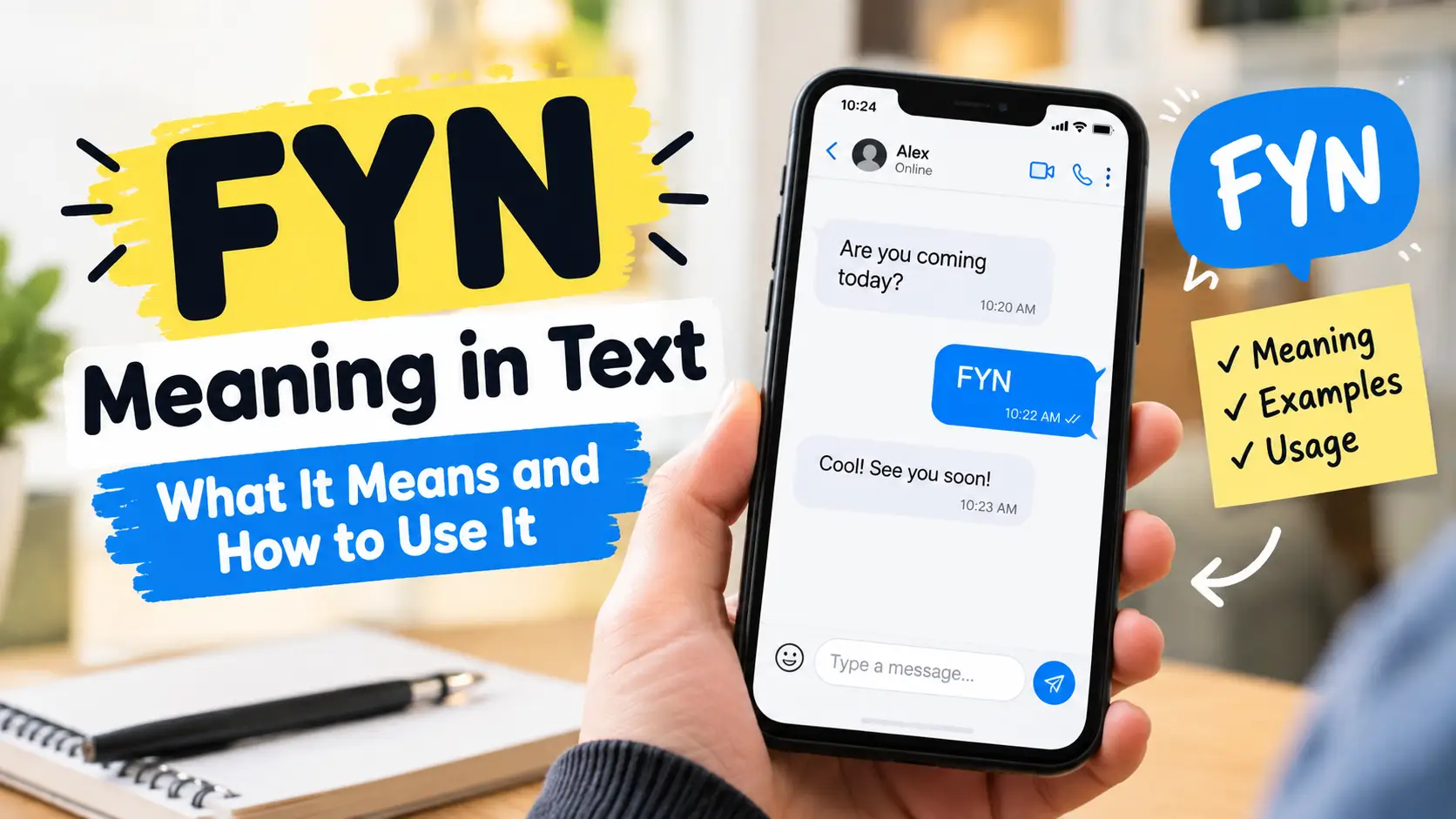
You ask a friend how they’re doing, and they reply with just “fyn.” Not “fine,” not “I’m okay” just those four stylized letters. It might look like a typo at first, but it isn’t.
FYN is a casual, stylized way of spelling “fine,” popping up constantly in texting, TikTok comments, and Instagram captions. It’s part of a much bigger trend of playful, informal respelling that gives ordinary words a different look and feel online.
Understanding FYN matters because, like the word “fine” itself, its real meaning depends almost entirely on tone. A short “fyn” can mean genuine reassurance, mild annoyance, or something else entirely, depending on the conversation around it. This guide breaks down exactly what FYN means, where this kind of stylized spelling comes from, and how to read it correctly.
Definition & Meaning
FYN is a stylized, phonetic spelling of the word “fine.”
It isn’t a hidden acronym standing for a longer phrase, it’s simply a casual, internet style way of writing a word people already say constantly, used the same way “fine” would be used in everyday conversation.
Example:
Friend 1: you okay? you seem quiet today Friend 2: yeah, I’m fyn, just tired
Here, FYN functions exactly like “fine” , a quick reassurance that everything is okay.
Because “fine” itself carries a wide range of possible tones in everyday English, FYN inherits that same flexibility:
- Genuine reassurance “it’s fyn, don’t worry about it.”
- Mild annoyance or dismissiveness a bare “fyn.” with no further explanation, similar to the classic, slightly clipped “fine” that signals someone isn’t actually okay.
- A casual compliment, in some contexts occasionally used to describe someone as attractive or good looking, similar to saying someone looks “fine.”
More real life examples:
Text: it’s fyn, we can reschedule for another day
Comment: you looking fyn in this pic 👀
Group chat: everything’s fyn on my end, don’t worry
A second, separate usage worth noting shows up in some hip hop and Black internet culture spaces, where FYN carries its own cultural association and significance beyond simply representing the word “fine,” tied to language and expression within that specific community.
The short version: in the vast majority of everyday texting, FYN is simply a stylized way of writing “fine,” and reading its actual tone reassuring, annoyed, or complimentary depending on the message around it, just like the original word does.
Background & History
FYN belongs to a long running tradition in texting culture: respelling common, frequently typed words in a more casual, stylized way. This isn’t unique to FYN similar patterns show up in words like “ur” for “your,” “u” for “you,” and “yur” for “your” or “yeah.”
Unlike abbreviations built specifically for typing speed, this kind of stylized respelling is less about saving keystrokes and more about tone and personality. Swapping the standard “i” for a “y” in “fine” gives the word a slightly different visual feel, softer, more casual, and closely tied to how the word actually sounds when spoken quickly or casually.
This kind of playful spelling became especially visible as social media comment culture grew, particularly on platforms like TikTok and Instagram, where quick, expressive replies are the norm and standard spelling often takes a back seat to personality and style. Because “fine” is already one of the most frequently typed words in casual conversation used constantly to check in, reassure, or brush something off, it became a natural candidate for this kind of stylistic respelling.
FYN also carries a separate, culturally specific history within Black American vernacular and hip hop culture, where language and slang often carry deep community significance beyond their surface meaning, and terms can hold cultural weight tied to identity and expression rather than functioning as a simple twist on standard English spelling.
Today, FYN commonly appears in:
- Texting between friends, especially quick check ins or casual replies
- TikTok and Instagram comments, both as a casual reply and as a playful compliment
- Group chats, wrapping up a conversation or reassuring someone
- Community specific spaces, where it carries its own additional cultural context
Usage in Various Contexts
In texting between friends (reassurance):
Friend 1: hope everything’s okay after today Friend 2: yeah, it’s fyn, thanks for checking in
As a slightly clipped, less than genuine response:
Friend 1: you seem off, everything good? Friend 2: fyn.
Here, the short, punctuation-free reply hints that things might not actually be fine, mirroring how a plain “fine.” often works in spoken conversation.
On social media (as a compliment):
Comment: you looking real fyn today 😍
In casual group chats:
Friend 1: sorry if today’s plan felt rushed Friend 2: nah it’s fyn, no worries at all
In gaming or casual online chat:
Teammate: sorry about that last round You: it’s fyn, we’ll get the next one
Across these settings, FYN carries exactly the same range of tone that “fine” always has. A warm, detailed “it’s fyn, don’t worry” reads as genuine. A bare “fyn.” can read as short, flat, or even a little annoyed. In compliment contexts, it shifts entirely toward describing someone’s appearance. The spelling itself doesn’t change the meaning, it just gives the word a more casual, internet native feel.
Common Misconceptions & Clarifications
Misconception 1: FYN is an acronym standing for a hidden phrase. It isn’t. Unlike many texting abbreviations, FYN doesn’t stand for a longer phrase; it’s simply a stylized spelling of the existing word “fine.”
Misconception 2: FYN always means someone is genuinely okay. Not necessarily. Just like the word “fine” itself, a bare “fyn” with no further explanation can sometimes signal mild annoyance or that something isn’t quite right, despite the reassuring surface meaning.
Misconception 3: FYN only means “okay” or “reassured.” In some casual, complimentary contexts, especially in comments reacting to a photo, FYN can describe someone as attractive, similar to saying someone looks “fine.”
Misconception 4: FYN is disrespectful or rude. It isn’t inherently. Its tone depends entirely on context, just like the standard word “fine” does in any spoken or written conversation.
Misconception 5: FYN is a completely new invention with no real history. It’s better understood as part of a long standing pattern of playful internet respelling, applied to an extremely common, everyday word.
Clarification on tone: because FYN is just a stylized version of “fine,” it inherits all of that word’s natural ambiguity. A period after “fyn.” can feel clipped or distant, while “fyn 😊” or “it’s totally fyn!” reads as much warmer and more genuine.
Similar Terms & Alternatives
| Term | Meaning | Typical Use |
| FYN | Fine (stylized spelling) | Reassurance, casual reply, or compliment |
| FINE | Standard spelling | Same range of tone as FYN |
| IM GOOD | I’m okay | Casual reassurance |
| ALLG | All Good | Reassurance, similar tone |
| NP | No Problem | Responding to an apology or thanks |
| FAF | Fine as f*** / Fit as f*** | Stronger, more emphatic compliment |
Examples in use:
Friend: sorry again about earlier You: allg, don’t even worry about it
Text: im good, just a long day
Comment: faf, no cap
These related terms share FYN’s core function: casually expressing reassurance, agreement, or, in some cases, a compliment.
How to Respond to This Term
How you respond to “fyn” depends on the tone it seems to carry.
If it reads as genuine reassurance casual response:
“Okay good, glad to hear it!”
If it reads as a little flat or possibly not okay:
“You sure? I’m here if you want to talk”
If it’s used as a compliment casual response:
“aw thank you! 😊”
Funny response:
“fyn as in okay, or fyn as in 👀 which one is it”
Professional response (rare, but possible in a lightly casual context):
“Glad to hear everything’s okay.”
General tips for responding:
- If “fyn” feels short or clipped, a gentle follow up question often opens the door for someone to share more if they want to.
- If it’s clearly used as a compliment, a simple, appreciative reply fits naturally.
- In professional or unfamiliar settings, standard spelling (“fine”) reads as more polished.
Regional or Cultural Differences
FYN is primarily an English language texting spelling, most visible in casual, youth driven online spaces across English speaking countries like the US, UK, Canada, and Australia.
Because it’s a stylistic variation rather than a fixed abbreviation, its use tends to follow broader internet texting trends rather than any single region’s slang traditions.
As mentioned earlier, FYN also carries specific cultural significance within Black American and hip hop influenced online spaces, where it can carry meaning tied to identity, community, and cultural expression, separate from its more general use as a stylized version of “fine.”
Some additional patterns worth noting:
- Non-English speaking online communities sometimes adopt casual English spellings like FYN directly, especially on international platforms like TikTok, where English internet slang spreads quickly.
- Because FYN isn’t as universally standardized as more established texting shorthand, its recognition can vary depending on someone’s exposure to the specific online spaces where it’s most common.
Comparison with Similar Terms
| Term | Core Meaning | Emotional Tone | Best Used When |
| FYN | Fine | Flexible: reassuring, flat, or complimentary | Casual check ins, compliments |
| ALLG | All good | Warm, reassuring | Responding to apologies or plans |
| IM GOOD | I’m okay | Neutral, reassuring | General well being check ins |
| NP | No problem | Neutral, friendly | Responding to thanks or requests |
| FAF | Fine as f*** | Strong, emphatic | Enthusiastic compliments |
The clearest distinction between FYN and more consistently warm terms like ALLG is tonal range. FYN, like the word “fine” itself, can swing from genuinely reassuring to noticeably flat, while ALLG stays warm and positive in nearly every context.
Usage in Online Communities & Dating Apps
On TikTok and Instagram, FYN appears frequently in comments, both as a casual reply to a caption asking how someone’s doing, and as a playful compliment on a photo.
On Tinder and other dating apps, FYN often shows up in its complimentary sense:
Match: just got back from the gym You: you’re looking fyn in that last pic ngl
Here, it functions as a lighthearted, casual compliment rather than a comment on someone’s well being.
In gaming communities, FYN is less common, though it could occasionally appear as a quick, casual reassurance after a mistake or rough round.
Tips for responding appropriately:
- On dating apps, a “fyn” compliment is generally a friendly, low pressure way to show interest a simple thank you works well in response.
- If “fyn” feels flat or uncertain in a personal conversation, a caring follow up question is often appreciated.
- On social media, FYN comments are usually casual and don’t require an overly detailed response.
Hidden or Offensive Meanings
FYN does not carry any offensive or explicit meaning on its own. As a stylized version of “fine,” it inherits that word’s completely ordinary, everyday use.
A few points are worth understanding about tone and interpretation:
- A flat “fyn.” can mask real feelings, just as “fine” often does in spoken conversation it’s worth paying attention to context rather than taking it at face value every time.
- Its complimentary use is casual, not inherently inappropriate. Describing someone as “fyn” in a photo comment functions similarly to calling them “fine” or “attractive” out loud casual and appreciative, though tone and relationship still matter.
- No hidden negative meaning exists. FYN doesn’t carry any secondary, inappropriate definition beyond what “fine” itself already carries in everyday language.
In short, FYN is considered safe and casual in nearly all contexts, with its main nuance being the same tone reading challenge that comes with the word “fine” in any form.
Suitability for Professional Communication
FYN is not suitable for professional or formal communication. As a stylized, casual spelling, it doesn’t fit the clear, standard language expected in workplace emails or official messages.
Why it doesn’t fit well:
- It replaces standard spelling with an informal variation.
- It can come across as unpolished in a professional context.
- Formal writing benefits from the standard spelling, “fine,” which reads as clear and appropriate in any setting.
Professional alternatives:
| Instead of “fyn” | Use |
| Reassurance | “Everything is fine.” / “That works well for me.” |
| Compliment (avoid in professional settings) | Not applicable in professional writing |
Example rewrite:
Casual: “it’s fyn, we can push the meeting back” Professional: “That’s fine, we can push the meeting back.”
FAQs
1. What does FYN mean in a text message? It’s a casual, stylized spelling of “fine,” used the same way the standard word would be used.
2. Does FYN always mean someone is okay? Not necessarily. Like the word “fine,” a short, plain “fyn” can sometimes hint that something isn’t quite right.
3. Can FYN be used as a compliment? Yes, in some casual contexts, especially on social media, it can describe someone as attractive, similar to saying they look “fine.”
4. Is FYN an acronym for something else? No, it’s not an acronym, it’s simply a stylized spelling of an existing word.
5. Is FYN appropriate to use at work? No, standard spelling (“fine”) is a better choice for professional communication.
6. Does FYN have any cultural significance beyond just “fine”? Yes, it also carries specific meaning within some hip hop and Black internet culture spaces, tied to identity and expression.
7. How do I know if someone’s “fyn” is genuine or not? Look at the surrounding message and punctuation. A warm, detailed reply usually feels sincere, while a bare, clipped “fyn.” might suggest otherwise.
Conclusion
FYN is a casual, stylized way of spelling “fine,” used across texting and social media to reassure, brush something off, or occasionally compliment someone’s appearance. Because it’s simply a playful respelling rather than a hidden acronym, it carries the exact same range of tone as the original word, sometimes genuinely reassuring, sometimes a little flat, depending on context.
It fits naturally into texting, social media comments, and casual online conversation, adding a bit of personality without changing the underlying meaning. In professional or formal writing, though, sticking with the standard spelling remains the clearer, safer choice.

Noman Hassan is a content creator and writer focused on text meanings, slang, abbreviations, acronyms, and internet expressions. Through Orvexale.com, he provides clear and simple explanations to help readers understand modern texting language. His goal is to make confusing terms easy to understand with practical examples and everyday context.