You wrap up a conversation with a friend, and instead of typing “see you later,” you just send “cu!” Two letters, same meaning, way less typing.
CU is one of the oldest and most enduring pieces of internet shorthand still in everyday use. It shows up in texting, Snapchat, gaming chat, and casual DMs, always doing the same simple job: signing off a conversation on a friendly, forward looking note.
Understanding CU matters mostly because of how common it is. You’re bound to run into it constantly once you start texting or chatting online regularly. Knowing exactly what it means, and how its tone can shift slightly depending on punctuation or context, helps you read (and send) it naturally. This guide breaks down exactly what CU stands for, where it came from, and how to use it comfortably in everyday conversation.
Definition & Meaning
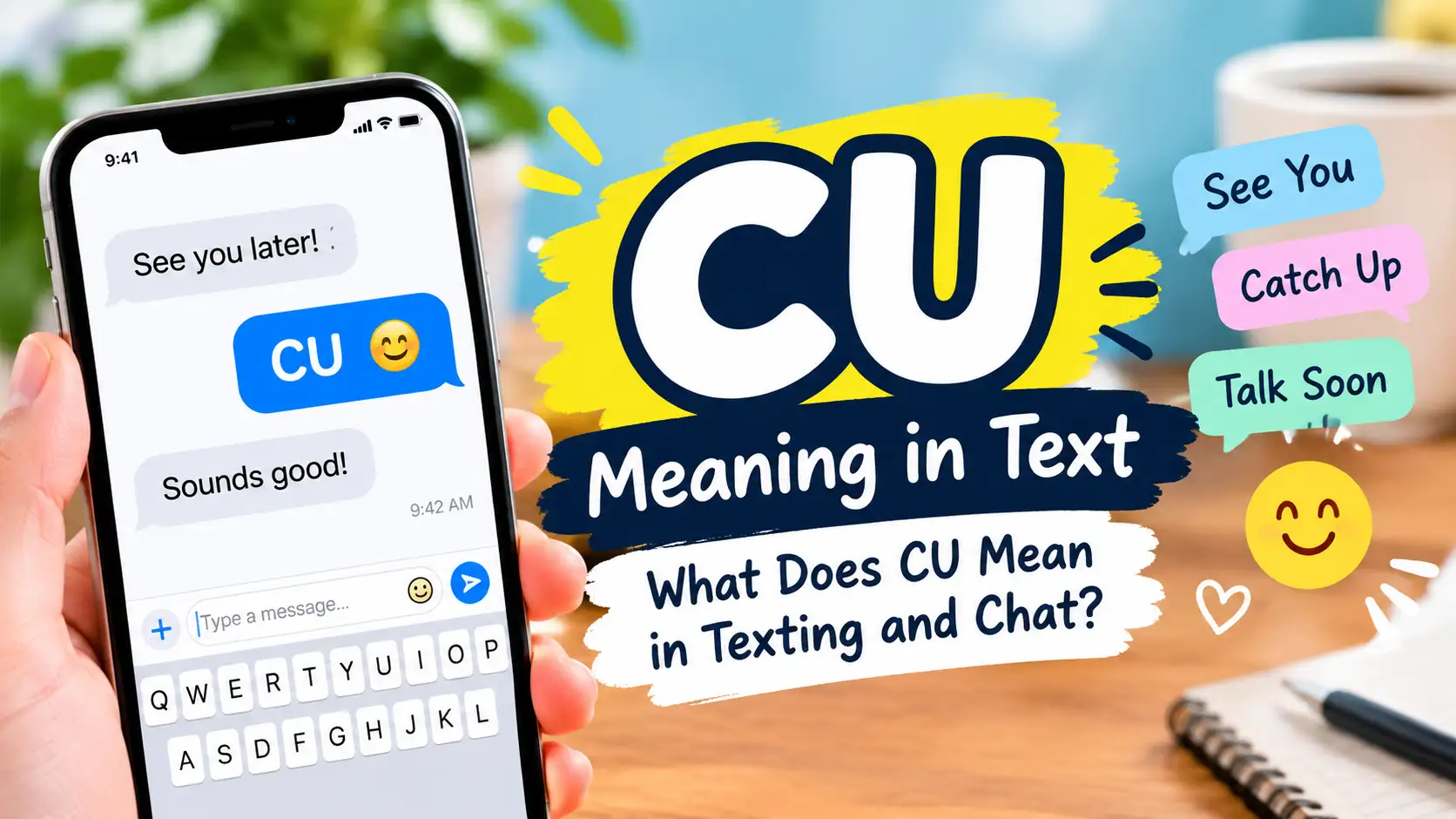
CU stands for “See You.”
It’s a quick, casual way to say goodbye, especially when you expect to talk to or see the person again soon.
Example:
Friend 1: alright, heading out now Friend 2: cu later!
Here, CU works exactly like saying “see you” out loud a friendly, low effort sign off.
Another example:
Person A: I’ve gotta run to class Person B: okay, cu at lunch
CU is a type of wordplay called a gramogram, a letter or short group of letters that sounds out a full word or phrase when read aloud. “C” sounds like “see,” and “U” sounds like “you,” combining to spell out the phrase phonetically rather than as a true acronym.
CU has one dominant, widely recognized meaning in texting and online chat, with little variation:
- “See You” is the standard, near universal meaning across texting, gaming, and social media.
Outside of casual chat, CU also has a few unrelated technical and scientific meanings, though these rarely come up in everyday texting:
- “Copper” is the chemical symbol for the element copper.
- “Control Unit” a component of a computer’s central processing unit.
- “Credit Union” is a type of financial institution.
More real life examples:
Text: cu tomorrow!
Gaming chat: gg everyone, cu next round
Snapchat caption: cu this weekend 🥳
The short version: in nearly all casual texting and online chat, CU simply means “see you” a fast, friendly way to say goodbye while looking forward to the next time you’ll talk or meet up.
Background & History
CU is one of the earliest examples of internet shorthand, with roots stretching back even before modern texting existed. As a gramogram, using letters and numbers to represent full words phonetically was already a playful writing trick used in print and early digital communication.
As early online chat rooms, bulletin board systems, and instant messengers grew popular in the 1980s and 1990s, users looked for fast ways to type common phrases, especially with slower typing speeds and, later, small mobile phone keypads. “See you” was a natural candidate for this kind of phonetic shorthand, since saying goodbye is such a frequent part of everyday conversation.
CU became especially common through early platforms like IRC (Internet Relay Chat) and AOL Instant Messenger, alongside similar phonetic abbreviations like CYA (“see ya”) and later combinations like CUL8R (“see you later”). These terms were among the first widely recognized pieces of internet slang, predating even now famous abbreviations like LOL in some online spaces.
As texting became mainstream through the 2000s, CU carried over naturally, fitting perfectly into a culture that valued short, quick messages, especially on phones with limited character allowances or physical keypads that made typing slower.
Unlike many slang terms that evolve or pick up new meanings over time, CU has remained remarkably stable. It hasn’t shifted in tone or gained unexpected new definitions; it simply continues to serve the same basic function it always has: a quick, friendly way to say goodbye.
Today, CU remains common in:
- Texting between friends and family, especially casual, everyday conversations
- Social media captions and comments, particularly Snapchat and Instagram
- Gaming chat, signing off after a match or session
- Casual group chats, wrapping up a conversation on a friendly note
Usage in Various Contexts
In texting between friends:
Friend 1: alright, I’ll let you get back to it Friend 2: cu later, have a good one!
Here, CU signals a warm, casual goodbye.
On social media:
Caption: heading out, cu this weekend 👋
In gaming chat:
Teammate: good game everyone You: gg, cu next time
In casual group chats:
Friend 1: okay, talk to everyone tomorrow Friend 2: cu all then!
In slightly more personal conversations:
Friend: can’t wait to catch up properly soon You: same here, cu next week for sure
In quick, low effort sign offs:
Text: gtg, cu
Across these settings, CU consistently signals a friendly, casual goodbye with an implied sense that you’ll talk or meet again. Its tone stays warm in almost every context, making it one of the safer, easier abbreviations to use without much risk of being misread.
Common Misconceptions & Clarifications
Misconception 1: CU is a modern abbreviation created for texting. It’s actually one of the oldest pieces of internet shorthand, with roots in early online chat culture long before smartphones existed.
Misconception 2: CU always implies a specific, planned meetup. Not necessarily. It’s often used loosely, without confirming an exact time or place, similar to saying “see you around” rather than confirming firm plans.
Misconception 3: CU is too casual to use with anyone other than close friends. While it is casual, it’s widely understood and generally accepted even among people who aren’t especially close, much like a casual spoken goodbye.
Misconception 4: CU always means the same thing in every context. In casual chat, yes, it almost always means “see you.” Outside of texting, though, CU can occasionally refer to unrelated technical terms like copper or a credit union, though this is rare in everyday conversation.
Misconception 5: CU is only used by younger texters. Because of its long history, CU is actually recognized and used across a wide range of age groups, unlike some newer, more youth specific slang.
Clarification on tone: because CU is so short, small differences in punctuation can shift its feel slightly. “Cu!” or “cu later 😊” reads as warm and friendly, while a plain “cu.” with a period might come across as a little more neutral or brief, depending on the rest of the conversation.
Similar Terms & Alternatives
| Term | Meaning | Typical Use |
| CU | See You | Casual goodbye |
| CYA | See Ya | Slightly more informal variant of CU |
| CUL8R | See You Later | Playful, fuller version combining letters and numbers |
| TTYL | Talk To You Later | Similar sign off, focused on conversation rather than meeting |
| BYE | Goodbye | Simple, direct farewell |
| L8R | Later | Casual, quick goodbye |
| PEACE | Goodbye (casual) | Relaxed, informal farewell |
Examples in use:
Friend: alright, heading to bed You: cya, sleep well!
Friend: talk soon! You: ttyl!
Text: gotta run, l8r!
These related terms all share CU’s core function: wrapping up a conversation in a quick, casual, friendly way.
How to Respond to This Term
Responding to “cu” is usually simple, since it’s a low pressure, friendly sign off.
Casual response:
“cu! have a good one”
Funny response:
“cu, unless I get lost again 😂”
Professional response (if it appears in a casual workplace chat):
“Sounds good, see you then!”
Privacy conscious response (if you’d rather keep things brief):
“See you soon!”
General tips for responding:
- Mirroring the same casual tone back, like “cu too!” or “see you then,” fits naturally in most conversations.
- If CU refers to a specific planned meetup, a quick confirmation of the time or place can help avoid any confusion.
- In professional settings, spelling out “see you” fully feels more polished than using the abbreviation.
Regional or Cultural Differences
CU is an English language abbreviation with deep roots in early internet culture, making it widely recognized across nearly all English speaking regions, including the US, UK, Canada, and Australia.
Because “see you” as a spoken phrase is so universally understood in English, CU translates smoothly across different English speaking communities, with very little regional variation in meaning.
Some related patterns show up in similar sign offs:
- In British slang, “see ya” or “cheers” are common alternatives, sometimes used interchangeably with CU.
- In American slang, “later” or “peace” serve a similar casual, friendly purpose.
- Non English speaking online communities often adopt CU and similar phonetic abbreviations directly, especially in international gaming communities where English remains a common shared language.
Because CU has been around for so long and spread so widely through global online communication, it’s one of the more universally recognized pieces of internet shorthand, with relatively consistent meaning across regions.
Comparison with Similar Terms
| Term | Core Meaning | Emotional Tone | Best Used When |
| CU | See you | Warm, casual | General goodbyes, expecting future contact |
| CYA | See ya | Casual, slightly more relaxed | Informal goodbyes |
| TTYL | Talk to you later | Casual, conversation focused | Ending a chat, not necessarily meeting up |
| CUL8R | See you later | Playful, nostalgic | Casual, especially in older internet culture |
| BYE | Goodbye | Neutral, direct | Simple, straightforward farewells |
The clearest distinction between CU and similar terms is subtle emphasis. CU and CUL8R carry a slight implication of meeting up again, while TTYL focuses more specifically on continuing a conversation rather than necessarily seeing someone in person.
Usage in Online Communities & Dating Apps
On Snapchat and Instagram, CU frequently appears in captions or quick replies, especially when someone is heading out or wrapping up their day.
On Tinder and other dating apps, CU commonly shows up once plans have been made:
Match: looking forward to Saturday! You: same, cu then 😊
Here, it keeps the tone light and casual while confirming enthusiasm about the upcoming plan.
In gaming communities, CU is extremely common in text and voice chat, especially at the end of a match or session:
Teammate: good game, that was close You: gg, cu next time we queue up
Tips for responding appropriately:
- On dating apps, CU works well as a warm, low pressure way to close out a conversation before a planned date.
- In gaming chat, it’s a completely normal, expected way to sign off after playing together.
- On social media, CU fits naturally into quick captions or replies without needing much elaboration.
Hidden or Offensive Meanings
CU does not carry any offensive or explicit hidden meaning in its dominant, everyday usage. It is considered one of the safest, most universally friendly abbreviations in casual digital communication.
A few points are worth understanding about context:
- Its unrelated technical meanings are entirely separate. Uses like “copper” or “credit union” appear in completely different contexts and are extremely unlikely to cause confusion in casual texting.
- No secondary offensive definition exists. CU doesn’t carry any inappropriate meaning in mainstream slang or texting culture.
- Tone depends mostly on punctuation, not the term itself. A bare “cu.” might feel slightly more neutral than “cu!! see you soon,” but neither carries any negative connotation.
In short, CU is completely safe and appropriate for virtually any casual audience or conversation.
Suitability for Professional Communication
CU is generally too casual for formal professional communication, though it may occasionally appear in relaxed workplace chat among close colleagues.
Why it doesn’t fit well in formal writing:
- It reads as too informal for official emails or client communication.
- Spelling out “see you” fully feels more polished and appropriate in professional contexts.
Professional alternatives:
| Instead of “cu” | Use |
| Casual goodbye | “See you soon.” / “Looking forward to our next conversation.” |
| Confirming a meeting | “I’ll see you at [time/place].” |
Example rewrite:
Casual: “cu at the meeting!” Professional: “See you at the meeting.”
In relaxed workplace messaging platforms like Slack or Teams, CU might slip in naturally among colleagues who already communicate casually. For anything client facing or written formally, spelling out “see you” fully remains the safer, more professional choice.
FAQs
1. What does CU mean in a text message? It stands for “See You,” a casual, friendly way to say goodbye.
2. Is CU the same as CYA? They’re very similar, both meaning “see you” or “see ya,” just with slightly different casual spellings.
3. Does CU always mean a planned meetup? Not necessarily. It’s often used loosely, similar to saying “see you around,” without confirming specific plans.
4. Is CU outdated slang? Not really. While it’s one of the oldest pieces of internet shorthand, it remains widely used and understood today.
5. Can I use CU at work? It’s best avoided in formal communication, though it may be fine in casual workplace chat among close colleagues.
6. Does CU have any other meanings? Yes, in unrelated technical contexts, CU can refer to copper (the chemical element), a credit union, or a computer’s control unit, though these rarely come up in casual texting.
7. Is CU appropriate for dating app conversations? Yes, it’s a common, friendly way to close out a conversation, especially after confirming plans.
Conclusion
CU is a simple, long standing abbreviation for “See You,” used to say goodbye in a quick, friendly way. As one of the earliest pieces of internet shorthand, it has remained remarkably consistent in meaning, fitting naturally into texting, social media, and gaming conversations for decades.
It works well across nearly any casual setting, from everyday texting to dating app conversations and gaming chat sign offs. For professional or formal communication, though, spelling out “see you” fully remains the more polished choice.
Now that you know what CU means and where it comes from, you can send it and understand it with confidence the next time it wraps up a conversation.

Noman Hassan is a content creator and writer focused on text meanings, slang, abbreviations, acronyms, and internet expressions. Through Orvexale.com, he provides clear and simple explanations to help readers understand modern texting language. His goal is to make confusing terms easy to understand with practical examples and everyday context.