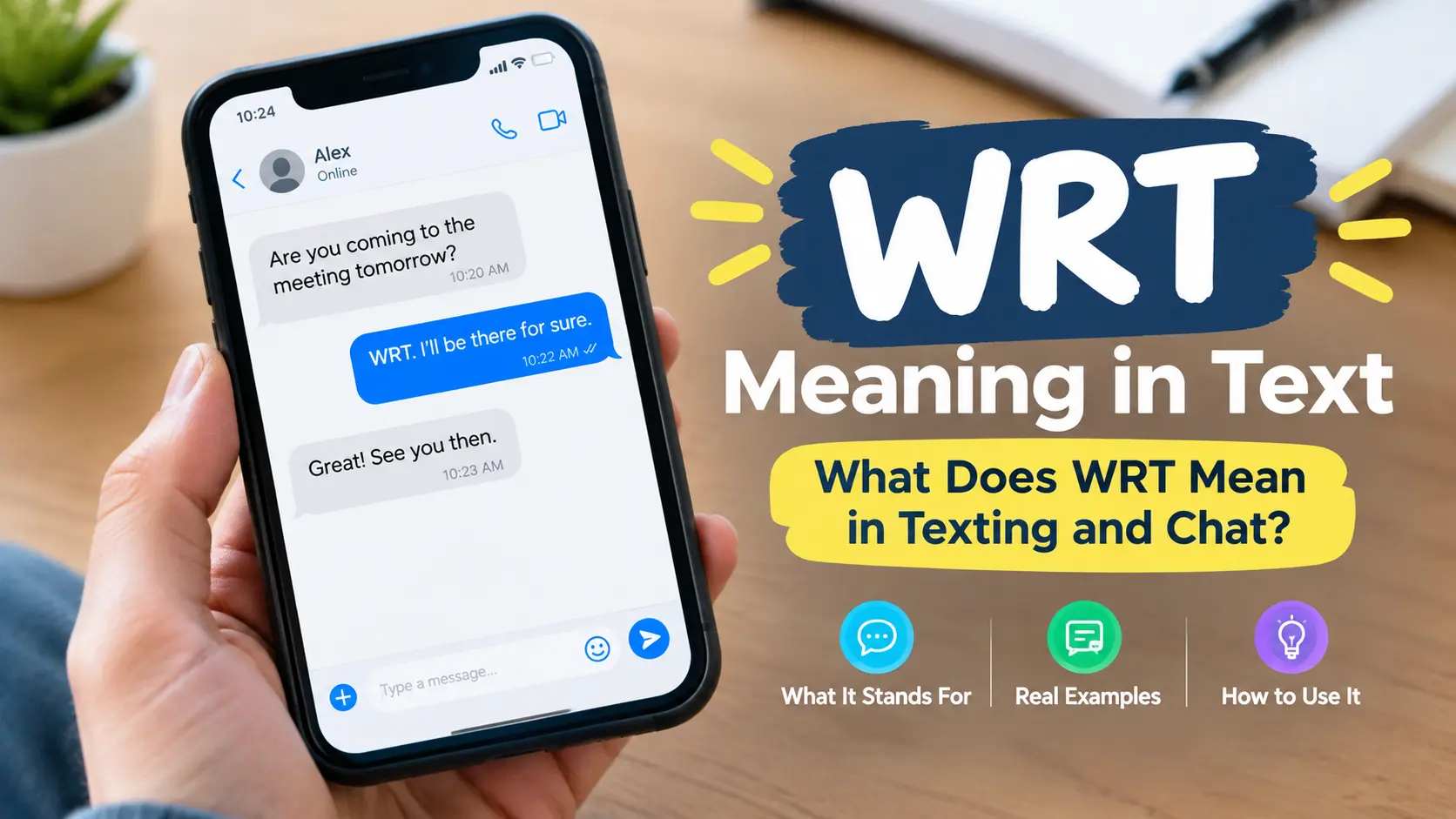
You get a message that says, “quick question wrt the schedule for tomorrow.” It looks a little formal for a text, almost like something out of an email. That’s because it kind of is.
WRT is one of those abbreviations that started in more formal, written communication and eventually made its way into everyday texting and online chat. It shows up in group messages, work adjacent conversations, forums, and even casual social media replies, always doing the same simple job: pointing to exactly what topic someone is talking about.
Understanding WRT matters because it’s a genuinely useful, practical piece of shorthand not primarily about humor or personality, but about clarity. Knowing what it means, and how to use it naturally, helps you follow conversations more easily and communicate your own point more efficiently. This guide breaks down exactly what WRT stands for, where it came from, and how to use it across different settings.
Definition & Meaning
WRT stands for “With Regard To” (and, less commonly, “With Respect To”).
It’s used to introduce or refer back to a specific topic, letting the reader know exactly what subject a message is about.
Example:
Text: just checking in wrt the plans for Saturday
Here, WRT clearly signals that the message is specifically about the Saturday plans, not something else.
Another example:
Coworker: Hey, wrt the report, do you have an update?
In this case, WRT immediately tells the reader which topic the question relates to.
WRT has a very consistent, stable meaning. Unlike many abbreviations with multiple competing definitions, it doesn’t vary much across different platforms or communities:
- “With Regard To” the dominant, most widely recognized meaning.
- “With Respect To” a closely related, nearly identical alternate expansion, used the exact same way.
Both versions serve the same basic function: pointing directly to a specific subject.
More real life examples:
Text: wrt dinner tonight, are we still doing 7pm?
Forum comment: wrt your earlier question, I think the answer is yes
Group chat: just following up wrt the trip itinerary
The short version: WRT is a quick, functional way to introduce or reference a topic clearly, similar to saying “regarding” or “about” at the start of a sentence.
Background & History
WRT has its roots in more formal written English. The full phrases “with regard to” and “with respect to” have long been standard in business writing, academic papers, legal documents, and professional correspondence, used to introduce or clarify a specific topic within a larger conversation or document.
As email became a dominant form of communication in the 1990s, and later as internet chat rooms and instant messaging grew, users looked for ways to speed up typing common professional phrases. WRT emerged as a natural shorthand for this formal expression, allowing people to keep the same clear, topic introducing function while typing faster.
This abbreviation followed a slightly different path than more purely casual internet slang like LOL or BRB. Rather than growing out of spoken, informal language, WRT developed specifically from written, often professional or academic phrasing, which is part of why it still feels a little more formal than many other texting abbreviations, even in casual use.
As texting, forums, and social media became more central to everyday communication, WRT carried over naturally into these spaces, especially in conversations that needed some structure or clarity discussing plans, referencing previous points in a conversation, or asking follow up questions about a specific topic.
Today, WRT remains especially common in:
- Texting and messaging apps, when referencing a specific topic or plan
- Work adjacent casual chat, following up on tasks or projects
- Online forums and comment sections, referring back to an earlier point in a discussion
- Emails and semi formal written communication, where it sometimes appears even in slightly more professional contexts
Its meaning has remained remarkably stable since it first became common. Unlike many slang terms, WRT hasn’t picked up new or shifting definitions; it continues to function exactly as it always has, as a clear, efficient way to point to a topic.
Usage in Various Contexts
In texting between friends:
Friend 1: wrt the trip, should we book the hotel soon? Friend 2: yeah, let’s lock it in this week
Here, WRT keeps the conversation focused and clear.
On social media or forums:
Comment: wrt your point about the ending, I actually disagree
In gaming chat:
Teammate: wrt strategy, should we push top or bottom? You: let’s go top, we have the advantage there
In casual group chats:
Friend 1: wrt dinner, does everyone still want sushi? Friend 2: yes please
In work adjacent casual messaging:
Coworker: quick note wrt the deadline, we might need an extra day You: noted, I’ll adjust the schedule
In more formal or semi formal written messages:
Email style text: wrt our earlier conversation, I’ve attached the updated file
Across these settings, WRT consistently serves the same clear function: pointing directly to a specific topic so the reader immediately understands what the message is about. Its tone stays fairly neutral and practical, fitting comfortably into both casual and slightly more formal conversations.
Common Misconceptions & Clarifications
Misconception 1: WRT is purely casual internet slang. While it’s commonly used in casual texting, WRT actually has roots in formal written English, making it slightly more versatile than typical slang abbreviations.
Misconception 2: WRT has multiple, very different meanings. Unlike many abbreviations, WRT stays fairly consistent. Both of its common expansions “with regard to” and “with respect to” mean essentially the same thing.
Misconception 3: WRT is rude or overly blunt. It isn’t. It’s a neutral, functional phrase used to clarify a topic, not to express any particular emotion or judgment.
Misconception 4: WRT can only be used in professional settings. It works comfortably in both casual and semi formal contexts, making it more flexible than some purely workplace specific terms.
Misconception 5: WRT is a newer piece of slang. Its origins trace back to standard written English long before texting existed, making it more established and longer standing than many trend driven abbreviations.
Clarification on tone: because WRT comes from more formal writing, it can occasionally feel slightly stiff or businesslike if used excessively in casual conversation. Using it sparingly, especially when actually referencing a specific topic, keeps it feeling natural rather than overly formal.
Similar Terms & Alternatives
| Term | Meaning | Typical Use |
| WRT | With Regard To / With Respect To | Introducing or referencing a specific topic |
| RE | Regarding | Common in email subject lines and replies |
| AS REGARDS | Regarding | Slightly more formal, full phrase alternative |
| ABOUT | Concerning | Casual, everyday alternative |
| IN REGARD TO | Regarding | Full, unabbreviated version of WRT |
| CONCERNING | Regarding | Formal alternative, common in writing |
Examples in use:
Email: RE: your question about the schedule
Text: just checking in about the trip plans
Formal letter: as regards your recent inquiry…
These related terms all serve a similar purpose to WRT: clearly pointing to a specific topic within a larger conversation or message.
How to Respond to This Term
Responding to “wrt” is usually straightforward, since it simply introduces a topic rather than requiring a specific type of reply.
Casual response:
“oh yeah, that should be fine!”
Funny response:
“wrt that? absolutely not happening 😂”
Professional response:
“Thanks for flagging that I’ll follow up shortly.”
Privacy conscious response (if you’d rather not go into detail):
“Good question, let’s discuss that separately.”
General tips for responding:
- Address the specific topic WRT points to directly, since that’s the whole purpose of the abbreviation.
- In professional or semi formal settings, responding with clear, complete sentences fits the tone naturally.
- If the topic isn’t clear, it’s fine to ask for clarification: “wrt what exactly, just to make sure I’m following!”
Regional or Cultural Differences
WRT is an English language abbreviation with roots in formal written English, which is used consistently across English speaking countries, including the US, UK, Canada, and Australia, particularly in professional, academic, and technical writing.
Because it originated from standard written phrases rather than regional slang, WRT doesn’t carry strong regional variation in meaning. Its use tends to depend more on writing style and context, casual versus professional than on geography.
Some related patterns show up in similar terms:
- In British professional writing, “with reference to” is a common formal alternative, often used in official letters and documents.
- In American business writing, “regarding” or its abbreviation “RE” are frequently used interchangeably with WRT.
- In academic and technical fields internationally, WRT is commonly used in written papers, discussions, and online forums, regardless of the writer’s specific country or region.
Because WRT is tied closely to formal writing conventions rather than internet culture specifically, its recognition tends to be fairly consistent among people familiar with professional or academic writing styles, more so than among casual texters unfamiliar with that background.
Comparison with Similar Terms
| Term | Core Meaning | Tone | Best Used When |
| WRT | With regard to | Neutral, functional | Referencing a specific topic in texting or writing |
| RE | Regarding | Neutral, slightly formal | Email subject lines, quick references |
| ABOUT | Concerning | Casual, everyday | General conversation |
| CONCERNING | Regarding | Formal | Professional or academic writing |
| AS REGARDS | Regarding | Formal | Official letters, formal documents |
The clearest distinction between WRT and more casual alternatives like “about” is tone. WRT carries a slightly more structured, precise feel, closer to formal writing, while “about” feels more relaxed and conversational, even though both serve a similar function.
Usage in Online Communities & Dating Apps
On Twitter/X and online forums like Reddit, WRT frequently appears in replies referencing a specific point made earlier in a discussion, especially in more detailed or technical conversations.
On Tinder and other dating apps, WRT is less common than more casual abbreviations, though it can occasionally appear when discussing logistics:
Match: wrt Saturday, does 6pm work for you? You: yep, 6 works perfectly
Here, it functions simply as a clear, efficient way to reference the specific plan being discussed.
In gaming communities, WRT sometimes appears in strategy discussions or forum posts, referencing a specific aspect of gameplay:
Forum comment: wrt the new update, has anyone tested the balance changes yet?
Tips for responding appropriately:
- On dating apps, WRT works fine for logistics focused messages, though more casual phrasing might feel slightly warmer in flirtier conversations.
- In forums and online communities, WRT is a normal, expected way to reference specific points in ongoing discussions.
- In gaming communities, it’s commonly used in more detailed, strategy focused conversations rather than fast paced in game chat.
Hidden or Offensive Meanings
WRT does not carry any offensive or explicit hidden meaning. It is a neutral, functional abbreviation with no ties to inappropriate or aggressive language.
A few points are worth understanding about tone and context:
- It’s inherently neutral and precise. Because it comes from formal written English, WRT doesn’t carry emotional weight in the way some slang simply introduces a topic.
- Overuse can feel slightly stiff. While not offensive, using WRT too often in casual conversation might come across as a bit formal or businesslike for the setting.
- No secondary, inappropriate meaning exists. WRT remains safe and appropriate across nearly all contexts, casual or professional.
In short, WRT is considered entirely safe and appropriate, with its only real consideration being tone matching its slightly formal feel to the right kind of conversation.
Suitability for Professional Communication
WRT is one of the few abbreviations that works reasonably well in both casual and professional communication, though it’s most naturally suited to semi formal or professional contexts rather than deeply formal writing.
Where it works well:
- Casual workplace messaging, like Slack or Teams, when referencing a specific topic or task.
- Semi formal emails between colleagues who already communicate somewhat informally.
Where it’s still better to spell it out fully:
- Formal client communication, official reports, or any document requiring a polished, professional tone.
Professional alternatives:
| Instead of “wrt” | Use |
| Referencing a specific topic | “With regard to…” / “Regarding…” / “In reference to…” |
Example rewrite:
Casual: “wrt the budget, can we revisit the numbers?” Professional: “With regard to the budget, could we revisit the numbers?”
In many workplace chat platforms, WRT is actually considered acceptable shorthand, even in fairly professional contexts, precisely because of its formal origins. For the most polished, client facing writing, though, spelling out the full phrase remains the safer choice.
FAQs
1. What does WRT mean in a text message? It stands for “With Regard To,” used to introduce or reference a specific topic in a conversation.
2. Does WRT have another meaning? Yes, it can also stand for “With Respect To,” which means essentially the same thing and is used the same way.
3. Is WRT considered slang or formal language? It’s a bit of both. WRT originated from formal written English but is now commonly used in casual texting and online chat as well.
4. Is WRT rude or blunt to use? No, it’s a neutral, functional term used simply to clarify what topic a message is about.
5. Can I use WRT in professional emails? It can work in casual or semi formal workplace messaging, but for polished, client facing communication, spelling out “with regard to” fully is generally safer.
6. Is WRT understood outside English speaking countries? It’s most commonly recognized in English speaking professional, academic, and online communities, tied closely to formal English writing conventions.
7. Is WRT the same as “RE” in emails? They’re similar in function, both used to reference a topic, though WRT is more commonly used within the body of a message, while RE typically appears in email subject lines.
Conclusion
WRT is a practical, clear abbreviation that stands for “With Regard To” (or occasionally “With Respect To”), used to introduce or reference a specific topic in a conversation. Unlike more purely playful internet slang, it grew out of formal written English, giving it a slightly more structured, precise feel even in casual use.
It fits naturally into texting, casual workplace chat, forums, and even dating app logistics, thanks to its clear, functional purpose. While it can work in semi formal professional communication, spelling out the full phrase remains the better choice for polished, client facing writing.

Asfan Wahab is a content creator and writer focused on text meanings, slang, abbreviations, acronyms, and internet expressions. Through Orvexale.com, he provides clear and simple explanations to help readers understand modern texting language. His goal is to make confusing terms easy to understand with practical examples and everyday context.