A friend texts you the address for tonight’s plans, and you reply with a quick “syt!” No long explanation needed, just a fast, friendly confirmation that you’ll be there.
SYT is a small, practical abbreviation that shows up in texting and group chats whenever people are finalizing plans. It’s not flashy or trendy in the way some slang is, but it does a genuinely useful job: confirming a meetup in the fewest possible keystrokes.
Understanding SYT matters because it’s one of those quiet, functional pieces of texting shorthand that keeps everyday plans moving smoothly. Knowing what it means, and how to use it naturally, helps you confirm plans quickly without any confusion. This guide breaks down exactly what SYT stands for, where it came from, and how to use it in your own conversations.
Definition & Meaning
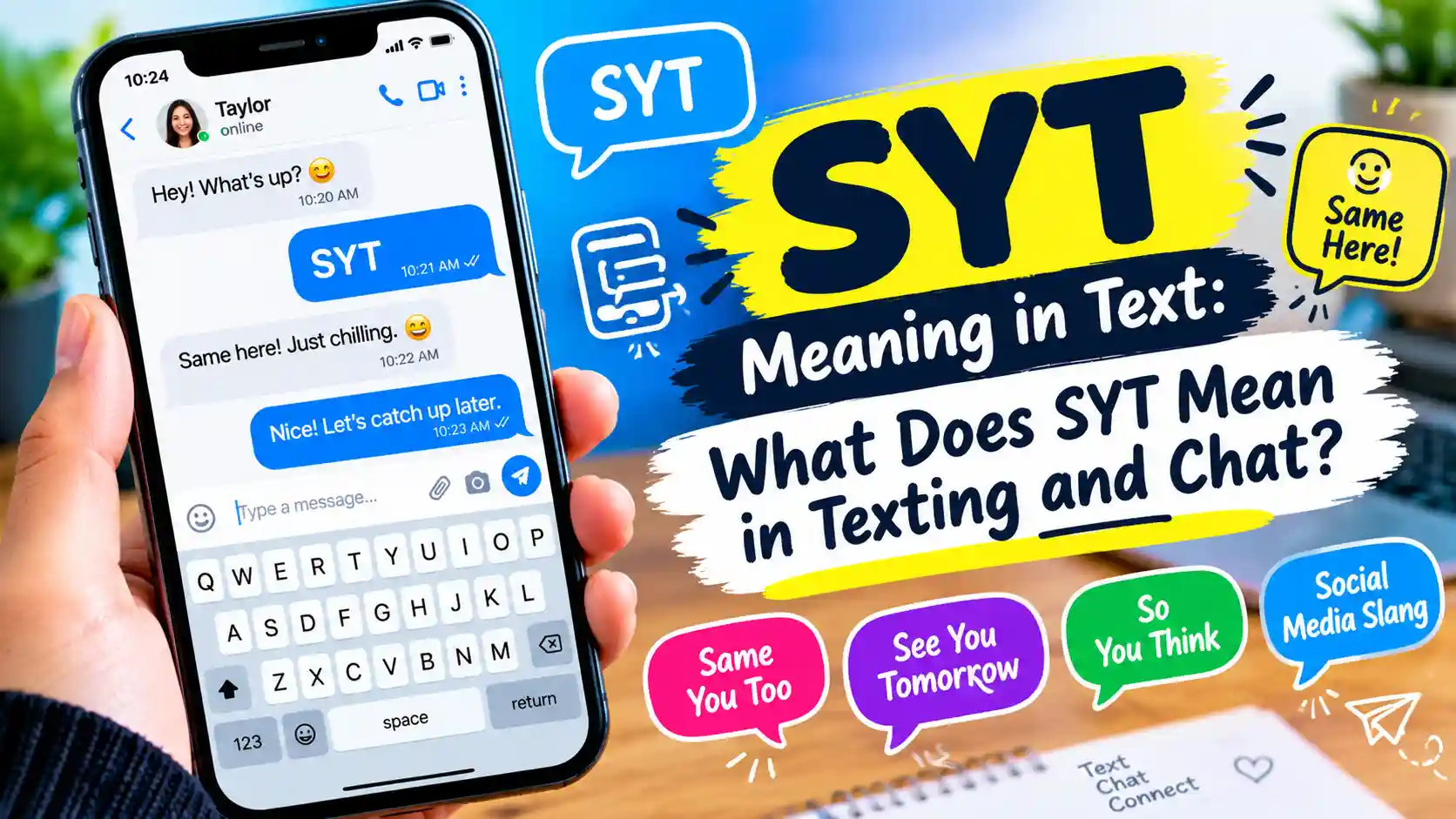
SYT most commonly stands for “See You There.”
It’s used to confirm that you’ll be meeting someone at an already agreed upon place or event, without needing to repeat the details.
Example:
Friend 1: don’t forget, dinner’s at 7 at the usual spot Friend 2: syt!
Here, SYT simply confirms the plan is set, without needing any further discussion.
Another example:
Person A: the concert starts at 8, doors open at 7:30 Person B: got it, syt
SYT works well specifically because it assumes shared context. Both people already know where “there” refers to, so the abbreviation doesn’t need to spell it out.
More real life examples:
Group chat: meeting at the park entrance at noon Reply: syt, see everyone soon!
Text: same coffee shop as last time? Reply: yep, syt
Friend: don’t be late this time 😂 You: no promises, but syt
A less common, older meaning also exists:
- “Sweet Young Thing” an older, somewhat dated slang phrase used to describe an attractive younger person, occasionally shortened to SYT. This usage predates modern texting and is far less common in everyday digital conversation today.
Context makes the difference clear. In everyday texting about plans, SYT almost always means “see you there.” The older “sweet young thing” usage is comparatively rare and typically appears in older slang references rather than casual modern texting.
The short version: SYT is a quick, practical way to confirm a meetup, letting the other person know you’re on board without needing to repeat any details.
Background & History
SYT as “see you there” grew out of the same practical need that shaped countless other texting abbreviations: confirming plans quickly, especially when typing on early mobile phones with small keypads.
As texting became a primary way people coordinated meetups through the 2000s and 2010s, short confirmation phrases became especially useful. “See you there” was a natural candidate for abbreviation, since it’s such a commonly used phrase whenever people finalize logistics whether that’s a dinner reservation, a concert, a study session, or a casual hangout.
This fits into a broader category of confirmation based texting shorthand, alongside similar abbreviations like CU (“see you”) and OMW (“on my way”). These terms all share the same underlying purpose: quickly wrapping up a logistical conversation so both people can move on without extra back and forth.
The older meaning of SYT, “Sweet Young Thing,” has a separate and much older history, tracing back to slang used well before texting existed, sometimes appearing in music, film, or casual conversation to describe an attractive younger person. This usage is largely disconnected from the modern texting meaning and shows up far less frequently in everyday digital communication today, mostly surviving as an older cultural reference rather than active slang.
Today, SYT (in its dominant, modern sense) remains most common in:
- Texting between friends and family, confirming meetup plans
- Group chats, wrapping up logistics for events or hangouts
- Casual social planning, especially for informal gatherings
- Quick replies on social media or messaging apps, confirming attendance
Its core meaning as a confirmation phrase has stayed consistent over time, functioning today exactly as it always has a fast, no fuss way to lock in a meetup.
Usage in Various Contexts
In texting between friends:
Friend 1: same time and place as last week? Friend 2: yep, syt
Here, SYT quickly confirms plans without needing to repeat any details.
In group chats:
1st Friend: Everyone meeting at the entrance at 6? Friend 2: syt! Friend 3: syt, see you all then
In casual event planning:
Text: don’t forget, the show starts at 8 Reply: syt, can’t wait
In more spontaneous plans:
Friend: heading to the café now if you want to join You: omw, syt in 10
In slightly more formal casual settings (like coordinating with acquaintances):
Text: the meetup is at the community center this Saturday Reply: sounds good, syt
Across these settings, SYT consistently functions as a quick, friendly confirmation. It works best when both people already understand the plan clearly, since the abbreviation itself doesn’t provide any new details it simply signals agreement and anticipation.
Common Misconceptions & Clarifications
Misconception 1: SYT always refers to “Sweet Young Thing.” This is a much older, less common usage. In modern day texting, SYT overwhelmingly means “see you there.”
Misconception 2: SYT is the same as “CU” or “see you.” They’re closely related, but SYT specifically confirms attendance at an already established location, while a plain “see you” or “CU” can apply more generally, without necessarily confirming a specific plan.
Misconception 3: SYT needs extra explanation to make sense. It usually doesn’t. Because SYT relies on already shared context (a plan that’s already been discussed), it works well as a short, standalone confirmation.
Misconception 4: SYT is only used by younger texters. While it’s common in casual, everyday texting, this kind of simple confirmation abbreviation is understood and used across a fairly wide range of age groups, since the phrase “see you there” itself is universally familiar.
Misconception 5: SYT can replace giving actual event details. It can’t. SYT works as a confirmation after plans have already been shared, not as a way to introduce plans in the first place.
Clarification on context: because SYT depends on shared understanding, it works best in ongoing conversations where the plan has already been mentioned. Using it without any prior context could understandably cause some confusion, since the abbreviation alone doesn’t specify what “there” refers to.
Similar Terms & Alternatives
| Term | Meaning | Typical Use |
| SYT | See You There | Confirming an already planned meetup |
| CU | See You | General, casual sign off |
| OMW | On My Way | Indicating you’re currently heading somewhere |
| BRT | Be Right There | Indicating you’ll arrive shortly |
| CYA | See You (informal, phonetic) | Similar to CU, casual farewell |
| CONFIRMED | Explicit confirmation | Clear, unambiguous plan confirmation |
Examples in use:
Friend: heading out now You: omw too, brt
Friend: alright, talk later! You: cya!
Text: are we still on for tonight? Reply: confirmed, see you at 7
These related terms all serve a similar practical purpose to SYT: quickly wrapping up logistics or confirming plans in casual conversation.
How to Respond to This Term
Responding to “syt” is usually simple, since it’s mainly a confirmation rather than something requiring a detailed reply.
Casual response:
“sounds good, see you soon!”
Funny response:
“syt, don’t be late this time 😂”
Professional response (if it appears in a casual workplace planning chat):
“Great, I’ll see you there.”
Privacy conscious response (if you’d rather keep plans low key):
“Perfect, see you then.”
General tips for responding:
- A short, friendly confirmation back is usually all that’s needed, since SYT already signals agreement.
- If any details are still unclear, it’s a good moment to double check (“syt, what time again?”) rather than assuming everyone has the same information.
- In professional or slightly more formal casual settings, spelling out “see you there” fully can feel a bit more polished.
Regional or Cultural Differences
SYT is an English language texting abbreviation, and because “see you there” is such a common, universally understood phrase, SYT translates easily across English speaking regions, including the US, UK, Canada, and Australia.
Because it functions purely as a practical confirmation phrase rather than a culturally specific slang term, SYT doesn’t carry strong regional variation in meaning. Its use tends to depend more on individual texting habits than on geography.
Some related patterns show up in similar phrases:
- In British texting culture, people might just as commonly say “see you then” or “catch you there” instead of using the abbreviation.
- In American slang, “see ya there” is a common spoken equivalent, often typed out fully rather than abbreviated.
- Non-English speaking online communities may adopt similar short confirmation phrases in their own language, though the exact English abbreviation SYT is less commonly borrowed compared to more universal terms like OMG or LOL.
Because SYT is functional rather than trend driven, its use tends to be steady rather than tied to any particular viral moment or region specific slang wave.
Comparison with Similar Terms
| Term | Core Meaning | Emotional Tone | Best Used When |
| SYT | See you there | Friendly, confirming | Confirming an already planned meetup |
| CU | See you | Casual, general | General sign offs, not plan specific |
| OMW | On my way | Active, in progress | Indicating current movement toward a location |
| BRT | Be right there | Reassuring | Letting someone know you’ll arrive soon |
| CONFIRMED | Explicit agreement | Clear, direct | Formally locking in a plan |
The clearest distinction between SYT and similar terms is timing and specificity. SYT confirms a future meetup at an already known location, while OMW and BRT describe your current status in getting there. CU is more general and doesn’t necessarily confirm a specific plan at all.
Usage in Online Communities & Dating Apps
On Twitter/X and Instagram, SYT occasionally appears in replies or DMs confirming attendance at an event, meetup, or gathering mentioned in a post.
On Tinder and other dating apps, SYT commonly shows up once a date has been arranged:
Match: how about that coffee shop downtown at 5? You: sounds great, syt
Here, it works as a simple, friendly way to confirm the date without over explaining.
In gaming communities, SYT is less common in its “see you there” sense, since gaming coordination often relies on other terms specific to lobbies or servers, though it could occasionally apply to real world meetups organized through gaming friend groups, like conventions or tournaments.
Tips for responding appropriately:
- On dating apps, SYT is a low pressure, friendly way to confirm plans without needing extra reassurance.
- In general social planning, using SYT signals reliability and keeps the conversation efficient.
- If there’s any doubt about the details, it’s always fine to briefly confirm the specifics rather than relying on SYT alone.
Hidden or Offensive Meanings
In its dominant modern usage, SYT does not carry any offensive or explicit meaning. As a simple confirmation phrase, it’s considered entirely neutral and functional.
A few points are worth understanding about its less common alternate meaning:
- The older “Sweet Young Thing” usage is dated and can be viewed as objectifying, since it reduces a person to their appearance and age. This meaning is rarely used in modern casual texting and appears far more often in older cultural or musical references than in everyday digital conversation.
- Context easily distinguishes the two meanings. A texting conversation about plans will use SYT as “see you there,” while the older phrase would typically appear in a very different, more descriptive context, if it appears at all today.
- No other hidden or inappropriate meaning is associated with SYT.
In short, SYT is considered safe, practical, and appropriate for nearly all casual texting situations in its modern, dominant sense.
Suitability for Professional Communication
SYT is generally too casual for formal professional communication, though its underlying purpose of confirming plans is perfectly appropriate in a workplace context when spelled out fully.
Why it doesn’t fit well as an abbreviation:
- It relies on the reader already understanding casual texting shorthand.
- Professional communication benefits from spelling out confirmations clearly, especially for meetings or events.
Professional alternatives:
| Instead of “syt” | Use |
| Confirming a meetup | “I’ll see you there.” / “Looking forward to it.” |
| Confirming a meeting | “Confirmed, I’ll be there at [time].” |
Example rewrite:
Casual: “syt for the client’s dinner!” Professional: “I’ll see you there for the client dinner.”
In relaxed workplace chats among close colleagues, SYT might occasionally slip in without issue. For anything client facing or written formally, spelling out the full confirmation is always the safer, more polished choice.
FAQs
1. What does SYT mean in a text message? It most commonly means “See You There,” used to confirm plans to meet someone at an already agreed upon location.
2. Does SYT have another meaning? Yes, an older, less common slang usage refers to “Sweet Young Thing,” though this is rarely used in modern everyday texting.
3. Is SYT the same as “CU” or “see you”? They’re related, but SYT specifically confirms an existing plan, while “CU” is a more general, casual sign off.
4. Can I use SYT without mentioning any plan details first? It works best after plans have already been discussed, since the abbreviation relies on shared context rather than introducing new information.
5. Is SYT appropriate to use with people I don’t know well? Yes, it’s a neutral, friendly confirmation phrase suitable for most casual social situations.
6. Can I use SYT at work? It’s best avoided in formal communication. Spelling out “I’ll see you there” is more appropriate for professional settings.
7. Is SYT considered outdated slang? Not particularly. As a functional confirmation phrase, it remains commonly used and understood in everyday casual texting.
Conclusion
SYT is a simple, practical abbreviation that stands for “See You There,” used to quickly confirm plans to meet someone at an already established location. It works well specifically because it relies on shared context, letting people wrap up logistics without unnecessary back and forth.
It fits naturally into texting, group chats, and casual social planning, including dating app conversations confirming a date. While it works well in everyday communication, spelling out the full phrase remains the better choice in professional or formal settings.

Noman Hassan is a content creator and writer focused on text meanings, slang, abbreviations, acronyms, and internet expressions. Through Orvexale.com, he provides clear and simple explanations to help readers understand modern texting language. His goal is to make confusing terms easy to understand with practical examples and everyday context.