A friend sends you a hilarious screenshot, and your only reply is “☠️☠️☠️.” No words needed. Somehow, a skull says it all.
The skull symbol has become one of the most flexible, widely used pieces of visual shorthand in modern texting. It shows up in group chats, Twitter/X replies, TikTok comments, and gaming banter, almost always doing one very specific job: expressing that something was so funny, so embarrassing, or so unbelievable that it “killed” you.
Understanding this symbol matters because it’s replaced older reactions like the crying laughing emoji for a huge number of texters, especially younger ones. Knowing exactly what it means, and when it might carry a different, more literal tone, helps you read a message correctly and avoid sending it at the wrong moment. This guide breaks down exactly what the skull means in text, where this usage came from, and how to use it naturally.
Definition & Meaning
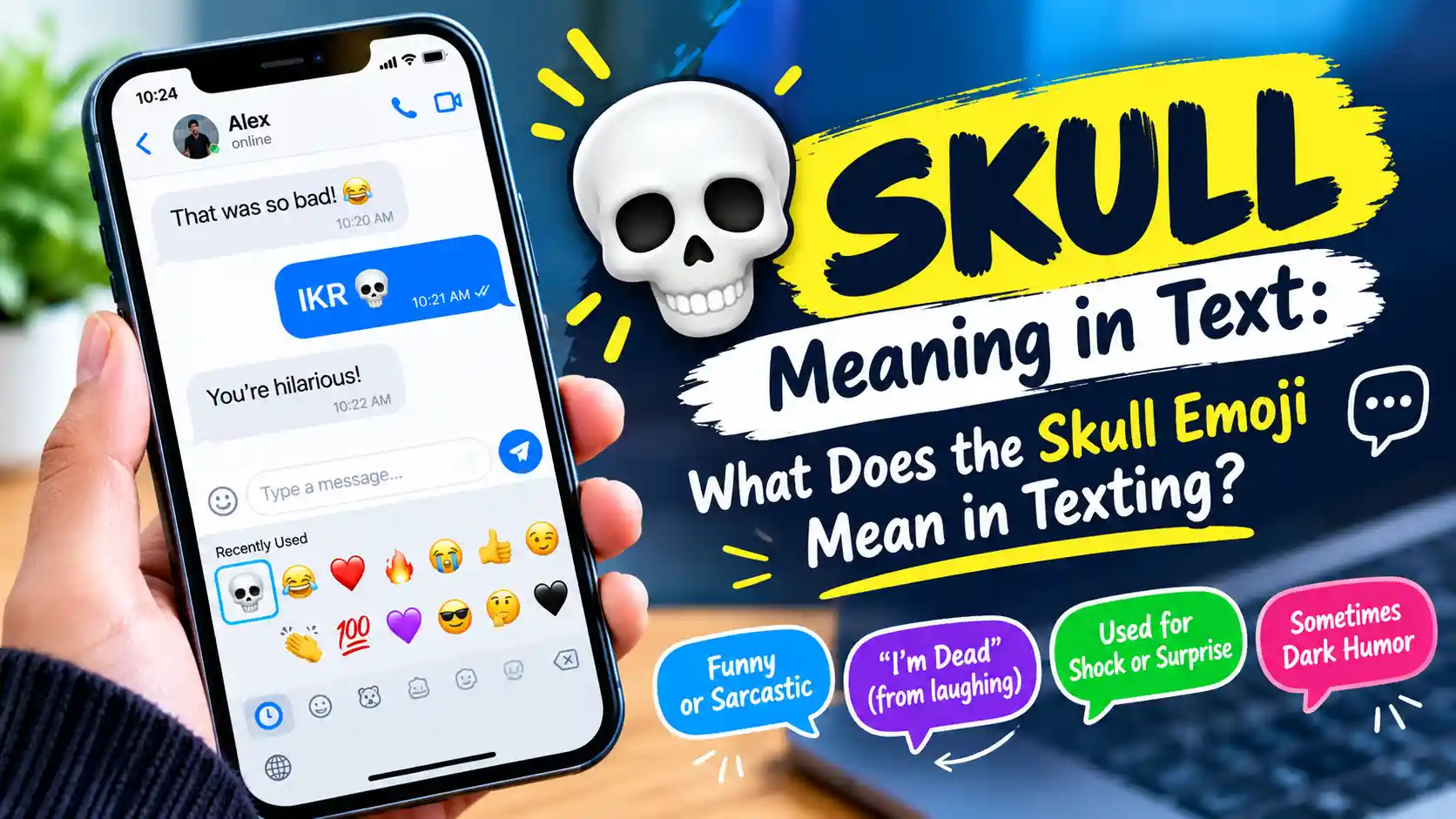
In modern texting, the skull symbol most commonly means “I’m dead” a dramatic, exaggerated way of saying something is extremely funny.
It works as a stand in for laughing so hard you figuratively died, similar to saying “I can’t” or “this killed me” out loud.
Example:
Friend 1: I just called my teacher “mom” in front of the whole class Friend 2: ☠️☠️☠️ no you didn’t
Here, the skull expresses intense, genuine amusement, the digital equivalent of laughing until you can’t breathe.
Example reacting to something embarrassing:
Text: just tripped in front of my crush ☠️
In this case, the skull adds a layer of self aware, dramatic comedy to an embarrassing moment, almost like saying “I want to disappear, but also this is kind of funny.”
It’s worth noting two closely related but visually distinct symbols exist:
- 💀 (plain skull) the version most strongly associated with “I’m dead from laughing,” especially among younger, internet heavy texters.
- ☠️ (skull and crossbones) historically tied more closely to warnings, poison symbols, and literal danger, though in casual texting it’s frequently used the same way as the plain skull to express extreme laughter or dramatic reaction.
More real life examples:
Comment: the way he just walked away mid sentence ☠️
Group chat: we got so lost today ☠️ never again
Text: my brain is fried after that exam ☠️
The short version: in nearly all casual texting today, a skull symbol means someone found something so funny, awkward, or dramatic that it “killed” them not a literal reference to death, but an exaggerated, playful reaction.
Background & History
The skull has carried a literal meaning for a very long time, long before texting or emoji existed. As a symbol, it has traditionally represented death, danger, mortality, or warning most visibly in its skull and crossbones form, used on poison labels, pirate flags, and hazard signs for centuries.
When emoji were first introduced, the skull (added to Unicode in 2010) mostly retained this traditional meaning. Early digital use leaned toward literal or spooky contexts, Halloween posts, horror references, or genuinely serious mentions of death or danger.
Everything changed in the early 2020s. Around this time, Generation Z social media users began using the skull emoji to represent “I’m dead from laughing,” essentially replacing the crying laughing face emoji as their reaction to something funny. This shift happened partly because younger users increasingly viewed the crying laughing emoji as overused or associated with older generations, making it feel less genuine or “cool” as a reaction.
The phrase behind this shift “I’m dying” or “I’m dead” as an expression of intense laughter actually predates the internet, showing up in casual speech and sitcoms for decades (“I’m dying of laughter,” “you’re killing me”). Internet culture simply picked up this existing idiom and attached it to a visual symbol, first briefly experimenting with the ghost emoji around 2015, before the skull became the dominant choice.
Once this new meaning caught on, it spread quickly across major platforms like Twitter/X, TikTok, and Instagram, becoming especially popular among Gen Z and, increasingly, Gen Alpha users. The skull’s slightly deadpan, exaggerated appearance fit well with a broader shift toward dry, ironic humor online using something visually serious to express something completely lighthearted.
Today, the skull symbol remains especially common in:
- Texting between friends, reacting to funny or embarrassing stories
- Social media comments, especially reacting to relatable or chaotic content
- Gaming chat, expressing disbelief, frustration, or humor during a match
- Meme culture, often repeated multiple times (☠️☠️☠️) for extra emphasis
Its meaning has evolved dramatically from its original, literal association with death to become one of the most flexible humor symbols in modern texting.
Usage in Various Contexts
In texting between friends:
Friend 1: guess who fell asleep during the meeting again Friend 2: ☠️ not again, how do you keep doing this
Here, the skull emphasizes just how funny and unbelievable the situation is.
On social media:
Comment: the way this cat just stared at the camera and walked away ☠️
In gaming chat:
Teammate: I just got eliminated by the weakest enemy in the game You: ☠️☠️ how
In casual group chats:
Friend 1: we showed up to the wrong restaurant entirely Friend 2: ☠️ tell me you’re joking
Expressing self aware embarrassment:
Text: just sent a text to the wrong group chat ☠️ mortifying
Occasionally used more literally (context matters):
Post: spooky season is here 🎃☠️
Across nearly all casual settings, the skull signals exaggerated, dramatic reactions usually to something funny, embarrassing, or absurd. Its more literal, death or danger meaning still exists but shows up far less often in everyday texting, mostly appearing around Halloween themed content or genuinely serious topics.
Common Misconceptions & Clarifications
Misconception 1: The skull always relates to literal death. In modern casual texting, this is rarely the case. It almost always represents exaggerated laughter or dramatic reaction rather than anything literal.
Misconception 2: The skull and skull and crossbones mean exactly the same thing. They’re often used interchangeably in casual texting, but the skull and crossbones (☠️) still carries a slightly stronger association with warning, poison, or danger in more literal or formal contexts, while the plain skull (💀) leans almost entirely toward humor today.
Misconception 3: Only young people understand this meaning. While it’s most strongly associated with Gen Z and younger Gen Alpha users, the “I’m dead from laughing” meaning has become widely recognized across many age groups through mainstream media coverage and everyday exposure on social media.
Misconception 4: Using the skull is always appropriate. Context matters significantly here. Sending a skull in response to genuinely sad or serious news illness, grief, or loss can come across as deeply insensitive, even if used out of habit rather than intent.
Misconception 5: The skull has replaced the crying laughing emoji completely. It hasn’t fully replaced it, but it has become a strong, especially popular alternative, particularly among younger texters who see the crying laughing emoji as less genuine or slightly dated.
Clarification on tone: because the skull can represent both dramatic humor and literal seriousness, context is everything. A skull after a funny story reads completely differently than a skull in a message about an actual emergency or loss. Always read the full message before assuming which meaning applies.
Similar Terms & Alternatives
| Symbol/Term | Meaning | Typical Use |
| 💀 / ☠️ | I’m dead (from laughing) | Reacting to something extremely funny |
| 😂 | Laughing with tears of joy | Traditional laughter reaction |
| 🤣 | Rolling on the floor laughing | Similar to 😂, slightly more intense |
| I’M DEAD | Text version of the same idea | Typed instead of using the emoji |
| DECEASED | Playful exaggeration of “dead” | Similar dramatic, humorous tone |
| CRYING | Laughing so hard you’re in tears | Common alternative reaction phrase |
Examples in use:
Comment: I’m actually deceased 😭 this is too funny
Friend: I’m dead, why would you do that 😂
Text: crying, this is the funniest thing I’ve seen all week
These related terms and emoji all overlap closely with the skull’s modern meaning, often used interchangeably depending on personal texting style.
How to Respond to This Term
Responding to a skull emoji is usually simple, since it almost always signals genuine amusement.
Casual response:
“I know, I can’t believe that actually happened 😭”
Funny response:
“glad my suffering brings you joy 💀”
Professional response (rare, but possible in a lightly casual work chat):
“Ha, that’s definitely a story for later!”
Privacy conscious response (if you’d rather not elaborate further):
“Right?? Anyway, moving on…”
If the skull appears in a more literal or serious context: It’s worth pausing and reading the full message carefully if it seems to reference something genuinely upsetting, a thoughtful, sincere response is more appropriate than treating it as a joke.
General tips for responding:
- Matching the energy with another skull, a laughing emoji, or a similar reaction usually keeps the tone consistent.
- If you’re ever unsure whether someone means it humorously or literally, the rest of the message almost always clarifies the intent.
- In professional settings, this symbol is best avoided altogether in favor of plain language.
Regional or Cultural Differences
The “I’m dead from laughing” meaning of the skull emoji originated specifically within American Gen Z internet culture in the early 2020s, but it spread rapidly and is now recognized across most English speaking countries, including the UK, Canada, and Australia, largely through global platforms like TikTok and Twitter/X.
Because visual, symbol based communication travels easily across language barriers, this meaning has also spread into many non English speaking online communities, especially among younger users active on international social media.
Some cultural notes are worth considering:
- The skull’s more traditional association with death, danger, or mortality remains stronger in certain contexts worldwide, particularly around religious or cultural observances related to death, where a literal interpretation might be more expected.
- In regions or communities less immersed in Gen Z internet culture, the skull may still primarily be read in its more traditional, literal sense.
- As with most rapidly spreading internet trends, recognition of the humorous meaning tends to correlate more with social media use and age than with any single country or region.
Comparison with Similar Terms
| Symbol/Term | Core Meaning | Emotional Tone | Best Used When |
| 💀 / ☠️ | I’m dead (laughing) | Dramatic, deadpan humor | Reacting to something extremely funny or absurd |
| 😂 | Laughing with joy | Warm, classic amusement | General humor, widely understood across ages |
| 🤣 | Rolling on the floor laughing | Intense, exaggerated | Similar to 😂 but more emphatic |
| 😭 | Crying (often from laughing) | Overwhelmed, emotional | Extreme reactions, funny or touching |
| ☠️ (literal use) | Danger, poison, warning | Serious | Hazard labels, literal warnings |
The clearest distinction is tone. The skull’s modern meaning leans into dry, deadpan, almost ironic humor, while 😂 and 🤣 feel warmer and more traditionally expressive. Its literal meaning, by contrast, remains genuinely serious and is easy to distinguish once you consider the full context of a message.
Usage in Online Communities & Dating Apps
On Twitter/X and TikTok, the skull is everywhere, often repeated in strings (☠️☠️☠️) under funny videos, relatable posts, or chaotic personal stories.
On Tinder and other dating apps, it commonly shows up as a lighthearted reaction to something funny or charmingly awkward:
Match: I once introduced myself with the wrong name at a job interview You: ☠️ okay that’s actually hilarious
Here, it signals genuine amusement and can help build easy, playful rapport early in a conversation.
In gaming communities, the skull frequently appears in text or voice chat, reacting to unexpected losses, funny mistakes, or absurd moments during a match:
Teammate: I just got taken out by the easiest enemy in the game You: ☠️☠️ how did that even happen
Tips for responding appropriately:
- On dating apps, a well placed skull reaction can add warmth and humor without needing extra words.
- In gaming chat, it’s a normal, lighthearted way to react to mistakes or unexpected moments.
- On social media, it works well as a simple, expressive comment, especially repeated for emphasis.
Hidden or Offensive Meanings
The skull does not carry a widely recognized offensive meaning in its modern, humorous sense. It is not linked to slurs, explicit content, or aggressive language in mainstream casual use.
A few things are worth keeping in mind about tone and context:
- Its literal meaning still exists and matters. Because the skull traditionally represents death or danger, using it carelessly in a genuinely serious or sensitive conversation illness, grief, or loss can come across as insensitive, even if that wasn’t the intent.
- Context determines whether it lands as funny or inappropriate. The exact same symbol can feel perfectly natural after a funny story, and completely out of place after upsetting news.
- No secondary offensive meaning exists in casual use. Outside of literal, serious contexts, the skull is considered safe, playful, and widely accepted.
In short, the skull is generally safe for casual, humorous use, but it’s worth pausing before sending it in any conversation involving real loss, danger, or serious distress.
Suitability for Professional Communication
The skull symbol is not suitable for professional or formal communication. As an emoji rooted in casual, exaggerated humor, it doesn’t fit the clear, measured tone expected in workplace emails, client messages, or official documentation.
Why it doesn’t fit well:
- It relies entirely on the reader understanding a specific, informal internet meaning.
- Its dual meaning (humor versus literal danger) could create real confusion in a formal context.
- Professional communication benefits from plain, unambiguous language.
Professional alternatives:
| Instead of the skull emoji | Use |
| Expressing amusement | “That’s hilarious!” / “I can’t believe that happened.” |
| Reacting to something dramatic or overwhelming | “That sounds like quite an experience.” |
Example rewrite:
Casual: “that meeting was a disaster ☠️” Professional: “That meeting was honestly pretty chaotic.”
In relaxed workplace chats among close colleagues, the skull might occasionally slip in without issue. For anything client facing or written formally, plain, clear language is always the safer choice.
FAQs
1. What does the skull emoji mean in a text message? It most commonly means “I’m dead” an exaggerated, humorous way of saying something is extremely funny.
2. Is the skull emoji always used for laughter? In modern casual texting, yes, most of the time. It can occasionally carry its more traditional, literal meaning of death or danger, depending on context.
3. Is there a difference between 💀 and ☠️? Historically, 💀 leans more toward the “I’m dead from laughing” meaning, while ☠️ carries a slightly stronger association with danger or warning, though both are often used interchangeably in casual texting today.
4. Why did the skull replace the crying laughing emoji for some people? Many younger users began viewing the crying laughing emoji as overused or less genuine, making the skull’s deadpan, exaggerated style feel like a fresher way to express intense laughter.
5. Is it okay to send a skull emoji as a reaction to bad news? It depends heavily on context. For lighthearted or mildly embarrassing situations, it’s fine. For genuinely serious or sad news, it’s best avoided.
6. Can I use the skull emoji at work? It’s best avoided in professional communication, where plain, clear language is more appropriate.
7. Is the skull emoji only used by younger people? It’s most strongly associated with Gen Z and Gen Alpha, but its meaning has become widely recognized across many age groups due to its popularity on mainstream social media.
Conclusion
The skull symbol has transformed from a traditional representation of death and danger into one of the most popular ways to express extreme laughter in modern texting. Sending ☠️ or 💀 today almost always means “I’m dead” a dramatic, humorous reaction to something funny, embarrassing, or absurd, rather than anything literal.
It fits naturally into texting, social media comments, gaming chats, and dating app conversations, thanks to its expressive, deadpan comedic tone. Its more traditional, serious meaning still exists, though, so context always matters especially in conversations involving real loss or danger. In professional settings, plain language remains the safer choice.

Asfan Wahab is a content creator and writer focused on text meanings, slang, abbreviations, acronyms, and internet expressions. Through Orvexale.com, he provides clear and simple explanations to help readers understand modern texting language. His goal is to make confusing terms easy to understand with practical examples and everyday context.