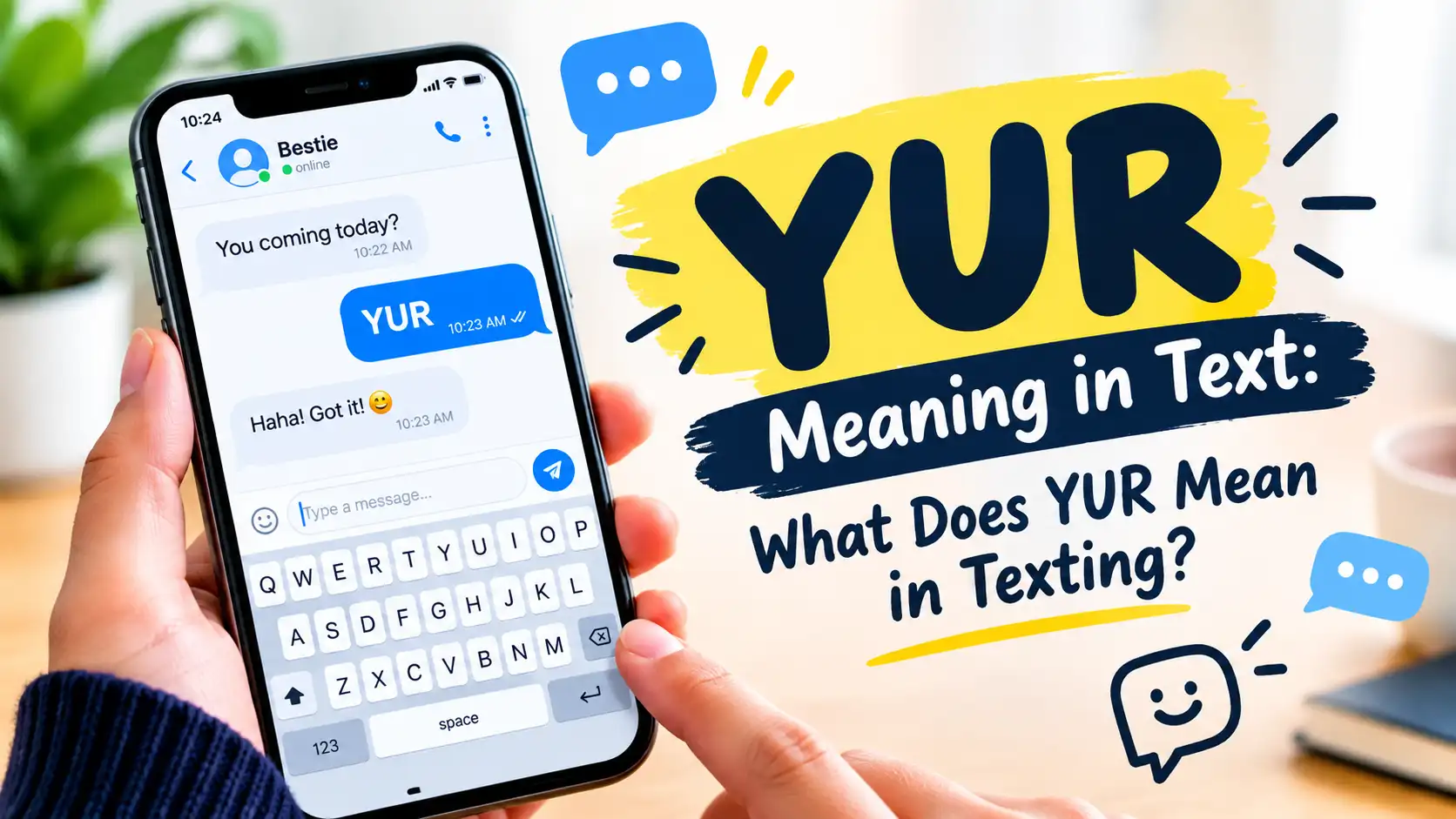
You get a text that says, “yur hair looks amazing today.” At first glance, it might look like a typo. It isn’t. YUR is a small, casual bit of internet spelling that shows up constantly in texting, TikTok comments, and Instagram captions.
It’s not a formal abbreviation with a hidden acronym behind it. Instead, it’s one of those relaxed, stylized spellings that texting culture loves a slightly playful way of writing a word you already know, just with a different look and feel.
Understanding YUR matters because it’s easy to misread at first, especially if you’re not used to casual internet spelling. Knowing exactly what it means, and how it’s typically used, helps you read texts and comments without that split second confusion. This guide breaks down exactly what YUR stands for, where it came from, and how to use it naturally.
Definition & Meaning
YUR most commonly stands for “your” (and sometimes “you’re”), written in a casual, stylized way.
It isn’t an acronym standing for a hidden phrase; it’s simply an informal spelling variation, similar to how “u” replaces “you” or “ur” replaces “your” in quick texting.
Example:
Friend 1: yur outfit is so cute today Friend 2: omg thank you!!
Here, YUR simply means “your,” used in a relaxed, casual way.
Example using the “you’re” sense:
Text: yur gonna love this show, trust me
In this case, YUR stands in for “you’re,” again just as a stylized, faster way of typing.
A secondary, less common usage also exists:
- “Yur” as an expressive version of “yeah” or “yes” used to sound a little more energetic or casual than a plain “yes,” especially in spoken style texting, gaming chat, or social media comments.
Example of this second meaning:
Friend: Are we still on for tonight? You: yur, for sure
Here, YUR functions as an enthusiastic, casual “yeah,” rather than a stand in for “your” or “you’re.”
More real life examples:
Comment: yur vibe today is immaculate 😍
Text: can I borrow yur charger real quick?
Gaming chat: yur turn now, go!
Context makes the meaning clear almost instantly. If YUR appears before a noun (like “hair,” “outfit,” or “turn”), it usually means “your.” If it appears as a standalone reply to a yes or no question, it likely means “yeah” or “yes.”
The short version: YUR is casual internet spelling, most often replacing “your,” and occasionally used as a relaxed, energetic version of “yeah.”
Background & History
YUR doesn’t have one specific origin story tied to a single event or platform. Instead, it grew naturally out of a much broader trend in texting culture: casually respelling common words for speed, style, or personality.
This habit dates back to the earliest days of texting, when character limits and small phone keyboards pushed people to shorten frequently typed words. “You” became “u,” “your” became “ur,” and eventually, playful variations like “yur” emerged as texting style became less about strict efficiency and more about personal flavor and tone.
As texting evolved from a purely practical tool into a space for personality and self expression, especially with the rise of social media captions, comment sections, and casual DMs, these small spelling variations took on a life of their own. Typing “yur” instead of “your” or “ur” isn’t really about saving time anymore, it’s more about matching the relaxed, informal tone of platforms like TikTok, Snapchat, and Instagram.
The secondary use of YUR, as a stylized version of “yeah” or “yes,” likely developed the same way many spoken style spellings do online by trying to capture how a word actually sounds when said casually, rather than how it’s spelled formally. This mirrors similar stylistic spellings like “nah” for “no” or “yep” for “yes.”
Because YUR grew organically out of everyday texting habits rather than from one specific trend or community, it doesn’t have a clearly documented starting point. It simply became more visible over time as short form video platforms and casual online comment culture made these small, stylized spellings more common and more noticeable.
Today, YUR appears mostly in:
- Texting between friends, especially in casual, relaxed conversations
- Social media comments and captions, particularly on TikTok, Instagram, and Snapchat
- Gaming chat, occasionally used as a quick, casual “yeah” or in place of “your”
- Meme culture, where stylized spelling often adds humor or personality
Usage in Various Contexts
In texting between friends (meaning “your”):
Friend 1: yur dog is adorable omg Friend 2: thank you, he thinks so too 😂
In texting (meaning “you’re”):
Text: yur doing amazing, keep going
On social media captions:
Caption: yur main character energy is showing today ✨
In gaming chat (meaning “your”):
Teammate: yur inventory’s full, drop something You: on it
In gaming chat (meaning “yeah”):
Teammate: Are you ready? You: yur, let’s go
In casual group chats:
Friend 1: yur plan sounds perfect, let’s do that Friend 2: yur, I’m down
Across these settings, the pattern is fairly simple: YUR before a noun almost always means “your.” YUR as a standalone response to a question usually means “yeah” or “yes.” The tone stays casual and relaxed in every case, fitting naturally into quick, informal exchanges rather than more serious or detailed conversations.
Common Misconceptions & Clarifications
Misconception 1: YUR is an acronym standing for a hidden phrase. It isn’t. Unlike many texting abbreviations, YUR doesn’t stand for a longer phrase; it’s simply a casual, stylized spelling of “your,” “you’re,” or occasionally “yeah.”
Misconception 2: YUR is a typo and should be corrected. While it can look like a typo at first glance, it’s intentional stylistic spelling in most casual online contexts, not a mistake.
Misconception 3: YUR always means the same thing. It doesn’t. Depending on where it appears in a sentence, it can mean “your,” “you’re,” or “yeah.” Context makes the intended meaning clear.
Misconception 4: YUR is brand new slang. It’s more accurate to say YUR is part of a long running pattern of casual respelling in texting culture, rather than a term with one specific starting point or viral moment.
Misconception 5: Using YUR makes a message seem careless or unclear. In casual contexts like texting friends or commenting on social media, it’s a normal, accepted part of informal writing style, not a sign of carelessness.
Clarification on tone: because YUR isn’t a strict, fixed abbreviation, its meaning depends entirely on the sentence around it. Reading the rest of the message almost always clears up whether it means “your,” “you’re,” or “yeah.”
Similar Terms & Alternatives
| Term | Meaning | Typical Use |
| YUR | Your / You’re / Yeah (stylized) | Casual texting and social media |
| UR | Your / You’re | Common shorthand, slightly more standard |
| U | You | Basic texting shorthand |
| YEP | Yes | Casual confirmation |
| NAH | No | Casual denial |
| FR | For real | Emphasizing sincerity or agreement |
Examples in use:
Friend: ur turn to pick the movie You: yep, let’s watch that new one
Friend: Did you actually finish it already? You: fr, just wrapped up
These related terms share YUR’s relaxed, informal tone, often used interchangeably depending on personal texting style.
How to Respond to This Term
Responding to “yur” is usually simple, since the tone is almost always casual and low stakes.
If it means “your” casual response:
“haha thank you!”
If it means “you’re” casual response:
“aw, that’s sweet of you to say”
If it means “yeah” casual response:
“awesome, see you then!”
Funny response:
“yur right, as always 😂”
Professional response (this term rarely appears at work, but if used jokingly):
“Ha, noted! I’ll follow up shortly.”
General tips for responding:
- Match the casual tone a relaxed, short reply usually fits best.
- If the meaning feels unclear, a quick clarifying question works fine: “yur as in yeah, or my turn? 😄”
- In professional settings, this spelling style is best avoided entirely in favor of standard writing.
Regional or Cultural Differences
YUR is an English language texting spelling, most common in casual, youth driven online spaces across English speaking countries like the US, UK, Canada, and Australia.
Because it’s a stylistic spelling rather than a fixed abbreviation, its use tends to follow broader texting culture rather than any single region’s slang traditions. Similar casual respellings like “ur” for “your” or “nah” for “no” are common across most English speaking online communities.
Some patterns worth noting:
- Non-English speaking online communities sometimes adopt casual English spellings like YUR directly, especially on international platforms like TikTok, where English slang spreads quickly regardless of a user’s first language.
- Because YUR isn’t as widely standardized as more established shorthand like “ur,” its recognition can vary more depending on how much time someone spends on platforms like TikTok, Snapchat, or Instagram.
Overall, YUR’s use depends more on someone’s familiarity with casual internet texting style than on their specific country or region.
Comparison with Similar Terms
| Term | Core Meaning | Emotional Tone | Best Used When |
| YUR | Your / You’re / Yeah | Casual, playful | Texting, captions, gaming chat |
| UR | Your / You’re | Casual, standard | General texting shorthand |
| YEP | Yes | Casual, neutral | Quick confirmations |
| NAH | No | Casual, neutral | Quick denials |
| FR | For real | Sincere, emphatic | Confirming honesty or agreement |
The clearest distinction between YUR and more standard shorthand like UR is style rather than meaning. YUR carries a slightly more playful, expressive feel, often used for personality or emphasis, while UR functions as a more neutral, purely practical abbreviation.
Usage in Online Communities & Dating Apps
On TikTok and Instagram, YUR frequently appears in comments and captions, often adding a casual, expressive tone to compliments or reactions.
On Tinder and other dating apps, YUR occasionally shows up in casual, flirty exchanges:
Match: yur profile made me laugh so hard You: haha glad it worked!
Here, it adds a relaxed, informal energy to the conversation.
In gaming communities, YUR sometimes appears in fast paced text or voice chat, either replacing “your” or standing in for a quick “yeah”:
Teammate: yur up next, get ready You: yur, I’m ready
Tips for responding appropriately:
- On dating apps, treat YUR as simply a casual, friendly tone rather than anything requiring special interpretation.
- In gaming chat, quickly check whether it’s replacing “your” or acting as a “yeah” based on the sentence structure.
- On social media, YUR is usually just part of a relaxed, informal comment style, not something to overanalyze.
Hidden or Offensive Meanings
YUR does not carry any offensive or explicit meaning. It is considered a harmless, casual spelling variation used purely for style or tone, with no ties to inappropriate or aggressive language.
A few points worth understanding about context:
- It’s purely stylistic, not symbolic. Unlike some slang terms, YUR doesn’t carry any secondary or hidden meaning beyond its casual spelling function.
- Confusion, not offense, is the main risk. Because YUR isn’t a fixed abbreviation, the biggest challenge is simply figuring out which standard word it’s replacing in a given sentence.
- No alternate inappropriate definition exists. YUR remains safe and appropriate across nearly all casual conversations.
In short, YUR is harmless and widely accepted in casual digital communication, with no offensive undertones to worry about.
Suitability for Professional Communication
YUR is not suitable for professional or formal communication. As a casual, stylized spelling, it doesn’t fit the clear, standard language expected in workplace emails, official messages, or client communication.
Why it doesn’t fit well:
- It replaces standard spelling with a casual, informal variation.
- It can come across as unpolished or careless in a professional context.
- Formal writing benefits from clear, correctly spelled language.
Professional alternatives:
| Instead of “yur” | Use |
| Your | “Your report looks great.” |
| You’re | “You’re doing a great job on this project.” |
| Yeah / Yes | “Yes, that works for me.” |
Example rewrite:
Casual: “yur presentation was awesome!” Professional: “Your presentation was excellent.”
FAQs
1. What does YUR mean in a text message? It’s a casual, stylized spelling most commonly used for “your,” and sometimes “you’re.”
2. Does YUR ever mean “yes” or “yeah”? Yes, in some contexts, especially as a standalone reply, YUR can function as an energetic, casual version of “yeah.”
3. Is YUR an official abbreviation? No, it’s not a fixed acronym with a hidden meaning, it’s simply informal internet spelling.
4. Is YUR the same as “ur”? They’re very similar, but YUR carries a slightly more playful, expressive tone, while “ur” is a more standard, neutral abbreviation.
5. Is YUR appropriate to use at work? No, it’s too casual for professional communication. Standard spelling works much better in formal settings.
6. How do I know if YUR means “your” or “yeah”? Check the sentence structure. If it comes before a noun, it likely means “your.” If it stands alone as a response, it likely means “yeah.”
7. Is YUR considered rude or inappropriate? No, it’s a harmless, casual spelling variation with no offensive meaning.
Conclusion
YUR is a casual, stylized spelling most commonly used in place of “your,” and occasionally “you’re” or an energetic version of “yeah.” Rather than standing for a hidden phrase, it reflects a broader texting habit of playfully respelling common words for a more relaxed, informal tone.
It fits naturally into texting, social media comments, gaming chat, and casual online conversations, adding personality without changing the underlying meaning of the word it replaces. In professional or formal writing, though, standard spelling remains the safer, more polished choice.

Noman Hassan is a content creator and writer focused on text meanings, slang, abbreviations, acronyms, and internet expressions. Through Orvexale.com, he provides clear and simple explanations to help readers understand modern texting language. His goal is to make confusing terms easy to understand with practical examples and everyday context.