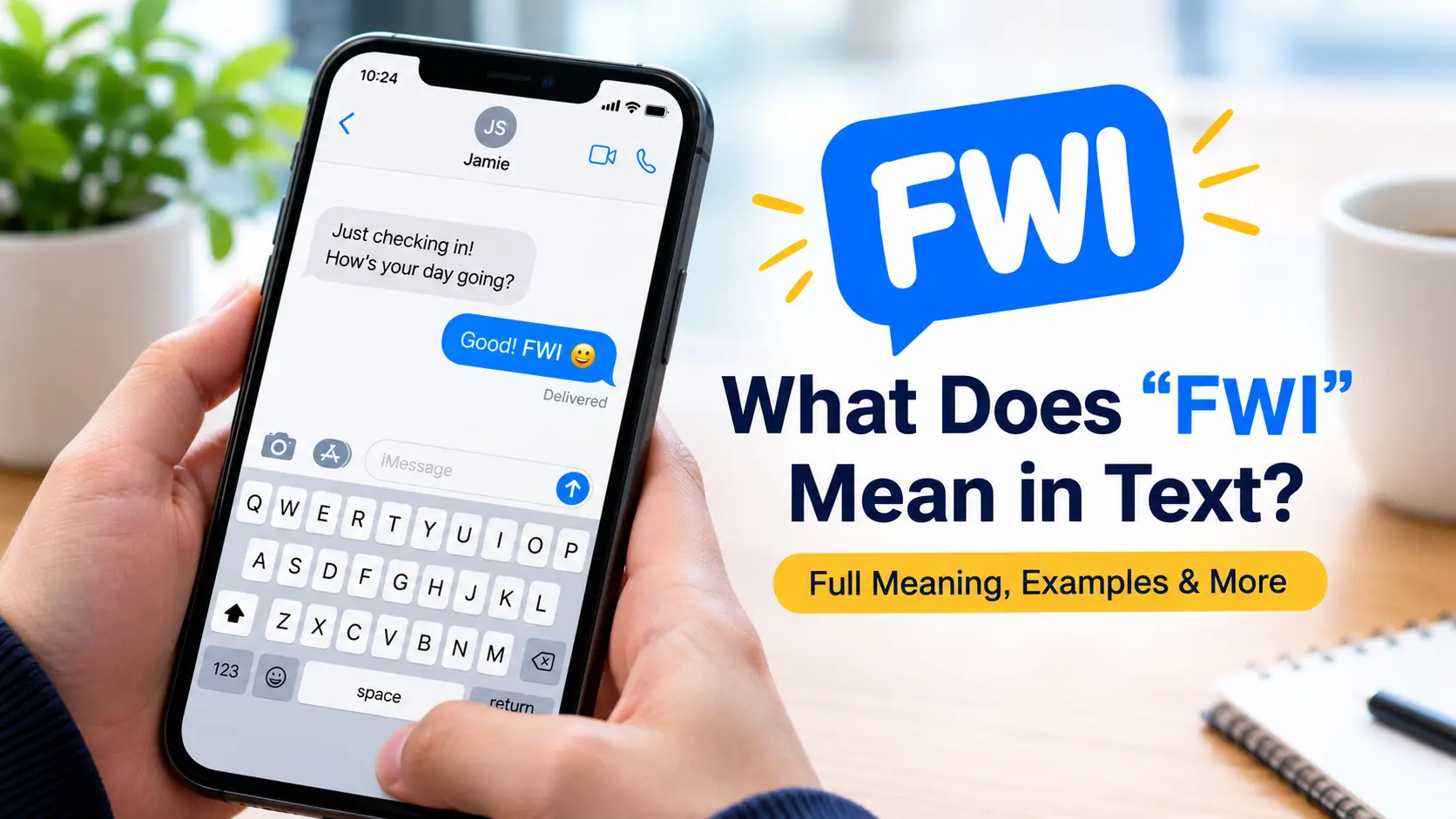
You’re scrolling through a group chat and someone drops “FWI, the party moved to 8pm.” You pause. What does that even mean?
Texting has its own language. Short letters replace whole phrases. FWI is one of those short forms. Most of the time, it’s a quick way to write FWIW, which means “For What It’s Worth.” People drop the extra “W” because typing fast matters more than typing perfect.
You’ll spot FWI in texts, Instagram comments, group chats, and even gaming lobbies. It shows up when someone wants to share an opinion or a fact, but doesn’t want to sound too pushy about it.
Knowing what FWI means helps you read the tone of a message correctly. Miss it, and you might think someone is being rude when they’re actually just being polite. This guide breaks down everything: the meaning, the history, the ways people use it, and how you should reply.
Definition & Meaning
FWI most often stands for “For What It’s…” shorthand that people use in place of FWIW (“For What It’s Worth”). In casual texting, letters get dropped all the time. FWI is simply a faster, looser version of the same idea.
At its core, FWI (like FWIW) means: “Here’s some information or my opinion. Take it or leave it.”
Key point: FWI is not a command. It’s a soft introduction. The person isn’t demanding you agree. They’re offering something small and letting you decide what to do with it.
Real life examples
- Text 1:
- Sam: “FWI, I heard the concert got moved indoors.”
- Priya: “Oh good to know, thanks!”
- Text 2:
- Jordan: “FWI I don’t think that shirt goes with those pants lol”
- Alex: “Noted 😂”
- Text 3 (workplace casual):
- Coworker: “FWI the client meeting got pushed to Thursday.”
- You: “Got it, thanks for the heads up.”
In each case, FWI signals: this is minor, useful, and not a big deal. It softens the sentence so it doesn’t come across as bossy or overly certain.
Important note: Some people also type FWI by accident when they mean FYI (“For Your Information”) or FWIW (“For What It’s Worth”). Context usually makes the real meaning clear. If someone is sharing a fact you need, they probably meant FYI. If they’re sharing an opinion, they probably meant FWIW.
Background & History
Abbreviations like FWI didn’t appear overnight. They grew out of a much older phrase: “for what it’s worth.”
This phrase has roots in old trade and negotiation language. Long before texting existed, people used “for what it’s worth” when offering an item, deal, or opinion of uncertain value. It basically meant: “I’m not sure how useful this is, but here it is anyway.”
When online chat rooms and early instant messaging became popular in the 1990s, people needed to type fast. Full phrases turned into acronyms. FWIW became one of the most common ones, used constantly in forums, chat rooms, and early text messages.
FWI likely emerged as a natural shortcut of FWIW. Dropping one letter saves a tiny bit of time, and in fast paced texting, tiny savings add up. It also spread because of autocorrect quirks and thumb typos that stuck around as informal norms.
Today, FWI (and FWIW) show up everywhere:
- Texting between friends and family
- Group chats at work or school
- Social media comments, especially on Twitter/X and Instagram
- Gaming chat, where speed matters most
- Online forums, like Reddit, where people share unsolicited opinions politely
The core meaning hasn’t changed much. It’s still a way to soften a statement and lower the stakes of sharing an opinion.
Usage in Various Contexts
FWI shows up differently depending on where you see it.
In texting
Texting is the most common home for FWI. It’s short, casual, and fits perfectly into quick back and forth conversations.
- Text:
- Mia: “FWI, traffic is bad on the highway rn”
- Leo: “Thanks, taking the back roads then”
On social media
On platforms like Twitter/X or Instagram, FWI often appears in replies or comments, especially when someone wants to add a fact without starting an argument.
- Comment thread:
- User1: “This movie was way too long.”
- User2: “FWI the director’s cut is even longer lol”
In gaming
Gamers type fast during matches. FWI pops up in voice chat transcripts or text chat to flag something useful without breaking focus.
- In game chat:
- Player1: “FWI there’s a sniper on the roof”
- Player2: “got it, thanks”
In casual conversations at work
Even in semi professional spaces like Slack or Teams, people use a cleaned up version of FWI to stay polite while sharing a heads up.
- Slack message:
- Teammate: “FWI the deploy is scheduled for 3pm today”
- You: “Appreciate the update”
Key point: In every context, FWI does the same job: it softens information so it doesn’t feel forceful.
Common Misconceptions & Clarifications
There’s some confusion around FWI, mostly because it looks similar to other acronyms.
Misconception 1: FWI and FYI mean the same thing
They don’t. FYI means “For Your Information” it’s neutral and factual. FWI (short for FWIW) leans more toward opinion or subjective input. FYI says “here’s a fact.” FWI says “here’s my take, worth what it’s worth.”
Misconception 2: FWI is rude or dismissive
Some people worry FWI sounds sarcastic, especially if it’s used to correct someone. Tone really depends on what follows it. Compare:
- “FWI, I think you’re wrong.” (can feel a bit blunt)
- “FWI, I found a cheaper version of that product.” (feels helpful)
The words after FWI carry the tone, not the acronym itself.
Misconception 3: FWI is always short for FWIW
Not always. In rare cases, people use FWI as shorthand for other niche phrases depending on the group or platform (like internal team jargon). If you’re unsure, context is your best guide. If a message doesn’t make sense as “for what it’s worth,” ask.
Misconception 4: Using FWI is unprofessional
FWI itself isn’t offensive, but it is casual. In relaxed workplace chats it’s usually fine. In client facing emails or formal reports, it’s better to spell things out fully.
Similar Terms & Alternatives
Several other acronyms serve similar purposes to FWI. Here’s how they compare.
| Acronym | Full Meaning | Tone | Best Used For |
| FWI / FWIW | For What It’s Worth | Soft, humble | Sharing opinions gently |
| FYI | For Your Information | Neutral, factual | Sharing facts or updates |
| IMO / IMHO | In My Opinion / In My Humble Opinion | Personal | Clearly stating a viewpoint |
| JS | Just Saying | Casual, sometimes blunt | Dropping a quick comment |
| NGL | Not Gonna Lie | Honest, direct | Admitting something openly |
| TBH | To Be Honest | Sincere | Sharing a candid opinion |
Key point: FWI (FWIW) is the gentlest of this group. It carries less weight than IMO and feels less blunt than JS or NGL.
How to Respond to This Term
How you reply to an FWI message depends on your relationship with the sender and the situation.
Casual response
- Friend: “FWI that restaurant closes early on Sundays.”
- You: “Oh good call, thanks!”
Funny response
- Friend: “FWI you have spinach in your teeth 😂”
- You: “WHY DIDN’T YOU TELL ME SOONER 😭”
Professional response
- Coworker: “FWI the report deadline moved up a day.”
- You: “Thanks for flagging that I’ll adjust my schedule.”
Privacy conscious or neutral response
If you don’t want to engage much or you’re unsure how to react:
- “Thanks for letting me know.”
- “Got it, appreciate the heads up.”
Key point: A short acknowledgment is almost always the safest response. It shows you received the info without over committing to a reaction.
Regional or Cultural Differences
FWI (and FWIW) are mostly rooted in English language texting culture, especially in the U.S., U.K., Canada, and Australia. It’s part of a broader internet slang ecosystem that spread through American chat rooms and social media in the late 1990s and 2000s.
That said, because English texting slang travels fast through global apps like Instagram, Discord, and WhatsApp, FWI shows up in text conversations worldwide, even among non native English speakers who pick up common internet phrases.
Regional slang variations exist too:
- In UK texting, people might use “FWIW” more formally than casually.
- In gaming communities globally, English acronyms like FWI often get adopted directly, even in non English chats, because gaming culture is heavily English influenced.
- In some Asian messaging apps (like LINE or KakaoTalk), English acronyms are used alongside local abbreviations, often mixed into the same sentence.
There’s no strong evidence of FWI carrying a different, culturally specific meaning elsewhere. It generally travels with the same soft, “take it or leave it” tone.
Comparison with Similar Terms
Here’s a closer, side by side comparison to help you choose the right acronym for the right moment.
| Term | Formality | Implies Opinion? | Implied Fact? | Risk of Sounding Rude |
| FWI / FWIW | Casual | Yes | Sometimes | Low |
| FYI | Semi formal | No | Yes | Very low |
| IMO | Casual | Yes | No | Low medium |
| JS | Very casual | Yes | No | Medium |
| NGL | Very casual | Yes | No | Medium |
Key takeaway: If you want to soften an opinion, FWI is one of the safest choices. It reads as helpful more often than not.
Usage in Online Communities & Dating Apps
FWI shows up in several online spaces beyond regular texting.
On dating apps (Tinder, Bumble, Hinge)
People use FWI (or FWIW) to soften an honest comment during a conversation, especially when giving feedback or sharing a preference.
- Dating app chat:
- Match: “FWI I’m not really into small talk, prefer diving into real convos.”
- You: “Same honestly, let’s skip the weather talk 😂”
On Twitter/X
FWI often appears in reply threads when someone wants to add a small correction or extra detail without sounding combative.
- Reply:
- “FWI that stat is from 2019, might be outdated now.”
In gaming communities (Discord, Twitch chat)
Fast typing matters, so FWI gets used to flag quick tips or corrections mid game or mid stream.
- Discord message:
- “FWI the patch notes just dropped, new update tonight.”
Tip for responding appropriately: On dating apps, respond warmly if the FWI reveals something personal it usually signals honesty. In gaming or social threads, a quick “thanks” or emoji reaction is enough.
Hidden or Offensive Meanings
FWI does not carry any widely known offensive or hidden meaning. It’s one of the more harmless acronyms out there, unlike some slang terms that hide inappropriate meanings behind innocent looking letters.
However, tone still matters. FWI can feel passive aggressive if paired with sarcastic or critical statements, such as:
- “FWI, that’s not how you’re supposed to do it.”
This isn’t because FWI itself is rude, it’s because the sentence after it carries a corrective, slightly condescending tone. The acronym doesn’t create the offense; the surrounding words do.
Key point: Always judge FWI by what follows it, not the letters themselves.
Suitability for Professional Communication
FWI is casual. It fits well in relaxed workplace chats, Slack, Teams, or quick texts between coworkers who know each other well.
It is not ideal for:
- Formal emails
- Client communication
- Official reports or documentation
- Communication with senior leadership you don’t know well
Professional alternatives
Instead of FWI, consider:
- “For your reference…”
- “Just a quick note…”
- “As a point of information…”
- “I wanted to mention that…”
These alternatives keep the same helpful spirit while sounding polished.
FAQs
1. What does FWI mean in a text?
It’s usually short for FWIW, meaning “For What It’s Worth” a way to gently share an opinion or piece of information.
2. Is FWI the same as FYI?
No. FYI shares neutral facts. FWI leans toward personal opinion or subjective info.
3. Is FWI rude?
Not by itself. It only feels rude if the sentence after it sounds sarcastic or corrective.
4. Can I use FWI in a work email?
It’s better to avoid it in formal emails. Save it for casual chats with close coworkers.
5. Does FWI mean something different in gaming?
No, it keeps the same meaning, sharing quick, useful info without demanding a reaction.
6. How should I respond to FWI?
A short “thanks” or acknowledgment works in almost every situation.
7. Is FWI used outside English speaking countries?
Yes, especially in gaming and social media, where English internet slang spreads globally.
Conclusion
FWI is a small acronym with a simple job: softening information so it doesn’t feel forceful. Most of the time, it stands in for FWIW (“For What It’s Worth”), showing up in texts, social media, gaming chats, and casual work conversations.
It’s not offensive, not overly formal, and easy to use once you understand its tone. The key is remembering that FWI carries the message gently; the words that follow decide whether it lands as helpful or a little sharp.

Noman Hassan is a content creator and writer focused on text meanings, slang, abbreviations, acronyms, and internet expressions. Through Orvexale.com, he provides clear and simple explanations to help readers understand modern texting language. His goal is to make confusing terms easy to understand with practical examples and everyday context.