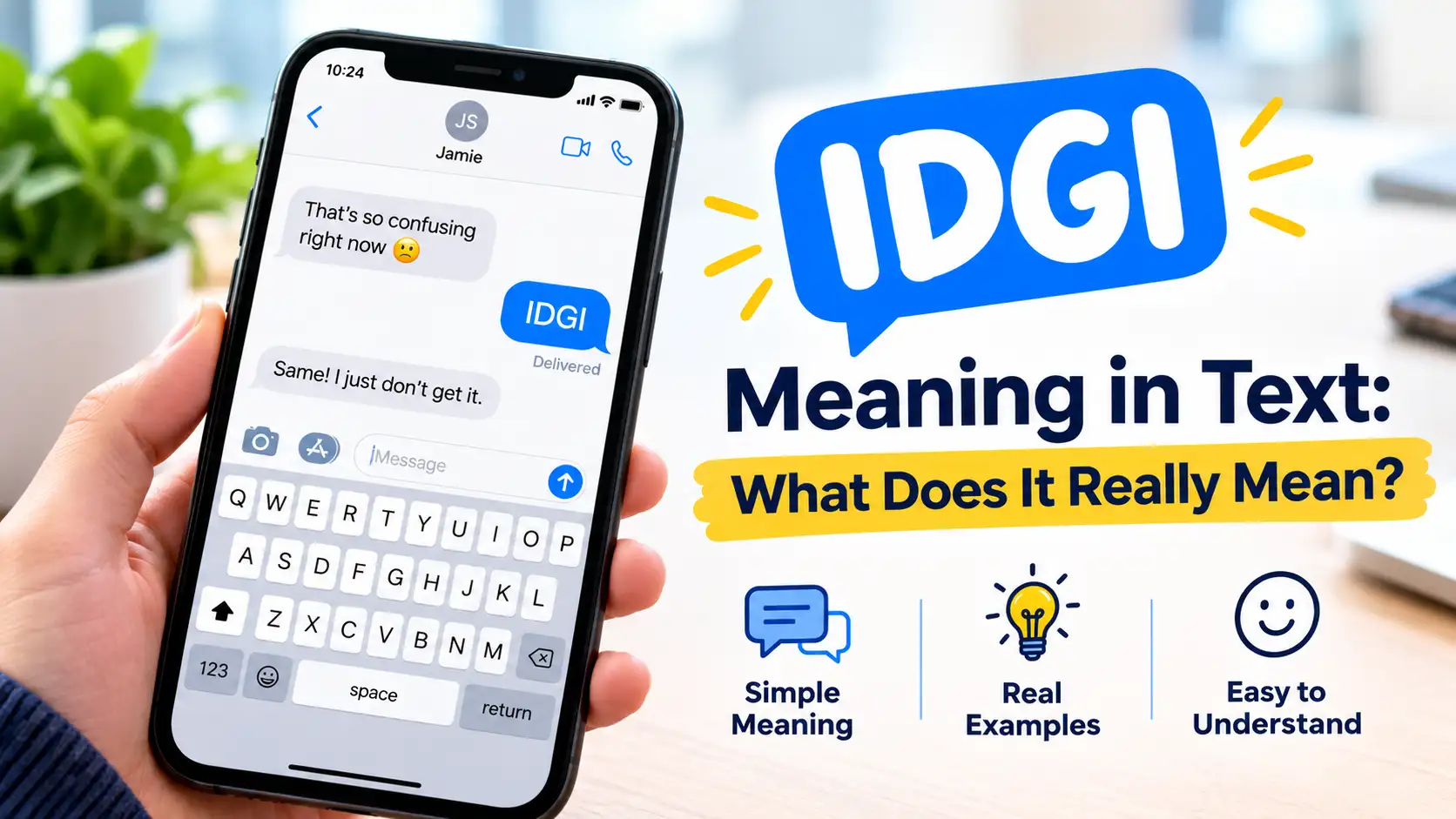
You open a text. A friend writes, “IDGI.” You stare at the screen. What does that mean?
Don’t worry. It’s simple. IDGI means “I don’t get it.” It is a short way to say you are confused.
People use it every day. You will see it in texts, group chats, and comments on social media. Gamers type it in match chats. Coworkers sometimes drop it in fast messages.
Why does this matter? Because tone is hard to read online. If you miss the meaning, you may reply the wrong way. You may even think someone is upset when they are just puzzled.
Knowing IDGI helps you talk faster and smarter. It also helps you avoid mix ups.
In this guide, you will learn what IDGI means, where it came from, and how to use it. You will also learn how to reply and what to say at work. Let’s start.
Definition & Meaning
What Does IDGI Stand For?
IDGI stands for “I don’t get it.”
It is a text abbreviation. Each letter stands for one word:
- I = I
- D = Don’t
- G = Get
- I = It
That’s all. There is no hidden code.
What Does It Really Say?
When someone types IDGI, they are saying one of these things:
- “I am confused.”
- “This joke makes no sense to me.”
- “I don’t see the point.”
- “Can you explain?”
The exact meaning depends on the moment. Sometimes it is a real question. Sometimes it is a shrug.
Real Life Examples
Example 1: A joke that missed
Mia: Why did the scarecrow win an award?
Leo: IDGI.
Mia: He was outstanding in his field!
Leo: Ohhh. Got it now. 😂
Example 2: A confusing trend
Sam: Everyone is posting that blue frog meme.
Ana: IDGI. What’s funny about it?
Sam: It’s just a vibe, honestly.
Example 3: A plan that makes no sense
Dad: We are driving to the lake to look at the parking lot.
Kid: IDGI. Why?
Dad: The boat place is next to it.
Quick Tips
- IDGI is not rude by itself. Tone changes everything.
- It can be typed in capital letters or lowercase. Both work.
- You can add a question: “IDGI, can you explain?”
Background & History
Where Did It Come From?
IDGI belongs to a big family of text shortcuts. Think of IDK (I don’t know) and IDC (I don’t care). These grew up in early chat rooms, instant messaging, and text messages.
Why did people shorten words? Typing was slow. Old phones made you press one key many times to write a single letter. Early texts also had tight length limits. Short words save time and money.
Who Invented It?
No one knows. That is normal for slang. Nobody can point to the first person who typed IDGI. It likely grew slowly, as people copied the pattern of IDK and IDC.
How Has It Changed?
Over time, the term moved from private chats to the open web.
- Early days: Chat rooms and instant messengers.
- Text message era: Used to save space.
- Social media era: Used in replies, comments, and captions.
- Today: Used in gaming chats, group chats, and even quick work notes.
Its tone has also shifted. In the past, it mostly meant real confusion. Now it can also mean “I don’t see why this is a big deal.” That version can sound a bit dismissive.
Where Is It Common Today?
You will most often see IDGI in:
- Text messages between friends
- Comment sections on TikTok, Instagram, and X
- Discord servers and game chats
- Reddit threads
- Dating app chats
Younger users use it most, but people of all ages have picked it up. The short form fits fast talk, and fast talk is how most of us chat now.
Usage in Various Contexts
IDGI shows up in many places. The meaning stays the same. The feeling changes with the setting.
In Texting
Here, IDGI is quick and friendly. It tells the other person, “Please explain.”
Jay: The meeting moved to the blue room.
Kim: IDGI. Which blue room?
Jay: Second floor, near the stairs.
On Social Media
People often use IDGI under posts, memes, or trends. It can mean they truly don’t understand. It can also be a mild joke.
Post: New song drops tonight. No one is ready.
Comment: IDGI. Who is this artist?
Reply: Look at the pinned post. You’ll get it.
In Gaming
Gamers type fast. Every second counts. IDGI is short and clear.
Player 1: Go left, then wait for the signal.
Player 2: IDGI. What signal?
Player 1: The red flare. You’ll see it.
Sometimes it shows up in a complaint about the game itself:
Player: IDGI. Why did my shield break in one hit?
Friend: Enemy has the new weapon.
In Casual Conversation
Some people even say the letters out loud. It’s rare, but it happens. “I D G I” can be a playful way to say, “That makes no sense to me.”
In Group Chats
Group chats move fast. Ten messages can appear in a minute. IDGI helps you jump in without a long note.
Ella: Okay, so the plan is pizza, then the thing.
Ravi: IDGI. What thing?
Ella: The movie! Keep up. 😄
Key Points to Remember
- Use IDGI when you’re confused.
- Add a question if you want a real answer.
- Watch your tone. A short “idgi” alone can seem cold.
Common Misconceptions & Clarifications
“IDGI Means I Don’t Care”
This is the most common mix up. IDGI is not IDC. IDC means “I don’t care.” IDGI means “I don’t get it.” One is about feelings. The other is about understanding.
Sara: I’m not going to the party.
Tom: IDGI. You were so excited last week!
Here, Tom cares a lot. He just doesn’t understand the change.
“IDGI Is Always Rude”
Not true. Most of the time, it is neutral. It only sounds rude when used with a sharp tone, like mocking someone’s hobby or post.
Compare these:
- “IDGI, can you explain?” → Friendly
- “lol idgi why do people like this” → Could sound dismissive
“IDGI Is a Formal Term”
It isn’t. IDGI is casual slang. You won’t find it in reports, emails to clients, or school essays.
“It Has Only One Meaning”
In texting and social media, yes, it means “I don’t get it.” But letters can stand for other things in other fields. A company, a school, or a group might use those four letters as initials. If the chat is about a brand or team, check the context.
Can It Be Misread?
Yes. Since there is no face or voice, people fill in the tone themselves. A quick “IDGI” might feel like:
- Confusion
- Boredom
- Sarcasm
- A challenge
When in doubt, add a few words. “IDGI, help me out?” is clear and kind.
Is It Inappropriate?
No, the term is clean. It has no bad words. But the message around it might not be. If you use it to put someone down, that is the problem, not the acronym.
Simple Rule
Say it when you’re truly puzzled. Add a question. Keep your tone kind. Do that, and you’ll rarely be misread.
Similar Terms & Alternatives
IDGI has many cousins. Some mean nearly the same thing. Others just sound close. Here are common alternatives.
Words With a Similar Meaning
- “I don’t understand” – The plain, clear version.
- “Confused” or “confused rn” – Short and casual.
- “Lost” – “I’m lost” means you can’t follow.
- “Huh?” – A quick sign of confusion.
- “What?” – Simple, but can sound sharp.
- “???” – Just question marks. Very common.
- “Not following” – Polite and useful at work.
- “Explain pls” – A direct request.
- “I don’t see it” – Softer, and works for jokes or images.
- “IDK” – Means “I don’t know,” which is close, but not the same.
Comparison Table
| Term | Meaning | Tone | Best Use |
| IDGI | I don’t get it | Casual | Friends, group chats |
| Huh? | I’m confused | Casual | Quick reactions |
| ??? | I’m confused | Casual/Playful | Memes, comments |
| Not following | I can’t follow you | Polite | Work chats |
| I don’t understand | I don’t get it | Neutral | Any setting |
| Can you explain? | Please clarify | Kind | Any setting |
| I’m lost | I can’t keep up | Casual | Talking through steps |
Which One Should You Pick?
- Friends: IDGI, huh?, or ???
- Class or work: “Can you explain that a bit more?”
- A joke: “I don’t get the joke.”
A Short Example
Nina: The deadline is now Friday, not Monday.
Omar: Not following. Wasn’t it Monday last week?
Nina: It changed yesterday. Sorry for the mix up!
Pick the one that fits the person you’re talking to. That is the whole trick.
How to Respond to This Term
When someone sends IDGI, they want help. Here is how to answer in different styles.
1. Casual Style
Use this with friends. Keep it light and clear.
Friend: IDGI.
You: No worries! I’ll explain. The joke is that the cat is the boss.
Other quick replies:
- “Let me break it down.”
- “It’s an inside joke. Long story.”
- “Okay, so basically…”
2. Funny Style
Humor can keep the mood fun. Just don’t tease too hard.
Friend: idgi
You: That’s okay. Some of us are just built differently. 😄 Here’s the joke…
More ideas:
- “Loading explanation… please wait.”
- “Don’t worry, it took me three tries too.”
3. Professional Style
At work, be kind and clear. Skip slang.
Coworker: IDGI. Why did the plan change?
You: Good question. The client asked for a new date. I’ll send a short summary.
More ideas:
- “Happy to clarify. Which part is unclear?”
- “Let me walk you through it.”
4. Privacy Conscious Style
Sometimes someone asks about something private. You don’t have to share.
Friend: IDGI. Why did you leave early?
You: It was a personal thing. I’d rather not go into it. Thanks for understanding!
More ideas:
- “That’s a bit private, but I appreciate you asking.”
- “I’ll fill you in another time.”
5. Kind and Simple Style
When the other person seems upset, be gentle.
Friend: idgi… why is everyone mad at me?
You: Hey, I get why it feels confusing. Want me to explain what happened?
Key Tips
- Answer the question. They asked because they needed help.
- Don’t mock. People ask when they’re unsure.
- Keep it short. A long reply may confuse them more.
- Ask what part is unclear. It saves time.
Regional or Cultural Differences
Is IDGI Used Everywhere?
IDGI is an English language abbreviation. It is used in the United States, Canada, the UK, Australia, and many other places where people text in English. There is no big split in meaning between these regions.
What About Other Languages?
Other languages have their own shortcuts. Many people also mix English acronyms into chats in their own language, especially when gaming or using global apps. So you may see IDGI in a group chat, even when most of the words are not English.
Regional Slang Variations
The idea of “I don’t get it” appears in many local forms. Here are some English versions:
- “I’m not following” – Common in the U.S. and at work.
- “I don’t get you” – Sometimes heard in parts of South Asia and other regions, meaning “I don’t understand what you mean.”
- “Say what?” – Playful, casual, mostly American.
- “Come again?” – Polite, popular in many English speaking places.
- “Can’t make head nor tail of it” – An older British style phrase, less used in texts.
Age and Platform Matter More Than Place
The bigger difference isn’t the country. It is age and app.
- Teens and young adults use IDGI the most.
- Older users may prefer full words or “???”
- Gamers and Discord users lean on short forms.
- Work chats lean on full sentences.
Cultural Tone
In some cultures, saying “I don’t get it” directly may feel blunt. People there might choose a softer line like “Could you explain that again?” Politeness rules change from place to place. When you chat with people from other cultures, a little extra kindness goes a long way.
Example
Ayesha (in Pakistan): Bhai, the new rule is too complicated.
Zain (in Canada): IDGI. What’s the rule?
Ayesha: You have to fill three forms. Each one asks the same thing!
The abbreviation worked across countries. That is the beauty of shared internet slang.
Comparison with Similar Terms
Many text acronyms start with “ID.” They look alike. They do not mean the same thing. Here is how they compare.
Comparison Table
| Term | Full Form | Meaning | Feeling It Shows |
| IDGI | I don’t get it | I’m confused | Puzzled |
| IDK | I don’t know | I lack the answer | Unsure |
| IDC | I don’t care | This doesn’t matter to me | Uninterested |
| IDGAF | I don’t give a f*** | Strong version of IDC | Rude or bold |
| IDT | I don’t think | I doubt it | Doubtful |
| IDRK | I don’t really know | Soft version of IDK | Unsure |
| IDEK | I don’t even know | I’m baffled | Overwhelmed |
Key Differences
IDGI vs. IDK
IDK means you have no answer. IDGI means you can’t understand something. One is about facts. The other is about meaning.
Sam: What time does the store close?
Lee: IDK.
Sam: The store closes when the sign is red.
Lee: IDGI.
IDGI vs. IDC
IDC says you don’t care. IDGI says you’re confused. Mixing them up can cause fights.
IDGI vs. IDGAF
IDGAF is strong and rude in most cases. IDGI is gentle by comparison. Use IDGAF with care, and never at work.
IDGI vs. IDEK
IDEK often shows you’re totally lost. It has a “this is wild” feel. IDGI is more calm.
Quick Memory Trick
- G = Get. IDGI is about getting it.
- K = Know. IDK is about knowing.
- C = Care. IDC is about caring.
Once you learn those letters, the whole family makes sense.
Usage in Online Communities & Dating Apps
Social Platforms
X (formerly Twitter): People reply “IDGI” under posts they find confusing. It can be a real question or a quick joke.
TikTok and Instagram: Comments like “idgi 😭” are common under trends or odd videos.
Reddit: IDGI appears in threads where users ask for explanations. Other users often respond with a helpful breakdown.
Gaming Communities
Games move fast. Players use IDGI to show they’re confused by rules, updates, or team plans.
Player A: We’re pushing mid after the smoke.
Player B: IDGI. What smoke?
Player A: The one I’m about to throw. Follow me!
On Discord, IDGI is often used in help channels. A kind reply builds a good community.
Dating Apps
On Tinder, Bumble, and Hinge, IDGI can show up in early chats. It might mean:
- They don’t understand your joke.
- They don’t get your bio.
- They feel a message came out of nowhere.
Match: Your bio says “professional napper.”
You: Yes! I love to sleep.
Match: IDGI. Is that a real job? 😂
You: Nope. Just my dream career.
Here, IDGI is playful. It can open a fun back and forth.
But it can also feel cold. If someone sends only “idgi” in response to your effort, it may show low interest. Read the whole chat, not just one line.
Tips for Responding Well
- Stay friendly. A good vibe keeps chats going.
- Explain simply. Don’t over explain jokes. It kills them.
- Keep it light. Add an emoji if it fits.
- Don’t take it personally. Confusion isn’t rejection.
- Ask back. “Which part confused you?” keeps talk flowing.
- Protect your privacy. If someone asks for personal details, you can decline politely.
A Note on Safety
On any platform, don’t share private info just because someone says “IDGI” and pushes for more. Explain what is comfortable, and skip the rest.
Hidden or Offensive Meanings
Is IDGI Offensive?
No. IDGI is not an offensive term. The phrase carries no swear word or secret insult. Instead, it simply means “I don’t get it.”
Are There Hidden Meanings?
Not in normal texting. But there are gray areas:
- Sarcasm: “Oh, idgi. Why would anyone like that?” The words are clean, but the tone is snide.
- Dismissal: Typing “idgi” to shut down someone’s story can feel like a put down.
- Passive aggression: “IDGI.” with a period can sound cold.
- Different letters, same look: Some brands or groups use those letters as initials. That’s not slang, just a coincidence.
Why Tone and Context Matter
Text has no voice. No face. No smile. A single word can feel warm or cold depending on who reads it.
Look at these two:
Version 1:
Ben: I’m moving to a new city.
Cara: IDGI. What about your job? Tell me more!
Version 2:
Ben: I’m moving to a new city.
Cara: idgi.
In the first, Cara is curious. In the second, she may seem upset or bored. Same term, different feeling.
How to Avoid Sending the Wrong Message
- Add a follow up. “IDGI, can you explain?” is clear.
- Use a friendly emoji if the chat is casual.
- Avoid it in tense moments. In an argument, it can add fuel.
- Read your message twice before sending.
When Someone Uses It Against You
If someone says IDGI in a mean way, you don’t have to respond in kind. You can say:
- “Happy to explain if you’re curious.”
- “It’s okay if it’s not your thing.”
Stay calm. Stay kind. That often ends the tension.
Bottom Line
The word is safe. The mood behind it is what counts.
Suitability for Professional Communication
Is IDGI Okay at Work?
Usually, no. IDGI is slang. It can seem too casual for emails, meetings, reports, or messages to clients and bosses.
When It Might Be Fine
In a very relaxed team chat, among close coworkers, IDGI might pass. Some startups and creative teams are casual. But even then, it’s safer to write it out.
Why Avoid It?
- It may seem lazy or unclear.
- It doesn’t ask a clear question.
- Not everyone knows the term.
- It can sound dismissive to a boss or client.
Professional Alternatives
Here are better ways to say “I don’t get it” at work:
- “Could you clarify that point?”
- “I’m not following. Could you explain?”
- “Can you walk me through it?”
- “I want to make sure I understand. Do you mean…?”
- “Could you share an example?”
- “I need a bit more context.”
Examples
Casual (avoid):
Boss: We’re moving the launch to Q3.
You: IDGI.
Professional (better):
Boss: We’re moving the launch to Q3.
You: Thanks for the update. Could you share what led to the change?
Notice the difference. The second reply shows you care. It also gets you a real answer.
More Examples
Client: The scope has changed.
You: I want to be sure I understand. Which parts are added?
Teacher: Read chapter four and prepare a summary.
Student: Could you explain what the summary should include?
Quick Tips
- Know your audience. Bosses and clients need clear words.
- Be specific. Say which part confuses you.
- Stay polite. It builds trust.
- Save slang for friends.
FAQs
1. What does IDGI mean in text?
IDGI means “I don’t get it.” It’s a short way to say you’re confused or don’t understand something.
2. Is IDGI the same as IDK?
No. IDK means “I don’t know.” IDGI means “I don’t get it.” One is about not having an answer. The other is about not understanding something.
3. Is IDGI rude?
Not on its own. It’s neutral. But tone can make it sound rude. Add a friendly follow up to keep it kind.
4. Can I use IDGI in a work email?
It’s best to avoid it. Use a full sentence instead, like “Could you clarify that point?” This sounds clearer and more professional.
5. How do I reply if someone texts me IDGI?
Explain the thing they don’t understand. Keep it short and friendly. You can say, “Let me break it down,” and then give a simple answer.
6. Is IDGI used in gaming?
Yes. Gamers use it often in chats on Discord and in game text. It saves time when the action is fast.
7. Does IDGI have any offensive meaning?
No. The term itself is clean. Only the tone can be harsh. If you say it to mock someone, it may hurt. Otherwise, it’s safe.
Conclusion
IDGI is a small term with a simple meaning. It stands for “I don’t get it.” You can use it when a joke, plan, or trend leaves you puzzled.
Let’s recap the key points:
- It’s casual slang, best for friends, group chats, and social media.
- It’s not the same as IDK or IDC. Each one shows a different feeling.
- Tone matters most. A short “idgi” can sound cold. A friendly follow up fixes that.
- Avoid it at work. Use clear, polite sentences instead.
- When someone sends it to you, help them. A short, kind answer works best.

Noman Hassan is a content creator and writer focused on text meanings, slang, abbreviations, acronyms, and internet expressions. Through Orvexale.com, he provides clear and simple explanations to help readers understand modern texting language. His goal is to make confusing terms easy to understand with practical examples and everyday context.