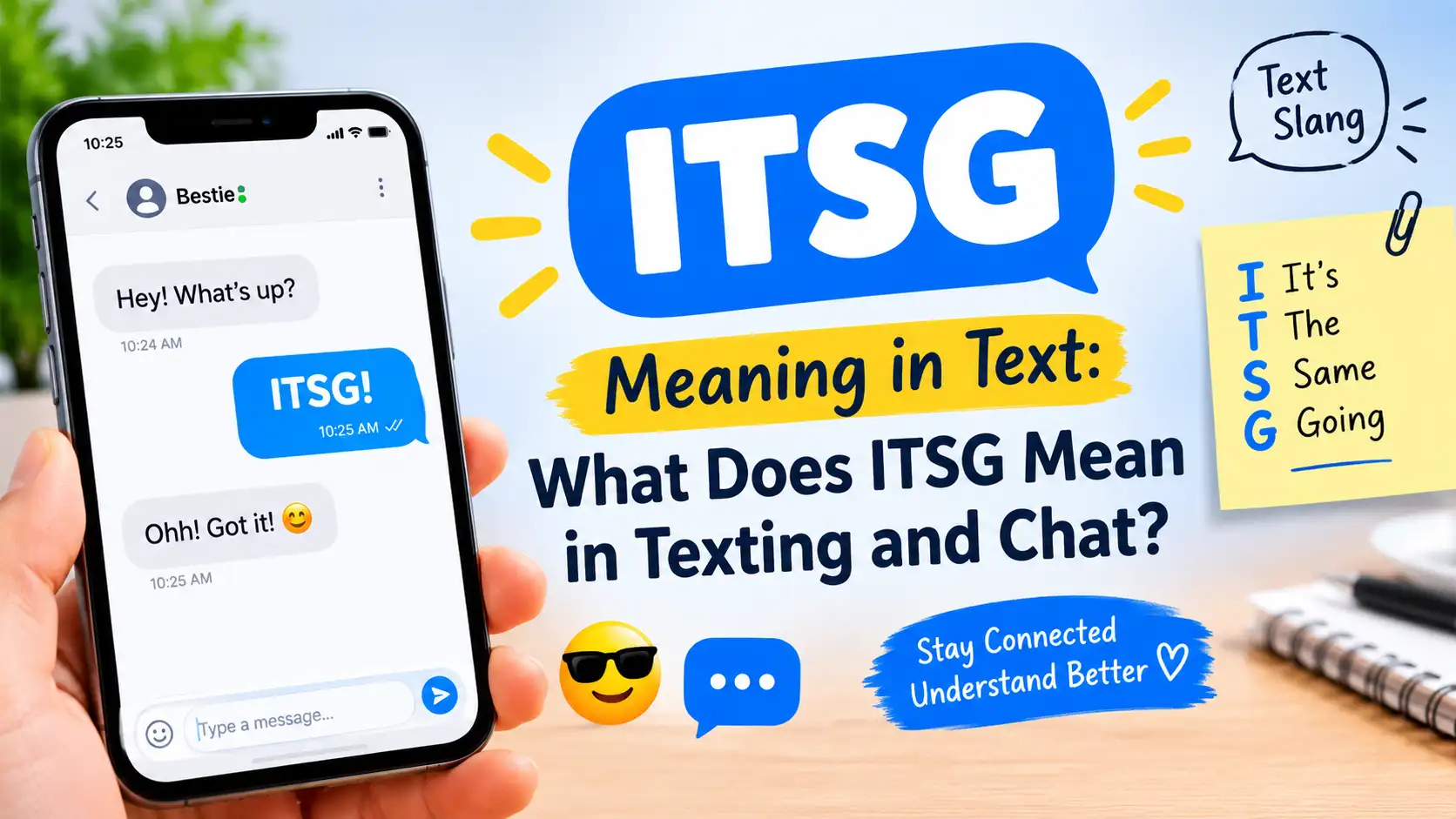
You get a text that just says “itsg, that’s exactly what happened.” No context. No explanation. Just four letters doing a lot of emotional heavy lifting.
If this looks like a typo to you, you’re actually onto something. ITSG is a jumbled variation of a much more common abbreviation ISTG, meaning “I swear to God.” The letters get scrambled easily while typing fast, especially on a phone, which is exactly why you might see both spellings floating around in texts, comments, and captions.
This term shows up constantly across texting, social media, and casual conversation, almost always attached to a moment of strong emotion honesty, frustration, excitement, or disbelief. Understanding it matters because it adds real intensity to a message, and knowing how to read (and use) it properly helps you catch that emotional weight instead of missing it entirely.
This guide breaks down exactly what ITSG/ISTG means, where it came from, and how to use it naturally.
Definition & Meaning
ITSG is a scrambled or mistyped version of “ISTG,” which stands for “I Swear To God.”
It’s used to emphasize that something is true, serious, or deeply felt a way of adding conviction to a statement, similar to saying “I swear” or “for real” out loud.
Example:
Friend 1: wait, did that actually happen? Friend 2: itsg, I couldn’t believe it either
Here, ITSG (functioning exactly like ISTG) reinforces that the story is genuinely true.
Example expressing frustration:
Text: istg if he cancels on me one more time
In this case, the phrase carries a different emotional tone irritation rather than sincerity while still meaning the same thing at its core.
Despite including the word “God,” the phrase is rarely used in a literal religious sense. Instead, it functions as a modern intensifier a way of adding emphasis and emotional weight to whatever comes next.
More real life examples:
Comment: istg this is the best show I’ve ever watched
Group chat: istg you guys are going to be the death of me 😭
Text: I’m not exaggerating, istg, the line was an hour long
The short version: whether typed as “itsg” or its more common form “istg,” the phrase means “I swear to God,” used casually to underline honesty, frustration, excitement, or disbelief not as a religious statement, but as an everyday way of saying “I really mean this.”
Background & History
The full phrase “I swear to God” has existed in everyday spoken English for a very long time, used as a way to emphasize honesty or sincerity, regardless of religious belief. Long before texting, people said this phrase out loud constantly, in everything from casual conversation to heated arguments.
As instant messaging grew popular in the early 2000s, through platforms like MSN Messenger, AIM, and Yahoo! Chat, users began shortening frequently typed phrases to save time and keystrokes. “I swear to God” naturally became a candidate for this kind of abbreviation, following the same pattern that produced other emotionally charged shorthand like OMG (“oh my god”) and SMH (“shaking my head”).
ISTG became the standard, widely recognized abbreviation, spreading further as texting and later social media platforms like Twitter, Instagram, and TikTok became dominant spaces for casual communication. Because it was typed so often, and usually quickly, in emotionally charged moments, letter mix ups were common leading to variations like “itsg” appearing alongside the more standard spelling.
This kind of accidental scrambling isn’t unusual in fast typed internet slang. Fingers move quickly, especially on phone keyboards, and once an abbreviation becomes common enough, readers often recognize the intended meaning even when the letters are slightly out of order.
Today, ISTG (and its occasional scrambled cousin, ITSG) remains especially common in:
- Texting between friends, especially during storytelling or venting
- Social media captions and comments, emphasizing genuine reactions
- Group chats, adding emotional weight to a statement
- Gaming chat, expressing frustration or disbelief during a match
Its core meaning has stayed remarkably consistent since it first became popular a quick, informal way to stress that you’re being completely honest or that you feel something strongly.
Usage in Various Contexts
In texting between friends:
Friend 1: you’re joking right? Friend 2: istg I’m not, it actually happened
Here, ISTG (or “itsg”) reinforces sincerity, almost like putting a hand over your heart while speaking.
On social media:
Comment: istg this song has been stuck in my head all week 😭
In gaming chat:
Teammate: istg if we lose this round after all that You: same, I’m losing my mind
In casual group chats:
Friend 1: he actually showed up in pajamas to the interview Friend 2: itsg no way 😭
In venting or frustrated conversations:
Text: istg my wifi has been down all day, I can’t take it anymore
In excited or enthusiastic reactions:
Friend: we got the tickets!! You: istg this is the best news I’ve heard all week
Across these settings, ISTG/ITSG consistently signals strong emotion, whether that’s sincerity, frustration, excitement, or disbelief. The tone shifts based on what surrounds it, but the underlying function adding emphasis stays exactly the same.
Common Misconceptions & Clarifications
Misconception 1: “Itsg” is a separate abbreviation with its own unique meaning. It isn’t. It’s simply a scrambled or mistyped version of the far more common “ISTG,” carrying the exact same meaning.
Misconception 2: ISTG is a religious statement. While the phrase technically references God, it’s almost never used with literal religious intent in modern texting. It functions purely as an emotional intensifier.
Misconception 3: ISTG always signals anger or frustration. Not necessarily. Depending on context, it can express excitement, sincerity, disbelief, or affection just as easily as annoyance.
Misconception 4: ISTG is disrespectful to religious people. This depends heavily on personal and cultural perspective. Some people may find casual references to swearing on God mildly uncomfortable, even in a non religious context, so it’s worth being mindful of who you’re talking to.
Misconception 5: ISTG is brand new slang. The full phrase has been part of everyday speech for generations. The abbreviation itself dates back to early instant messaging in the 2000s, making it fairly established by internet slang standards.
Clarification on tone: because ISTG is such a flexible intensifier, its emotional meaning depends entirely on the sentence around it. “Istg I love this so much” and “istg I’m so done with this” use the exact same phrase to express completely opposite feelings.
Similar Terms & Alternatives
| Term | Meaning | Typical Use |
| ISTG (ITSG) | I Swear to God | Emphasizing honesty, frustration, or strong emotion |
| FR | For Real | Confirming something is true |
| NO CAP | No lie | Emphasizing sincerity |
| OMG | Oh My God | Expressing surprise or shock |
| SWEAR DOWN | I promise / I swear | British slang alternative to ISTG |
| DEADASS | Seriously, for real | Emphasizing sincerity, especially in American slang |
| SMH | Shaking My Head | Expressing disbelief or disappointment |
Examples in use:
Friend: did that actually happen? You: fr, I couldn’t believe it either
Comment: no cap, this is the best meal I’ve had all year
British friend: swear down, he actually said that to my face
These related terms all serve a similar purpose to ISTG: adding emotional emphasis and reinforcing sincerity or intensity in casual conversation.
How to Respond to This Term
How you respond to “istg” or “itsg” depends on the emotion behind it.
If it signals excitement casual response:
“wait that’s amazing, tell me everything!”
If it signals frustration supportive response:
“ugh, that sounds so annoying, I’m sorry”
Funny response:
“istg you say that about everything 😂”
Professional response (rare, but possible in a lightly casual work chat):
“I hear you, let’s figure out a solution.”
Privacy conscious response (if you’d rather not dive deeper into the topic):
“Yikes, hope it gets sorted out soon!”
General tips for responding:
- Match the emotional tone excitement calls for enthusiasm, frustration calls for empathy.
- If you’re unsure whether someone is joking or serious, a quick clarifying question works well: “wait istg fr fr?”
- In professional settings, skip the abbreviation and respond with plain, sincere language instead.
Regional or Cultural Differences
ISTG is primarily an English language texting abbreviation, most closely associated with American internet and texting culture, though it’s now widely recognized across most English speaking countries, including the UK, Canada, and Australia.
Because “I swear to God” as a spoken phrase has long been common across English speaking cultures, the sentiment behind ISTG translates easily, even in regions where a different phrase might be more traditional.
Some regional variations show up in similar expressions:
- In British slang, “swear down” or “on my life” serve a very similar emphatic purpose.
- In some American slang, “deadass” or “no cap” are used interchangeably with ISTG to express sincerity.
- Non English speaking online communities often adopt English intensifiers like ISTG directly, especially younger users active on international platforms like TikTok and Instagram.
Because ISTG references a specific religious phrase, its comfort level can vary depending on cultural or personal attitudes toward casually referencing religion, even in a non literal sense. This is worth being mindful of, especially in more religiously conservative communities or conversations.
Comparison with Similar Terms
| Term | Core Meaning | Emotional Tone | Best Used When |
| ISTG (ITSG) | I swear to God | Sincere, intense, flexible | Emphasizing truth or strong emotion |
| FR | For real | Sincere, casual | Confirming something is true |
| NO CAP | No lie | Sincere, emphatic | Stressing honesty |
| OMG | Oh my god | Surprised, excited | Reacting to something unexpected |
| DEADASS | Seriously | Sincere, direct | Emphasizing sincerity, especially in American slang |
The clearest distinction is intensity. ISTG tends to carry slightly more emotional weight than lighter terms like FR or NO CAP, often signaling genuine frustration, disbelief, or deep sincerity rather than just casual confirmation.
Usage in Online Communities & Dating Apps
On Twitter/X and TikTok, ISTG frequently appears in captions and comments reacting to something surprising, funny, or deeply relatable, often paired with an emotional or exaggerated tone.
On Tinder and other dating apps, ISTG commonly shows up when sharing a personal story or emphasizing sincerity:
Here, it adds warmth and genuine reaction to the conversation.
In gaming communities, ISTG frequently appears in text or voice chat, especially during frustrating or exciting moments in a match:
Teammate: istg if we throw this lead You: we’ve got this, stay focused
Tips for responding appropriately:
- On dating apps, ISTG often signals genuine enthusiasm or sincerity responding warmly usually keeps the conversation flowing naturally.
- In gaming chat, it’s a normal, low stakes way to express frustration or excitement during gameplay.
- On social media, matching the emotional tone of the post or comment works best.
Hidden or Offensive Meanings
ISTG (and its scrambled variant, ITSG) does not carry any widely recognized offensive or explicit meaning. It is not linked to slurs, adult content, or aggressive language in mainstream usage.
A few things are worth understanding about tone and interpretation:
- It references God casually, not literally. In nearly all modern usage, it functions as an intensity marker rather than an actual religious oath.
- Some people may still find it slightly uncomfortable. Depending on personal or cultural attitudes toward religion, casually swearing “to God” even in an abbreviated, non literal way might land differently for different readers.
- No secondary offensive definition exists. ISTG doesn’t carry any hidden inappropriate meaning in mainstream texting or social media use.
In short, ISTG is considered safe and widely accepted in casual conversation, though it’s worth being a little mindful of context and audience given its religious reference.
Suitability for Professional Communication
ISTG (and ITSG) is not suitable for professional or formal communication. It’s an emotionally charged, casual intensifier, and using it in workplace emails, client messages, or official communication would feel out of place and unprofessional.
Why it doesn’t fit well:
- It relies on the reader already understanding casual internet slang.
- Its casual reference to swearing “to God” isn’t appropriate for neutral, formal writing.
- Professional communication values calm, measured language over emotional emphasis like this.
Professional alternatives:
| Instead of “istg” / “itsg” | Use |
| Emphasizing honesty | “I want to be completely transparent about this.” |
| Expressing frustration | “This has been genuinely frustrating to deal with.” |
| Expressing enthusiasm | “I’m really excited about this.” |
Example rewrite:
Casual: “istg this project has been a nightmare” Professional: “This project has honestly been quite challenging.”
In relaxed workplace chats among close colleagues, a bit of casual language might slip in occasionally. But for anything client facing or written formally, calm, direct language is always the safer choice.
FAQs
1. What does ITSG mean in a text message? It’s a scrambled or mistyped version of “ISTG,” which stands for “I Swear To God,” used to emphasize honesty or strong emotion.
2. Is ITSG a religious phrase? Not really. While it references God, it’s almost always used casually as an intensifier rather than a literal religious statement.
3. Is ISTG the same as ITSG? Yes, they mean the same thing. “Itsg” is simply a common typo or letter mix up of the more standard “istg.”
4. Does ISTG always mean someone is upset? No, it can express excitement, sincerity, or disbelief just as easily as frustration, depending on context.
5. Is ISTG offensive to religious people? It’s not intended to be, but some people may find casual references to swearing on God mildly uncomfortable depending on their personal or cultural views.
6. Can I use ISTG at work? No, it’s too casual and emotionally charged for professional communication. Calmer, more direct language works better in formal settings.
7. Is ISTG appropriate for dating app conversations? Yes, it’s commonly used to express genuine reactions or sincerity in a lighthearted, casual way.
Conclusion
ITSG is simply a scrambled version of the much more common abbreviation ISTG, which stands for “I Swear To God.” Both forms serve the same purpose: adding emotional emphasis to a message, whether that’s genuine honesty, frustration, excitement, or disbelief.
It shows up constantly in texting, social media, gaming chats, and dating app conversations, carrying real emotional weight despite its casual, non religious tone in most modern use. While it fits naturally into everyday conversation, it’s best avoided in professional writing, where calmer, more measured language communicates more effectively.

Asfan Wahab is a content creator and writer focused on text meanings, slang, abbreviations, acronyms, and internet expressions. Through Orvexale.com, he provides clear and simple explanations to help readers understand modern texting language. His goal is to make confusing terms easy to understand with practical examples and everyday context.