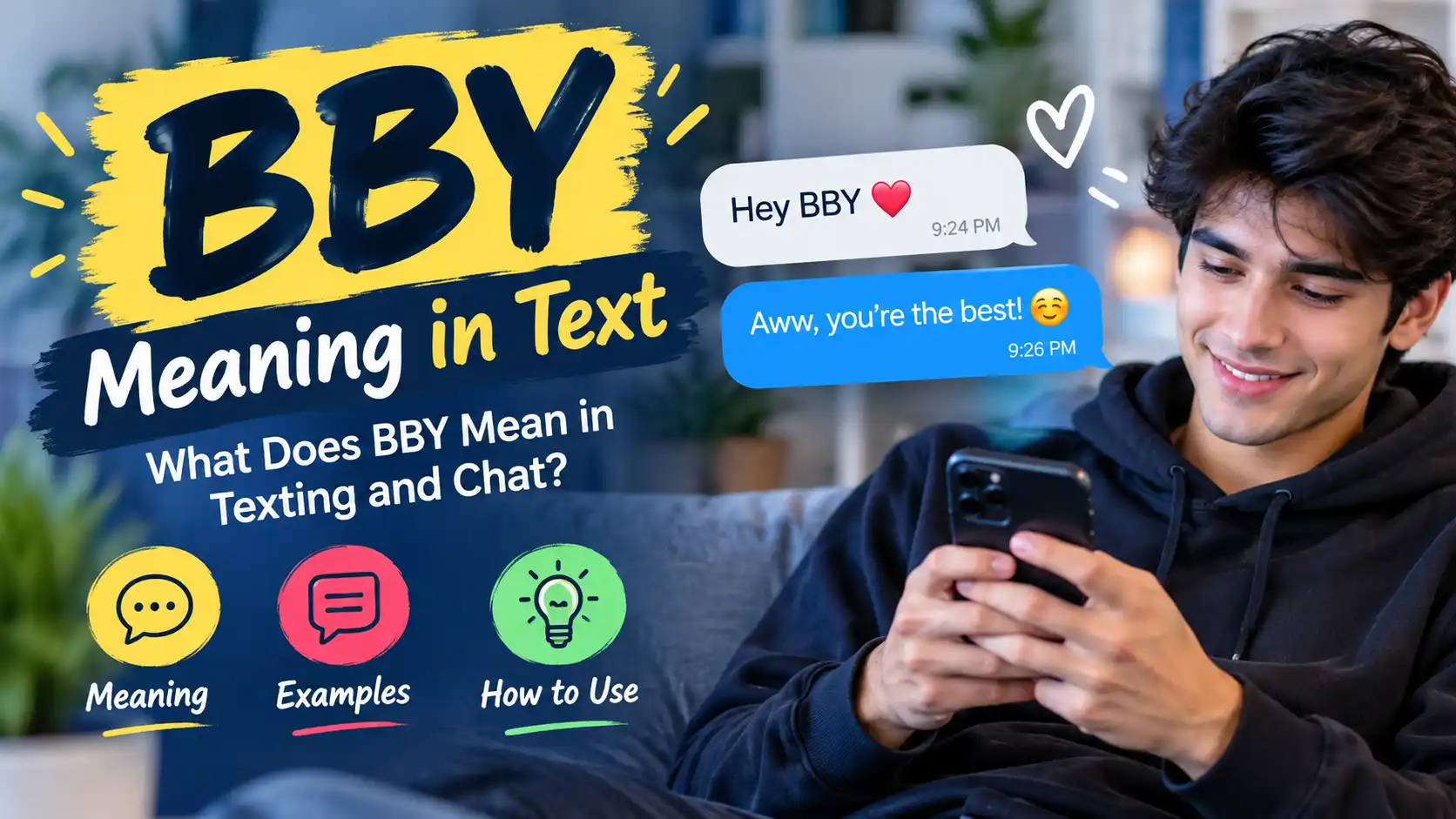
You get a text that just says “hey bby, miss you.” Sweet, simple, and instantly recognizable if you text a lot but a little puzzling if you don’t.
BBY is one of the most common terms of endearment in modern texting. It shows up in romantic messages, close friendships, Instagram comments, and TikTok captions alike, always carrying the same warm, affectionate energy, even when the tone shifts slightly depending on who’s using it.
Understanding BBY matters because it’s one of the small words that shapes how a message feels. The same three letters can read as flirty, sweet, playful, or purely friendly, depending entirely on context and relationship. This guide breaks down exactly what BBY means, where it came from, and how to use or respond to it naturally, no matter the setting.
Definition & Meaning
BBY is a shortened version of “baby,” used as a term of endearment.
It works exactly like “baby” does when spoken out loud expressing affection, closeness, or warmth toward someone, whether that’s a romantic partner, a close friend, or even a family member.
Example:
Partner 1: just got home, exhausted Partner 2: aw bby, get some rest, love you
Here, BBY carries the same warmth as saying “baby” in person, soft, caring, and personal.
Example between friends:
Friend 1: I can’t believe I forgot my umbrella again Friend 2: bby 😭 you always do this
In this case, BBY is used platonically, almost like saying “babe” or “hun” to a close friend, without any romantic meaning attached.
BBY doesn’t carry multiple competing definitions the way some abbreviations do; its meaning stays consistent as a stand-in for “baby.” What changes is the tone and relationship behind it, not the word itself:
- Romantic use between partners, expressing love, comfort, or flirtation.
- Platonic use between close friends, expressing warmth or playful affection.
- Casual social media use commenting on someone’s post in a friendly, complimentary way.
More real life examples:
Text: morning bby, hope you have a good day ☀️
Comment on a photo: you look amazing bby 😍
Group chat: bby stop, you’re too dramatic 😂
The short version: BBY simply means “baby,” used the same affectionate way people already use that word out loud just faster to type.
Background & History
The word “baby” has been used as a term of endearment in English for well over a century, long before texting existed. It has always carried a dual meaning literally referring to an infant, and figuratively expressing closeness, affection, or care toward someone important, romantic or otherwise.
As texting became the dominant way people communicated, especially through the 2000s and 2010s, people naturally began shortening common, frequently typed words to save time. Dropping the vowels from “baby” to create “bby” follows the exact same logic behind other clipped texting words like “luv” for “love” or “u” for “you” keeping just enough letters to instantly recognize the word, while cutting down on typing.
This kind of vowel dropping abbreviation became especially common in early SMS culture, when character limits and small phone keyboards made shorter words genuinely more practical. Even after those technical limitations faded, the shortened style stuck around simply because it had become a familiar, casual way to type.
As social media platforms like Instagram, Twitter, Snapchat, and later TikTok grew, BBY carried over easily into comments, captions, and direct messages, keeping its same core meaning while spreading across new spaces. Because “baby” as a term of endearment already worked well in short bursts of text, BBY fit naturally into fast scrolling, caption heavy platforms.
Today, BBY commonly appears in:
- Texting between romantic partners, expressing affection or checking in
- Friendships, used playfully or warmly without romantic intent
- Social media comments and captions, complimenting or addressing someone casually
- Snapchat and Instagram DMs, especially among younger users
Its core meaning hasn’t shifted much over time. What has expanded is simply how often and how casually it’s used, spreading well beyond strictly romantic contexts into everyday friendly banter.
Usage in Various Contexts
In texting between romantic partners:
Partner 1: thinking about you today Partner 2: aw bby, miss you too
Here, BBY expresses genuine affection and closeness.
Between close friends:
Friend 1: I locked myself out again Friend 2: bby how do you keep doing this 😭
In this context, BBY reads as warm, teasing, and platonic, closer to saying “babe” or “hun” to a friend.
On social media comments:
Comment: you look so good in this bby 😍
In captions:
Caption: just vibing with my bbys this weekend
Here, “bbys” (plural) refers to a close friend group rather than a romantic partner.
In gaming or casual online chat (less common, but present):
Player 1: nice play! Player 2: thanks bby 😂
In flirty, early stage dating conversations:
Match: good morning! You: morning bby, sleep well?
Across these settings, the tone of BBY shifts significantly depending on who’s using it. Between romantic partners, it reads as sincere and affectionate. Between friends, it often becomes playful or teasing. On social media, it usually functions as a light, friendly compliment. The word itself stays the same only the emotional weight behind it changes.
Common Misconceptions & Clarifications
Misconception 1: BBY always implies a romantic relationship. This isn’t accurate. While it’s common between partners, it’s just as often used platonically between friends, especially in comment sections or group chats.
Misconception 2: BBY is only used by teenagers. While younger users popularized the abbreviation, adults across many age groups now use it comfortably in casual texting and social media.
Misconception 3: BBY always signals flirtation. Not necessarily. Context and relationship matter enormously here. The same word can be sincere, playful, sarcastic, or purely friendly, depending on who’s saying it and why.
Misconception 4: BBY is a completely different word from “baby.” It isn’t, it’s simply a shortened spelling. The full meaning and emotional tone carry over directly from the original word.
Misconception 5: Using BBY is always appropriate in any friendly conversation. It depends on the relationship. Using it with someone you don’t know well, or in a professional or unfamiliar context, can come across as overly familiar or even confusing.
Clarification on tone: because BBY relies so heavily on context, the same message can land very differently depending on the relationship. “Bby stop 😂” between close friends feels playful, while the same phrase from someone you barely know might feel oddly intimate or presumptuous.
Similar Terms & Alternatives
| Term | Meaning | Typical Use |
| BBY | Baby (term of endearment) | Romantic or platonic affection |
| BAE | Before Anyone Else / significant other | Romantic partner, casual tone |
| BABE | Baby (alternate spelling) | Similar to BBY, slightly more traditional |
| HUN | Honey | Friendly or affectionate, often platonic |
| BOO | Romantic partner | Affectionate, often playful |
| BBYG | Baby girl | A more specific, often romantic variant |
Examples in use:
Text: hey babe, you home yet?
Friend: love you hun, talk later!
Partner: morning boo, hope you slept well
These related terms all overlap closely with BBY, sharing the same warm, affectionate energy across romantic and platonic contexts alike.
How to Respond to This Term
How you respond to “bby” depends entirely on your relationship with the person and the tone of the message.
Casual response (between friends):
“bby stop, you’re making me blush 😂”
Funny response:
“wow, didn’t know we were on bby terms now 😏”
Romantic response (between partners):
“aw bby, love you too 🥰”
Professional response (if it appears in an unexpected, lightly casual context):
“Thanks! Let’s keep the conversation on track though 😊”
Privacy conscious or boundary setting response (if it feels too familiar):
“Haha, I’d prefer just my name if that’s okay!”
General tips for responding:
- Between close friends or partners, mirroring the warm tone usually feels natural.
- If someone you don’t know well uses it, it’s completely fine to gently steer the conversation back to a more neutral tone if it feels too familiar.
- In flirty, early dating conversations, playing along casually often keeps the mood light without over committing to anything serious.
Regional or Cultural Differences
BBY is primarily an English language texting abbreviation, closely tied to the widespread use of “baby” as a term of endearment across English speaking cultures, particularly in the US, UK, Canada, and Australia.
Because “baby” as an affectionate nickname is deeply embedded in English language pop culture, especially through music, movies, and everyday speech, BBY translates easily across regions, even where the exact abbreviation might be slightly less common.
Some regional variations show up in similar terms:
- In British slang, “hun” or “love” are commonly used in similar affectionate ways, sometimes even more frequently than “bby.”
- In American slang, “bae” and “boo” are extremely common alternatives, often used interchangeably with BBY.
- Non-English speaking online communities frequently adopt English terms of endearment like BBY directly, especially on international platforms like TikTok and Instagram, where affectionate English slang often blends naturally into other languages.
Because terms of endearment are a universal concept across virtually every culture, the underlying sentiment behind BBY is easily understood everywhere, even if the specific English abbreviation isn’t used in every region.
Comparison with Similar Terms
| Term | Core Meaning | Emotional Tone | Best Used When |
| BBY | Baby | Warm, affectionate, flexible | Romantic or close platonic relationships |
| BAE | Significant other | Romantic, casual | Referring to or addressing a partner |
| BOO | Romantic partner | Playful, affectionate | Light, romantic conversations |
| HUN | Honey | Friendly, warm | Often platonic, sometimes romantic |
| BABE | Baby (alternate spelling) | Warm, slightly more traditional | Similar contexts to BBY |
The clearest distinction is flexibility. BBY works comfortably in both romantic and platonic settings, while terms like BAE and BOO lean almost exclusively romantic. This flexibility is part of why BBY has spread so widely across different types of relationships online.
Usage in Online Communities & Dating Apps
On Instagram and TikTok, BBY appears constantly in comments and captions, often as a quick, friendly compliment or affectionate nickname, regardless of the relationship between the people involved.
On Tinder and other dating apps, BBY often shows up once a conversation has warmed up a bit, signaling growing comfort or flirtation:
Match: had such a good time talking to you today You: aw bby, same here 😊
Here, it signals a shift toward a more personal, affectionate tone.
In gaming communities, BBY is less common than in social media or texting, but it can occasionally appear in friendly banter between teammates who know each other well.
Tips for responding appropriately:
- On dating apps, treat “bby” as a sign of growing warmth, and feel free to match the tone if you’re comfortable doing so.
- On social media, it’s usually just a friendly, low stakes compliment, no need to read too deeply into it unless the context suggests otherwise.
- If a stranger or new match uses it too early in a conversation, it’s completely reasonable to set a more neutral tone if it feels premature.
Hidden or Offensive Meanings
BBY does not carry any widely recognized offensive or explicit meaning. It is not linked to slurs, adult content, or aggressive language in mainstream usage.
A few things are worth keeping in mind about tone and context:
- Its meaning depends heavily on relationship and intent. The same word can feel sweet, playful, or overly familiar depending on who’s using it and how well you know them.
- It can occasionally feel presumptuous from strangers. Because “baby” implies closeness, receiving it from someone you don’t know well can feel a little forward, even though the word itself isn’t offensive.
- No hidden negative meaning exists. BBY doesn’t carry any secondary, inappropriate definition in mainstream texting or social media use.
In short, BBY is considered safe and affectionate in nearly all casual contexts. The main consideration is simply whether the closeness it implies matches the actual relationship between the people using it.
Suitability for Professional Communication
BBY is not suitable for professional or formal communication. It’s a term of endearment, and using it in workplace emails, client messages, or official communication would feel inappropriate and overly familiar, regardless of intent.
Why it doesn’t fit well:
- It implies personal closeness that doesn’t belong in professional relationships.
- It could easily be misread as inappropriate or unprofessional, even if meant harmlessly.
- Professional communication depends on maintaining clear, respectful boundaries.
Professional alternatives:
Since BBY has no direct professional equivalent (it’s inherently personal), the better approach in formal settings is simply avoiding any term of endearment altogether and using the person’s name instead.
| Instead of “bby” | Use |
| Addressing someone affectionately | Use their name |
| Expressing appreciation in a work context | “Thanks so much, I appreciate it.” |
Example rewrite:
Casual: “thanks bby, you’re the best!” Professional: “Thank you so much, I really appreciate your help.”
FAQs
1. What does BBY mean in a text message? It’s a shortened version of “baby,” used as a term of endearment toward a partner, close friend, or someone you feel warmly toward.
2. Does BBY always mean something romantic? No, it’s often used platonically between close friends as a playful or affectionate nickname.
3. Is BBY only used by younger people? While it’s especially popular among younger texters, people across many age groups use it comfortably in casual conversation.
4. Is it okay to call a friend “bby”? Yes, it’s commonly used platonically and is generally seen as warm and friendly rather than romantic.
5. Can BBY come across as too forward from someone I just met? It can, especially in early conversations. It’s reasonable to gently redirect the tone if it feels premature.
6. Can I use BBY at work? No, it’s far too casual and personal for professional communication. Use the person’s name instead.
7. Is BBY the same as “bae” or “boo”? They’re similar, but BBY is more flexible, comfortably used in both romantic and platonic contexts, while “bae” and “boo” lean more specifically romantic.
Conclusion
BBY is a simple, affectionate abbreviation for “baby,” used to express warmth, closeness, or flirtation across texting, social media, and casual online conversation. Its meaning stays consistent, but its tone shifts depending on the relationship between sincere and loving between partners, playful and teasing between friends, or lightly complimentary in social media comments.
It fits naturally into personal, casual conversations across nearly every platform, from Instagram to dating apps. In professional or unfamiliar settings, though, it’s best left out entirely, replaced with someone’s actual name instead.

Asfan Wahab is a content creator and writer focused on text meanings, slang, abbreviations, acronyms, and internet expressions. Through Orvexale.com, he provides clear and simple explanations to help readers understand modern texting language. His goal is to make confusing terms easy to understand with practical examples and everyday context.