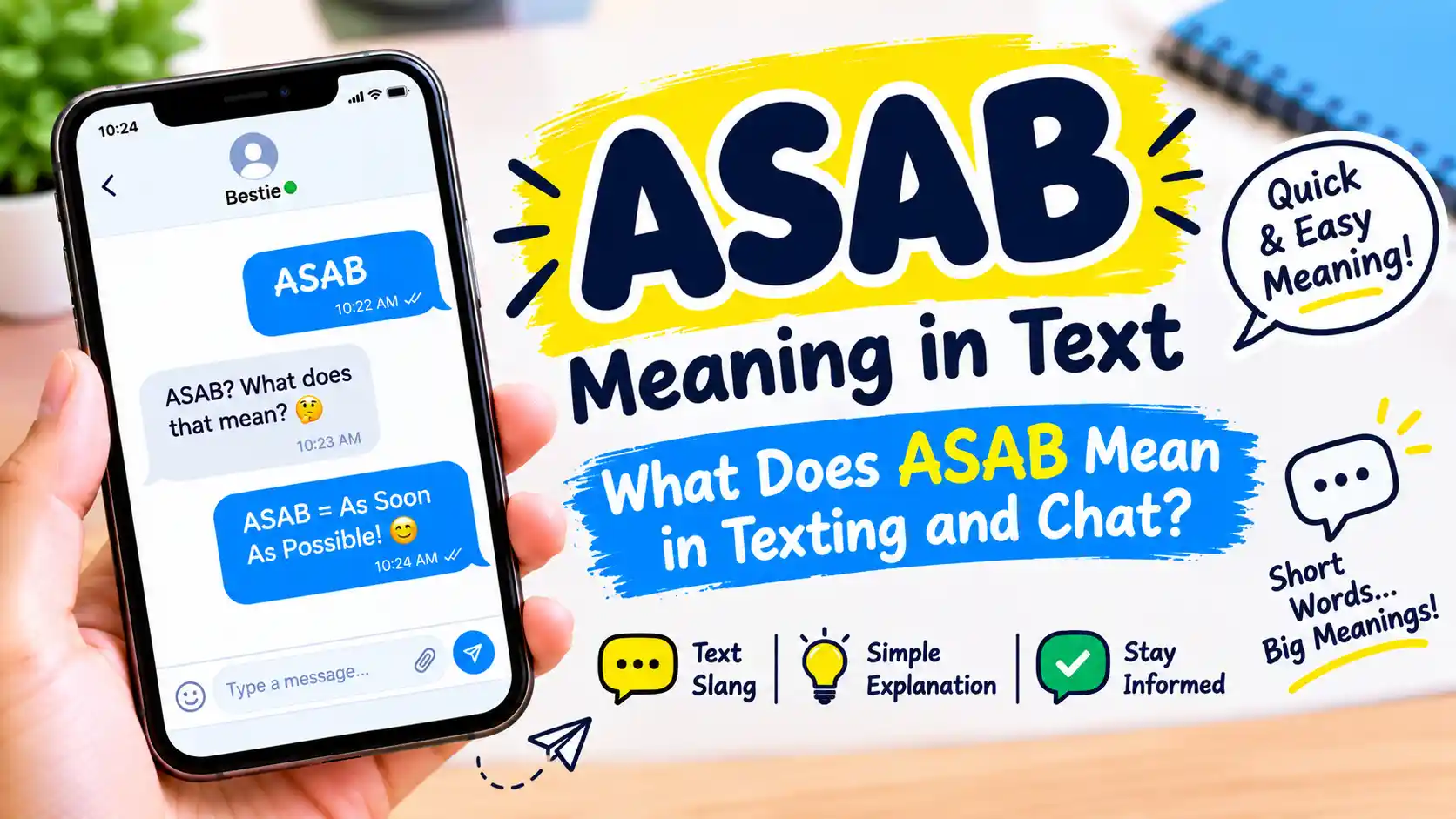
You open a text and see “ASAB” in all caps. It looks urgent. That’s because it is.
ASAB stands for “as soon as bloody possible.” It’s a stronger, more emphatic cousin of the familiar “ASAP.” People use it in texts, work chats, group messages, and social media to push urgency without sounding harsh.
This little abbreviation shows up more often than you’d think, whether it’s a coworker needing a file, a friend asking for a favor, or a gamer calling for backup. Knowing what it means, and how to respond, helps you catch the urgency in a message instantly and reply the right way.
This guide covers where ASAB comes from, how people use it across different platforms, and how to answer it without missing a beat.
Definition & Meaning
ASAB stands for “as soon as bloody possible.” The word “bloody” adds emphasis, a common feature in British English used to stress importance or frustration. Think of ASAB as ASAP with extra punch.
People use ASAB to say:
- Something needs to happen right now, no delays.
- The request carries real urgency, not just casual priority.
- There’s mild frustration or pressure behind the ask.
Here’s how it plays out in real messages:
Boss: Need those slides ASAB, client call moved up You: On it, sending in 10
Friend: Can you call me back ASAB? Something happened You: Calling now
Group chat: someone send the address ASAB, we’re already late Mia: sending now!!
Notice the tone. ASAB carries more weight than a simple “please reply soon.” It signals real time pressure, sometimes paired with stress or a tight deadline. The word choice itself, especially “bloody,” gives it a slightly more emotional edge than a plain “ASAP.”
Some texters also treat ASAB as a simple stand-in for “as soon as possible,” without the added emphasis, especially outside British influenced English. In that use, it functions almost identically to ASAP.
Background & History
ASAB grew out of the same texting habits that gave us ASAP, brb, and other clipped phrases. As phones became the main way people communicated quickly, users looked for ways to type less while saying more.
The word “bloody” has long been common in British English as a mild intensifier, used to stress emotion or urgency in everyday speech. When texting culture picked up speed, this phrase found its way into abbreviated form, blending an already common phrase with a distinctly British twist.
Over time, the term spread beyond strictly British circles. Global connectivity, especially through gaming communities, group chats, and social media, exposed users everywhere to phrases that started in one region and spread worldwide. ASAB became one of many small linguistic exports that traveled through texting and online chat.
Today, ASAB appears most often in fast paced digital spaces: work messaging apps, gaming voice and text chats, and casual friend group texts. It hasn’t replaced ASAP, but it exists as a stronger option when someone wants to stress just how urgent a request really is.
Its history mirrors many texting abbreviations. Born from spoken slang, shortened for speed, then spread through digital communication until it became recognizable well beyond its original audience.
Usage in Various Contexts
ASAB shows up whenever urgency needs to be clear and quick.
Texting
Partner: call me back ASAB, need to talk about tonight You: okay give me 5 mins
Here, ASAB signals something time sensitive, though not necessarily an emergency.
Social Media
Comment: can someone explain what happened ASAB, I’m so confused Reply: check the pinned post, it explains everything
On social media, ASAB often shows up when people want quick clarification during a fast moving conversation or trending topic.
Gaming Chats
Teammate: need healing ASAB, I’m about to die You: coming, hold on!
In gaming, timing is everything. ASAB cuts through the noise instantly, letting teammates know a request can’t wait.
Casual Conversations Among Friends
Friend: where are you, we need to leave ASAB You: two minutes away, don’t leave without me!
This use keeps things light while still pushing urgency, especially among close friends who use casual, expressive language.
Professional Settings
Coworker: can you send that file ASAB, the meeting just got pushed up You: Sending it right now.
While ASAB works in fast, informal workplace chats, it’s less common in formal emails, largely due to its casual and mildly informal tone.
Across every setting, ASAB does one job well: it makes urgency obvious without needing a long explanation.
Common Misconceptions & Clarifications
A few mix ups happen with ASAB, so here’s what to clear up.
Misconception 1: ASAB and ASAP mean exactly the same thing. They’re close, but not identical. ASAP is neutral and widely accepted everywhere. ASAB adds emotional emphasis, often implying more pressure, stress, or informality behind the request.
Misconception 2: The word “bloody” makes ASAB offensive. In British English, “bloody” is a mild intensifier, similar to saying “really” or “very.” It’s not considered a swear word in most contexts, though it can sound casual or slightly rough depending on the audience. It’s not vulgar, but it’s not fully neutral either.
Misconception 3: ASAB only works in British English contexts. While it originated with British phrasing, ASAB has spread internationally, especially through texting and gaming. Many users apply it as a stronger version of ASAP without thinking about its British roots.
Misconception 4: Using ASAB always signals anger. Not necessarily. Tone depends on context. A group chat friend using ASAB about grabbing coffee doesn’t carry the same weight as a coworker using it during a work crisis. The urgency is real, but the emotional intensity shifts with the situation.
Clarification on appropriateness: ASAB isn’t crude or inappropriate in casual settings, but its informal tone means it’s best kept out of client facing or highly formal communication.
Similar Terms & Alternatives
Several phrases carry similar urgency to ASAB. Here’s how they stack up.
| Term | Meaning | Best Used When |
| ASAB | As soon as bloody possible | Urgent request with added emphasis |
| ASAP | As soon as possible | Standard urgent request, neutral tone |
| RN | Right now | Immediate, casual urgency |
| STAT | Immediately (medical origin) | High urgency, often professional or emergency use |
| Now now | Immediately, no delay | Casual, sometimes playful urgency |
| On the double | Very quickly | Older or more formal urgent phrasing |
| NBD but soon | Not a big deal, but timely | Softer urgency, less pressure |
ASAB stands out because it blends urgency with personality. ASAP feels neutral and professional, while ASAB carries a slightly more emotional, expressive punch, useful when someone wants to stress real pressure without sounding overly formal.
How to Respond to This Term
Replies to ASAB should match the urgency behind it.
Casual:
Friend: need that answer ASAB You: on it, give me 2 mins
Funny:
Friend: ASAB or the plan’s ruined!! You: relax, I got you, superhero mode activated
Professional:
Coworker: can you confirm ASAB, deadline moved up You: Confirmed, sending details shortly.
Privacy conscious or brief:
Person: ASAB please You: On it.
Reassuring:
Person: need this ASAB, kind of stressed You: don’t worry, I’m handling it right now
Matching tone matters here. If the sender sounds stressed, a reassuring reply helps more than a purely casual one. If it’s lighthearted, playful responses keep the mood easy.
Regional or Cultural Differences
ASAB carries clear British roots, thanks to the word “bloody,” which is far more common in British, Irish, Australian, and New Zealand English than in American English.
- UK and Australia: “Bloody” is a familiar, mild intensifier in everyday speech, so ASAB feels natural and instantly understood.
- United States: “Bloody” is less common in casual speech, so ASAB sometimes gets used without full awareness of its British flavor, mostly just as a stronger stand in for ASAP.
- Global gaming and online communities: Because gaming chat pulls from players worldwide, ASAB spreads regardless of regional origin, often losing its specific British association over time.
Outside English speaking regions, ASAB appears mainly in bilingual or English influenced online spaces, particularly among gamers and social media users exposed to global English slang.
Comparison with Similar Terms
Here’s a closer look at tone, formality, and urgency level.
| Term | Formality | Urgency Level | Typical Platform |
| ASAB | Informal | High, with emphasis | Texting, gaming, casual work chats |
| ASAP | Neutral to formal | High | Texting, email, workplace |
| STAT | Formal, professional | Very high | Medical, emergency, professional |
| RN | Very informal | High | Texting, casual chat |
| Now now | Very informal | Medium to high | Texting, casual speech |
The key difference: ASAB pushes urgency with personality, while ASAP stays neutral and safe across almost any setting.
Usage in Online Communities & Dating Apps
On Twitter/X, ASAB often shows up during trending topics or live events, where users want fast answers:
Reply: wait what happened, explain ASAB Reply 2: thread incoming, one sec
In gaming communities, ASAB is a staple during high pressure moments, especially in competitive matches where seconds matter.
On dating apps like Tinder or Hinge, ASAB appears less often, since urgency doesn’t usually fit early conversations. It shows up more in planning logistics once a match has already progressed:
Match: can you confirm the time ASAB? Trying to book the table You: yes! 7pm works perfectly
Tip for responding on these platforms: Match the pace. A quick, clear reply respects the urgency, while over explaining can slow things down when speed is the whole point.
Hidden or Offensive Meanings
ASAB doesn’t carry a hidden or offensive meaning in mainstream use. Its only mildly sensitive element is the word “bloody,” which functions as a soft intensifier in British English rather than a harsh or vulgar term.
Still, tone and audience matter. In more formal or international settings unfamiliar with British slang, ASAB might come across as slightly odd or overly intense if the recipient doesn’t recognize the phrase. In workplaces with strict formality standards, even a mild intensifier can feel out of place.
There’s no coded or double meaning tied to ASAB in slang dictionaries or online communities. It functions exactly as it reads: an emphasized version of urgent timing.
Suitability for Professional Communication
ASAB works best in casual or fast paced informal work chats, not in formal emails or client communication.
For professional alternatives, consider:
- “Please send this as soon as possible.”
- “This is time sensitive, thank you for the quick turnaround.”
- “Please prioritize this today if possible.”
- “Urgent: response needed within the hour.”
Even in relaxed workplace cultures, ASAB’s informal tone and British colloquial flavor make it better suited for internal chat messages between close teammates rather than anything client facing or formally documented.
FAQs
1. What does ASAB mean in texting? It means “as soon as bloody possible,” a stronger, more emphatic version of ASAP.
2. Is ASAB the same as ASAP? They’re similar, but ASAB carries extra emphasis and urgency, often with a slightly emotional or stressed tone.
3. Is ASAB rude or offensive? No. “Bloody” functions as a mild intensifier in British English, not a vulgar term, though tone can still shift depending on the setting.
4. Can I use ASAB in a work email? It’s better suited for casual chat messages. For formal emails, use “as soon as possible” or “urgent” instead.
5. Where did ASAB come from? It comes from British English’s use of “bloody” as an intensifier, blended into the common phrase “as soon as possible.”
6. Is ASAB used outside the UK? Yes, especially in gaming and global texting communities, though its British roots are strongest.
7. How should I respond to someone who says ASAB? Match their urgency with a quick, clear reply, and add reassurance if they sound stressed.
Conclusion
ASAB means “as soon as bloody possible,” a punchier way of saying something needs attention right now. It shows up in texts, gaming chats, social media, and casual work conversations whenever urgency needs to come through clearly.
While it carries British roots, ASAB has traveled well beyond that origin, especially online. Save it for casual, fast moving conversations, and reach for more formal phrasing in professional writing.
Next time ASAB lands in your inbox or chat, you’ll know exactly how urgent the message really is, and how to respond without missing a beat.

Noman Hassan is a content creator and writer focused on text meanings, slang, abbreviations, acronyms, and internet expressions. Through Orvexale.com, he provides clear and simple explanations to help readers understand modern texting language. His goal is to make confusing terms easy to understand with practical examples and everyday context.