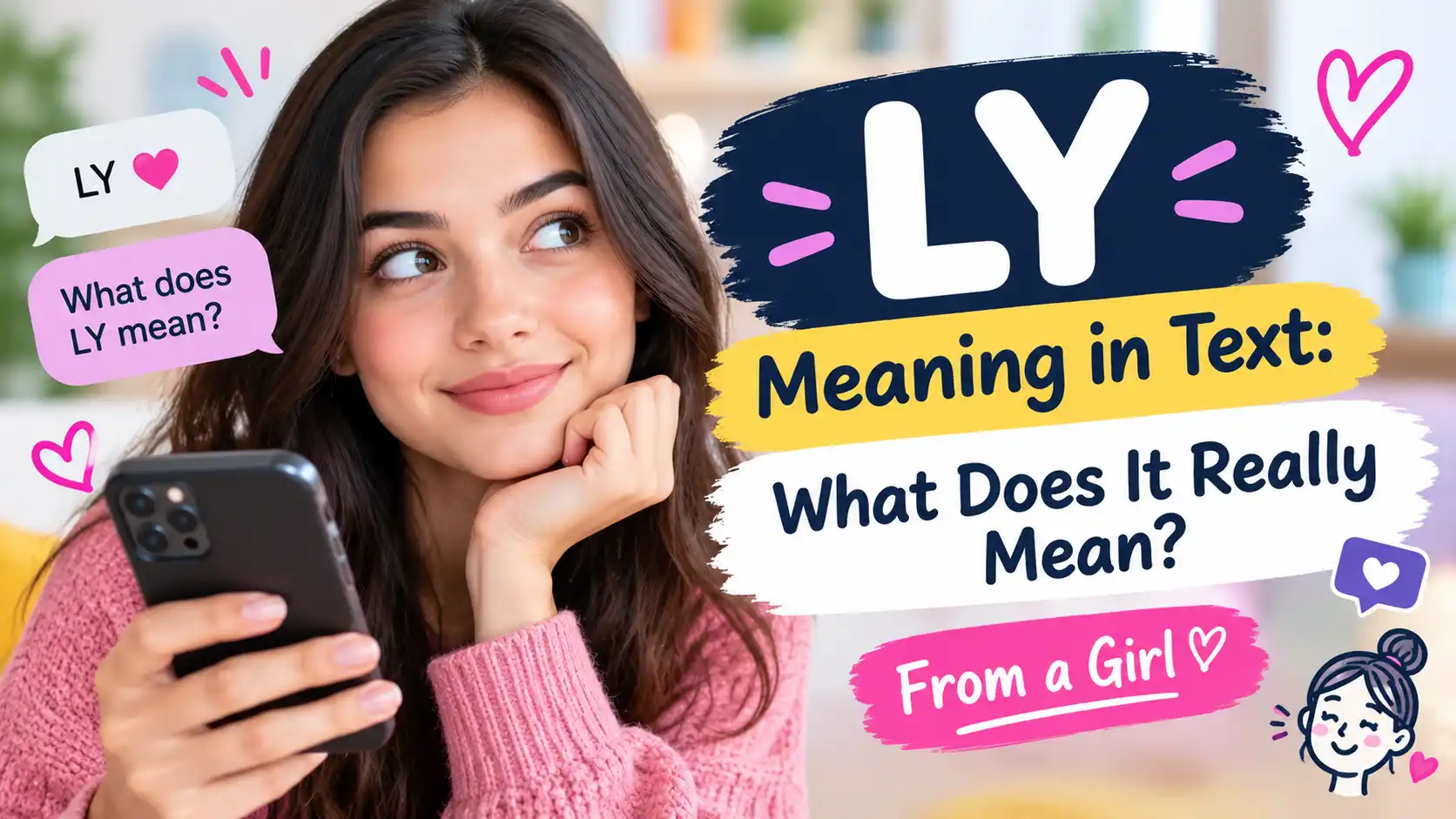
You get a text. It says, “ly.” Just two letters. Now you wonder what it means. Is she being sweet? Is she flirting? Or is it just a quick sign off?
You are not alone. Many people see “LY” and freeze. Short texts can hide big feelings, and one wrong guess can make things awkward.
LY usually means “love ya.” It is a quick, warm way to say you care. You will see it in texts, on Snapchat, on Instagram, and in group chats. Gamers use it when a teammate saves the match. Friendly coworkers sometimes use it too.
Why does this matter? Because tone changes everything. The same two letters can mean “you’re my best friend” or “I like you.” This guide breaks it down in plain words. You will learn what it means, where it came from, and how to reply. Let’s start.
Definition & Meaning
What Does LY Stand For?
LY stands for “love ya.” Some people also write it as “love you.” It is a short form of a warm phrase. Think of it as a tiny hug in text form.
The Feeling Behind It
Most of the time, LY is light and friendly. It is not a big, serious love confession. It is closer to “you matter to me” or “I’m glad you’re in my life.”
A girl might send it to:
- A close friend
- A sister or cousin
- A partner
- A group chat she feels safe in
Real Life Examples
Example 1: A friend after a favor
Her: Thanks for helping me with my homework!
You: Anytime!
Her: ly 💛
She is saying thanks with warmth. Nothing more.
Example 2: Ending a call
Her: Okay, I have to go. Talk tomorrow?
You: Sure. Sleep well.
Her: ly, bye!
This is a casual goodbye. She says it the way people say “take care.”
Example 3: A romantic partner
Her: Miss you already.
You: Miss you more.
Her: ly so much
Here it carries more weight. The words around it matter.
Why It Is So Short
People text fast. Two letters are quicker than “love you.” They also feel softer and less heavy than the full phrase. That is why many girls pick “ly” over “I love you.” It lets them share care without making things intense.
Key point: LY means “love ya.” The context tells you how deep it goes.
Background & History
Where It Started
Short texting words began long before smartphones. In the early days of mobile phones, texts had a 160 character limit. Typing was slow, since phones only had number keys. People cut words down to save time and money.
That is how “u” became “you” and “gr8” became “great.” Phrases of affection got shorter too. “Love you” turned into “luv u.” Then it turned into “ly.”
The Chat Room Era
In the late 1990s and 2000s, chat rooms and instant messengers grew fast. People typed in a rush and used acronyms to keep up. “LOL,” “BRB,” and “TTYL” came from this time. Affection acronyms like “ILY” (I love you) and “LY” joined the list.
Social Media Changed Things
Then came MySpace, Facebook, Instagram, and Snapchat. Comments and captions were short. Teens and young adults used “ly” under photos of friends. It became a quick way to show support in public.
How It Has Changed
Today, “ly” is often softer and more casual than “ily.” Many people see “ily” as the more serious one. “LY” feels like a light pat on the back.
It also gets stretched into new forms:
- lyy or lyyy for extra warmth
- lysm for “love you so much”
- lyt for “love you too”
Where It Is Common Today
You will mostly see it in:
- Private texts
- Instagram and Snapchat chats
- Group chats among friends
- Comments on close friends’ posts
In short: LY grew out of the need to type less. It stayed because it feels warm, quick, and easy.
Usage in Various Contexts
In Texting
This is where “ly” lives most. A girl may use it to end a chat, say thanks, or comfort someone.
Her: Ugh, bad day.
You: I’m sorry. Want to talk?
Her: Maybe later. Just needed to vent.
You: I’m here.
Her: ly ❤️
On Social Media
On Instagram or Snapchat, “ly” often shows up in replies to stories and DMs.
Her: (replies to your story) Omg this is so cute!!
You: Thank you!
Her: ly, you always post the best stuff
Here it is a compliment with a bit of warmth.
In Gaming
Girls who play online may use “ly” with teammates they know well. It is less common with strangers.
Her: That revive was perfect!
You: Got your back.
Her: ly, best teammate ever 😂
It works like a friendly high five.
In Casual Conversation
Between close friends, “ly” is easy and automatic.
Her: Are you coming to my party?
You: Wouldn’t miss it.
Her: Yay! ly!
In Group Chats
In a group, “ly” often means “love you all” or just a general good vibe.
Her: Thanks for the birthday wishes, everyone!
Friend: Happy birthday!
Her: ly guys
In Long Distance Relationships
Partners who live far apart may use it more often, since texting is their main link.
Her: Landed safely.
You: Great. I was worried.
Her: Aw. ly
Key point: The setting and her habits shape the meaning. Look at how she texts other people too.
Common Misconceptions & Clarifications
Misconception 1: “LY Means She Is in Love With Me”
Not always. LY is often platonic. Many girls text “ly” to best friends, sisters, and even coworkers they like. It is a kind word, not a promise.
Misconception 2: “LY Is the Same as ILY”
They are close, but not equal. “ILY” is usually a bit stronger. “LY” feels lighter. Some people use them the same way, but many do not.
Misconception 3: “It Always Means Love Ya”
Mostly, yes. But some other meanings exist:
- ly is a common word ending, as in “really” or “lovely.”
- Ly can be a name or surname, as in the Vietnamese surname Ly.
- Rarely, it is a typo for another short word.
If the message is only “ly” in reply to a question, it is almost always “love ya.”
Misconception 4: “She Is Flirting”
She might be. But don’t assume. Look at the clues:
- Does she text everyone this way?
- Does she add hearts or a wink?
- Does she start the chat often?
- Does she ask personal questions?
Misconception 5: “It Is Rude or Wrong to Say It Back”
Not at all. Saying “ly too” to a friend is fine. If you are unsure, keep it light.
Can It Be Misread?
Yes. Text has no voice or face. A “ly” from a girl you barely know might feel odd. A “ly” from your partner after a fight might feel like a peace offering.
Example:
Her: ly
You: …wait, what do you mean?
Her: Lol, I mean love ya. Like a friend 😅
There is nothing wrong with asking. A short, kind question clears things up fast.
Key point: Do not read too much into two letters. Read the whole chat, her habits, and her tone.
Similar Terms & Alternatives
Many words say the same thing as “ly.” Here are the common ones.
| Term | Meaning | Tone |
| LY | Love ya | Light, friendly |
| ILY | I love you | Warmer, more direct |
| LYSM | Love you so much | Very warm |
| LYT | Love you too | Reply to “ly” |
| LU | Love you | Casual, short |
| Luv u | Love you | Playful |
| XOXO | Hugs and kisses | Sweet, often flirty |
| 💛 / ❤️ | Love, care | Depends on the emoji |
| Ty | Thank you | Polite, not loving |
| Miss u | I miss you | Warm, personal |
Longer Fun Ones
- LYLAS: Love you like a sister
- LYLAB: Love you like a brother
- LYL: Love you lots
Words Girls Use in Place of LY
Some girls skip acronyms. They may say:
- “Love you lots!”
- “You’re the best.”
- “Miss you!”
- “Thinking of you.”
- “You’re my person.”
Emojis Count Too
Sometimes a heart says it all. But not all hearts mean the same thing.
- 💛 💙 💜: Friendly and warm
- ❤️: Warmer, can be romantic
- 😘: Playful or flirty
- 🥰: Affection, sweet mood
Quick Rule
The more words and hearts she adds, the stronger the feeling. A lone “ly” is usually light. “lysm 🥺❤️” is a lot warmer.
How to Respond to This Term
You have options. Pick the one that fits your bond with her.
Casual Reply
Good for friends.
Her: ly!
You: ly too!
Or:
You: Aw, love ya too!
Funny Reply
Good when the mood is light.
Her: ly
You: I know, I’m very lovable 😎
Or:
You: ly more. Don’t argue.
Sweet Reply
Good for partners or very close friends.
Her: ly
You: Love you too. Always.
Playful and Flirty Reply
Use this only if the vibe is already flirty.
Her: ly 😘
You: Careful, I might get used to this.
Professional or Polite Reply
If a coworker or classmate sends it, keep it kind but neutral.
Her: Thanks for covering my shift, ly!
You: Happy to help! Glad it worked out.
Privacy Conscious Reply
If you are not ready to say it back, you don’t have to.
Her: ly
You: Aw, that’s so kind. Thank you 😊
Or:
You: You’re awesome. Thanks for being such a good friend.
This keeps things warm. It also avoids a promise you don’t feel.
If You Are Unsure
Ask, gently.
Her: ly
You: Aw! You’re sweet. Was that a friendly ly or something more? 😄
Key point: Match her energy. If she is light, be light. If she is serious, be honest. Never feel forced to say “love you” back.
Regional or Cultural Differences
English Speaking Countries
In the US, Canada, the UK, and Australia, “ly” is common among teens and young adults. It is seen as a casual, friendly term.
The UK
British texting often uses “love” as a casual word. Shopkeepers, friends, and family say “cheers, love.” So “love ya” and “ly” feel very natural. It often has no romantic meaning at all.
South Asia
In countries like Pakistan and India, young people text in English and mix in local words. “Ly” or “luv u” may appear among close friends and cousins. But expressions of love can feel more private in some families and communities. Girls may use “ly” with female friends far more than with boys. A girl sending “ly” to a boy may feel like a bigger step there. Context and culture matter a lot.
Other Languages
Many languages have their own short forms:
- Spanish: “tq” or “tk” for “te quiero”
- French: “jtm” for “je t’aime”
- Portuguese: “te amo” or “ta” in casual chat
- German: “hdl” for “hab dich lieb”
These are not the same as “ly,” but they play the same role.
Slang Variations
Around the world you may see:
- luv ya
- luvya
- lyk (sometimes a typo)
- lyy
- lysm
Cultural Comfort Levels
Some cultures speak of love openly. Others save it for family or partners. So a girl’s “ly” may mean something different depending on where she grew up and who she is texting.
Key point: Don’t judge “ly” by your own culture alone. Know who she is. Then read the message.
Comparison with Similar Terms
Here is how “ly” compares to close cousins.
| Term | Strength | Best Used With | Romantic? |
| LY | Light | Friends, family, partners | Sometimes |
| ILY | Medium | Close friends, partners | Often |
| LYSM | Strong | Best friends, partners | Sometimes |
| ILYSM | Very strong | Partners, family | Often |
| Ty | Very light | Anyone | No |
| XOXO | Medium | Friends, partners | Often |
| Miss u | Medium | Close ones | Sometimes |
LY vs. ILY
LY is casual. ILY feels more deliberate. Think of “ly” as a smile. Think of “ily” as a hug.
Example:
Her: ly
You: ly too
Now compare:
Her: ily
You: …I love you too?
The second one feels heavier.
LY vs. LYSM
LYSM adds “so much.” It shows more feeling. A girl who writes “lysm” probably feels strongly about you, or is very expressive.
LY vs. Ty
Do not mix these up. “Ty” means thank you. It has no love in it. If a girl writes “ty” and you reply “ly too,” it will feel odd.
LY vs. XOXO
XOXO is more playful. It can be flirty. “LY” is calmer and more sincere.
LY vs. Miss U
“Miss u” says she wants you around. “LY” says she cares. Both are sweet, but “miss u” points to absence, while “ly” points to affection.
Key point: Length and extra words change the weight. More letters, more love.
Usage in Online Communities & Dating Apps
Tinder, Bumble, and Hinge
On dating apps, “ly” is rare early on. If a match sends it in the first days, it may be very casual or a sign she is playful. After weeks of chatting, it can carry real warmth.
Her: This was such a fun chat!
You: Same. Talk tomorrow?
Her: Yes! ly, goodnight 😊
Here it is warm, but check the pace. She may still be just friendly.
Twitter/X and Instagram
Girls often use “ly” in replies to friends.
Friend: Sending you good vibes for your exam!
Her: aww ly 🫶
It is public and casual. It means “thank you, you’re kind.”
Snapchat
Snapchat chats are short and fast. “Ly” is very common there, often sent at the end of a chat or with a photo.
Gaming Communities
Discord servers and gaming lobbies use “ly” among friends. With strangers, it is less common. A girl might drop it after a great game.
Her: GG everyone
You: GG! That last round was wild.
Her: ly all, you were awesome
Fan Communities
In fandoms, people use “ly” toward fellow fans. It is a group love thing.
Tips for Responding Well
- Match the platform. Casual on Snapchat, gentler on dating apps.
- Don’t rush. On a new match, a warm thanks is enough.
- Read her pattern. Does she say it to everyone?
- Be honest. If you feel the same, say so. If not, be kind.
- Avoid pressure. Never push her to say more.
Key point: On dating apps, take “ly” as a good sign, not a promise.
Hidden or Offensive Meanings
Is LY Offensive?
No. By itself, “ly” is a kind word. It is not rude, and it has no hidden insult built in.
Possible Alternative Meanings
There are a few things to watch for:
- A typo: She may have meant “lol,” “ily,” or “ty.”
- A word ending: In a longer message, ” ly” is just part of a word.
- A name: Ly is a surname in some cultures.
- Sarcasm: “Yeah, ly” said after an argument could be a joke or a jab.
Can It Be Used the Wrong Way?
Yes, in a few cases:
- Mixed signals: A girl who says “ly” to be nice, then pulls away.
- Guilt tripping: Someone uses it to get their way.
- Sarcasm: “Sure. ly.” after a fight can sting.
Why Tone Matters
Text has no voice. A smile, a shrug, or a laugh all vanish. So the words around it and the emojis carry the tone.
Example:
Her: ly 😊
That is warm.
Her: ly.
That could feel cold or tired.
Her: ly 🙄
That may be sarcasm.
Same letters. Very different feelings.
Watch for Red Flags
- She says “ly” but ignores your messages.
- She says it only when she needs a favor.
- She uses it to smooth over hurtful behavior.
In those cases, the two letters don’t tell the whole story. Actions speak louder than acronyms.
If You Feel Uncomfortable
You are allowed to say so.
You: I appreciate that. I just want to keep things as friends.
Be kind but clear. Honest words protect both of you.
Key point: LY is not offensive. The tone, timing, and behavior decide how it feels.
Suitability for Professional Communication
Is LY Okay at Work?
Usually, no. “Ly” is casual and warm. Most workplaces expect neutral, polite language. Sending “ly” to a boss or a client may seem too personal.
When It Might Be Fine
- In a very relaxed team chat
- Between close coworkers who are also friends
- On a private message where the culture is friendly
Even then, use it sparingly. Ask yourself: would I be okay if my manager read this?
When to Avoid It
- Emails to clients
- Messages to a boss
- Group chats with senior staff
- Any formal document or announcement
- Chats with someone you barely know
Examples
Not ideal:
Coworker: Thanks for covering my shift.
You: ly!
Better:
You: Happy to help! Let me know if you need anything else.
Professional Alternatives
Here are warm but proper options:
| Casual | Professional |
| ly | Thank you so much. |
| ly, you’re the best | I really appreciate your help. |
| ly for this | Grateful for your support. |
| ly all | Thanks, everyone. Great work. |
| lysm | Thank you, this means a lot. |
If a Coworker Sends It to You
Stay calm. Most likely she means it in a friendly way. You can reply with a kind, neutral line.
Coworker: Thanks for the help, ly!
You: Anytime! Glad it worked out.
This is polite and safe. It does not return the “love” but stays warm.
If It Feels Unwelcome
When a coworker’s messages start to feel too personal, tell her politely. If it continues, speak to HR or a manager.
Key point: At work, choose clear and kind over quick and cute. Save “ly” for friends.
FAQs
1. What does “ly” mean in a text from a girl?
It usually means “love ya.” It is a short, friendly way to show care. Sometimes it means “love you.” The tone depends on the bond you share.
2. Does “ly” mean she likes me romantically?
Not always. Many girls send it to friends and family. Look at her other habitsLook for the context: Does she use hearts? Does she text you often? Does she flirt in other ways? If not, it is probably friendly.
3. How do I reply to “ly”?
Keep it simple. You can say “ly too,” “love ya too,” or “you’re the best.” If you don’t feel the same way, try “aw, thank you, that’s sweet.”
4. Is “ly” the same as “ily”?
Close, but not the same. “ILY” means “I love you” and often feels stronger. “LY” is lighter and more casual.
5. Is “ly” appropriate at work?
Usually not. It is casual and personal. Use “thank you” or “I really appreciate it” instead.
6. Can “ly” mean something rude?
No. It is a kind phrase. But the tone can shift with emojis or sarcasm. A cold “ly.” or a “🙄” can change the feeling.
7. Should I say “ly” back if I don’t feel the same?
You don’t have to. Be honest and kind. You can reply with “thank you” or “you’re awesome” and keep things warm without promising more.
Conclusion
“LY” is a small phrase with a soft heart. It usually means “love ya.” It is quick, warm, and friendly. You will see it in texts, on social media, in games, and in group chats.
Remember these key points:
- LY is usually light and caring, not always romantic.
- Context matters. Read her tone, her emojis, and her habits.
- You can reply in many ways: casual, funny, sweet, or polite.
- Culture changes meaning. What feels normal in one place may feel bigger in another.
- At work, skip it. Use “thank you” instead.
- When unsure, ask. A kind question beats a wrong guess.

Asfan Wahab is a content creator and writer focused on text meanings, slang, abbreviations, acronyms, and internet expressions. Through Orvexale.com, he provides clear and simple explanations to help readers understand modern texting language. His goal is to make confusing terms easy to understand with practical examples and everyday context.