You are scrolling through your phone. A friend sends you a text. It says, “He forgot the tickets again. smh.” You pause. What does that mean?
SMH is one of the most common short forms in texting. You see it in chats, tweets, comments, and game lobbies. Even your boss might type it one day.
The term is short, but the feeling behind it is big. It shows you are annoyed, let down, or in shock. You can say a lot with just three letters.
Knowing what SMH means helps you read a message the right way. It also keeps you from sending the wrong signal. Use it at the wrong time, and you may sound rude. Skip it when it fits, and you may miss a chance to be funny.
In this guide, you will learn what SMH means and where it came from. You will also learn how to use it and how to reply.
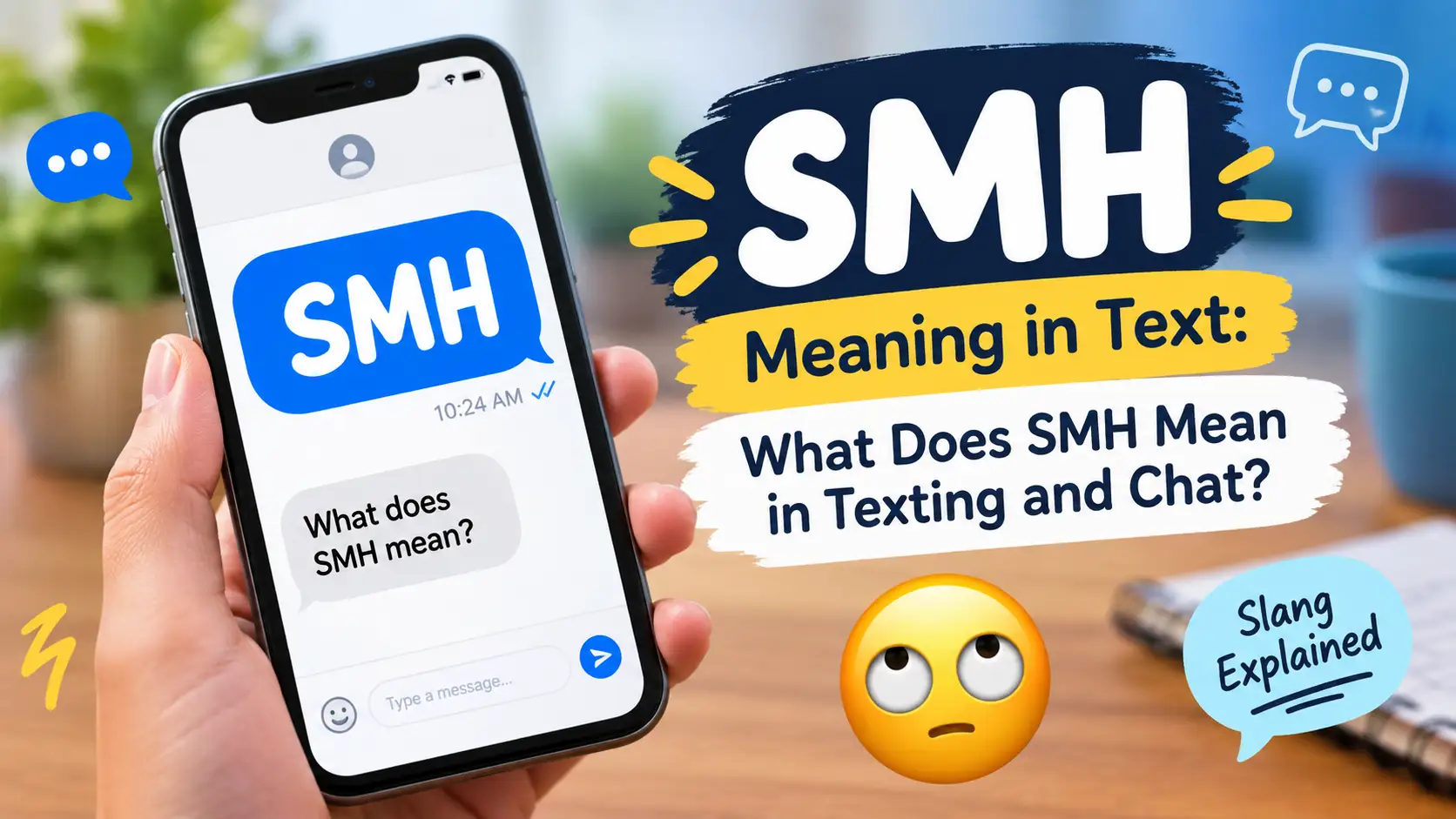
What Does SMH Mean in Text?
SMH stands for “shaking my head.”
People use it when something is silly, sad, or hard to believe. Picture someone slowly moving their head from side to side. That is the feeling. You can’t shake your head in a text. So SMH does it for you.
The Core Meaning
SMH can show one of these feelings:
- Disappointment: “I expected better.”
- Disbelief: “I can’t believe this happened.”
- Mild disapproval: “That was not a smart move.”
Real Life Examples
Example 1: A lost phone
Mia: My brother left his phone in the taxi. Again.
Zoe: smh
Example 2: A sports loss
Tom: We lost by one point. We had the ball with ten seconds left.
Ben: smh. So close.
Example 3: A social media comment
Ana: People still don’t wear seat belts. smh
How to Say It
Most people just type it. If you say it out loud, you can say each letter: “S M H.” Some people say the full phrase, “shaking my head.”
Uppercase or Lowercase?
Both work. “SMH” looks louder. “smh” looks calmer and more casual. Most people use lowercase in texts.
Quick Facts
- It has three letters and three words.
- It is not a rude word by itself.
- It works best when the reason is clear from the message.
- It is often placed at the end of a sentence, like a sigh.
Now you know the basic meaning. Next, let’s see where it came from.
Background & History of SMH
Where Did SMH Come From?
Nobody can point to one person who made it up. SMH grew out of early internet chat. In the late 1990s and early 2000s, people typed fast in chat rooms and forums. Short forms saved time. LOL and BRB were already popular. SMH joined them soon after.
The Texting Boost
Old phones had tiny keyboards. You had to press a key many times to type one letter. A text could only hold about 160 characters. So people cut their words down. “Shaking my head” became “smh.” It was quick and clear.
The Twitter Effect
Then came Twitter. Tweets once had a 140 character limit. Every letter counted. SMH fit perfectly. Around the late 2000s and early 2010s, it spread fast. Fans, celebrities, and news pages used it. The hashtag #smh helped it go viral.
How It Changed Over Time
At first, SMH was mostly a light sigh. Over time, it grew more flexible. Today it can mean:
- Light teasing between friends
- Deep frustration about the news
- Sarcasm about a silly mistake
Emoji changed things too. The facepalm emoji 🤦 gave people another way to show the same feeling. Yet SMH did not fade. Many people use both together.
Where It Is Common Today
You will find SMH in:
- Text messages
- Instagram, TikTok, and X comments
- Reddit threads
- Discord and game chats
- Casual work chats
Many major dictionaries now list it. That shows how far it has come from a chat room shortcut.
A Quick Timeline
| Period | What Happened |
| Late 1990s to early 2000s | Chat rooms and forums make short forms popular |
| Mid 2000s | Texting turns shortcuts into daily habits |
| Late 2000s to 2010s | Twitter and social media make SMH mainstream |
| Today | Used worldwide, often with emoji |
Usage in Various Contexts
SMH changes a little depending on where you use it. Here is how it works in the most common places.
In Texting
In a text, SMH is a quick reaction. It often shows up alone or at the end of a message.
Lena: The bus was 40 minutes late. Then it broke down.
Rita: smh. Transport is a joke.
On Social Media
On social media, SMH often goes with news, trends, or bad behavior. It is a fast way to say, “I can’t believe this.”
Post: “A man wore flip flops to climb a mountain.”
Comment: “smh. Some people never learn.”
In Gaming
Gamers use SMH when a teammate makes a bad play. It is usually half joking.
Jay: I walked right into the trap.
Kai: smh. You had the map open!
Jay: Fair. My bad.
In Casual Conversation
Some people even say “S M H” out loud. It sounds funny, so friends use it as a joke.
Sam: I ordered pizza. They sent me a salad.
Dee: Wow. Just… smh.
In Work Chats
At work, SMH is rare, but it can appear in casual team chats. It is best kept between close coworkers.
Chris: The printer jammed again.
Pat: smh. Third time this week.
Key Tips for Using SMH
- Add context. Say why you are shaking your head.
- Match the mood. Use it for small annoyances, not for serious sad news.
- Know your audience. Friends get it. Your grandma might not.
- Keep it short. One “smh” is enough. Ten in a row looks like spam.
Common Misconceptions & Clarifications
SMH is simple. But people still mix it up. Here are the most common mistakes.
Misconception 1: SMH Always Means Anger
Not true. SMH can be soft and playful. A friend who says “smh” after you spill coffee is likely just teasing.
Ken: I tripped on a flat road.
Ali: smh 😂
That is not anger. That is friendship.
Misconception 2: SMH Means “So Much Hate”
Some people say SMH means “so much hate.” That meaning is very rare. In almost every chat, SMH means “shaking my head.” If someone uses the rare meaning, they will usually make it clear.
Misconception 3: SMH Is a Rude Word
SMH is not a swear word. It is mild. But related forms, like SMFH, do include a curse word. We cover those later.
Misconception 4: SMH Always Means “No”
Shaking your head can mean “no.” But SMH is not a “no.” A reaction shows how you feel about something. It expresses an emotion rather than answering a question.
Mia: Do you want to come out tonight?
Zoe: smh, I have so much work.
Here, “smh” shows tired frustration. It does not say no. The words after it do.
Can SMH Be Misread?
Yes. Text has no face or voice. So a message can feel colder than you meant.
- A friendly “smh” may feel mean to a stranger.
- A serious “smh” may feel funny if it has an emoji.
- A message with only “smh” can feel cold or snarky.
How to Avoid Confusion
- Add a few extra words to explain.
- Use an emoji to show a light tone.
- Skip it when the topic is sad or personal.
When in doubt, say what you mean in full words.
Similar Terms & Alternatives
Many phrases show the same feeling. Some are stronger. Some are softer. Here are the top ones.
Common Alternatives
- SMDH: “Shaking my damn head.” It is stronger.
- SMFH: “Shaking my f***ing head.” It is much stronger and has a curse word.
- FML: “F*** my life.” Used when the bad thing happens to you.
- Facepalm 🤦: A picture of a hand on the face. It means “how silly.”
- Ugh: A short sound of annoyance.
- Bruh: A casual way to show shock or let down.
- Yikes: Used when something is awkward or bad.
- Wow: Can show real shock or sarcasm.
Comparison Table
| Term | Meaning | Strength | Best Used |
| SMH | Shaking my head | Mild | Friends, social media |
| SMDH | Shaking my damn head | Medium | Close friends |
| SMFH | Shaking my f***ing head | Strong | Very casual, private chats |
| FML | Life is bad for me | Medium | Personal bad luck |
| 🤦 | Facepalm | Mild | Any casual chat |
| Ugh | Annoyed | Mild | Any casual chat |
| Bruh | Can’t believe it | Mild | Friends |
| Yikes | Awkward or bad | Mild | Friends, social media |
Which One Should You Pick?
Ask yourself two things:
- How strong is my feeling? Small problem? Use SMH. Big problem? Use a stronger word, if your friends are fine with it.
- Who is reading? If it is a group chat with family, stay with SMH or an emoji.
Fun Fact
Many people mix them. You may see “smh 🤦” in one message. It doubles the eye roll effect.
How to Respond to SMH
When someone sends you SMH, you have many choices. The best reply depends on the mood and the person.
Casual Replies
Good for friends and family.
Friend: He forgot my birthday. smh.
You: Oh no. That’s rough. Want to grab dinner?
Other options:
- “I know, right?”
- “Ugh, same.”
- “That’s the worst.”
Funny Replies
Good when the mood is light.
Friend: I locked my keys in the car. smh.
You: Classic you. 😂 Want me to bring a coat hanger?
Other options:
- “Legends never learn.”
- “Add it to the list of the week.”
- “Are you okay? You seem to shake your head a lot today.”
Professional Replies
Good for work chats.
Coworker: The client changed the plan again. smh.
You: I understand the frustration. Let’s talk about a new plan this afternoon.
Other options:
- “That’s frustrating. How can I help?”
- “Let’s look at the next steps together.”
Privacy Conscious Replies
Sometimes a message asks you to explain, and you don’t want to. That is okay.
Friend: You didn’t come to the party? smh.
You: It was a busy day. I’d rather chat about it later.
Other options:
- “It’s a long story. Maybe another time.”
- “I’d like to keep that private, but thanks for asking.”
- “Let’s talk about it in person.”
Quick Tips for Replying
- Read the mood first. Is it a joke or a real complaint?
- Show you care. A short “That’s rough” goes a long way.
- Don’t get defensive. Most “smh” messages are light.
- Ask a question if you are unsure. “Wait, what happened?” works well.
Regional & Cultural Differences
SMH started in English. But it now travels far.
Where SMH Is Used the Most
You will see SMH in many English speaking places, such as the United States, the United Kingdom, Canada, and Australia. It is also common online in countries where many people chat in English, like Nigeria, India, and the Philippines.
Regional Slang Variations
People in different places pick different words for the same feeling:
- United States: “smh,” “smdh,” “bruh”
- United Kingdom: “oh dear,” “tut,” “unbelievable,” often milder in tone
- Australia: “seriously?” or “you’re kidding”
- Nigeria and other parts of Africa: Many chats use “smh” plus local phrases mixed in
These are common trends, not strict rules. Every friend group has its own style.
Other Languages
Many people who speak other languages still type “smh” in English. It has become a global internet word. Others use local phrases:
- Spanish: “negando con la cabeza” (rarely typed), or “ay, no”
- French: “pfff” or “franchement”
- Many people simply use the facepalm emoji 🤦
A Big Cultural Note: Head Movements
Here is something interesting. In real life, head shakes do not mean the same thing everywhere.
- In most places, shaking the head side to side means “no.”
- In Bulgaria, a side to side shake can mean “yes.”
- In parts of South Asia, a soft side to side wobble can mean “okay” or “I understand.”
Because of this, “shaking my head” might not carry the same image for everyone. Online, though, SMH has one meaning worldwide: “I can’t believe this.”
Tips for Global Chats
- If you chat with people from other countries, keep your message clear.
- Add a few plain words after SMH.
- Use an emoji to make your tone easy to read.
Comparison with Similar Terms
Some short forms look alike but feel different. Here is how SMH stacks up.
SMH vs SMDH vs SMFH
All three mean “shaking my head.” The middle letters change the strength.
- SMH: Mild. Safe for most chats.
- SMDH: Adds “damn.” It sounds more upset.
- SMFH: Adds a strong curse word. It sounds very angry.
Example:
Sam: He cheated on the test. smh.
Sam: He cheated on the test and got an award. smdh.
SMH vs LOL
LOL means “laughing out loud.” SMH means you are not amused. But sometimes people use both.
Dee: I put salt in my coffee. lol smh.
That means, “This is funny, but I also can’t believe I did it.”
SMH vs FML
FML is about your own bad luck. SMH is about something you saw or heard.
- “I missed my train. FML.” (My life is bad.)
- “He missed his train again. smh.” (I can’t believe it.)
SMH vs the Eye Roll 🙄
The eye roll emoji shows boredom or sarcasm. SMH shows disbelief or let down.
Full Comparison Table
| Term | Feeling | Tone | Safe at Work? |
| SMH | Disbelief, let down | Mild | Sometimes, in casual chats |
| SMDH | Stronger disbelief | Medium | Rarely |
| SMFH | Strong anger | Strong | No |
| LOL | Amused | Light | Yes, casual |
| FML | My bad luck | Medium | No |
| 🙄 | Bored or sarcastic | Mild | Sometimes |
| 🤦 | Silly mistake | Mild | Sometimes |
The Key Difference
SMH is the “middle of the road” choice. It is not as soft as “ugh” and not as harsh as SMFH. That makes it a safe pick in most casual chats.
Usage in Online Communities & Dating Apps
SMH lives online. Each platform has its own style.
On X (Twitter)
Short posts made SMH a star. People use it to react to news, sports, and viral stories.
Post: “The referee missed that call. Again.”
Reply: “smh. Every single week.”
On Instagram and TikTok
In comments, SMH is a quick way to show you saw something silly. It often comes with emoji.
Comment: “smh 😂 why would he do that”
On Reddit and Discord
In forums, SMH is used in longer threads. Some communities are strict about tone, so read the rules first.
In Gaming Communities
In lobbies, SMH is used after bad plays or unfair matches.
Player 1: Who left the base open?
Player 2: smh. Not me.
Be careful, though. In a heated match, “smh” can feel like an insult to a teammate. Add a joke or a “gg” to keep things friendly.
On Dating Apps Like Tinder or Bumble
On dating apps, SMH usually appears when people share stories about bad dates or odd profiles.
Match: My last date showed up an hour late.
You: smh. That’s rough. I’m glad you’re still trying.
Tips for Dating Apps
- Don’t use SMH for your match. It can sound like you are judging them.
- Use it about the situation, not the person.
- Add a warm word. “Ugh, I feel you” lands softer.
- Save it for later chats. On day one, plain words show more care.
Tips for Responding Online
- Stay calm. Most SMH posts are not attacks.
- Ask a friendly question. “What happened?” often starts a good chat.
- Report real bullying. If SMH is used to put someone down again and again, that may be harassment.
Hidden or Offensive Meanings
SMH itself is mild. But the way you use it can change how it feels.
Are There Offensive Meanings?
The word does not have a hidden rude meaning. It is not a code word for something bad. Still, there are a few things to know.
- SMDH and SMFH include curse words. They are stronger.
- “So much hate” is a rare fan made meaning. Most people do not use it.
- SMH can be used in a mean way when aimed at a person.
Why Tone and Context Matter
Compare these two messages:
- “He fell off his chair. smh 😂” (Playful. Everyone laughs.)
- “Look at what she wore today. smh.” (Judging. It can hurt.)
The same three letters. A very different feeling.
When SMH Can Hurt
Avoid SMH when:
- Someone shares sad news, like a loss or an illness.
- A person is asking for help.
- You are talking about someone’s looks, body, or background.
- The other person is already upset.
Bad example:
Friend: I failed my exam.
You: smh.
That sounds cold. A kinder reply would be: “I’m sorry. Do you want to talk about it?”
Passive Aggressive Use
Sometimes people use SMH to show anger without saying why. This can start fights.
Partner: You forgot to call me. smh.
Instead, try: “I felt sad when you didn’t call. Can we talk?”
How to Stay Safe
- Think before you type. Would you say it face to face?
- Add a reason to your SMH.
- Watch for replies. If someone seems hurt, say sorry.
A short pause can save a friendship.
Suitability for Professional Communication
Is SMH okay at work? The short answer: usually not.
Formal Settings
In emails to clients, bosses, or teachers, avoid SMH. Casual slang can sometimes seem too informal or unfriendly. The expression may also communicate a negative feeling without clearly explaining the reason
Do not write:
“The report was late again. smh.”
Casual Work Chats
In tools like Slack or Teams, it depends on your team. If everyone jokes and uses slang, a light “smh” may be fine. Look at how others write. Follow their lead.
Tip: If your manager never uses slang, you should not either.
Risks of Using SMH at Work
- It can seem unprofessional.
- It can be read as judging a coworker.
- Messages can be saved and shared later.
- People from other cultures may not know what it means.
Professional Alternatives
Here are better ways to share the same feeling:
| Instead of SMH | Try This |
| “The deadline moved again. smh.” | “It’s disappointing that the deadline moved again.” |
| “They forgot the file. smh.” | “I’m surprised the file was missed.” |
| “This plan is a mess. smh.” | “I have some concerns about this plan.” |
| “Late again. smh.” | “Let’s find a way to fix the delays.” |
How to Sound Firm but Kind
- Use “I” words. “I feel worried” sounds gentler than “You messed up.”
- Be specific. Say what went wrong.
- Offer help. “How can we fix this?” moves the team forward.
Clear words build trust. Slang can wait for the weekend.
FAQs
1. What does SMH mean in text?
SMH means “shaking my head.” People use it to show disbelief, disappointment, or mild annoyance.
2. Is SMH rude?
Not by itself. It is a mild phrase. But it can feel rude if you aim it at a person or use it when someone is sad.
3. What is the difference between SMH and SMDH?
SMDH means “shaking my damn head.” It adds a mild curse word and shows a stronger feeling.
4. Can I use SMH at work?
In formal emails, no. In a casual team chat with friendly coworkers, it may be fine. When in doubt, use full words.
5. Does SMH ever mean “so much hate”?
Rarely. Some people use that meaning, but 99 out of 100 times it means “shaking my head.”
6. How do I reply to SMH?
Match the mood. Use a friendly reply for friends, a funny one for jokes, and a calm, clear one at work. If you want privacy, say so kindly.
7. Should I write SMH in capital letters?
You can use either. “SMH” feels louder. “smh” feels casual. Choose what fits your chat.
Conclusion
SMH is a small term with a big job. SMH stands for “shaking my head.” People use it to express disbelief, disappointment, or mild annoyance in a short and simple way.
It started in chat rooms and grew with texting and Twitter. Today, it is used worldwide, in games, comments, and even dating apps.
Here are the key points to remember:
- Know the meaning. It is a head shake in text form.
- Watch your tone. The same word can be playful or harsh.
- Pick the right place. It is fine with friends. It is risky at work.
- Choose good replies. A kind word can turn a moment around.

Asfan Wahab is a content creator and writer focused on text meanings, slang, abbreviations, acronyms, and internet expressions. Through Orvexale.com, he provides clear and simple explanations to help readers understand modern texting language. His goal is to make confusing terms easy to understand with practical examples and everyday context.