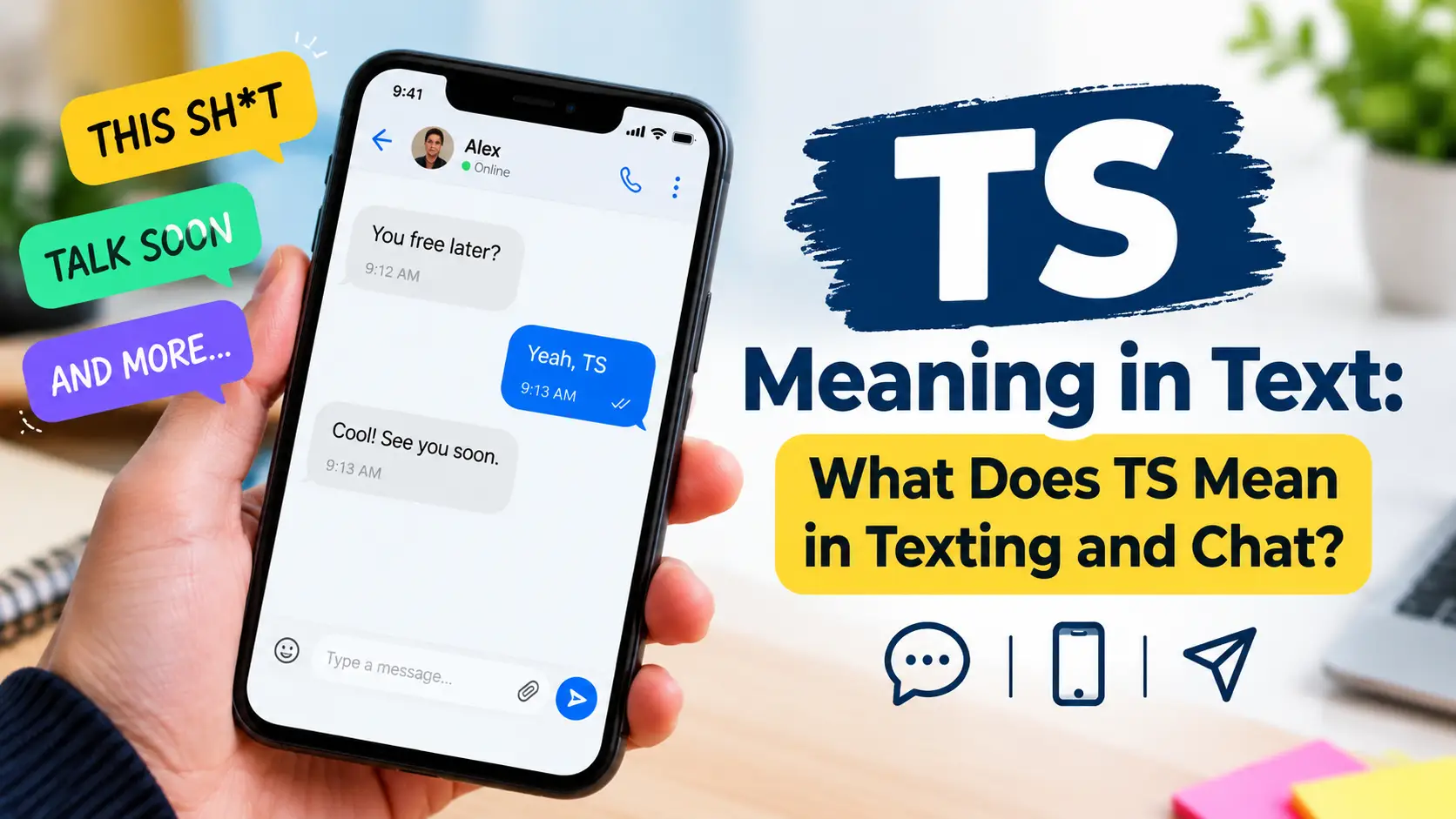
In this context, TS is likely slang for “this shit,” referring to the video, situation, or something shown in it. The meaning depends on the conversation, but the phrase usually expresses strong surprise, disbelief, amusement, or another intense reaction.
TS is one of the fastest spreading pieces of Gen Z slang in recent years, especially popular in TikTok comments, Snapchat captions, and casual texting. It’s short, blunt, and shows up constantly but it can be genuinely confusing if you haven’t run into it before, partly because it stands in for a mild swear word, and partly because it has a few older, unrelated meanings too.
Understanding TS matters because it’s everywhere right now, especially among younger texters, and knowing what it actually means (and what it doesn’t) helps you read comment sections, captions, and casual texts without getting lost. This guide breaks down every common meaning of TS, where the newest one came from, and how to use or respond to it naturally.
Definition & Meaning
TS most commonly stands for “this sh*t” (or “that sh*t”), used as a quick, emphatic way to react to something.
It functions almost like an intensified version of saying “this is” or “that’s,” adding extra punch to a reaction, comment, or feeling.
Example:
Comment: ts is actually so funny 😭 (Meaning: “this sh*t is actually so funny”)
Another example:
Friend 1: he really said that in front of everyone Friend 2: ts is not real 💀
Here, TS adds emphasis and disbelief to the reaction, similar to how someone might say “this is wild” out loud, just with more edge.
Beyond this dominant, currently trending meaning, TS has a few older or unrelated meanings that still show up depending on context:
- “Talk Soon” a friendly sign off at the end of a conversation, unrelated to the newer slang usage.
- “True Story” is a short way to agree that something actually happened, often in response to a relatable comment.
- “TeamSpeak” an older voice chat platform popular in gaming communities before Discord became dominant, still referenced in some gaming circles.
A common combination worth knowing: “TS PMO” combining “this sh*t” with “PMO” (“pisses me off”) to mean “this sh*It is pissing me off.” Despite the wording, it’s usually posted in a dramatic, comedic way rather than reflecting real anger, often under chaotic or absurd videos.
More real life examples:
Comment: ts pmo, why does this always happen 😭
Text: great talking to you, ts soon! (Here, TS means “talk soon,” a sign off unrelated to the slang usage above.)
Comment: lol ts, happened to me too (Here, TS means “true story,” agreeing with a relatable post.)
The short version: in most texts and social media comments today, TS = “this sh*t,” used purely as an emphasis word not meant as genuine profanity so much as a stylistic way to react strongly to something.
Background & History
TS as an emphasis word has roots in African American Vernacular English (AAVE), where phrases involving “this sh*t” have long been used casually to add emphasis or emotional weight to a statement, separate from any literal reference to the word itself.
This usage crossed into mainstream internet slang largely through TikTok, where fast typing, quick reactions, and comment section culture reward short, punchy phrases. As TikTok’s influence grew alongside similar slang terms like “skibidi,” “rizz,” and “gyat,” TS became one of the more versatile, easy to type intensifiers, spreading quickly through captions, comments, and short form video culture.
Because platforms like TikTok and Snapchat reward speed and emotional reactions, abbreviations that let users type fast, strong responses tend to spread rapidly. TS fit perfectly into this environment: short enough to type instantly, expressive enough to carry real emotional weight, and flexible enough to fit almost any reaction, positive or negative.
Interestingly, TS didn’t emerge from just one single source. Alongside its slang meaning, it had already existed for years in other contexts:
- In gaming communities, TS long referred to TeamSpeak, a widely used voice chat platform before Discord took over as the dominant choice.
- In everyday texting, TS had already meant “talk soon” as a casual sign off, or occasionally “true story” as a quick way to agree with something relatable.
Because these different meanings developed separately and continued existing alongside each other, TS never settled into one single, universally fixed definition which is part of why it can feel confusing depending on where you encounter it.
Today, TS is most heavily associated with its newest, dominant meaning:
- TikTok comments and captions, reacting to something surprising, funny, or dramatic
- Snapchat and Instagram, similarly used for quick, emotional reactions
- Everyday texting among younger users, especially Gen Z and Gen Alpha
- Gaming and Discord chat, where it may still occasionally reference TeamSpeak depending on the community
Usage in Various Contexts
In TikTok or Instagram comments (newest meaning):
Here, TS adds emphasis to genuine surprise or amazement.
In texting between friends (newest meaning):
Friend 1: Did you see what happened at lunch today? Friend 2: ts was wild, I couldn’t believe it
Expressing exaggerated frustration (“ts pmo”):
Comment: ts pmo, why does my wifi always cut out during the best part 😭
This combination usually reads as comedic complaining rather than serious anger.
As a casual sign off (older meaning, “talk soon”):
Text: this was fun, ts! talk to you later
Agreeing with something relatable (older meaning, “true story”):
Comment: the way I ALSO forgot my own phone number just now Reply: lol ts, happens to me constantly
In gaming chat (referencing TeamSpeak):
Player 1: hop on ts so we can coordinate better Player 2: sure, give me a sec to join
Across these settings, context and platform make the meaning obvious almost instantly. TikTok comments and quick, emotional reactions overwhelmingly point to “this sh*t.” A casual sign off points to “talk soon.” A relatable agreement points to “true story.” Older gaming chat, especially among longtime players, may still point to TeamSpeak.
Common Misconceptions & Clarifications
Misconception 1: TS only ever means “this sh*t.” While this is by far the most common and currently trending meaning, TS also has older, completely unrelated meanings like “talk soon,” “true story,” and “TeamSpeak,” depending on context.
Misconception 2: TS is always meant as genuine profanity. In its slang usage, TS functions more as an emphasis word than literal cursing. Much like how some people say “this stuff” instead of a stronger word, typing “TS” softens the phrase slightly while keeping the same emphatic energy.
Misconception 3: TS PMO always means someone is genuinely angry. Usually, it doesn’t. It’s typically used in a dramatic, comedic way to react to something chaotic, absurd, or mildly annoying more of an exaggerated eye roll than real anger.
Misconception 4: TS is only used by teenagers. While it’s especially popular among Gen Z and Gen Alpha, it has spread widely enough that most active social media users have encountered it, even if they don’t use it themselves.
Misconception 5: TS has one single, agreed upon definition everywhere. It doesn’t. Because it emerged from multiple directions at once slang, gaming, and everyday texting its meaning depends heavily on the specific platform and conversation.
Clarification on tone: because TS stands in for a phrase that includes mild profanity, some readers may find it a little more informal or edgy than typical texting slang. It’s worth being mindful of the audience before using it, especially with people who might not recognize or appreciate the underlying phrase.
Similar Terms & Alternatives
| Term | Meaning | Typical Use |
| TS | This sh*t / Talk Soon / True Story / TeamSpeak | Emphasis, sign offs, agreement, gaming |
| TS PMO | This sh*t is pissing me off | Exaggerated, comedic frustration |
| NO CAP | No lie | Emphasizing sincerity |
| FR | For real | Confirming something is true |
| DEADASS | Seriously, for real | Sincere emphasis |
| ISTG | I swear to God | Strong emphasis on honesty |
| PMO | Pisses me off | Standalone frustration |
Examples in use:
Comment: no cap, this is the best thing I’ve seen all week
Friend: for though, that was such a wild story
Comment: pmo when people do that 😭
These related terms all share TS’s emphatic, reaction driven energy, especially in TikTok and Instagram comment culture.
How to Respond to This Term
How you respond to “ts” depends heavily on which meaning applies and the tone of the message.
If it’s the slang emphasis meaning casual response:
“ts really is wild, I can’t get over it 😭”
Funny response:
“ts pmo fr, why does this always happen”
Professional response (rare, but if it somehow appears in a casual work chat):
“Ha, definitely an unexpected situation!”
Privacy conscious response (if you’d rather steer away from the intensity):
“Haha yeah, that was something else.”
If it means “talk soon” casual response:
“Sounds good, talk soon!”
If it means “true story” casual response:
“right?? happens to everyone lol”
General tips for responding:
- Read the surrounding context first: a comment reacting to something surprising almost always means the slang meaning, while a sign off at the end of a text usually means “talk soon.”
- Matching the exaggerated, dramatic tone of “ts pmo” moments tends to fit the humor better than responding too seriously.
- In professional or unfamiliar settings, it’s best to avoid the term altogether, since its meaning may not be clear (or entirely appropriate) outside casual social media culture.
Regional or Cultural Differences
TS, in its dominant slang meaning, is rooted in African American Vernacular English (AAVE), where casual emphasis phrases like this have long been part of everyday speech before crossing into mainstream internet slang through platforms like TikTok.
Because TikTok has a massive global audience, TS has spread quickly across English speaking countries, including the US, UK, Canada, and Australia, and even into non English speaking communities where English language slang is commonly adopted directly, especially among bilingual users active on TikTok and Instagram.
Some regional and generational differences are worth noting:
- Gen Z tends to use TS naturally as part of everyday texting and commenting.
- Millennials and older users often recognize the term but may still prefer typing out full words like “this” in most contexts.
- In gaming communities, especially among longtime players, TS may still primarily bring to mind TeamSpeak rather than the newer slang meaning, depending on the group’s age and gaming history.
Because TS emerged from a specific linguistic and cultural background before spreading widely online, it’s worth using it thoughtfully and being aware of where the phrase comes from, rather than treating it as a completely neutral internet abbreviation.
Comparison with Similar Terms
| Term | Core Meaning | Emotional Tone | Best Used When |
| TS (slang) | This sh*t | Emphatic, reactive | Reacting strongly to something surprising or funny |
| TS PMO | This sh*t is pissing me off | Dramatic, comedic frustration | Reacting to something chaotic or mildly annoying |
| NO CAP | No lie | Sincere, emphatic | Stressing honesty |
| FR | For real | Sincere, casual | Confirming something is true |
| TS (talk soon) | Talk soon | Friendly, neutral | Ending a conversation |
The clearest way to separate these meanings is context. TS as an emphasis word almost always appears mid reaction, reacting to something specific. TS as “talk soon” almost always appears as a sign off at the very end of a message.
Usage in Online Communities & Dating Apps
On TikTok, TS is extremely common in comment sections, usually reacting to something funny, dramatic, relatable, or absurd in a video.
On Twitter/X, TS shows up similarly, often in quick, emotional reactions to trending topics or viral posts.
Across Tinder and other dating apps, TS is less common, though it may occasionally appear in more casual, playful conversations among younger users:
Match: you would not believe the date I went on last week You: ts sounds like it needs its own show 😭
In gaming communities, especially older or more established groups, TS may still commonly reference TeamSpeak rather than the newer slang meaning:
Player 1: hop on ts before we start the match Player 2: got it, joining now
Tips for responding appropriately:
- On TikTok and social media, TS is usually safe to use casually when reacting to lighthearted or dramatic content.
- On dating apps, it can add a playful, expressive tone to storytelling, especially with younger matches familiar with current slang.
- In gaming chat, always check whether the community is referring to TeamSpeak specifically before assuming the newer slang meaning applies.
Hidden or Offensive Meanings
TS’s dominant slang meaning is built directly on a mild swear word, which is worth being upfront about, even though the abbreviated form softens it considerably in casual use.
A few things are worth understanding about tone and context:
- It’s an intensifier, not typically meant as genuine profanity. Most people using “ts” aren’t trying to be crude, they’re using it the same way they might say “this stuff” or “that thing,” just with more emphasis.
- “TS PMO” is usually comedic, not genuinely hostile. Despite the frustrated wording, it’s typically used dramatically, similar to an exaggerated eye roll rather than real anger.
- Because it stands in for profanity, it may not suit every audience. Some readers, especially older users or those in more formal or conservative settings, may find it a bit more crude than typical texting slang, even in its softened, abbreviated form.
- No separate, more explicit hidden meaning exists beyond what’s already covered here; its edge comes from the swear word it’s shortening, not from any additional inappropriate definition.
In short, TS carries mild, built in profanity by design, so it’s worth reading the room before using it, especially with people you don’t know well.
Suitability for Professional Communication
TS is not suitable for professional or formal communication in its slang sense. Because it directly abbreviates a mild swear word, it has no place in workplace emails, client messages, or any official communication, regardless of how casual the setting feels.
Why it doesn’t fit well:
- It’s built on profanity, even in its shortened, softened form.
- It relies entirely on the reader recognizing current internet slang.
- Professional communication should avoid any language that could come across as crude or unprofessional, even unintentionally.
Professional alternatives:
| Instead of “ts” (slang meaning) | Use |
| Reacting to something surprising | “That’s surprising.” / “I wasn’t expecting that.” |
| Reacting to something frustrating | “This has been frustrating to deal with.” |
Example rewrite:
Casual: “ts is actually so annoying” Professional: “This situation has genuinely been frustrating.”
If TS is used to mean “talk soon” in a lightly casual professional chat, it’s still better to spell out the full phrase to avoid any confusion with its more common slang meaning.
FAQs
1. What does TS mean in text? It most commonly stands for “this sh*t” (or “that sh*t”), used as an emphatic reaction, especially in TikTok comments and casual texting.
2. Does TS always relate to profanity? Its dominant current slang meaning does reference a mild swear word, though it functions more as an emphasis phrase than literal cursing in most casual use.
3. What does TS PMO mean? It combines “this sh*t” with “pisses me off,” meaning “this sh*t is pissing me off.” It’s usually used dramatically or comedically rather than to express real anger.
4. Does TS have any other meanings? Yes, older meanings include “talk soon” (a sign off), “true story” (agreement), and “TeamSpeak” (a gaming voice chat platform).
5. Where did TS come from? Its slang meaning has roots in African American Vernacular English and spread widely through TikTok and short form video culture.
6. Is TS appropriate to use with everyone? Not necessarily. Because it’s built on mild profanity, it’s worth considering your audience, especially with people unfamiliar with current slang or in more formal settings.
7. Can I use TS in professional communication? No, its slang meaning should be avoided entirely in professional writing due to its underlying profanity. Even its other meanings are best spelled out fully in formal contexts.
Conclusion
TS is one of the fastest spreading pieces of current internet slang, most commonly standing for “this sh*t,” used as a quick, emphatic reaction to something surprising, funny, or dramatic. It also carries a few older, unrelated meanings, including “talk soon,” “true story,” and “TeamSpeak,” depending on the platform and community.
Because its dominant meaning is built on mild profanity, TS carries a bit more edge than typical texting slang, even in its shortened, softened form. While it fits naturally into TikTok comments, casual texting, and social media reactions, it has no place in professional or formal communication.

Asfan Wahab is a content creator and writer focused on text meanings, slang, abbreviations, acronyms, and internet expressions. Through Orvexale.com, he provides clear and simple explanations to help readers understand modern texting language. His goal is to make confusing terms easy to understand with practical examples and everyday context.