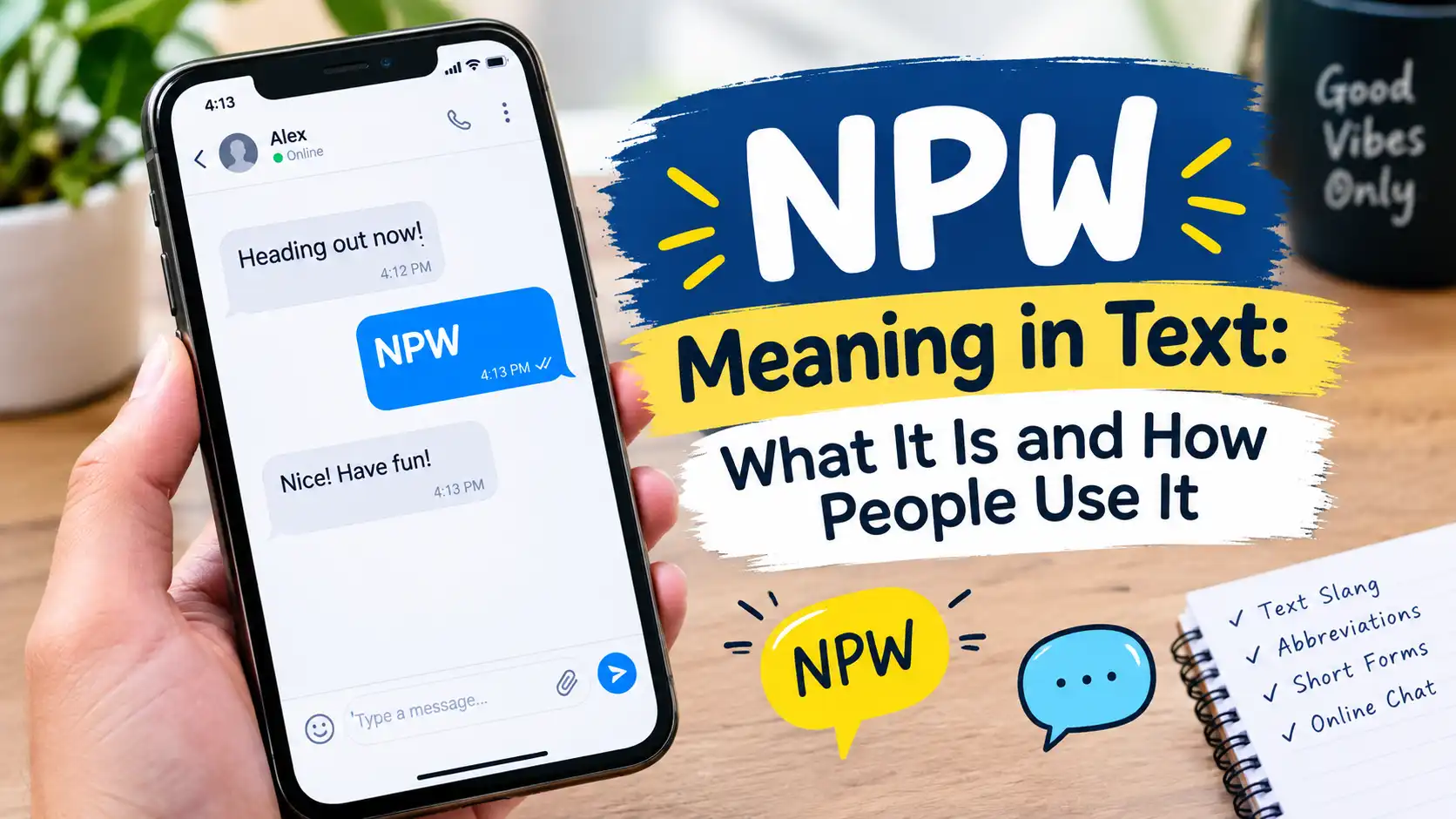
Texting moves fast. People shorten words to keep up. You’ve probably seen “NP” for “no problem.” NPW takes that one step further. It usually means “No Problem Whatsoever.” It’s a small upgrade. It adds extra warmth to a simple reply.
You might spot NPW in a group chat, a comment on social media, or a quick reply in a game. It shows the sender is not just fine with something. They are completely fine with it. That small difference matters in texting, where tone is easy to miss.
Knowing terms like NPW helps you read messages the right way. It also helps you sound natural when you reply. This guide covers what NPW means, where it came from, how people use it, and when to avoid it.
Definition & Meaning
NPW most often stands for “No Problem Whatsoever.” It is built the same way as NP. Someone just adds a “W” for “whatsoever” to make the message feel bigger and warmer.
Think of it as a dial. “NP” is a calm, easy yes. “NPW turns the dial up.” It says: this was not just fine, it was truly no trouble at all.
Example:
Maria: Hey, sorry for texting you so late about the schedule change.
Jordan: NPW! I was still up anyway.
Here, “NPW” tells Maria not to worry even a little. A plain “np” would have worked too, but “NPW” makes the reassurance feel stronger.
It’s worth noting: NPW is not in most major slang dictionaries the way NP is. It’s an informal variant that some people use and many people have never seen. So context always matters. If a friend who uses “NP” a lot suddenly types “NPW,” they likely mean the same thing, just with more feeling behind it.
Outside of texting slang, NPW has other, older meanings that have nothing to do with casual chat:
- Not Proceeded With used in legal and government documents, meaning a case or process was dropped.
- Net Peptide Weight is a term used in chemistry and manufacturing.
- Business names, like certain financial or wealth management firms that use NPW as an abbreviation.
If you see NPW in a work email or an official document, it almost certainly isn’t texting slang. Context tells you which meaning applies.
Background & History
Short forms like NP have been around since the early days of online chat rooms in the 1990s and early 2000s. Typing speed mattered. Screen space was limited. People shortened everything they could.
“NP” became one of the most common replies to “thank you” or “sorry.” It was short, friendly, and easy to type with one hand.
NPW grew out of that same habit, but later, and much less formally. As texting culture kept pushing toward speed and casualness, some users started adding small extra letters to old abbreviations to add feeling. “NW” for “no worries” and “NP” for “no problem” already existed. Adding a “W” to NP, meaning “whatsoever,” followed a familiar pattern in slang: take a short phrase, then stretch it slightly for emphasis.
This kind of small variation is common in internet language. Think of how “lol” became “lolz” or “loll” for some users, just to add tone. NPW works the same way. It isn’t a new invention with a clear founding moment. It’s a natural drift from an older, well known term.
Today, NPW shows up mostly among younger texters, in casual group chats, and sometimes in gaming voice to text chats. It hasn’t spread nearly as wide as NP. Many people who text daily have simply never seen it. That’s an important thing to know before you use it with someone you don’t text often.
Usage in Various Contexts
In texting, NPW usually replies to thanks or an apology.
Sam: Sorry I’m late.
Ravi: NPW, we just got here.
In social media comments, NPW often follows a favor or a shoutout.
Post: “Thanks to @dee_creates for the shoutout! 🙏”
Comment: “NPW! Your work deserves it.”
In gaming chats, NPW often responds to a teammate thanking you for help.
Player1: thx for the save
Player2: npw, gg
In casual conversation, people sometimes use it to close a topic gently.
Friend: I feel bad for canceling on you again.
You: Seriously, NPW. Life happens.
Across all these settings, the tone stays the same: relaxed, reassuring, and a bit more emphatic than a plain “np.” It rarely appears in long sentences. Most people just type “NPW” on its own, or add one short line after it.
One pattern worth noting: NPW tends to show up more in reply to something the other person feels guilty or awkward about lateness, a favor, an interruption rather than in reply to good news or excitement. It’s a comfort word, not a celebration word.
Common Misconceptions & Clarifications
The biggest misconception is that NPW is as widely recognized as NP. It isn’t. Many people, especially outside certain younger or gaming heavy group chats, will not immediately know what it means. If you send it to someone unfamiliar with texting slang, they may just ask, “what’s NPW?”
Another mix up: some readers confuse NPW with NSFW (“not safe for work”) because the letters look similar at a glance in a fast moving chat. This can cause a brief, confusing moment, especially in group chats where people skim quickly. If your message could be misread this way, it’s worth spelling it out.
There’s also confusion with formal or technical uses of NPW, especially “Not Proceeded With” in legal writing. Someone unfamiliar with texting slang who sees “NPW” in a message might assume it’s a serious or official term, when really it’s just a casual, friendly reply.
Finally, some people wonder if NPW can sound sarcastic or dismissive, the way a flat “sure, whatever” can. It usually doesn’t carry that tone. Context and punctuation matter here. “NPW!” with an exclamation point reads as warm. “npw.” with a period and nothing else can read as cold or annoyed, especially to someone already worried about bothering you. If warmth matters, add an emoji or a short follow up line.
Similar Terms & Alternatives
Several short phrases fill a similar role to NPW. Here’s how they compare:
| Term | Meaning | Tone |
| NP | No problem | Casual, standard |
| NPW | No problem whatsoever | Casual, extra reassuring |
| NW | No worries | Casual, relaxed |
| YW | You’re welcome | Neutral, slightly formal |
| All good | Everything is fine | Warm, common in speech and text |
| No biggie | It wasn’t a big deal | Playful, casual |
| Don’t mention it | No need to thank me | Polite, a bit formal |
NP is the safest choice if you’re not sure your reader knows slang. It’s understood almost everywhere. NPW adds warmth but risks confusion with people who haven’t seen it. NW (“no worries”) is a strong middle ground widely known, friendly, and clear.
If you want to sound extra reassuring without risking confusion, “no worries at all” or “seriously, it’s fine” does the same job as NPW, just spelled out.
How to Respond to This Term
If someone sends you an NPW, how you respond depends on the setting.
Casual reply:
“Haha okay, thanks!”
Funny reply:
“NPW back at you 😂”
Professional setting (rare, but possible in informal work chats):
“Thanks, I appreciate that.”
(Avoid replying with slang in return unless the workplace culture is already very casual.)
Privacy conscious or neutral reply, if you don’t want to over explain:
“Got it, thank you.”
If you’re unsure what NPW means when you receive it, it’s completely fine to ask. A simple, friendly question works well:
“Ha, what’s NPW mean? Haven’t seen that one!”
This keeps the conversation natural and avoids any awkward misunderstanding.
Regional or Cultural Differences
NPW doesn’t have strong documented regional roots the way some slang does. It appears mainly in English language texting and online chat, particularly among younger users in the US, UK, Canada, and Australia, though usage is inconsistent even within those groups.
Unlike widely globalized terms like “lol” or “omg,” NPW hasn’t crossed into other languages in any notable way. Most non-English texting cultures have their own local short forms for “no problem” (for example, “de nada” shortened in Spanish contexts, or “mou ii yo” style phrases in Japanese chat culture), rather than borrowing NPW.
Within English speaking regions, you’re more likely to see NPW in gaming communities and Gen Z group chats than in general adult texting. Older texters and more formal communities tend to stick with “no problem,” “no worries,” or full sentences.
Comparison with Similar Terms
A closer side by side of the emphasis level of common reassurance terms:
| Term | Emphasis Level | Best Used With |
| NP | Standard | Anyone familiar with basic texting slang |
| NW | Standard, slightly warmer | Friends, casual acquaintances |
| NPW | Higher emphasis | Close friends, gaming buddies, younger texters |
| All good, no worries at all | High emphasis, fully spelled out | Anyone, including people unfamiliar with slang |
| It’s seriously fine | High emphasis, very clear | Situations where someone feels guilty or anxious |
The key difference isn’t really meaning most of these terms land in the same place. The difference is how much reassurance they signal, and how widely they’re understood.
Usage in Online Communities & Dating Apps
On platforms like Twitter/X and Discord, NPW shows up in quick replies, similar to how it’s used in texting, usually after a thank you or an apology in a thread or voice chat.
On dating apps like Tinder or Bumble, NPW is less common, since early conversations there tend to lean on fuller sentences to build a good first impression. If it does appear, it’s usually later in a chat, once two people are texting more casually for example, after one person apologizes for a late reply.
Match: Sorry, been slammed at work, just seeing this now.
You: NPW, no rush at all!
Tip for responding appropriately: In early dating app conversations, it’s generally safer to spell things out a bit more (“no worries at all!”) since first impressions matter and not everyone reads slang the same way. Save NPW style shorthand for once a conversation feels established.
In gaming communities, NPW fits naturally into fast paced voice to text or chat exchanges, much like “gg” or “np” already do.
Hidden or Offensive Meanings
NPW does not have a widely known offensive or hidden meaning. It’s a friendly, low stakes term in almost every context.
The main risk isn’t hidden meaning it’s misreading. As mentioned earlier, in a fast scrolled message, “NPW” can be glanced at and briefly mistaken for “NSFW,” which does carry an adult content meaning. This is a reading error, not a hidden meaning within NPW itself, but it’s worth being aware of, especially in group chats or comment sections where people skim quickly.
Tone and punctuation matter more than the term itself. A short, flat “npw” with no punctuation can come across as dismissive in a serious conversation, even though that’s not the intent. Adding a touch more warmth, an exclamation point, an emoji, or a short follow up sentence keeps the reassurance clear.
Suitability for Professional Communication
NPW is not appropriate for formal professional communication, such as emails to clients, official reports, or communication with senior leadership. It’s too casual, and since it isn’t widely recognized it risks being confusing or looking unprofessional.
Professional alternatives:
- “No problem at all.”
- “Happy to help.”
- “That’s completely fine.”
- “Thanks for letting me know no issue on my end.”
In more relaxed workplace chats, like an informal Slack channel among close teammates, something like “np” might be acceptable depending on your company’s culture. NPW is a step too casual even there, mainly because many coworkers simply won’t recognize it. When in doubt, spell it out.
FAQs
1. What does NPW mean in a text?
It usually means “No Problem Whatsoever,” a stronger, friendlier version of “NP.”
2. Is NPW the same as NP?
They mean almost the same thing. NPW just adds extra emphasis and warmth.
3. Is NPW widely understood?
No. It’s far less common than “NP” and many texters have never seen it. Context and familiarity with the sender matter.
4. Can NPW be used in professional emails?
No. It’s too informal for professional writing. Use “no problem at all” or “happy to help” instead.
5. Does NPW have any hidden or rude meaning?
No confirmed hidden meaning exists. The main risk is confusing it with “NSFW” when skimmed quickly.
6. What’s a safer alternative if I’m not sure my reader will understand NPW?
Use “no worries at all” or “totally fine” both are widely understood and carry the same warmth.
7. Where did NPW come from?
It likely grew as a natural extension of “NP,” following the same pattern as other slang that adds letters for emphasis, like “NW” for “no worries.”
Conclusion
NPW is a small, informal upgrade to “NP,” usually meaning “No Problem Whatsoever.” It adds extra warmth and reassurance to a quick reply, and shows up mostly in texting, gaming chats, and casual social media replies among younger users.
It isn’t as widely recognized as “NP,” so it’s best saved for people who already know your texting style, close friends, gaming teammates, or established conversations. In professional settings or with people unfamiliar with slang, spelling it out as “no problem at all” is the safer, clearer choice. Understanding small terms like this helps you read tone correctly and reply naturally, wherever the conversation happens.

Asfan Wahab is a content creator and writer focused on text meanings, slang, abbreviations, acronyms, and internet expressions. Through Orvexale.com, he provides clear and simple explanations to help readers understand modern texting language. His goal is to make confusing terms easy to understand with practical examples and everyday context.