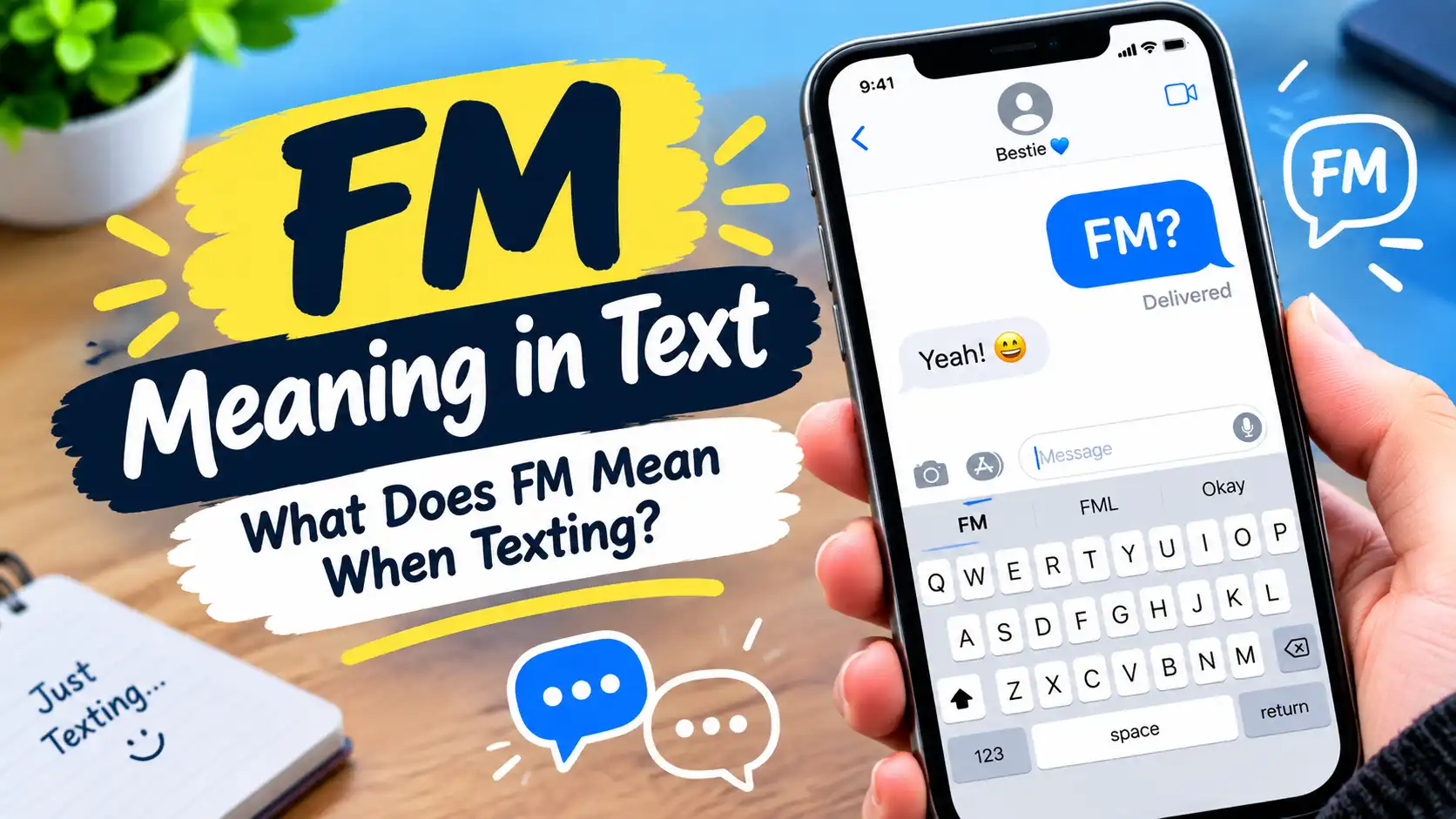
A friend sends a photo and captions it “this outfit is so fm.” A few messages later, someone else texts “fm, whatever works.” Same two letters, doing two completely different jobs.
FM is one of those small, flexible abbreviations that shifts meaning depending entirely on the sentence around it. It shows up in texting, Instagram captions, group chats, and casual replies, and unlike more fixed slang, it doesn’t have one single definition everyone agrees on.
Understanding FM matters because guessing wrong can genuinely change how you read a message. Knowing its most common meanings, and how to quickly tell them apart, helps you follow casual conversations without missing the point. This guide breaks down every common meaning of FM, where this kind of shorthand comes from, and how to use it naturally.
Definition & Meaning
FM does not have one single, fixed meaning it changes based on context. The most common casual meanings include:
1. “For Me”
Friend 1: Is this seat taken? Friend 2: no, it’s fm
2. “Follow Me”
Used especially on Instagram and TikTok, inviting people to follow an account.
Caption: new page just dropped, fm! 📸
3. “Fine by Me” / “Fine with Me”
Used to casually agree to a plan without much fuss.
Friend 1: should we push dinner to 8 instead? Friend 2: fm, works either way
4. “Feel Me”
Used to check whether someone understands or relates to what’s being said.
Text: today has just been a lot, fm?
5. An exclamation similar to a stronger swear, used to express shock, frustration, or disbelief
This usage functions the same way people sometimes type “smh” or an exaggerated sigh as an informal reaction rather than a literal statement.
Text: just missed the bus by ten seconds… fm
Outside of casual texting, FM also has a well established, unrelated technical meaning:
- “Frequency Modulation” a method used in radio broadcasting, developed by engineer Edwin Armstrong in the 1930s, long before texting slang existed.
More real life examples:
Comment: this song is so fm right now, been on repeat all day (meaning “for me”)
Group chat: movie or takeout tonight? fm, either is good
Instagram bio: fm for daily outfit inspo
Context makes the correct meaning clear almost instantly. A caption asking people to check out a profile usually means “follow me.” A casual reply agreeing to plans usually means “fine by me.” A short check in about feelings usually means “feel me.” And a reaction to something mildly unlucky or frustrating might be the more exclamatory use.
The short version: FM is a flexible abbreviation that borrows its meaning entirely from the sentence around it, with “for me,” “follow me,” and “fine by me” being its most common casual uses today.
Background & History
FM as a technical term predates texting slang by nearly a century. Frequency Modulation was introduced in the 1930s as a major advancement in radio broadcasting, offering clearer sound quality than the earlier AM (Amplitude Modulation) standard. For decades, “FM” was almost exclusively associated with radio stations and broadcasting technology.
As SMS texting exploded in popularity in the early 2000s, character limits and small phone keypads pushed people to shorten common phrases wherever possible. Because “for me,” “follow me,” and “fine by me” are all everyday phrases used constantly in casual conversation, they became natural candidates for abbreviation, following the same shorthand logic that produced terms like LOL, BRB, and IMO.
As social media platforms like Instagram and TikTok grew, the “follow me” meaning in particular gained specific traction, since these platforms are built around building an audience and encouraging engagement. Captions and comments using “fm” as a quick call to action became a natural fit for that environment.
Because FM never settled into one single, dominant meaning the way some abbreviations did, it has remained a genuinely context dependent term. Different corners of the internet have shaped their own primary use for it, social media leaning toward “follow me,” casual texting leaning toward “for me” or “fine by me,” and more emotionally expressive spaces occasionally using it as a stand in for a stronger exclamation.
Today, FM continues to live across all of these meanings simultaneously:
- Instagram and TikTok often use “follow me.”
- Everyday texting and group chats often use “for me” or “fine by me.”
- Casual, relatable venting posts occasionally use the exclamatory sense.
- Technical and broadcasting contexts continue to use “Frequency Modulation” exactly as they always have.
Usage in Various Contexts
In texting between friends (fine by me):
Friend 1: Can we do Saturday instead of Friday? Friend 2: fm, that actually works better
On social media (follow me):
Caption: daily fit checks starting today, fm for more 👀
In casual replies (for me):
Friend: who’s this gift from? You: it’s fm, I got it myself lol
In check in style messages (feel me):
Text: I just need a quiet weekend, fm?
In gaming or casual online chat (context dependent):
Teammate: that was such a rough round You: fm, that whole game was chaos
In venting style, exclamatory use:
Text: locked myself out again… fm
Across these settings, the surrounding sentence almost always makes the intended meaning clear. Social media captions calling for engagement points to “follow me.” Quick, agreeable replies point to “fine by me.” Personal, relatable check-ins point to “feel me.” And short, reactive complaints point to the more expressive, exclamatory use.
Common Misconceptions & Clarifications
Misconception 1: FM always refers to the radio. While “Frequency Modulation” is the original, technical meaning, it’s rarely what someone means when texting casually.
Misconception 2: FM has one single, agreed upon slang meaning. It doesn’t. Unlike more standardized abbreviations, FM shifts meaning significantly depending on platform and context.
Misconception 3: FM is always vulgar or inappropriate. This isn’t accurate. While one of its casual uses functions as a stand-in for a stronger exclamation, its far more common uses “for me,” “follow me,” and “fine by me” are completely neutral and everyday.
Misconception 4: FM is only used on social media. It’s just as common in everyday texting and group chats, where it usually means “for me” or “fine by me” rather than anything related to following an account.
Misconception 5: FM is gender specific slang. It isn’t. People of all genders use FM interchangeably across its various casual meanings.
Clarification on tone: because FM carries several possible meanings, small context clues matter. A caption paired with a profile link almost certainly means “follow me.” A short, agreeable reply to a plan almost certainly means “fine by me.” Reading the full message rather than the abbreviation alone clears up any ambiguity.
Similar Terms & Alternatives
| Term | Meaning | Typical Use |
| FM | For Me / Follow Me / Fine by Me / Feel Me | Texting, social media, casual chat |
| F4F | Follow for Follow | Reciprocal following on social media |
| NP | No Problem | Casual agreement or acceptance |
| IMO | In My Opinion | Sharing a personal viewpoint |
| FR | For Real | Emphasizing sincerity |
| DM/PM | Direct/Private Message | Referring to private messaging, not following |
Examples in use:
Comment: love your content! f4f?
Friend: should we just order in tonight? You: np, sounds good to me
Comment: fr this show is so underrated
These related terms overlap with some of FM’s functions, especially around social media engagement (F4F) and casual agreement (NP).
How to Respond to This Term
How you respond to “fm” depends entirely on which meaning applies.
If it means “follow me” casual response:
“just followed! love your page”
If it means “fine by me” casual response:
“awesome, let’s do that then”
If it means “for me” casual response:
“Oh nice, good choice!”
If it means “feel me” supportive response:
“totally, I get that completely”
Professional response (rare, but possible in a lightly casual context):
“Sounds good, that works on my end too.”
General tips for responding:
- Check the surrounding message first; it almost always reveals which meaning applies.
- On social media, responding to a “follow me” caption with a quick follow or comment is the expected reaction.
- In casual texting, treating FM as agreement (“fine by me”) is usually a safe default when the meaning isn’t immediately obvious.
Regional or Cultural Differences
FM’s technical meaning, “Frequency Modulation,” is recognized globally wherever radio broadcasting exists, with no regional slang variation at all.
FM’s casual texting meanings are primarily used in English speaking online spaces, including the US, UK, Canada, and Australia, spreading through platforms like Instagram, TikTok, and everyday texting.
Some regional patterns show up in related terms:
- In British texting culture, people might say “fine by me” fully rather than abbreviating it, though the sentiment is identical.
- In American slang, “for me” and “fine by me” are both common in everyday casual texting, often used interchangeably with FM.
- Non-English speaking online communities sometimes adopt English social media abbreviations like FM directly, especially around “follow me” call to actions, since audience building language tends to spread quickly across international platforms.
Because FM’s meaning depends so heavily on context rather than regional slang traditions, its recognition tends to vary more by platform familiarity than by specific geography.
Comparison with Similar Terms
| Term | Core Meaning | Platform | Tone |
| FM (for me) | Personal possession or relevance | Texting, general chat | Neutral, casual |
| FM (follow me) | Social media call to action | Instagram, TikTok | Promotional, friendly |
| FM (fine by me) | Casual agreement | Texting, group chats | Relaxed, agreeable |
| FM (feel me) | Checking for understanding | Texting, personal chat | Reflective, personal |
| F4F | Reciprocal following | Social media | Promotional |
The clearest way to separate FM’s meanings is platform and sentence structure. A caption inviting engagement points to “follow me.” A short, agreeable reply points to “fine by me.” A personal, relatable statement points to “feel me.”
Usage in Online Communities & Dating Apps
On Instagram and TikTok, FM frequently appears in captions and bios encouraging people to follow an account, often paired with related terms like F4F.
On Tinder and other dating apps, FM usually leans toward its more conversational meanings:
Match: pineapple on pizza is actually amazing You: fm, no notes, I fully agree
Here, it functions as a quick, easygoing way to show agreement.
In gaming communities, FM occasionally appears in casual chat, usually functioning as “fine by me” when agreeing to a plan or strategy:
Teammate: should we regroup at the base first? You: fm, let’s do that
Tips for responding appropriately:
- On social media, treat FM captions as a normal, low pressure invitation to engage.
- On dating apps, FM used conversationally usually signals easy agreement or shared opinion.
- In gaming chat, it’s a quick, casual way to confirm a plan without overexplaining.
Hidden or Offensive Meanings
FM’s dominant casual meanings for me, follow me, fine by me, and feel me do not carry any offensive connotation. They’re neutral, everyday expressions used constantly in casual conversation.
A few points are worth understanding about its more expressive use:
- The exclamatory use borrows from a stronger swear, used as a reaction rather than a literal statement. This usage functions similarly to typing “smh” or “ugh” expressing frustration or disbelief rather than making a direct request.
- Tone and context determine which meaning applies. A short, cheerful “fm 😊” reads completely differently from a frustrated “fm” following bad news.
- The technical meaning carries no slang connotation whatsoever. In broadcasting or engineering contexts, FM remains entirely neutral and professional.
In short, FM is generally safe and casual in the vast majority of everyday use, with its more expressive, exclamatory use being context specific and easy to distinguish from its neutral meanings.
Suitability for Professional Communication
FM’s casual texting meanings are not suitable for professional or formal communication, though its technical meaning works perfectly well in the right professional context.
Where it doesn’t work well:
- Using FM to mean “for me,” “follow me,” or “fine by me” in a formal email or client message feels too casual and could cause confusion.
Where it works professionally:
- Referring to Frequency Modulation in technical, engineering, or broadcasting related communication.
Professional alternatives:
| Instead of “fm” (casual meaning) | Use |
| Fine by me | “That works for me.” / “I’m happy with that.” |
| For me | “This one is mine.” / “I got this for myself.” |
| Feel me | “Do you know what I mean?” / “Does that make sense?” |
Example rewrite:
Casual: “fm, let’s just go with the later time” Professional: “That works for me let’s go with the later time.”
FAQs
1. What does FM mean in a text message? It most often means “For Me,” “Fine by Me,” or “Follow Me,” depending on context. It can also mean “Feel Me” or, less commonly, function as an exclamation of frustration.
2. Does FM always relate to social media? No, it’s just as common in everyday texting, where it usually means “for me” or “fine by me” rather than anything related to following an account.
3. Is FM always vulgar? No, it’s far more common casual meanings are entirely neutral. One less common usage borrows from a stronger exclamation, but this depends heavily on context.
4. What does FM mean outside of texting? It most notably stands for “Frequency Modulation,” a technical term used in radio broadcasting since the 1930s.
5. How do I know which meaning of FM applies? Context is key. Social media captions usually mean “follow me,” casual replies usually mean “fine by me,” and personal check-ins usually mean “feel me.”
6. Is FM only used by younger texters? No, its casual meanings are used across a wide range of ages, especially in everyday texting and social media.
7. Can I use FM in professional communication? Its casual meanings should be avoided in formal writing, but its technical meaning is entirely appropriate in the right professional or engineering context.
Conclusion
FM is a flexible abbreviation that borrows its meaning almost entirely from context. In everyday texting, it most often means “For Me” or “Fine by Me,” while on social media, it commonly means “Follow Me.” It can also mean “Feel Me,” or occasionally function as a quick, informal exclamation of frustration or surprise. Outside of slang, it remains a well established technical term for “Frequency Modulation.”
Because its meaning depends so heavily on the platform and surrounding conversation, context is everything when reading or using FM. While it fits naturally into casual texting and social media, its slang meanings are best avoided in professional writing, where spelling things out fully remains the clearer choice.

Noman Hassan is a content creator and writer focused on text meanings, slang, abbreviations, acronyms, and internet expressions. Through Orvexale.com, he provides clear and simple explanations to help readers understand modern texting language. His goal is to make confusing terms easy to understand with practical examples and everyday context.