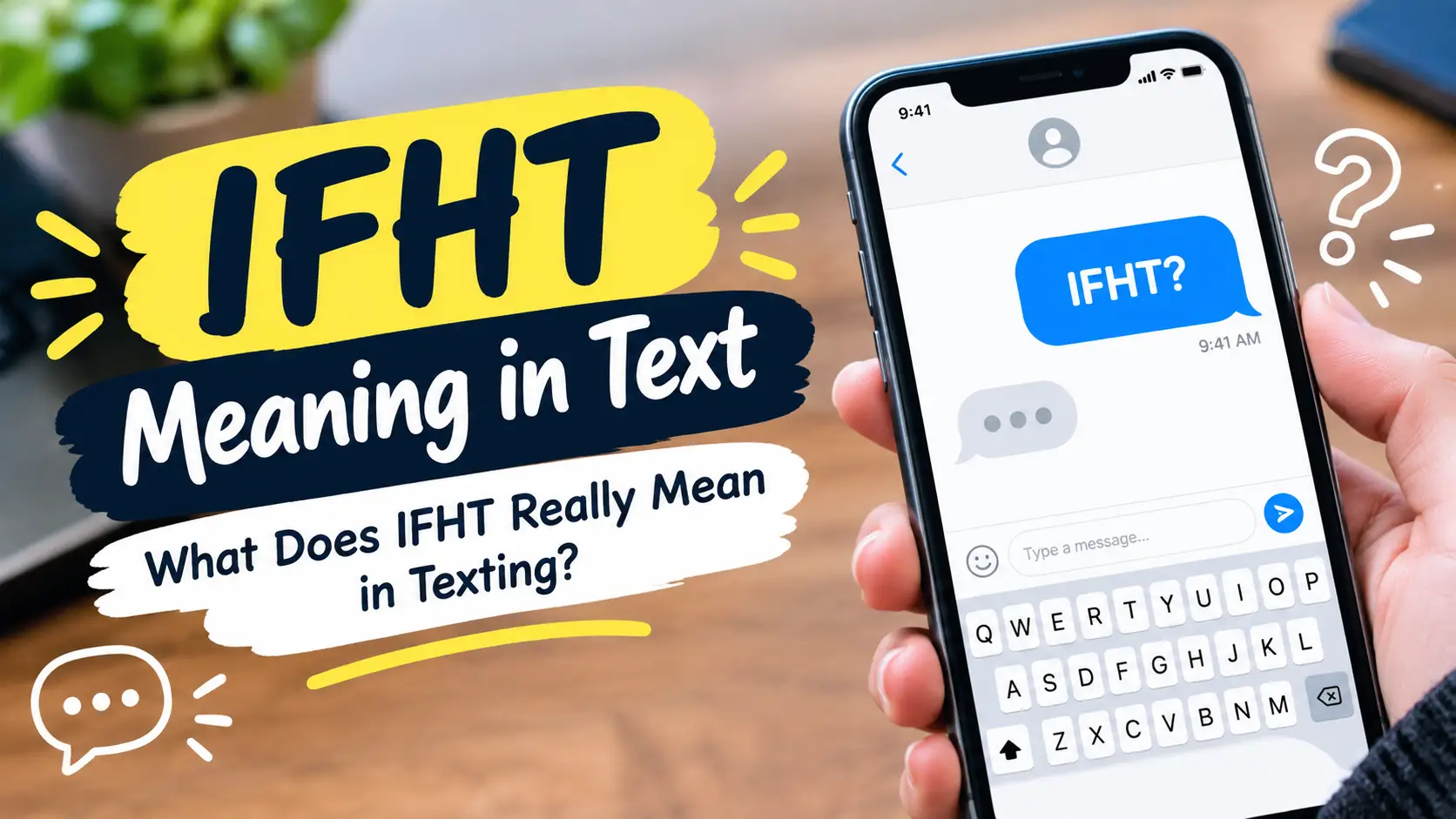
You’re venting to a friend about a bad day, and they reply with just “ifht.” No further explanation, just four letters that seem to carry a lot of frustration behind them.
IFHT occasionally appears in venting texts, comment sections, and casual chats between friends. It’s not as universally recognized as terms like LOL or SMH, which is part of why it can catch people off guard the first time they see it.
Understanding IFHT matters because, like a lot of smaller, less mainstream slang, its meaning isn’t as fixed or widely agreed upon as more established abbreviations. Knowing its most common interpretation and being aware that it can carry a fairly strong, blunt tone helps you read it correctly and use it thoughtfully. This guide breaks down what IFHT most often means, where this kind of shorthand comes from, and how to approach it in conversation.
Definition & Meaning
Most people use IFHT as shorthand for “I F**ing Hate This,” a blunt, frustrated way to express strong dislike or annoyance.
Example:
Friend 1: ugh, my internet keeps cutting out mid call Friend 2: ifht when that happens, so annoying
Here, IFHT captures genuine frustration in a quick, informal way, similar to venting out loud.
Another example:
Text: ifht, traffic has been brutal all week
It’s important to note that IFHT isn’t a widely standardized abbreviation. Unlike terms with one dictionary-confirmed meaning, people use it differently across online spaces, and its exact meaning can depend on the person using it. The “I f***ing hate this” expansion has the clearest documented use, but major slang references do not define the term consistently. So, always check the surrounding context instead of assuming IFHT has one fixed meaning.
More real life examples:
Comment: ifht when people cancel plans last minute
Group chat: ifht mornings, genuinely
Text: ifht, I just remembered I have that appointment today
Because of its blunt, frustrated tone, IFHT tends to show up specifically in venting or complaining messages reacting to something annoying, inconvenient, or mildly infuriating rather than in neutral or lighthearted conversation.
The short version: IFHT most often expresses strong, informal frustration or dislike, similar to saying “I really hate this” with extra emphasis, though it’s a fairly niche term without one single, universally agreed upon meaning.
Background & History
IFHT doesn’t have a well documented origin story tied to a specific platform, community, or viral moment. Instead, it appears to have developed the way a lot of minor, less mainstream internet slang does: informally, through repeated use in casual texting and comment sections, without ever becoming standardized enough to appear consistently across major slang dictionaries.
Its likely expansion, “I fing hate this,”** fits into a broader, long running pattern of internet abbreviations built around blunt emotional venting. This mirrors similar shorthand like SMH (“shaking my head”) or FML (“f** my life”), which compresses strong, informal reactions into a few quick letters, making it easy to express frustration without typing out a full sentence.
Because IFHT hasn’t achieved the same widespread recognition as more established venting abbreviations, it likely remains more common within specific friend groups, comment sections, or smaller online communities rather than being a term with broad, cross platform recognition. This is fairly typical for a lot of internet slang; many abbreviations exist and circulate in smaller pockets of the internet without ever becoming universally known.
Today, IFHT (in its most likely meaning) tends to appear in:
- Venting texts between friends, reacting to something frustrating or inconvenient
- Comment sections, expressing shared annoyance about a relatable situation
- Casual group chats, complaining about everyday frustrations
Because people do not widely standardize the term, different online communities or friend groups may use and recognize it differently.
Usage in Various Contexts
In texting between friends:
Friend 1: I just got stuck in another surprise meeting.Friend 2: Ugh, IFHT. That’s the worst.
Here, IFHT reinforces shared frustration about an annoying situation.
In comment sections:
Comment: ifht when the WiFi cuts out right before an important call
In casual group chats:
Friend 1: Monday again already Friend 2: ifht mornings, no cap
In venting style texts:
Text: ifht, I completely forgot to submit that form on time
People use IFHT almost exclusively to express frustration, annoyance, or strong dislike about a specific thing, situation, inconvenience, or recurring problem.
It doesn’t tend to show up in neutral, cheerful, or purely informational messages, since its tone is inherently negative.
Common Misconceptions & Clarifications
Misconception 1: IFHT is a widely recognized, standardized abbreviation. People do not widely recognize or standardize it. Compared with more established slang, IFHT remains relatively niche, and major sources do not consistently document or agree on its meaning.
Misconception 2: IFHT always carries serious anger. Not necessarily. Like many venting style abbreviations, it can range from genuine frustration to a lighter, exaggerated complaint about something minor and everyday.
Misconception 3: IFHT is appropriate in any casual setting. Because its likely meaning includes strong language, it’s worth being mindful of the audience and relationship before using it, even in casual texting.
Misconception 4: IFHT has one universally agreed meaning.Because people use and define IFHT inconsistently, you should treat its meaning as likely rather than certain and pay close attention to the context.
Clarification on tone: because IFHT is blunt and informal by nature, it fits best in venting conversations between people who already communicate casually. In more formal or unfamiliar contexts, its tone would likely feel out of place.
Similar Terms & Alternatives
| Term | Meaning | Typical Use |
| IFHT | I [really] hate this (blunt version) | Venting about frustration or annoyance |
| SMH | Shaking My Head | Disbelief or mild disappointment |
| FML | F*** My Life | Exaggerated frustration about bad luck |
| UGH | General frustration | Everyday annoyance |
| I CAN’T EVEN | Overwhelmed frustration | Reacting to something exasperating |
| THIS IS THE WORST | Direct complaint | Straightforward frustration |
Examples in use:
Friend: another delayed flight, smh
Text: fml, I locked myself out again
Comment: ugh, Mondays are rough
These related terms all share IFHT’s venting function, expressing frustration or annoyance in a quick, informal way.
How to Respond to This Term
Casual, sympathetic response:
“ugh, that’s the worst, I’m sorry”
Funny response:
“big mood, ifht too honestly”
Professional response (this term is not appropriate for work settings see below):
Not recommended in professional contexts.
Privacy conscious response (if you’d rather not dive deeper into the frustration):
“That sounds frustrating, hope it gets better soon.”
General tips for responding:
- A short, empathetic reply usually fits best, since IFHT typically signals venting rather than a request for advice.
- If the frustration seems significant, checking in with a more thoughtful follow up can help.
- Given its likely blunt language, it’s best used only with people you already text casually and comfortably.
Regional or Cultural Differences
Because IFHT is a fairly niche, inconsistently used piece of slang, it doesn’t have well documented regional patterns the way more established abbreviations do. It appears to circulate informally within English language texting and comment culture, likely concentrated among certain smaller online communities or friend groups rather than being broadly recognized across regions.
Because its likely core meaning (“I hate this”) is a simple, universally understood sentiment, similar blunt expressions of frustration exist in casual speech across many English speaking regions, even if this specific abbreviation isn’t consistently used everywhere.
Comparison with Similar Terms
| Term | Core Meaning | Emotional Tone | Best Used When |
| IFHT | Strong dislike or frustration | Blunt, informal | Venting about something annoying |
| SMH | Disbelief | Mildly frustrated | Reacting to something disappointing |
| FML | Exaggerated bad luck | Dramatic, informal | Venting about a frustrating situation |
| UGH | General annoyance | Mild frustration | Everyday complaints |
The clearest distinction is intensity. IFHT, based on its likely expansion, carries a notably stronger, blunter tone than softer venting terms like UGH, closer in spirit to more intense abbreviations like FML.
Usage in Online Communities & Dating Apps
Because IFHT is a niche term, it’s less commonly seen on dating apps or in lighthearted social media banter, where tone tends to stay more upbeat. It’s more likely to appear in venting focused comment sections or casual complaint style posts:
Comment: ifht when a show gets cancelled after one good season
In gaming communities, a similar blunt frustration might show up after a tough loss, though more established terms are far more commonly used in that context.
Tips for responding appropriately:
- Given its likely intensity, IFHT is best reserved for close, casual relationships rather than early conversations with someone new.
- On social media, treat it as a relatable venting reaction rather than something requiring a serious response.
Hidden or Offensive Meanings
Based on the strongest available sourcing, IFHT’s likely expansion includes a mild profanity, which is worth keeping in mind before using it in any setting where strong language wouldn’t be appropriate.
A few points are worth understanding:
- Its tone is inherently blunt. Even setting aside the specific words it may stand for, it’s clearly meant to express strong frustration rather than mild annoyance.
- Context and audience matter. Because its meaning isn’t fully standardized, and likely includes informal, strong language, it’s best used selectively with people who already communicate casually with you.
- No further hidden meaning beyond frustration appears to exist. Outside of expressing dislike or annoyance, IFHT doesn’t seem to carry any additional inappropriate connotation.
Suitability for Professional Communication
IFHT is not suitable for professional or formal communication. Given its likely inclusion of strong, informal language, it has no place in workplace emails, client messages, or any official communication.
Professional alternatives:
| Instead of “ifht” | Use |
| Expressing frustration | “This has been frustrating to deal with.” |
| Expressing strong dislike | “I really don’t enjoy this part of the process.” |
Example rewrite:
Casual: “ifht, this project keeps getting delayed” Professional: “This project’s repeated delays have been genuinely frustrating.”
FAQs
1. What does IFHT mean in a text message? It’s most commonly used as shorthand for a blunt expression of strong dislike or frustration, similar to “I really hate this.”
2. Is IFHT a well known abbreviation? Not particularly. It’s a fairly niche term without one single, widely agreed upon definition across major slang sources.
3. Is IFHT appropriate to use casually with friends? It can be, especially in venting conversations, though its likely blunt language means it’s best reserved for people you already text informally.
4. Can I use IFHT at work? No, it’s not appropriate for professional communication due to its likely strong language and informal tone.
5. Does IFHT always mean serious anger? Not necessarily it can range from genuine frustration to a lighter, exaggerated complaint about something minor.
6. Is there one confirmed meaning for IFHT? Not definitively. It’s used inconsistently online, so context should always guide interpretation.
7. What are some similar terms to IFHT? Terms like SMH, FML, and UGH serve a similar venting purpose, expressing frustration or annoyance in a quick, informal way.
Conclusion
IFHT is a niche, informal abbreviation most commonly understood as a blunt way of expressing strong frustration or dislike, similar to saying “I really hate this.” Because it isn’t a widely standardized term, its exact meaning can vary depending on who’s using it, so reading the surrounding conversation matters more than usual here.
It fits into venting style texts and comment sections among people who already communicate casually, but it’s likely informal, strong language makes it unsuitable for professional or unfamiliar settings. As with many smaller pieces of internet slang, context is the best guide to understanding exactly what someone means when they use it.

Noman Hassan is a content creator and writer focused on text meanings, slang, abbreviations, acronyms, and internet expressions. Through Orvexale.com, he provides clear and simple explanations to help readers understand modern texting language. His goal is to make confusing terms easy to understand with practical examples and everyday context.