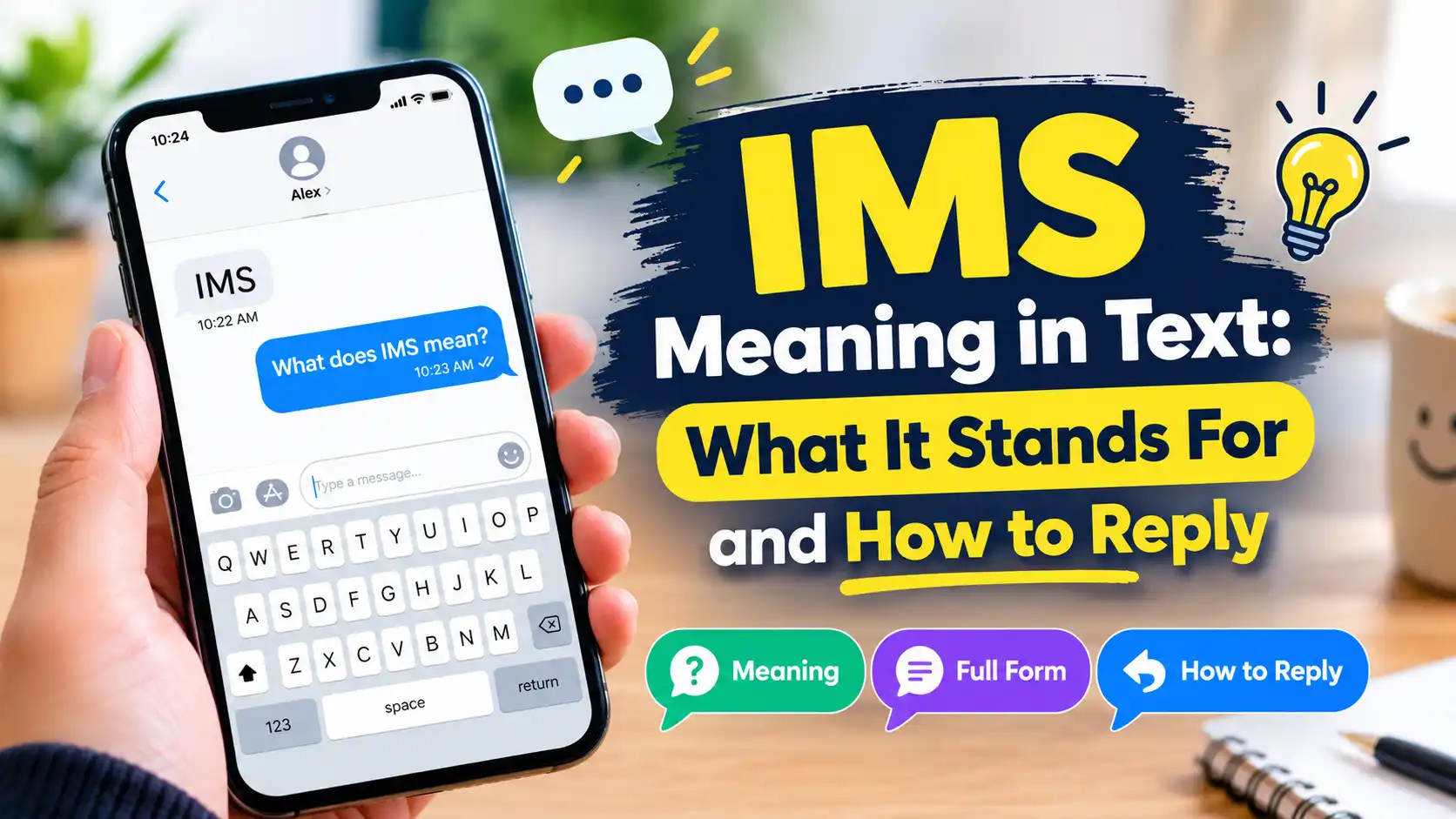
A text pops up. It says “ims.” Three small letters. No other words.
What does it mean? Is it a code? Is it a typo?
Relax. In most chats, IMS means “I miss you.” It is a short, soft message. People send it to friends, family, and crushes. You may see it in texts, DMs, and comments. You may even see it in a game lobby after a friend logs back in.
Here is the catch. IMS is not as common as “IMU.” Some people also use IMS for other things, like work terms. So context matters.
Knowing what IMS means helps you reply the right way. A kind reply can make someone’s day. A wrong guess can feel awkward.
This guide keeps it simple. You will learn the meaning, the uses, the replies, and the safe alternatives. Let’s dive in.
Definition & Meaning
What does IMS stand for?
IMS = “I Miss You.”
It is a short way to tell someone you think about them. You wish they were near. It is warm and personal.
Real life examples
A friend who moved away:
Nina: ims 🥺
Zara: Aww, I miss you too! Call me tonight?
A partner on a work trip:
Ali: Lights out here. ims
Sana: ims more 💛 Sleep well.
A family member:
Mom: ims, come home soon
Omar: Soon, Mom. I promise.
How it feels
IMS is soft and quick. It is not a long love note. It is a small hello from the heart.
Other meanings
Some meanings exist outside of chat slang:
- Instant Messaging Service: a tech term.
- IP Multimedia Subsystem: a phone network term.
- Information Management System: a computer database.
- Integrated Management System: a business term.
Rule: if a friend or partner sends it in a casual text, it means “I miss you.” If it shows up in a work email about systems, it is likely a tech or business term.
Quick clue list
- Casual chat + emojis? Probably “I miss you.”
- Work email + tech talk? Probably a system name.
- Still unsure? Ask.
You: Wait, does ims mean “I miss you”?
Friend: Yes! Did you not get it? 😂
There is no shame in asking. Slang is confusing.
Background & History
Where did it come from?
The phrase “I miss you” is very old. People have said it in letters, calls, and cards for ages.
Texting changed how we say it. Early phone texts cost money and had limits. Fewer letters meant a cheaper, faster message. People made short forms like “ILY” for “I love you” and “IMU” for “I miss you.”
IMS follows the same pattern. Three letters. One big feeling.
A note on the facts
No one can point to the exact first person who typed “ims.” Its start is hard to trace. Slang grows in small groups first. Then it spreads. That is how most short forms are born.
How it grew
- Texting: Short forms saved time.
- Social media: Comments and DMs made them popular.
- Messaging apps: Chat apps made quick messages feel natural.
- Young users: Teens and young adults spread new slang fast.
How it changed
At first, short forms were used for speed. Now, they are used for style and closeness. Sending “ims” can feel cozy. It sounds like a whisper, not a speech.
Where it is used now
You will see IMS mostly in:
- Private chats between friends and partners
- DMs on Instagram, Snapchat, and X
- Comments on photos and videos
- Gaming chats among friends
You will not often see it in formal writing. It is a casual, personal term.
Will it last?
Slang comes and goes. “IMU” is still the more common form. IMS may stay a small, friendly variant. Time will tell.
Usage in Various Contexts
The same three letters can feel different in each place. Here is how people use IMS.
Texting
This is the most common use. It is sweet and simple.
Bilal: ims
Hira: Aww. Come over on Friday?
Social media
People comment IMS on posts from old friends. Or on photos of a shared memory.
Post: “Old school photo 📸”
Comment: ims all of you 🥹
Gaming
Gamers use it when a friend has been offline for days.
Player 1: Bro, where were you? ims
Player 2: Exams. I’m back now! Let’s queue up.
Here, it is friendly and light. It is not romantic.
Casual conversations
Some people say it out loud as “I M S.” It is rare. Most people just say “I miss you.”
Long distance chats
This is a big one. Couples and families far apart use IMS often.
Dad: Video call at 8?
Sara: Yes! ims Dad ❤️
Quick guide
| Setting | Tone | Example |
| Texting | Sweet, quick | “ims” |
| Social media | Nostalgic | “ims all of you” |
| Gaming | Friendly | “ims bro” |
| Long distance | Warm | “ims so much” |
Tip: IMS works best with people you know well. It is personal.
Common Misconceptions & Clarifications
Misconception 1: IMS always means romance
Not true. You can send IMS to a friend, a cousin, or a parent. It is about missing someone, not always about love.
Misconception 2: IMS is the same as IMU
Close, but not the same. Both can mean “I miss you.” But IMU is far more common. Some people may not know IMS at all. If you use it, be ready to explain.
Misconception 3: IMS is only slang
Wrong. IMS also exists as a tech and business term. It can mean Information Management System or Integrated Management System. In a work setting, it may have nothing to do with feelings.
Misconception 4: It must be a typo
Sometimes it is. A person may have meant “ims” for another word. But if the context is warm, it probably means “I miss you.”
Can it be misread?
Yes. Short texts have no voice or face. Here is an example:
Kai: ims
Leah: Ims? What is that?
Kai: I miss you! 😅
Kai forgot that not everyone knows the term.
Can it seem too much?
For new friends or a new match, IMS may feel too fast. If you barely know someone, “I miss you” can sound intense.
How to stay clear
- Add a full sentence the first time: “I miss you, ims!”
- Use emojis to show warmth.
- Ask when you are not sure: “Do you mean ‘I miss you’?”
A clear message is a kind message.
Similar Terms & Alternatives
Many phrases can replace IMS. Some are short. Some are sweet.
Short forms
- IMU: “I miss you.” The most common short form.
- ILY: “I love you.” Stronger than IMS.
- ILYSM: “I love you so much.”
- MISS U: A simple, clear version.
- MYSM: “Miss you so much.”
Full phrases
- “I miss you.” Simple and sincere.
- “I’ve been thinking about you.” Warm and gentle.
- “Wish you were here.” Shows longing.
- “Can’t wait to see you.” Hopeful and sweet.
Casual or joking versions
- “Where u been?” Playful.
- “Come back.” Funny and sweet.
- “It’s too quiet without you.” Light and kind.
Comparison table
| Term | Meaning | Tone |
| IMS | I miss you | Soft, casual |
| IMU | I miss you | Soft, common |
| ILY | I love you | Deeper |
| MYSM | Miss you so much | Strong |
| “Wish you were here” | Longing | Warm |
Example
Rita: imu 🥺
Tom: ims too. Weekend plans?
Both terms mean the same thing here.
Tip: If you think the other person may not know IMS, use IMU or write it out.
How to Respond to This Term
Your reply depends on how you feel and who sent it. Here are four styles.
1. Casual
Keep it easy and warm.
Friend: ims
You: Aw, ims too! Let’s hang out soon.
2. Funny
Add a smile.
Friend: ims 🥺
You: Of course you do. I’m the best. 😎
Or:
You: Same. It’s too quiet without me, right?
3. Professional
If a coworker sends it as a friendly note, keep it kind and light.
Coworker: ims, since you left the team!
You: That’s kind of you. I miss the team too. Let’s catch up over coffee.
If the “IMS” is a system name at work, just reply about the system.
Manager: Please update the IMS today.
You: Sure. I’ll update the Information Management System by 3 p.m.
4. Privacy conscious
Maybe you do not feel the same. Or you are not ready to share. That is okay.
Match: ims
You: That’s sweet. I’m still getting to know you, so let’s take it slow.
Or:
You: Thanks for saying that. I’m having a quiet week, but I’ll message soon.
If you do not know the term
Ask kindly.
You: Sorry, what does ims mean?
Quick tips
- Read the mood before you reply.
- Be honest. Do not say “ims too” if you do not mean it.
- Say thanks if you want to be polite.
- Set a gentle limit if it feels too fast.
Regional or Cultural Differences
Is IMS global?
Mostly it is an English texting term. It spreads through the internet. But it is not as widely known as IMU or ILY.
English speaking places
You may see it in the US, UK, Canada, and Australia. Teens and young adults use it most. Older people may not know it.
Other languages
Many cultures have their own way to say “I miss you.”
- Spanish: “Te extraño” or “Te echo de menos.”
- French: “Tu me manques.” This means “you are missing from me.”
- Urdu and Hindi: “Tumhari yaad aa rahi hai.” This means “your memory is coming to me.”
- Arabic: “Wahashtini” is a common way to say it.
In chats, people often mix English short forms with local words. So you might see “ims” in a Roman Urdu or Spanish message.
Cultural tone
People commonly say “I miss you” in some places and express it openly. In other areas, they use the words less. Certain families show these feelings through actions, such as calling someone or having a meal together.
Regional slang for the same idea
| Place | Common phrase |
| US | “Miss you,” “Miss ya” |
| UK | “Miss you loads” |
| Australia | “Miss ya heaps” |
| South Asia | “Yaad aa rahi hai” |
| Latin America | “Te extraño” |
A gentle rule
When you talk to people from other cultures, use clear words. “I miss you” works everywhere. Short forms may not.
Comparison with Similar Terms
Let’s compare IMS with other short forms. The small differences matter.
IMS vs. IMU
Both can mean “I miss you.” IMU is more widely known. IMS may need a quick explanation.
IMS vs. ILY
ILY means “I love you.” It is stronger and more serious. IMS is softer. It only says you miss the person.
“ims” = I wish you were here.
“ily” = I care deeply about you.
IMS vs. MISS U
MISS U is clear and common. Nobody has to guess. IMS is shorter but less clear.
IMS vs. IDK
IDK means “I don’t know.” People sometimes mix up three letter forms. They are not related.
IMS vs. IMO
IMO means “in my opinion.” It shares two letters with IMS but has a very different job.
IMS vs. Miss ya
“Miss ya” is casual and friendly. It feels a bit more spoken than typed. IMS feels more like a quick text.
Comparison table
| Term | Meaning | Feeling |
| IMS | I miss you | Soft, short |
| IMU | I miss you | Soft, common |
| ILY | I love you | Deeper |
| MISS U | I miss you | Clear |
| IMO | In my opinion | Neutral |
| IDK | I don’t know | Unsure |
Key point: IMS and IMU mean the same thing. IMU is just easier for most people to recognize.
Usage in Online Communities & Dating Apps
Twitter / X
People use IMS in replies to old friends or favorite creators. It is short and fits the platform.
Tweet: “Back after a long break!”
Reply: ims 🥹 welcome back
Instagram and Snapchat
In DMs and Story replies, IMS is a warm, quick note.
Story: A photo from a past trip
Reply: ims this trip so much
TikTok
In comments, IMS often reacts to nostalgic or emotional videos.
Gaming communities
On Discord and in game chats, IMS is a friendly hello to a returning teammate.
Player: ims, squad. I’m back.
Teammate: Welcome back! We need you in the next round.
Dating apps (Tinder, Bumble, Hinge)
Be careful here. IMS can feel too strong too soon.
Match (day 2): ims already 😅
You: Ha, that’s sweet! Tell me about your day.
If you barely know someone, IMS may feel rushed. If you have been chatting for weeks, it may feel sweet.
Tips for responding on dating apps
- Check how long you have been talking. Early on, keep replies light.
- Be honest. Do not fake feelings.
- Be kind. If you are not ready, say so gently.
- Watch for pressure. IMS should never feel like a demand.
Tips for online communities
- Read the room. Each group has its own style.
- Keep it friendly. A warm IMS is welcome.
- Do not overuse it. Too much can feel clingy.
- Report harassment if a message feels unsafe.
Golden rule: online, feelings are easy to misread. A short extra line makes a big difference.
Hidden or Offensive Meanings
Is IMS offensive?
No. IMS is a gentle, kind term. It is not rude. It is not a curse word.
Possible mix ups
- Tech or business meaning: In work chats, IMS may be a system name. Do not reply with “I miss you too” by mistake.
- A different word: Some people may use “ims” as a typo or a name.
- Clingy feeling: If someone sends IMS too often, it may feel heavy.
Why tone matters
The same message can feel different based on who sends it.
Best friend: “ims” — sweet
Stranger on a dating app: “ims” — odd
Coworker: “ims” — awkward
The words are the same. The feeling is not.
Signs IMS may not be welcome
- It comes from someone you barely know.
- It comes again and again after you did not reply.
- It comes with pressure, like “Why are you ignoring me?”
If it feels uncomfortable
You have the right to set limits. You can say:
I appreciate it, but I’m not comfortable with that. Let’s keep things friendly.
Or:
You: Please give me some space.
If someone keeps pushing, blocking or reporting them. Your comfort matters.
If you sent it by mistake
Fix it fast.
You: Oops, wrong chat! Sorry about that. 😅
Bottom line
IMS is not a bad word. It is a soft word. Use it with care, and with people who welcome it.
Suitability for Professional Communication
Is IMS okay at work?
Usually not, if it means “I miss you.” Here is why.
- It is slang. Formal writing needs clear words.
- It is personal. It can feel too close for work.
- It can be confusing. IMS also has tech and business meanings.
Where it might be fine
In a friendly chat with close coworkers, a light “ims” might work after someone returns from leave. Even then, be careful.
Where to avoid it
- Emails to clients
- Reports and memos
- Messages to managers
- Job applications
- Customer support chats
The other IMS at work
If your job uses IMS as a system name, that is fine. Just write it out the first time.
“Please log the data in the Information Management System (IMS).”
This avoids any mix up.
Professional alternatives
| Instead of “ims” | Say this |
| ims, welcome back | “Welcome back. We’re glad you’re here.” |
| ims the team | “I miss working with the team.” |
| ims, come visit | “It would be great to see you again.” |
| ims your energy | “Your energy is always a great help.” |
Example in a work chat
Coworker: You are back from leave!
You: Yes! Good to be back. I missed everyone.
This is warm and clear.
Example of what not to do
Manager: Please send the report.
You: ims 😅
That is confusing. It may look unprofessional.
Tips
- Match the tone of your workplace.
- Use full sentences in formal messages.
- Be warm. Professional does not mean cold.
Save personal slang for personal chats.
FAQs
1. What does IMS mean in text?
IMS most often means “I miss you.” It is a short, soft way to tell someone you think of them.
2. Is IMS the same as IMU?
Yes, they can mean the same thing. But IMU is more common. If you use IMS, some people may need an explanation.
3. Can IMS mean something else?
Yes. It can mean Information Management System, Instant Messaging Service, or Integrated Management System. It can also stand for IP Multimedia Subsystem. In casual chats, “I miss you” is the best guess.
4. Is IMS romantic?
Not always. You can use it with friends, family, and teammates. Context tells you how deep the feeling is.
5. How should I reply to IMS?
Match your feelings. Say “ims too” if you mean it. If you are not sure, say something kind and light like “That’s sweet, thank you.”
6. Is IMS okay to use at work?
Better not. Use full sentences like “I miss working with you.” Slang can seem unprofessional.
7. What if I do not know what IMS means?
Just ask. A simple “Do you mean ‘I miss you’?” is polite and clear. Most people will be happy to explain.
Conclusion
IMS is a tiny message with a warm heart. In most chats, it means “I miss you.” It is short, soft, and personal.
Here are the key points to remember:
- IMS = “I miss you” in casual texts.
- IMU is more common, so IMS may need a quick explanation.
- Context matters. At work, IMS may be a system name.
- Use it with people you know well, not strangers.
- When in doubt, write the full phrase.

Asfan Wahab is a content creator and writer focused on text meanings, slang, abbreviations, acronyms, and internet expressions. Through Orvexale.com, he provides clear and simple explanations to help readers understand modern texting language. His goal is to make confusing terms easy to understand with practical examples and everyday context.