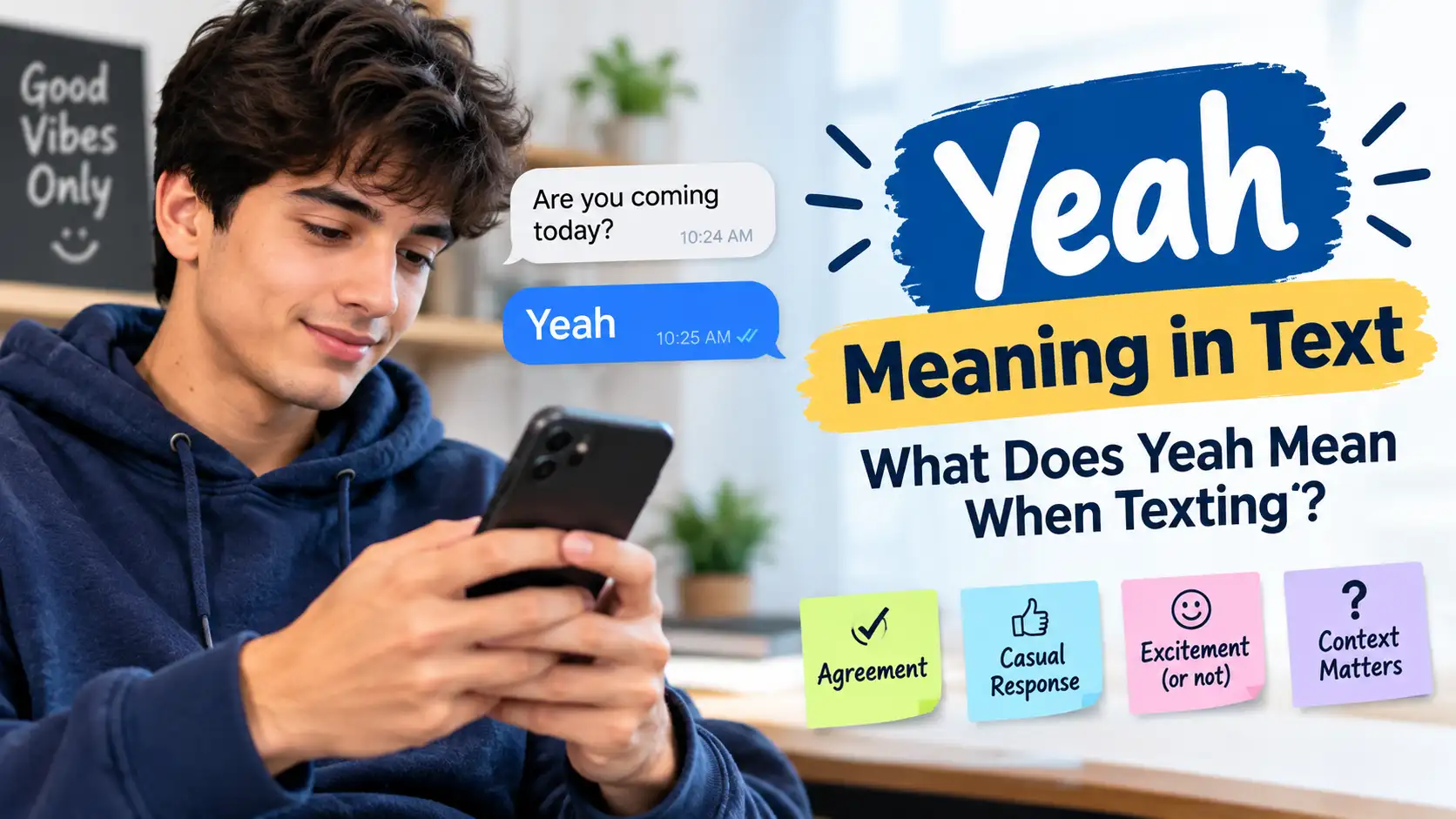
You send a message. You wait. Then it comes back: “yeah.”
No punctuation. No emoji. Just four letters sitting there on your screen.
“Yeah” is one of the most common words in texting, social media, and casual chat. It shows up in every kind of conversation from a quick reply to a friend, to a comment on a gaming server, to a one word answer on a dating app. But its meaning changes depending on tone, context, and what came before it.
Understanding “yeah” matters because texting strips away tone of voice and facial expression. A word that sounds friendly out loud can look cold or distant in text. Knowing how to read it and how to use it helps you avoid awkward misunderstandings in daily chats, work messages, and new relationships.
Definition & Meaning
At its core, “yeah” is a casual way of saying “yes.” It’s informal, relaxed, and used constantly in spoken English. In texting, it carries that same casual tone, but because text lacks voice inflection, “yeah” can read very differently depending on the situation.
Basic meaning: Agreement, confirmation, or acknowledgment.
- “Are you coming tonight?” → “Yeah, I’ll be there.”
- “Did you finish the report?” → “Yeah, sent it an hour ago.”
Real life examples of usage:
- Confirming plans
“Are we still on for 7?”
“Yeah, see you then.” - Casual agreement
“This show is actually really good.”
“Yeah, I’m hooked.” - Short, flat reply (can feel distant)
“I miss you.”
“Yeah.”
That last example shows why “yeah” is tricky. On its own, with no follow up, it can feel dismissive even if that’s not the intent. The word itself is neutral; the context and what surrounds it give it real meaning.
“Yeah” also appears in longer forms like “yeahh,” “yeahhh,” or “yeaaah,” which usually soften the tone or add emphasis, excitement, or sarcasm depending on how they’re used.
Background & History
“Yeah” isn’t a modern texting invention. It’s a natural, informal variant of “yes” that developed in spoken English over many decades. Linguists trace casual pronunciations like “yeah” back to shifts in everyday speech in the early to mid 20th century, particularly in American English, where relaxed, quick word forms became common in casual conversation.
As telephones, radio, and later television spread casual speech patterns widely, “yeah” became a standard part of informal spoken English across English speaking countries. It was never considered “proper” or formal, that’s part of its identity. It’s the version of “yes” people use with friends, family, and peers, not in job interviews or formal writing.
When texting emerged in the late 1990s and 2000s, “yeah” moved naturally from speech into text. It fit texting culture perfectly: short, fast, informal. As character limits and typing speed became bigger factors (especially on early flip phones), short words like “yeah” were even more practical than “yes.”
Today, “yeah” is everywhere:
- Texting the default casual “yes”
- Social media comments quick agreement or reaction
- Gaming chat fast confirmation during matches
- Voice to text and messaging apps spoken casualness carried into text
Its meaning hasn’t changed much over time, but its emotional weight has grown. Because so much daily communication now happens through text instead of speech, a short word like “yeah” carries more interpretive pressure than it ever did when spoken aloud with tone and body language attached.
Usage in Various Contexts
**Yeah” adapts to whatever platform or conversation it’s used in.
In texting between friends:
“Party’s at Jake’s tonight.”
“Yeah, I heard. Are you going?”
On social media (comments/replies):
Comment: “This song is a bop 🎶”
Reply: “Yeah it’s been on repeat all week”
In gaming chat:
“Push mid now?”
“yeah go go go”
Gaming chat especially favors “yeah” because it’s fast to type during action heavy moments, often skipping capitalization and punctuation entirely.
In casual conversation about plans:
“Should we reschedule for Friday?”
“Yeah, that works better for me.”
As a filler or thinking pause (spoken into text):
“Yeah… I don’t know, maybe.”
This use shows hesitation rather than firm agreement. The pause created by “…” changes the entire meaning from confident “yes” to uncertain “maybe.”
In flirty or dating contexts:
“Are you free this weekend?”
“Yeah, what did you have in mind? 😊”
Here, the emoji and follow up question shift “yeah” from flat to inviting.
As sarcasm:
“You really think that’s a good idea?”
“Yeah, totally.” (meaning the opposite)
Sarcastic “yeah” usually depends on prior context; the reader has to sense the eye roll behind it.
Across all these settings, one pattern holds true: “yeah” alone is neutral, but “yeah” plus tone markers, emojis, punctuation, follow up words carries the real message.
Common Misconceptions & Clarifications
A common misconception is that a one word “yeah” always means disinterest or coldness. That’s not accurate. Texting habits vary a lot by person. Some people are naturally brief texters regardless of how they feel.
Misconception 1: “Yeah” with no punctuation means annoyance.
Clarification: Many people simply don’t use punctuation in casual texting. It’s a texting style, not always an emotional signal.
Misconception 2: “Yeah” is always more casual than “yes.”
Clarification: True in most contexts, but “yes” can sometimes feel more formal or even blunt, depending on tone. “Yeah” is usually the warmer, more conversational choice among friends.
Misconception 3: “Yeah” is rude in professional settings.
Clarification: It’s not “rude” exactly, it’s just too informal for most workplace communication, especially in emails or messages to clients or supervisors.
Misconception 4: A short “yeah” reply means someone is upset with you.
Clarification: It might simply mean they’re busy, driving, or not big on typing long replies. Context and consistency of behavior matter more than a single short reply.
Can “yeah” be considered inappropriate?
Generally, no it’s a mild, everyday word. It becomes a tone issue, not a content issue. The word itself isn’t offensive; it’s how it’s paired with silence, timing, or follow up (or lack of one) that shapes how it lands.
The biggest clarification worth remembering: text has no tone of voice. Reading “yeah” as cold, sarcastic, excited, or uncertain often says more about the reader’s assumptions than the sender’s intent.
Similar Terms & Alternatives
Several words and phrases serve a similar function to “yeah,” each with a slightly different feel.
| Term | Tone | Common Use |
| Yes | Neutral to formal | Professional or clear confirmation |
| Yeah | Casual | Everyday texting and conversation |
| Yep / Yup | Very casual, upbeat | Friendly, quick confirmation |
| Sure | Agreeable, sometimes hesitant | Accepting an offer or plan |
| Totally | Enthusiastic agreement | Strong, energetic yes |
| Definitely | Confident agreement | Emphasizing certainty |
| Ye / Ya | Very informal, trendy | Younger or internet heavy texting |
| Ok / Okay | Neutral acknowledgment | Confirming without much emotion |
| Uh huh | Casual, spoken style | Quick verbal style agreement |
| For sure | Relaxed, confident | Casual agreement, often with friends |
Examples in context:
- “Yep, on my way!” cheerful and quick
- “Sure, why not.” agreeable but slightly indifferent
- “Definitely, count me in.” enthusiastic and certain
- “For sure, let’s do it.” casual confidence
Choosing between these alternatives can shift the emotional temperature of a reply without changing its basic meaning of “yes.”
How to Respond to This Term
How you respond to “yeah” depends on the context and what kind of reply you want to give.
Casual response:
“Yeah, sounds good!”
“Yeah for sure, what time?”
Funny/playful response:
“Yeahhh buddy 😎”
“Yeah yeah yeah, I hear you 😂”
Professional response (replacing “yeah” entirely):
“Yes, that works for me.”
“Confirmed I’ll have it ready by Friday.”
Privacy conscious or cautious response:
If someone texts “yeah” and you’re unsure of the context or intent (especially from an unfamiliar number or platform):
“Can you clarify what you mean?”
“Yeah to what, sorry can you remind me?”
When “yeah” feels too flat and you want more warmth:
Instead of just “yeah,” try: “Yeah, definitely sounds fun!”
When you want to keep things short but polite:
“Yep, all good.”
Matching your response style to the relationship and setting keeps the conversation natural, whether you’re texting a friend, replying on social media, or messaging a coworker.
Regional or Cultural Differences
“Yeah” is widely used across English speaking countries the United States, United Kingdom, Canada, Australia, and beyond but regional texting slang adds local flavor.
- United States: “Yeah,” “yep,” and “for sure” are extremely common in everyday texting.
- United Kingdom: “Yeah” is standard, often paired with “cheers” or “innit” in casual speech.
- Australia: “Yeah nah” and “nah yeah” are uniquely Australian expressions confusing to outsiders, but locally understood as soft disagreement or soft agreement depending on order.
- Canada: Similar to American usage, sometimes softened with “yeah, eh?”
In non English speaking cultures, “yeah” has been informally borrowed into casual texting among younger, English influenced speakers, especially in countries with heavy exposure to American media, gaming, and social platforms. It often appears mixed into local language texts as a quick, internationally recognized way to say “yes.”
Overall, while “yeah” is rooted in English, its casual tone and simplicity have made it a familiar word far beyond strictly English speaking contexts, especially online.
Comparison with Similar Terms
| Term | Formality | Emotional Tone | Best Used In |
| Yes | Formal–Neutral | Direct, clear | Work emails, formal requests |
| Yeah | Informal | Relaxed, friendly | Texting, casual chats |
| Yep | Very informal | Upbeat, quick | Friends, fast replies |
| Sure | Informal | Agreeable, sometimes neutral | Accepting plans/offers |
| Totally | Informal | Enthusiastic | Strong agreement |
| Ok | Neutral | Flat, functional | Quick acknowledgments |
Key differences:
- “Yes” carries more weight and formality; “yeah” feels relaxed and conversational.
- “Yep” and “totally” add more personality and energy than a plain “yeah.”
- “Sure” can sometimes hint at mild reluctance, while “yeah” is usually neutral to positive.
Usage in Online Communities & Dating Apps
On dating apps like Tinder or Hinge, “yeah” often shows up in early conversations as a low effort but friendly reply.
“Hey, how’s your week going?”
“Yeah it’s been good, busy with work lol, you?”
Here, “yeah” softens the reply and keeps things casual rather than overly formal.
Tip: If someone replies with just “yeah” and nothing else on a dating app, it may signal low interest or a distracted moment, context and consistency matter more than one message.
On Twitter/X, “yeah” often appears in quote tweets or replies expressing quick agreement:
“yeah this is exactly what I was thinking”
In gaming communities (Discord, in game chat), “yeah” is used constantly for fast confirmations during gameplay:
“rotate top?”
“yeah on it”
Tips for responding appropriately:
- On dating apps, pair “yeah” with a follow up question to keep conversation flowing.
- In gaming chat, short “yeah” replies are completely normal and expected don’t overanalyze them.
- On social media, “yeah” works well for quick, genuine agreement without sounding forced.
Hidden or Offensive Meanings
“Yeah” itself does not carry hidden or offensive meanings. It’s a neutral, common word. However, tone and delivery can shift how it lands:
- Sarcastic “yeah” can come across as dismissive or mocking, especially paired with phrases like “yeah, sure” or “yeah, right.”
- Repeated “yeah yeah yeah” can signal impatience or annoyance, as if brushing someone off.
- A blunt, standalone “yeah” during a serious conversation (like discussing feelings) can unintentionally feel cold or uninterested, even if that’s not the intent.
Context always matters more than the word itself. The same “yeah” can be warm, sarcastic, distracted, or dismissive; it depends entirely on the conversation around it, not the word in isolation.
Suitability for Professional Communication
“Yeah” is generally too casual for formal professional communication, especially in emails, official messages, or conversations with clients, supervisors, or unfamiliar colleagues.
Better professional alternatives:
- “Yes, that works for me.”
- “Confirmed.”
- “Absolutely, I’ll take care of it.”
- “That sounds good, I’ll proceed.”
Exception: In very casual workplace chat tools (like informal Slack channels among close teammates), “yeah” may be acceptable depending on company culture. Even then, it’s safer to lean formal when messaging supervisors or clients.
FAQs
1. Does “yeah” mean the same thing as “yes”?
Yes, but “yeah” is more casual and conversational, while “yes” is more formal or direct.
2. Is a one word “yeah” reply rude?
Not inherently it often just reflects a quick or busy reply style rather than rudeness.
3. Why does “yeah” sometimes feel cold in text?
Because text lacks tone of voice, a short reply can read as flat even when no negative emotion is intended.
4. Is “yeah” appropriate for work emails?
No “yes” or more formal phrasing is better suited for professional communication.
5. What does “yeah” mean on dating apps?
It usually signals casual agreement or interest, though message length and follow up questions matter more than the word itself.
6. Are “yeah” and “yep” the same?
They’re very similar, though “yep” often feels slightly more upbeat and quick.
7. Can “yeah” be sarcastic?
Yes, especially in phrases like “yeah, sure” or “yeah, right,” which usually signal doubt or disagreement.
Conclusion
“Yeah” is simple on the surface, a casual way of saying “yes” but its meaning shifts depending on tone, context, and what surrounds it in a conversation. In texting, gaming, social media, and dating apps, it’s a fast, flexible word that adapts to almost any casual setting. The key takeaway: “yeah” alone is neutral; context gives it meaning. Understanding how it’s used and how to respond to it helps you communicate more clearly and avoid unnecessary misreadings in everyday digital conversations.

Asfan Wahab is a content creator and writer focused on text meanings, slang, abbreviations, acronyms, and internet expressions. Through Orvexale.com, he provides clear and simple explanations to help readers understand modern texting language. His goal is to make confusing terms easy to understand with practical examples and everyday context.