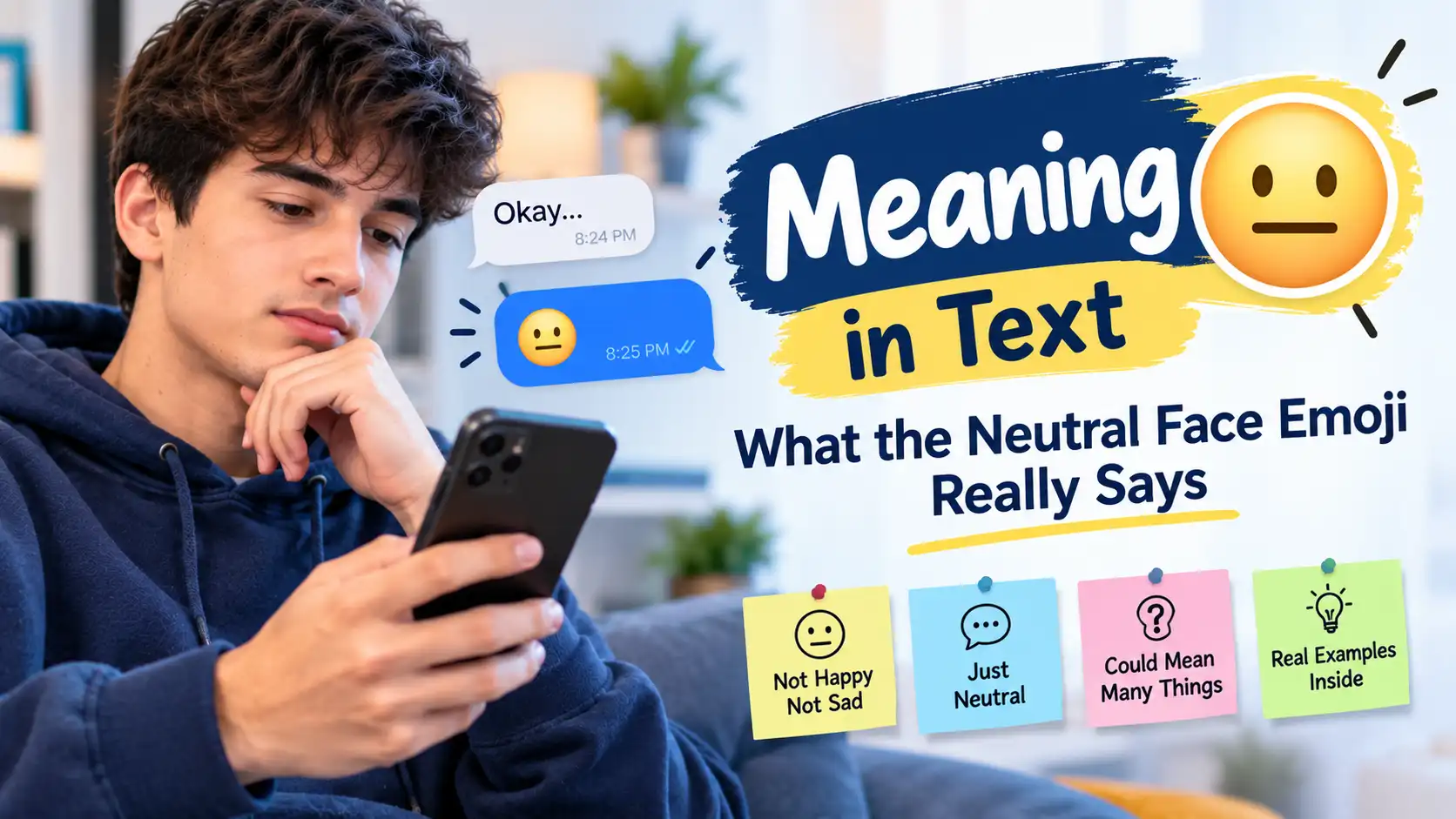
Someone sends you a message. You reply. Then back comes: 😐
No words. Just a flat, straight lined face staring back at you.
The 😐 emoji officially called the “Neutral Face” is one of the most confusing emojis in texting. There is no smile. There is no frown. It simply… sits there.You’ll spot it in texts, social media comments, gaming chats, and group threads, often used to express awkwardness, mild annoyance, or “I have nothing to say.”
Understanding 😐 matters because emojis carry emotional weight that words alone don’t. A single blank faced emoji can mean “that was weird,” “I’m unimpressed,” or “I don’t know how to respond.” Misreading it can turn a harmless reply into an unnecessary argument. Knowing what it really signals and how to reply to it helps you avoid confusion in everyday digital conversations.
Definition & Meaning
😐 is officially named the “Neutral Face” emoji. Visually, it shows a flat, straight mouth with simple dot or oval eyes, no smile, no frown, no strong emotion. That’s exactly the point: it represents a lack of clear feeling.
In practice, though, “neutral” rarely means truly emotionless. Depending on context, 😐 usually signals one of a few things:
- Awkwardness a response to something uncomfortable or cringey
- Mild disapproval a subtle “I’m not into this”
- Boredom or indifference “meh, whatever”
- Speechlessness not knowing how to respond
- Deadpan humor a dry, sarcastic reaction
Real life examples of usage:
- Reacting to something awkward
“My mom just liked my Instagram post from 2016.”
“😐” - Expressing mild annoyance
“Traffic added 40 minutes to my commute.”
“😐” - Responding to something unimpressive
“I made you a playlist.”
“😐 it’s just one song on repeat isn’t it” - Deadpan reaction to a joke
“Why did the chicken cross the road?”
“😐”
Unlike a laughing emoji or a crying emoji, 😐 doesn’t tell the reader how to feel about the message it forces them to read between the lines. That ambiguity is exactly why it’s so widely used, and so often misunderstood.
Background & History
The neutral face emoji has been part of the Unicode Standard since Unicode 6.0, released in 2010. It belongs to the same emoji family as the smiling face, frowning face, and other basic facial expressions collectively designed to represent core human emotions in digital form.
Early emoji sets, inspired by Japanese emoticon culture, focused mostly on clearly positive or negative faces. The neutral face filled a gap: a face for everything in between the emotional territory that isn’t happy or sad, but something flatter and harder to name.
As smartphones and messaging apps adopted standardized emoji keyboards through the 2010s, 😐 became widely available across platforms like iOS, Android, WhatsApp, and Facebook Messenger. Its flat design made it instantly recognizable and easy to use as a quick reaction.
Over time, its meaning shifted with internet culture. What started as a literal “neutral” emotion marker evolved into a tool for sarcasm, dry humor, and passive aggressive commentary especially among younger texters and social media users. It became less about having no emotion and more about choosing not to show emotion on purpose, which itself sends a message.
Today, 😐 is common across texting, group chats, Twitter/X replies, TikTok comments, and gaming Discord servers. It’s often paired with capital letters, ellipses, or short phrases to sharpen its tone, since the emoji alone can be read many different ways.
Usage in Various Contexts
😐 adapts its meaning depending on where and how it’s used.
In texting between friends:
“I told her the truth and she got mad.”
“😐 well what did you expect”
On social media (comments/replies):
Comment: “This new update ruined the app.”
Reply: “😐 they really did that”
In gaming chat:
“I just threw the match, sorry guys.”
“😐”
In gaming, 😐 often replaces typing out frustration a quick, wordless way to react to a teammate’s mistake without starting an argument.
In group chats reacting to drama:
“Guess who showed up uninvited to the party 👀”
“😐 no way”
As a reaction to cringe or secondhand embarrassment:
“He actually said that out loud in the meeting.”
“😐 I would have left the room”
As dry sarcasm:
“I definitely didn’t eat your leftovers.”
“😐 sure you didn’t”
Expressing ‘I have nothing to add’:
“Anyway, that’s basically my whole week.”
“😐 rough”
Across these examples, one thing stays consistent: 😐 rarely stands alone as a full reply. It usually needs surrounding words, capitalization, or repetition (like “😐😐😐”) to make its exact tone clear. Without that context, readers often fill in the gap based on their own assumptions.
Common Misconceptions & Clarifications
A common misconception is that 😐 always means annoyance or anger. That’s not quite right. While it can signal mild frustration, it more often expresses awkwardness, disinterest, or a dry non reaction rather than genuine anger.
Misconception 1: 😐 means the person is upset with you.
Clarification: It often just means “I don’t know how to respond” or “that was awkward” not necessarily directed at the reader personally.
Misconception 2: 😐 is the same as a frowning face.
Clarification: A frown clearly signals sadness or displeasure. 😐 is intentionally ambiguous flatter, drier, and less emotionally direct.
Misconception 3: Using 😐 is passive aggressive.
Clarification: It can be, but it’s often just a low effort way to react without writing a full sentence, especially in fast paced chats.
Misconception 4: 😐 is rude in every context.
Clarification: It depends entirely on the conversation. Among friends, it’s usually harmless and even funny. In more sensitive conversations, it can come across as dismissive if used carelessly.
Can 😐 be considered inappropriate?
Not inherently it’s a mild, widely used emoji. The issue is less about offensiveness and more about ambiguity. Because it doesn’t clearly express positive or negative emotion, it’s easy to misread, especially in serious or emotional conversations where a clearer response might be expected.
The key clarification: 😐 is a blank canvas. Its real meaning almost always comes from the words around it, the relationship between the people texting, and the tone of the conversation leading up to it.
Similar Terms & Alternatives
Several emojis and phrases express similar flat, unimpressed, or awkward reactions, each with a slightly different flavor.
| Emoji/Term | Tone | Common Use |
| 😐 Neutral Face | Flat, ambiguous | Awkwardness, dry reactions |
| 😑 Expressionless Face | Blanker, more “done” | Exasperation, silent judgment |
| 🙄 Eye Roll | Annoyed, sarcastic | Clear irritation or disbelief |
| 😒 Unamused Face | Displeased, unimpressed | Mild annoyance, side eye energy |
| 😶 No Mouth Face | Speechless | “I have nothing to say” |
| 🫤 Slightly Frowning w/ Diagonal Mouth | Uneasy, unsure | Uncomfortable or uncertain reaction |
| “meh” | Indifferent | Casual verbal shrug |
| “…” | Awkward pause | Silence, hesitation, or discomfort |
Examples in context:
- “😑 I can’t believe he said that” more exasperated than 😐
- “🙄 here we go again” clearly annoyed, not ambiguous
- “😶 no comment” speechless rather than flat
- “🫤 not sure how I feel about this” uneasy, not dismissive
While these alternatives overlap with 😐, none capture its exact mix of flatness and ambiguity which is why it remains a go to choice for dry, hard to label reactions.
How to Respond to This Term
How you respond to a 😐 depends on the context and what kind of reply you want to give.
Casual response:
“😐 same tbh”
“lol why the face”
Funny/playful response:
“😐 oop”
“that face says everything”
Professional response (avoiding emoji entirely):
“Understood, let me know if you’d like to discuss further.”
“I’d be happy to clarify if needed.”
Privacy conscious or cautious response:
If someone sends 😐 and the meaning feels unclear or you’re unsure of their tone:
“Is everything okay?”
“Not sure what that face means, can you explain?”
When you sense mild annoyance and want to address it directly:
“Did I say something wrong?”
“You okay? That emoji seems off.”
When you want to keep things light:
“Was that a good 😐 or a bad 😐 lol”
Matching your response to the relationship and setting helps keep the conversation clear, especially since 😐 is one of the more ambiguous emojis in common use.
Regional or Cultural Differences
😐 is part of the standardized Unicode emoji set, so its appearance stays consistent across most platforms and countries, unlike text slang, which varies more by region.
- United States: Commonly used for dry humor, sarcasm, or reacting to cringe moments.
- United Kingdom: Often used similarly, sometimes layered with British deadpan humor and understatement.
- East Asia (Japan, South Korea): Emoji culture originated largely in Japan, where subtle, ambiguous expressions are already common in communication 😐 fits naturally into that style of indirect emotional signaling.
- Latin America and Europe: Widely used the same way, often alongside local slang phrases expressing awkwardness or indifference.
Cultural nuance: In cultures that value indirect communication, 😐 can serve as a polite way to express disagreement or discomfort without being confrontational. In more direct communication cultures, it may come across as unclear or even mildly rude, since it avoids stating a clear opinion.
Overall, while the emoji itself looks the same everywhere, how “neutral” or “flat” reactions are culturally interpreted can shift its perceived tone from harmless to slightly cold, depending on where you are.
Comparison with Similar Terms
| Emoji | Emotional Clarity | Typical Tone | Best Used In |
| 😐 Neutral Face | Low (ambiguous) | Flat, dry | Awkward or unclear reactions |
| 😑 Expressionless | Low–Medium | Exasperated, “done” | Silent judgment, disbelief |
| 🙄 Eye Roll | High | Annoyed, sarcastic | Clear irritation |
| 😒 Unamused | Medium–High | Displeased | Mild annoyance |
| 😶 No Mouth | Medium | Speechless | “No comment” moments |
| 🙂 Slight Smile | Medium | Polite, mild positivity | Soft agreement or politeness |
Key differences:
- 😐 is more ambiguous than 🙄 or 😒, which clearly signal annoyance.
- 😑 feels more tired or “over it” compared to the flatter, more neutral 😐.
- 😶 focuses on silence, while 😐 focuses on lack of visible emotion.
Usage in Online Communities & Dating Apps
On dating apps like Tinder or Hinge, 😐 often shows up as a reaction to something awkward, cringey, or unimpressive in a match’s message.
“Do you come here often? 😏”
“😐 that’s a bold opener”
Here, 😐 signals dry amusement rather than genuine offense a light way to call out a cheesy line.
Tip: On dating apps, a 😐 reply can feel like a soft rejection of a message’s tone. If you receive one, it’s often worth lightening the mood or rephrasing rather than repeating the same approach.
On Twitter/X, 😐 frequently appears in replies to awkward posts or questionable takes:
“hot take: pineapple belongs on pizza”
“😐 we’re not doing this today”
In gaming communities (Discord, in game chat), 😐 is used to react to mistakes, bad plays, or awkward silences without escalating conflict:
“sorry I missed that call”
“😐 it’s fine”
Tips for responding appropriately:
- On dating apps, treat 😐 as a cue to shift tone or ask a genuine question.
- In gaming chat, don’t over read it, it’s often just a quick, low effort reaction.
- On social media, 😐 usually works best paired with a short comment for clarity.
Hidden or Offensive Meanings
😐 does not carry any inherently offensive or hidden meaning. It’s a standard, widely recognized emoji representing a neutral or ambiguous emotional state. However, tone and context shape how it’s received:
- Repeated use (😐😐😐) can amplify awkwardness, disbelief, or subtle frustration.
- Paired with sarcasm, it can feel more pointed or critical than intended.
- Sent during a serious or emotional conversation, it may come across as dismissive, even if the sender simply didn’t know how else to respond.
Context always outweighs the emoji itself. The same 😐 can read as playful, awkward, judgmental, or indifferent depending on the relationship between the people texting and what was said right before it.
Suitability for Professional Communication
😐 is generally not suitable for professional communication, especially in emails, official messages, or conversations with clients, supervisors, or unfamiliar colleagues. Its ambiguous tone makes it risky in settings where clear, respectful communication matters.
Better professional alternatives:
- “Understood, thank you for letting me know.”
- “I see, let’s discuss this further.”
- “Noted, I’ll follow up shortly.”
- “Thanks for the update.”
Exception: In very casual, close knit workplace chats (like informal Slack channels among teammates who know each other well), 😐 might appear occasionally. Even then, it’s safer to avoid it with supervisors, clients, or in any written communication that could be reviewed later.
FAQs
1. What does 😐 mean in text?
It represents a neutral or ambiguous reaction often awkwardness, mild annoyance, or indifference.
2. Is 😐 the same as being upset?
Not necessarily. It can express many things, from dry humor to genuine discomfort, depending on context.
3. Why is 😐 so hard to interpret?
Because it’s designed to show no strong emotion, its real meaning depends heavily on the words and tone around it.
4. Is it rude to send someone 😐?
Not inherently, but it can feel dismissive in serious or emotional conversations if used without explanation.
5. What’s the difference between 😐 and 😑?
😑 (Expressionless Face) usually feels more tired or “done,” while 😐 is flatter and more ambiguous.
6. Can 😐 be used sarcastically?
Yes it’s commonly used for dry, deadpan sarcasm in texts and social media.
7. Should I use 😐 in work messages?
It’s best avoided in professional settings; a short, clear written response is safer.
Conclusion
😐 looks simple a flat, expressionless face but its meaning shifts depending on tone, timing, and what surrounds it in a conversation. Across texting, gaming, social media, and dating apps, it serves as a flexible tool for awkwardness, dry humor, mild annoyance, or plain indifference. The key takeaway: 😐 rarely speaks for itself; context fills in what the face won’t say. Understanding how it’s used and knowing how to respond helps you avoid misreading tone in everyday digital conversations.

Asfan Wahab is a content creator and writer focused on text meanings, slang, abbreviations, acronyms, and internet expressions. Through Orvexale.com, he provides clear and simple explanations to help readers understand modern texting language. His goal is to make confusing terms easy to understand with practical examples and everyday context.