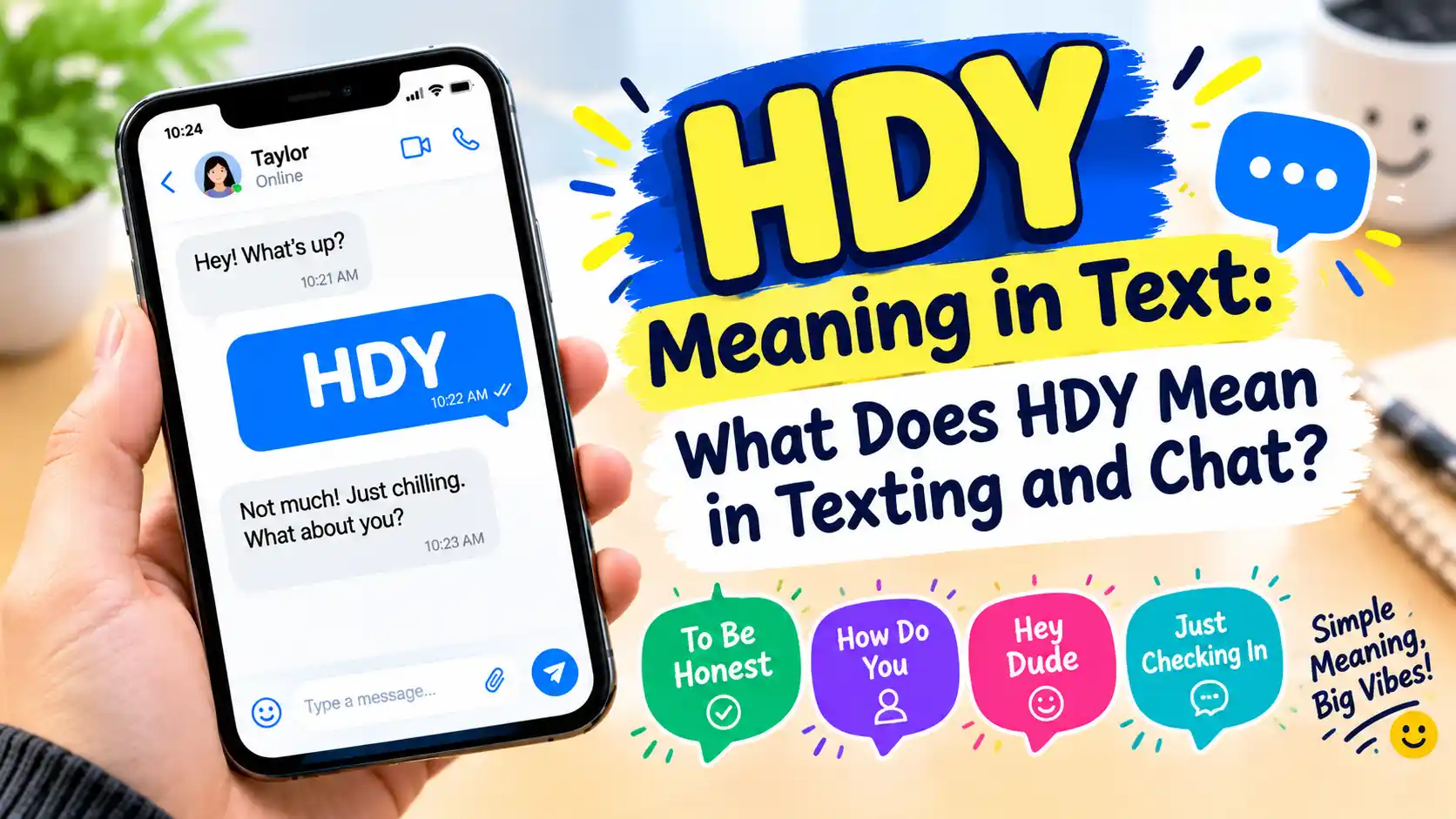
Texting moves fast. People shorten words to save time and keystrokes. HDY is one of these short forms. It stands for “how are you.” You will see it in text messages, group chats, and comment sections every day.
This little abbreviation shows up almost everywhere. Friends use it to check in. Gamers type it during a match. Coworkers might even drop it in a quick Slack message. Because it appears so often, knowing what it means and how to replyhelps you keep up with modern conversation.
This guide breaks down everything about HDY. You will learn its definition, history, common uses, and even how it differs from similar terms. By the end, you will know exactly when to use it and how to respond like a pro.
Definition & Meaning
HDY stands for “How Do You” or, more commonly, “How Are You.” It is a casual greeting used to ask about someone’s well being or current state.
The abbreviation works as a shortcut. Instead of typing out four words, a person types three letters. This saves time on mobile keyboards and speeds up fast paced chats.
Common expansions of HDY include:
- How are you the most frequent meaning
- How do you use it as the start of a longer question, like “HDY feel about this?”
- How’s your day sometimes used loosely in casual chats
Example usage:
Sam: Hey! hdy? Jess: Good, just got home from work. u?
In this exchange, HDY simply opens the conversation. It works as a friendly check in, similar to saying “hi” and asking about someone’s day in one breath.
Another example, used as part of a longer question:
Mia: hdy manage to finish that project so fast? Leo: lots of coffee, honestly
Here, HDY replaces “how do you,” turning the message into a curious follow up question rather than a greeting.
The meaning almost always depends on context. If someone opens a chat with just “hdy,” they are asking about your well being. If HDY appears mid-sentence, it usually means “how are you.”
Why it matters: texting relies on quick exchanges. Abbreviations like HDY keep messages short without losing meaning. Understanding this term helps you read the tone of a conversation and respond appropriately, whether it is a friendly greeting or a real question about your day.
Background & History
Text abbreviations like HDY grew out of necessity. In the early 2000s, mobile phones had physical keypads. Typing a message meant pressing number keys multiple times to get one letter. Every character counted.
SMS character limits pushed this trend further. Standard text messages capped out at 160 characters. Shortening common phrases lets people fit more into a single message. Terms like “u” for “you,” “r” for “are,” and “hdy” for “how are you” became everyday shortcuts.
As instant messaging platforms like AIM, MSN Messenger, and later WhatsApp and iMessage grew popular, these abbreviations carried over. Even though character limits disappeared, the habit of shortening words stuck. Fast typing became a cultural norm, especially among younger users.
Gaming culture also played a role. Online multiplayer games required quick communication during matches. Typing full sentences wasted precious seconds. Abbreviations like HDY, GG (good game), and BRB (be right back) became standard in gaming chat.
Over time, HDY spread beyond texting and gaming into broader online spaces. Social media comments, direct messages, and even some casual emails now use it. It has become part of the informal internet vocabulary that crosses generations, though it remains most common among younger users and in casual settings.
Where it’s common today:
- Text messages between friends and family
- Direct messages on Instagram, Twitter, and TikTok
- Gaming chat during online matches
- Casual Discord or group chat conversations
- Informal check ins in messaging apps like WhatsApp
The term has not changed much in meaning since its early use. It still means “how are you” or “how do you.” What has changed is its reach. What started as a texting shortcut is now recognized across nearly every digital communication platform.
Usage in Various Contexts
HDY shows up differently depending on where you see it. Here is how it plays out across common platforms.
Texting
In everyday texting, HDY works as a quick greeting.
Alex: hdy today? Priya: tired but okay, long day at work
Social Media
On platforms like Instagram or Twitter, people use HDY in comments or direct messages to check in casually.
Comment: “hdy been?? haven’t seen you post in a while”
Gaming
In gaming chat, HDY often opens a conversation between matches or during a lobby wait.
Player1: hdy man, been a minute since we teamed up Player2: good good, just got back from vacation
Casual Conversations
Among friends, HDY can also mean “how do you,” especially when asking for advice or opinions.
Ben: hdy usually deal with stress before exams? Nora: I just take breaks and go for a walk
Professional Settings
HDY rarely appears in formal communication. Professional messages typically spell out “how are you” in full. Using HDY in a work email or formal chat can come across as too casual, especially with clients or senior colleagues.
Quick comparison of contexts:
| Context | How HDY Is Used |
| Texting friends | Casual greeting |
| Social media DMs | Check in or catching up |
| Gaming chat | Quick greeting between matches |
| Group chats | Informal conversation starter |
| Professional email | Rarely used; considered too casual |
Understanding the platform helps you judge whether HDY fits. It works well in relaxed, personal spaces but feels out of place in formal or business communication.
Common Misconceptions & Clarifications
Some people confuse HDY with other similar looking abbreviations. This mix up can lead to awkward replies or misunderstandings.
Misconception 1: HDY always means “how are you.”
While this is the most common meaning, HDY can also stand for “how do you,” especially when it starts a longer question. Reading the full sentence helps clarify the intended meaning.
Misconception 2: HDY is the same as HRU.
HRU (how are you) and HDY are close but not identical. HRU almost always means “how are you,” while HDY has two possible meanings depending on context.
Misconception 3: HDY is rude or dismissive.
Some people assume that shortening a greeting makes it feel careless. In reality, HDY is simply a texting convention. Its casual tone matches the casual nature of most text conversations. It is not meant to sound cold or uninterested.
Misconception 4: HDY only applies to romantic or dating contexts.
While it appears often on dating apps, HDY is a general purpose greeting. Friends, family, coworkers, and gaming teammates all use it the same way.
Is it ever considered inappropriate?
HDY itself is neutral and friendly. However, tone matters. Sending it repeatedly without following up on someone’s answer, or using it as a way to avoid deeper conversation, can come across as low effort. Context and the relationship between the people texting shape how the message lands.
Clarifying example:
Text 1: “hdy” (as a standalone greeting) → means “how are you” Text 2: “hdy even get tickets that fast?” (mid sentence) → means “how do you”
Paying attention to placement in the sentence removes most confusion. When in doubt, a quick follow up question can clarify what the sender meant.
Similar Terms & Alternatives
Many abbreviations share space with HDY in casual texting. Knowing the differences helps you use the right one at the right time.
Common alternatives:
- HRU How are you
- WYD What are you doing
- SUP What’s up
- HBU How about you
- WYA Where you at
- HYD How you doing (a variation with similar meaning to HDY)
Comparison table:
| Abbreviation | Full Meaning | Typical Use |
| HDY | How are you / How do you | General greeting or question starter |
| HRU | How are you | Direct check in |
| SUP | What’s up | Casual, often used with close friends |
| WYD | What are you doing | Asking about current activity |
| HBU | How about you | Reciprocal question after answering |
| WYA | Where you at | Asking about someone’s location |
Example dialogue using alternatives:
Kim: sup, hru today? Tia: good! hbu? Kim: wyd rn, wanna hang out?
This exchange shows how these abbreviations often mix together in a single conversation. They all serve slightly different purposes but share the same casual, friendly tone.
Choosing between HDY and its alternatives usually comes down to personal habit and regional preference. Some people default to HRU, while others stick with HDY. Both communicate the same friendly intent.
How to Respond to This Term
Replying to HDY depends on your relationship with the sender and the setting of the conversation.
Casual Response
Keep it short and relaxed for friends and family.
Them: hdy? You: pretty good, just chilling. u?
Funny Response
Add humor if you want to keep things light.
Them: hdy? You: surviving on caffeine and hope, lol. hbu?
Professional Response
Even if someone texts you HDY in a work context, respond in a slightly more polished tone.
Them: hdy? You: Doing well, thanks for asking! How about you?
Privacy Conscious Response
If you’d rather not share details, keep your answer vague and redirect the conversation.
Them: hdy? You: all good, thanks! What’s going on with you?
When HDY Means “How Do You”
If the message is really asking for advice or an opinion, answer the actual question.
Them: hdy stay motivated to work out? You: I just schedule it like an appointment, making it harder to skip.
Tips for responding well:
- Match the tone of the sender. A casual greeting gets a casual reply.
- Read context clues to figure out if they mean “how are you” or “how do you.”
- Keep it brief in fast paced chats, but add detail in slower conversations.
- Redirect the question back to the sender to keep the conversation flowing.
There is no single “correct” reply. The best response fits the relationship, the platform, and the vibe of the conversation.
Regional or Cultural Differences
HDY is mostly an English language texting term, but its usage varies by region and audience.
English speaking countries:
In the United States, United Kingdom, Canada, and Australia, HDY appears frequently in texting and social media. It is especially common among teens and young adults.
Non English speaking regions:
In countries where English is a second language, HDY still shows up, particularly among younger internet users who mix English abbreviations into their native language texting. For example, someone texting in Spanish or Tagalog might still type “hdy” instead of writing the full phrase in their own language, especially in casual online spaces influenced by American pop culture and gaming communities.
Slang variations by region:
- In the UK, “you alright?” often replaces “how are you” entirely, so HDY may appear less often in daily speech but still shows up in texting among younger users.
- In the US, HDY, HRU, and “wyd” are all common and often used interchangeably.
- In parts of Southeast Asia and the Philippines, English abbreviations like HDY blend into local texting habits, especially in mixed language conversations.
Cultural context matters too. In cultures where indirect communication is valued, a simple “how are you” (or HDY) may prompt a more detailed answer about family, work, or health. In cultures that favor brevity, the reply might just be a quick “good, you?”
Because texting culture spreads quickly through social media and gaming, HDY has become recognizable across many regions, even outside native English speaking countries. Still, its frequency and the depth of response it invites can vary widely based on local communication norms.
Comparison with Similar Terms
To fully understand HDY, it helps to see it side by side with related greetings.
| Term | Meaning | Formality | Common Platform |
| HDY | How are you / How do you | Very casual | Texting, gaming, DMs |
| HRU | How are you | Very casual | Texting, social media |
| WYD | What are you doing | Very casual | Texting, DMs |
| Sup | What’s up | Very casual | Texting, close friends |
| How’s it going | How are you | Semi casual | Spoken and written |
| How are you doing | How are you | Neutral/formal | Professional and personal |
Key differences:
- HDY vs. HRU: HDY can double as “how do you,” while HRU almost exclusively means “how are you.”
- HDY vs. Sup: Sup feels more relaxed and often used only between close friends, while HDY works across a wider range of relationships.
- HDY vs. formal phrasing: Full phrases like “how are you doing” fit professional or unfamiliar contexts, while HDY stays strictly casual.
Choosing the right term depends on your audience. Abbreviations like HDY work well with friends and peers, but formal phrasing remains the safer choice for coworkers, clients, or new acquaintances.
Usage in Online Communities & Dating Apps
HDY shows up often on dating apps like Tinder, Bumble, and Hinge, as well as social platforms like Twitter and gaming communities.
On Dating Apps
HDY often works as an opening line or early conversation starter.
Match: hey! hdy? You: doing good, just got back from the gym. u?
Because dating app conversations move fast, HDY keeps the exchange light and low pressure. It signals interest without requiring a long message.
Tip: Follow up HDY with a specific question or comment about the person’s profile. This keeps the conversation moving instead of stalling after a one word reply.
Match: hdy, saw you like hiking too You: yeah I do! good, just planning my next trail. What’s your favorite spot?
On Twitter and Social Media
People use HDY in replies or direct messages to check in with mutuals or friends they haven’t talked to recently.
Reply: “omg hdy been, been way too long!!”
In Gaming Communities
HDY often appears in voice chat transcripts, Discord servers, or lobby chats before or after a match.
Player: yo hdy, been a while since our last squad match Player 2: good man, just been busy with work
Tips for responding on these platforms:
- Keep dating app replies engaging. Add a question or detail to avoid a dead end conversation.
- Match the platform’s tone. Twitter replies can be more playful, while Discord chats often stay quick and casual.
- Don’t overthink it. HDY is low stakes. A simple, honest reply works fine in most cases.
Across these platforms, HDY serves the same basic purpose: a fast, friendly way to open or continue a conversation.
Hidden or Offensive Meanings
For the most part, HDY has no hidden or offensive meaning. It is a straightforward abbreviation for “how are you” or “how do you.” Unlike some internet slang, it does not carry a secondary, inappropriate definition in common use.
Why context still matters:
Even though the term itself is harmless, tone and situation can shape how it feels.
- Repeated, empty use: If someone sends “hdy” over and over without engaging in real conversation, it might come across as low effort or disinterested, even though the phrase itself is polite.
- Sarcastic tone: In a heated conversation, someone might type “hdy?” sarcastically to imply “why do you even care.” This depends entirely on the surrounding conversation, not the term itself.
- Mismatched context: Using HDY in a serious or emotional conversation might feel dismissive, since the abbreviation reads as casual and light.
No widely recognized alternative or offensive definition exists for HDY in mainstream use. Unlike some abbreviations that have multiple slang meanings across different communities, HDY has stayed fairly consistent as a friendly greeting.
Bottom line: the words themselves are neutral. Reading the tone of the full conversation, not just the abbreviation, determines whether a message feels genuine, sarcastic, or dismissive.
Suitability for Professional Communication
HDY is not recommended for formal or professional communication. While it works fine among friends, family, and casual online spaces, it can appear unprofessional in workplace emails, client messages, or formal chats.
Why it doesn’t fit professional settings:
- It looks too casual for business correspondence.
- It can come across as rushed or careless in a first impression.
- Some recipients, especially older colleagues or clients, may not recognize the abbreviation at all.
Professional alternatives:
Instead of HDY, use full phrases in workplace communication:
- “How are you doing?”
- “I hope you’re doing well.”
- “How has your week been?”
- “I hope this message finds you well.”
Example of a professional greeting:
Instead of: “hey, hdy?” Use: “Hi Sarah, I hope you’re doing well. Do you have a moment to discuss the project timeline?”
Exception: in very informal workplace chat tools, like a casual Slack channel among close teammates, a relaxed abbreviation might slip through without issue. Even then, spelling things out fully remains the safer choice, especially with people you don’t know well or in writing that might be shared more broadly.
Rule of thumb: if you would not say “hdy” out loud in a meeting, avoid typing it in a professional message.
FAQs
1. What does HDY mean in texting? HDY usually means “how are you.” It can also mean “how do you” when used at the start of a longer question.
2. Is HDY the same as HRU? They are similar, but not identical. HRU almost always means “how are you,” while HDY can carry two different meanings depending on context.
3. Is it rude to reply to HDY with just “good”? No, a short reply like “good” is common and acceptable in casual texting. Adding a follow up question, like “you?”, keeps the conversation going.
4. Can I use HDY in a work email? It’s best to avoid it. Spell out “how are you” in professional communication to keep a polished tone.
5. Does HDY have any offensive meaning? No. HDY is a neutral, friendly abbreviation with no widely recognized offensive definition.
6. Why do people use HDY instead of typing the full phrase? It saves time and keystrokes, especially on mobile devices and in fast paced chats like gaming or group messages.
7. Is HDY used outside of English speaking countries? Yes, though usage varies. Many non English speakers, especially younger internet users, mix English abbreviations like HDY into their own language texting.
Conclusion
HDY is a simple, widely used texting abbreviation that means “how are you” or, in some cases, “how do you.” It shows up across texting, social media, gaming, and dating apps as a quick, friendly way to check in or start a conversation.
While it works well in casual settings, it is best avoided in professional communication, where full phrases sound more polished. Understanding the context around HDY if it opens a greeting or leads into a longer question helps you read messages accurately and respond appropriately.

Asfan Wahab is a content creator and writer focused on text meanings, slang, abbreviations, acronyms, and internet expressions. Through Orvexale.com, he provides clear and simple explanations to help readers understand modern texting language. His goal is to make confusing terms easy to understand with practical examples and everyday context.