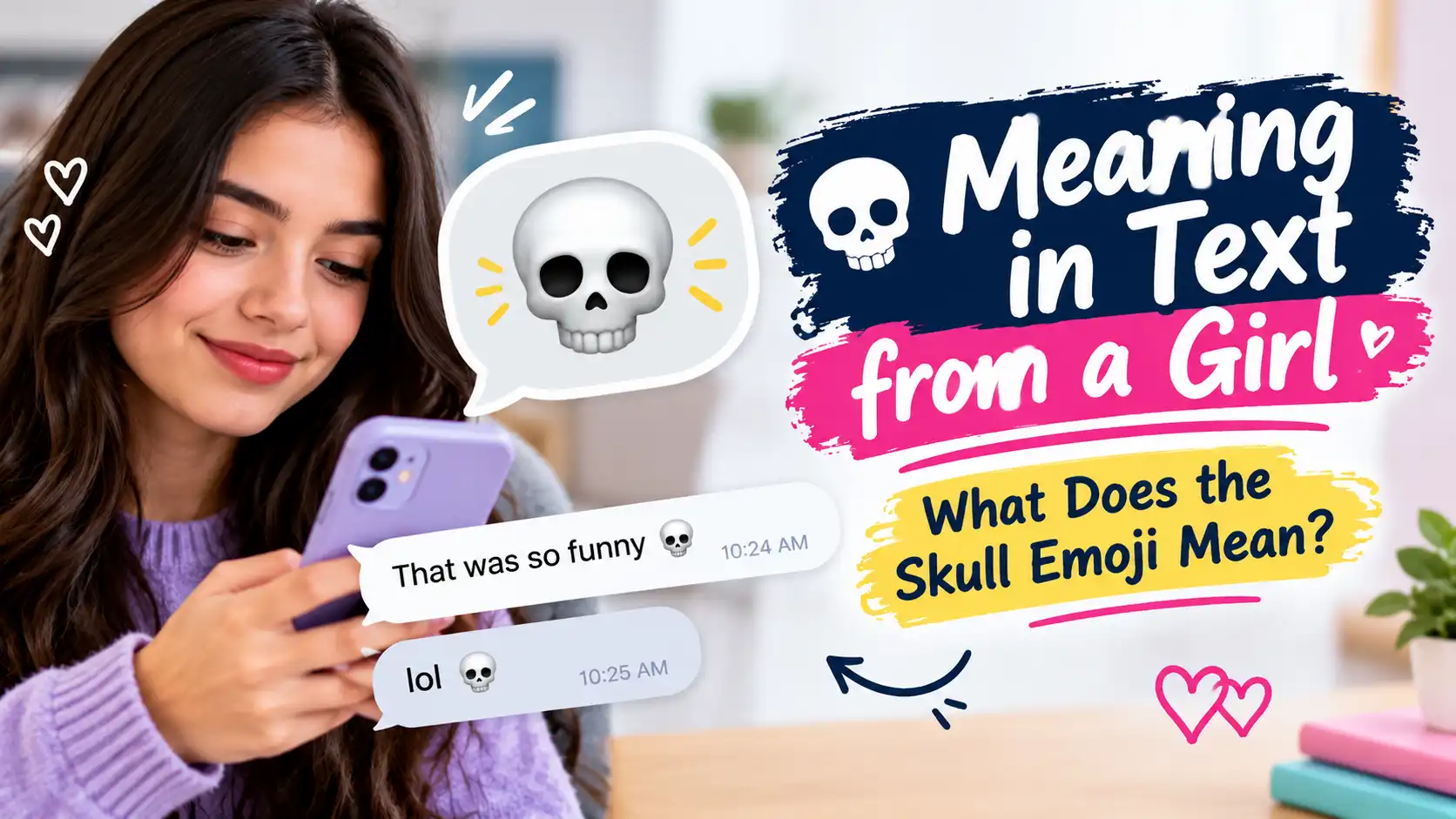
She sends you a skull. 💀 Nothing else. Just the skull.
Your heart skips. Could she be mad? Is she joking? Is something wrong?
Take a breath. In most texts, 💀 means “I’m dead,” as in “I’m dying of laughter.” It is a joke reaction, not a threat.
People use it in texts, social posts, game chats, and group threads. Girls use it. Guys use it. Friends use it all day long. It is one of the most common emojis online right now.
So why does it confuse people? Because a skull also means death, danger, and spooky stuff. The same picture can mean two very different things.
That is why context matters. A wrong guess can get awkward. You might panic over a joke. Or you might miss a hint that she likes you.
In this guide, you will learn what 💀 means. You will see where it came from. You will get real examples and smart replies.
Let’s get into it.
Definition & Meaning
The skull emoji 💀 most often means “I’m dead” or “that is so funny.” It shows that something made the sender laugh hard. It also works for shock, awkward moments, and “I can’t believe this.”
Think of it as a modern version of 😂. Many younger users feel 😂 is old. So they use 💀 instead.
The main meanings
- Laughing hard. “That’s so funny, I’m dead.”
- Teasing. “You did that? Wow.”
- Shock. “I can’t believe it.”
- Embarrassment. “I’m so embarrassed I could die.”
- Sarcasm. “Sure. Great idea.”
Real life examples
Example 1: Laughing
Jake: I tried to cook and set off the fire alarm.
Mia: 💀💀💀
Jake: It was a small fire.
Mia is laughing. The three skulls mean she finds it very funny.
Example 2: Teasing
Leo: I think I’m good at karaoke.
Zoe: 💀 You sang out of tune for an hour.
Leo: Ouch.
Zoe is playful. She likes him enough to tease.
Example 3: Awkward moment
Ava: I waved at a stranger. I thought it was my friend.
Ava: 💀
Here she is laughing at herself.
Example 4: Shock
Sam: My brother ate a whole cake.
Nia: 💀 Whole?
She is surprised and amused.
Quick tips to read it
- More skulls = more funny. 💀💀💀 is stronger than 💀.
- Look at the message before it. Was it a joke?
- Check the mood. Is the chat light or serious?
Key point: When a girl texts 💀, it is usually a good sign. It often means she is having fun.
Background & History
Skulls are old symbols. People have used them for centuries. They stood for death, danger, pirates, poison, and spooky times like Halloween.
The emoji is born
Emojis grew fast after phones added them in the early 2010s. The skull emoji came with them. At first, people used it for literal things: Halloween, horror movies, danger signs, and dark jokes.
The “I’m dead” era
Online, people began using “I’m dead” or “I’m dying” to mean “that’s hilarious.” It was a dramatic way to say LOL. Social media helped this spread. Many people credit online communities like Black Twitter and short video apps for pushing this kind of slang into the mainstream.
The shift from 😂 to 💀
The laughing crying emoji 😂 was everywhere. Then it began to feel overused. By the late 2010s and early 2020s, many Gen Z users saw it as dated. 💀 took its place. It fit the “I’m dead” phrase perfectly.
TikTok and memes
Short videos made the skull even bigger. Creators used it in captions and comments. Memes followed. Soon the skull was the top reaction for funny moments.
Where it is used today
Today, 💀 is common in:
- Text messages
- Instagram and TikTok comments
- Group chats
- Game chats
- Dating app chats
A note on the exact date
No one can name the exact day this began. Slang grows slowly, then all at once. What matters is how people use it now.
The lesson: emojis change meaning over time. A skull once meant “danger.” Now it often means “that’s hilarious.”
Usage in Various Contexts
💀 shows up in many places. The feeling stays the same, but the style shifts.
Texting
In private texts, it is a quick laugh.
Ella: I locked my keys in the car. Again.
Jay: 💀
Ella: Stop. It’s not funny.
Jay: It kind of is.
Social media
On social apps, people drop 💀 under funny posts.
Post: My dog just walked into the glass door.
Comment: 💀💀
It shows the viewer laughing.
Gaming
In games, 💀 often follows a fail or a funny loss.
Player 1: I ran straight into lava.
Player 2: 💀
Player 1: I didn’t see it!
You may also see “skill issue 💀.” It means “you need to get better,” but with a joke tone.
Casual talk with friends
With friends, it is pure fun.
Kai: I wore two different shoes today.
Lila: 💀 Did anyone tell you?
Kai: Only at lunch.
Group chats
In groups, it is a fast way to react.
Sis: Dad tried to use emojis. He sent a skull.
Mom: 💀 Why did he do that?
Sis: He thought it meant “spooky.”
That one shows how the emoji can be misread, especially by older users.
Work chats
At work, it is rare. Some casual teams may use it. Most managers will not.
Quick rule
Friends and memes: fine.
Work and school: be careful.
Common Misconceptions & Clarifications
The skull causes plenty of mix ups. Let’s clear them up.
Myth 1: “💀 means she wants to hurt me”
No. It almost never means a threat. In most cases it means she is laughing.
Myth 2: “💀 always means something is funny”
Not always. Sometimes it means awkward, shocked, or “that’s bad.” The message before it gives the clue.
Myth 3: “Only girls use 💀”
Not true. People of every gender use it. It is a generation-wide habit, not a “girl thing.” Still, many people search for what it means when a girl sends it, because they want to know if she likes the joke.
Myth 4: “💀 means she likes me”
Not by itself. It means she found something funny or surprising. It can be a good sign. But you need more clues, like her other words, her emojis, and how often she texts.
Myth 5: “💀 and ☠️ mean the same”
They are close, but not equal. 💀 is the casual laugh. ☠️ (skull and crossbones) feels more serious. It can mean danger, poison, or dark humor.
Myth 6: “Everyone understands it”
No. Some older users think it means death or bad news.
Example of a mix up:
Grandma: I’m not feeling well today.
Grandson: 💀
Grandma: Why did you send that?!
The grandson meant “oh no, that’s rough.” Grandma saw something scary.
Can it be misread?
Yes. Any emoji can be misread. The skull is a prime example.
Is it inappropriate?
Sometimes. If someone shares sad news, a skull feels cold. Save it for funny moments.
How to stay safe
- Read the mood first.
- Do not use it for sad or serious topics.
- Ask if you are unsure: “Is that a good 💀 or a bad 💀?”
Similar Terms & Alternatives
If 💀 is not your style, there are many other ways to show “that’s funny.”
Emoji alternatives
- 😂 – The classic laugh.
- 🤣 – Laughing on the floor.
- 😭 – “I’m crying from laughing.”
- ☠️ – A stronger skull.
- 🫠 – Melting from embarrassment.
- 😩 – Dramatic overload.
Text alternatives
- “LOL” – Laughing out loud.
- “LMAO” – Laughing my a * off. Stronger.
- “I’m dead” – The spoken version.
- “I’m deceased” – A funny twist.
- “Dying 😭” – Very funny.
- “Bro 💀” – Casual, playful.
Polite alternatives
- “That’s funny!”
- “Ha, good one.”
- “That made me laugh.”
Quick comparison table
| Term | Feeling | Tone | Best for |
| 💀 | Laughing, shocked | Playful, modern | Friends, social media |
| 😂 | Laughing | Classic | Everyone |
| 😭 | Laughing or crying | Dramatic | Friends |
| LOL | Amused | Mild | Anyone |
| LMAO | Very amused | Strong | Friends |
| ☠️ | Dark humor, danger | Edgy | Close friends |
Which one to choose?
Think about your reader.
- Friends: 💀 or 😭.
- Family: 😂 or “That’s funny!”
- Work: “Ha, good one.” Or nothing.
Emojis are fun. But the right one is the one that fits the room.
How to Respond to This Term
She sent 💀. What do you say? Match her mood.
1. Casual reply
Keep it easy. Smile in your words.
Her: 💀
You: Haha, I know. It was bad.
Or:
Her: 💀💀💀
You: Right? I couldn’t believe it either.
2. Funny reply
Play along. Add a joke.
Her: 💀
You: I’ll put that on my tombstone.
Or:
Her: 💀 You did what?
You: Don’t tell anyone. My pride is gone.
Use this when the mood is light.
3. Flirty reply
If you like her, stay warm and playful.
Her: 💀 You’re ridiculous.
You: Ridiculous but fun, right? 😄
Keep it respectful. Watch her reaction.
4. Professional reply
At work, do not copy the skull. Keep it simple.
Colleague: 💀 Did you see that meeting?
You: It was a lot. Let’s talk after.
Or ignore the emoji and answer the point.
5. Privacy conscious reply
If it is a stranger, do not share personal details. Stay short.
Stranger: 💀
You: Ha. What’s funny?
If they push, stop replying. You can block them.
6. Clarifying reply
If you are unsure, ask.
You: Is that a “funny” skull or a “yikes” skull?
Her: Funny! 😂
Quick tips
- Match her energy. Short for short. Playful for playful.
- Do not overthink it. Most of the time it is a laugh.
- Keep it kind. Even jokes can sting.
- Use it back only if it fits your style.
Regional or Cultural Differences
💀 is used in many places, but its meaning is strongest among younger users who spend time on social media.
English speaking countries
In the US, UK, Canada, and Australia, 💀 is very common with teens and young adults. It means “I’m dead” from laughing.
Other languages
Many languages have their own “I’m dying of laughter” phrases. The emoji often fits right in.
- French: “mort de rire” (MDR). It means “dead from laughing.” You can see why 💀 fits.
- Spanish: “me muero de risa.” It means “I’m dying of laughter.”
- German: “ich lach mich tot.” It means “I’m laughing myself dead.”
So the idea is not new. Many cultures joke about dying from laughter. The emoji just gives it a picture.
Cultural meaning of skulls
Skulls mean different things in different places.
- In Mexico, skulls are part of the Day of the Dead. They are colorful and respectful.
- In Western countries, skulls often mean danger or Halloween.
- In some religious or traditional settings, joking with skulls may feel disrespectful.
Age differences
Younger users use 💀 as a laugh. Older users may read it as something dark. That gap causes many funny (and awkward) moments.
Online culture
Gamers and meme fans around the world share this habit. So you may see 💀 in a chat with people from many countries.
Tip for global chats
If you are not sure, use plain words. Say “That’s funny!” It works everywhere.
An emoji is like a hand gesture. A thumbs up is fine in one place. In another place, it is rude. Know your audience.
Comparison with Similar Terms
💀 sits in a group of reactions. Here is how it differs from the others.
Comparison table
| Reaction | Main meaning | Strength | Common users |
| 💀 | Laughing, shocked, awkward | Medium to strong | Gen Z, young adults |
| 😂 | Laughing | Medium | All ages |
| 😭 | Laughing or sad | Strong | Gen Z |
| 🤣 | Big laugh | Strong | All ages |
| ☠️ | Dark humor, danger | Strong, edgy | Close friends |
| 😬 | Awkward, nervous | Mild | All ages |
| LOL | Amused | Mild | All ages |
Key differences
💀 vs. 😂
😂 is the classic laugh. 💀 feels newer and a bit drier. It fits a “that’s so ridiculous” mood.
💀 vs. 😭
😭 can mean “I’m crying laughing” or “I’m truly sad.” 💀 leans toward laughing only.
💀 vs. ☠️
💀 is casual. ☠️ is darker. It can also mean “danger.”
💀 vs. 😬
😬 shows nerves or awkwardness. 💀 shows awkwardness and laughter.
💀 vs. LOL
LOL is plain. 💀 has more flavor.
Example side by side
Tia: I called my teacher “Mom” today.
1 Gus: 😬
Tia: I wanted the floor to swallow me.
Gus: 💀
Gus shows both. The first is sympathy. The second is laughter.
Why it matters
Reactions often look alike. A tiny emoji change shifts the mood. Notice the details.
The best fix: read the whole chat, not just the emoji.
Usage in Online Communities & Dating Apps
Every platform has its own rhythm. Here is how 💀 fits.
Twitter / X
Replies are fast. 💀 is a quick “that’s hilarious.”
Tweet: I just mailed a letter to myself by mistake.
Reply: 💀
TikTok and Instagram
Comments are full of skulls under funny videos. More skulls means a bigger laugh.
Gaming communities
In game chat, 💀 follows a fail, a joke, or a silly play.
Player: I got eliminated by a chicken.
Teammate: 💀💀💀
It can also be used to tease someone. Keep it friendly.
Reddit and forums
Less common here. People write more. But you may see it in meme threads.
Dating apps (Tinder, Bumble, Hinge)
On dating apps, 💀 usually means she found your message funny. That is a good sign.
You: I can’t cook, but I make great toast.
Match: 💀 Toast is a start.
You: It’s my signature dish.
What it can mean on dating apps
- She is laughing. Good news.
- She is teasing. Often flirty.
- She is a bit unsure. It may mean “that’s odd.”
Tips for dating apps
- Look for more clues. Does she ask questions? Does she keep talking?
- Keep the joke going if she laughs.
- Do not over read it. One skull is not a love letter.
- Stay respectful. If she seems uncomfortable, change the topic.
- Use clear words when you plan to meet.
Responding well
- If it feels like laughter, joke back.
- If it feels like teasing, tease gently.
- If it feels unclear, ask: “Was that a good 💀?”
General rule
Online spaces move fast. Take a moment before you reply. A small pause helps you read the vibe.
Hidden or Offensive Meanings
Most of the time, 💀 is harmless. But it has a few hidden sides.
Sarcasm or dismissal
Sometimes 💀 means “that’s so bad” or “that’s cringe.”
You: I wrote you a poem.
Her: 💀
If she sends just that, with no warmth, she may be laughing at the idea, not with you. Check her tone in other messages.
Dark humor
Some people pair 💀 with jokes about death, harm, or sad topics. That can be hurtful. A joke about loss can cut deep. You never know what someone has been through.
When to check in
If a skull appears next to words about wanting to die or hurt oneself, do not treat it as a joke. Ask how the person is doing. Take it seriously. If you think someone is in danger, help them reach a trusted person or a local crisis service.
When it is harmless
- Between friends who joke.
- When it follows a funny moment.
- When it has a laughing tone.
When it is harmful
- After someone shares bad news.
- In an argument.
- When aimed at someone’s looks, loss, or pain.
Other hidden meanings
- A private code between friends.
- A threat, though this is rare. It usually comes with clear words.
- Spooky or Halloween mood. Easy to spot in October.
Why tone and context matter
A screen has no voice. There is no smile. So the reader guesses.
Example:
A: 💀
B: What does that mean?
Without context, B cannot tell.
Add a hint:
A: 💀😂
The laugh emoji makes it clear.
Safe habits
- Add a laugh emoji if you mean it as a joke.
- Skip it after sad news.
- Ask if it feels off.
- If it hurts you, you can ignore, report, or block.
The best rule: if it could hurt, send something kinder.
Suitability for Professional Communication
💀 is usually not a good fit for formal settings. Here is why.
Reasons to avoid it
- A skull can look dark. Some readers will not get the joke.
- It can seem unprofessional. Work messages should be clear.
- It may not match your audience. Older coworkers may be confused.
- It can be misread. A skull next to bad news feels cold.
Where it is not okay
- Emails to clients or managers
- Reports and formal notes
- Customer support chats
- Messages to teachers or school staff
- Job applications
Where it might be okay
- A very casual team chat.
- A joke thread among close coworkers.
- A workplace where everyone uses emojis often.
Even then, be careful. Screenshots last forever.
Professional alternatives
| Instead of | Try |
| 💀 | “That’s funny!” |
| 💀 | “Ha, good one.” |
| 💀 | “I had to laugh at that.” |
| 💀 | 😂 (only in casual teams) |
Examples
Weak:
You: Did you see the new policy? 💀
Better:
You: Did you see the new policy? It’s quite a change.
Weak:
Colleague: The server crashed again.
You: 💀
Better:
You: That’s frustrating. How can I help?
Why clear words win
Clear words build trust. They show you care about the message and the person. They also avoid mix ups.
At work, warmth and clarity beat trends.
Quick checklist
- Is my reader a friend? Emoji is fine.
- Is my reader a boss or client? Use words.
- Is the topic serious? Skip the skull.
When in doubt, leave it out.
FAQs
1. What does 💀 mean when a girl texts it?
Most often it means she is laughing. It is a modern way to say “I’m dead” or “that’s hilarious.” It can also show shock or embarrassment.
2. Does 💀 mean she likes me?
Not by itself. It means she found something funny. It can be a good sign, especially if she keeps chatting and asks you questions. Look for more clues.
3. Is 💀 rude?
Usually not. It is playful. But it can sound rude after bad news or in an argument. Tone matters.
4. What is the difference between 💀 and ☠️?
💀 is the casual laugh. ☠️ is more serious. It can mean danger or dark humor.
5. Why do people use 💀 instead of 😂?
Many younger users feel 😂 is overused or dated. 💀 feels fresher and fits the “I’m dead” phrase.
6. How should I reply to 💀?
Match the mood. When it is a laugh, laugh back. When it is teasing, tease gently. If you are unsure, ask: “Was that a good 💀?”
7. Can I use 💀 at work?
It is best to avoid it. Use words like “That’s funny” or “Ha, good one.” Clear words are safer.
Conclusion
The skull is small, but it says a lot. When a girl sends 💀, it most often means “I’m dead,” as in “that’s hilarious.” It can also show shock, teasing, or embarrassment.
Here are the key points:
- Most of the time, 💀 is a laugh.
- More skulls means more laughter.
- Context tells you the mood.
- One skull is not proof she likes you. Look for more signs.
- Skip it after sad news. Be kind.
- Avoid it at work. Use clear words.
- Ask when unsure. It costs nothing.

Noman Hassan is a content creator and writer focused on text meanings, slang, abbreviations, acronyms, and internet expressions. Through Orvexale.com, he provides clear and simple explanations to help readers understand modern texting language. His goal is to make confusing terms easy to understand with practical examples and everyday context.