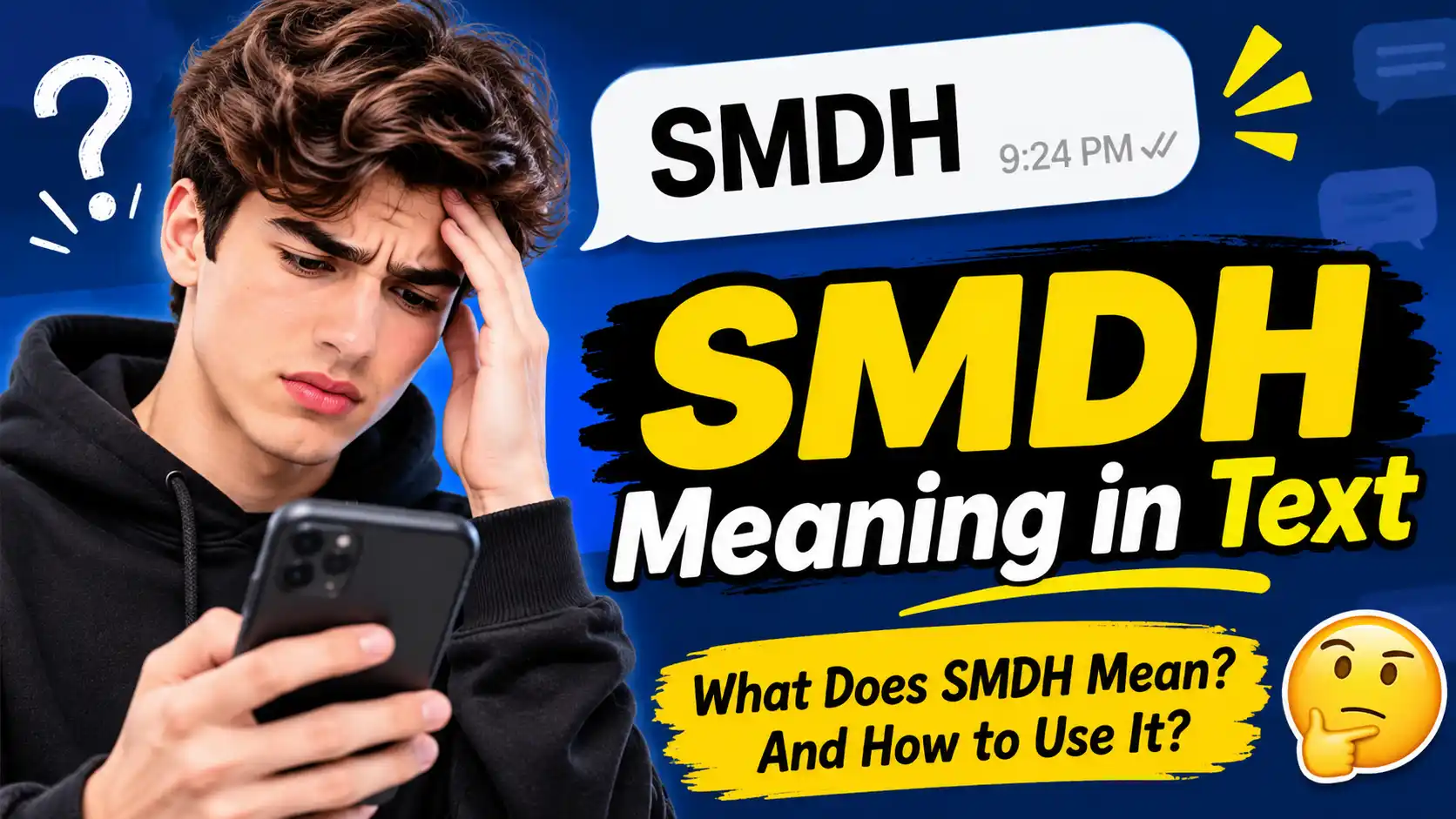
You open a chat. A friend sends one word: SMDH. You stare at it. What does it mean?
Don’t worry. You are not alone. Slang changes fast, and new short words pop up every day.
SMDH means “shaking my damn head.” It shows that you are upset, shocked, or let down. You use it when something is just too silly, sad, or wrong to explain.
People use it in texts, on social media, in games, and in group chats. You may even see it in a work chat now and then.
Why does it matter? Because tone is hard to read in text. One small word can show how someone feels. If you know what SMDH means, you will read chats with ease. You will also know when to use it and when to skip it.
In this guide, you will learn the meaning, the history, and the best ways to reply. Let’s dive in.
Definition & Meaning
What does SMDH stand for?
SMDH stands for “shaking my damn head.” Some people write “shaking my darn head” to keep it mild. The meaning stays the same.
It is a longer, stronger form of SMH (“shaking my head”). The extra letter D adds heat. Think of it as SMH with more feeling.
What does it really say?
When you type SMDH, you say one of these things:
- “I can’t believe this.”
- “I am let down.”
- “I have no words.”
It is a quick way to show you disapprove. You do not need to write a long reply. The three letters do the job.
Real life examples
Example 1: A bad habit
Mia: He left his dirty dishes in the sink again. Zoe: SMDH. Every single day.
Example 2: A silly news story
Sam: A man drove his car into a pond because his GPS said so. Leo: SMDH. Just look at the road, man.
Example 3: A sports loss
Ben: We lost by one point. After leading all games! Ali: SMDH. That hurts.
Example 4: A social media post
Someone posted a photo of a long line at the store. The caption says, “People still litter in 2026. SMDH.”
Key points to remember
- It shows disapproval, shock, or sadness.
- It is informal. It fits best with friends.
- It is louder than SMH.
- It can be a full reply by itself.
You can also use it at the end of a sentence, like a sigh. Or you can use it alone, like a loud sigh with no words at all.
One more thing: SMDH is not always angry. Sometimes it is just tired. Sometimes it is funny. The words around it tell you which one. Read the whole chat, and you will know.
Background & History
Where did it come from?
SMDH grew out of SMH. SMH is an older internet short form. People used it in early chat rooms, forums, and text messages. Typing was slow back then. Short forms save time. They also saved thumbs.
The exact first use of SMDH is hard to pin down. Slang rarely has a birth certificate. Most experts agree on one thing: SMDH came after SMH. Writers simply added the D to make the feeling stronger.
Why add the extra D?
Think about how people talk. When you are mildly bothered, you say, “Oh, come on.” When you are really bothered, you say it with more force. Text has no voice. So people added a stronger word.
The D stands for “damn.” It makes the message sharper. It tells the reader, “I am not just a little upset. I am really upset.”
How it spread
Several things helped SMDH grow:
- Text messages. People wanted fast replies.
- Social media. Short posts need short words. Early microblogging sites had tight limits on length.
- Gaming chat. Players type fast during a match. Short forms win.
- Memes and viral posts. Funny or sad news spreads, and SMDH often sits in the comments.
How it changed over time
At first, SMDH showed up mostly in all capitals. Today, you will see smdh, SMDH, and even smdhhh with extra letters. Each style carries a small difference.
- SMDH (capitals) feels loud and firm.
- smdh (lowercase) feels tired or casual.
- smdhhh feels dramatic or funny.
Some people also add an emoji, like a face with a flat mouth or a facepalm. The emoji adds a second layer of feeling.
Where is it used today?
Today, SMDH is common in:
- Group chats with friends and family
- Comment sections on social platforms
- Online games and live streams
- Dating app chats
- Forums and fan communities
It is rare in formal writing. You will not find it in a contract or a news report. But you will see it often in everyday digital talk.
Like all slang, its use can shift. Words rise and fade. Some live for a year. Some last for decades. SMH has lasted a long time. SMDH has grown right beside it and still looks strong.
Usage in Various Contexts
SMDH looks small. But it fits in many places. Let’s see how people use it.
In texting
Texting is the home of SMDH. It works as a quick reaction to news from a friend.
Dad: The store was out of milk. Again. Jen: SMDH.
Chris: My boss changed the meeting time. Five minutes before it started. Ana: smdh. That’s so rude.
Notice how short these replies are. That is the point. SMDH says a lot with very little.
On social media
On social media, people use SMDH in posts and comments. It often points to news or a bad trend.
Post: Someone left trash all over the park after the festival. Comment: SMDH. Some people never learn.
It can also close a post, like a final sigh.
“They canceled the show I loved for the third time. SMDH.”
In gaming
Gamers type fast. They have no time for long lines. SMDH fits well after a silly mistake.
Player 1: Our teammate ran straight into the enemy base. Player 2: SMDH. Alone, with no help.
Player 3: He left the match with ten seconds to go. Player 1: smdh. We were so close.
In games, SMDH can be a joke too. Friends use it to tease each other in a kind way.
In casual talk
People also say it out loud. Some friends say “S M D H” with a smile. This is rare, but it happens. It usually has a funny tone.
Tom: I locked my keys in the car. Twice today. Lia: S M D H, Tom. Seriously.
In group chats
Group chats are full of small reactions. SMDH is a common one. It shows you read the message and you share the feeling.
Mom: Your cousin forgot the cake for the party. Aunt: SMDH. Sis: I’ll grab one on the way.
In sports talk
Fans use SMDH to react to bad calls and missed shots.
Fan 1: The ref missed that foul. Fan 2: SMDH. Every game, the same thing.
Tone tip
Tone changes the meaning. Read these two lines.
- “SMDH.” with a period can sound cold and serious.
- “smdh lol” can sound light and playful.
Always look at the whole message. Also look at who sent it. A close friend and a stranger may use it in different ways.
Quick summary
| Place | Common feeling | Typical style |
| Texting | Annoyed, amused | Short, casual |
| Social media | Upset, critical | In posts and comments |
| Gaming | Frustrated, joking | Very fast, often lowercase |
| Group chats | Shared disbelief | One word reaction |
| Sports talk | Disappointed | Short reaction to a play |
Common Misconceptions & Clarifications
Slang is easy to mix up. Here are the most common mistakes people make with SMDH.
Myth 1: “SMDH is always rude.”
Not true. The word “damn” is mild to most people. Many use it in daily talk. SMDH is not a harsh insult. It is a sigh in text form.
Still, some people dislike swearing. If you chat with them, use SMH or a calmer phrase instead.
Myth 2: “SMDH means the sender is angry at me.”
Usually, it does not. In most chats, SMDH points at a third thing. It could be a news story, a bad call, or a silly act. It rarely points at you.
Ravi: Did you see the price of gas today? Kims: SMDH.
Kim is upset about gas prices. Kim is not upset with Ravi.
But be careful. If the SMDH comes right after something you said, it might be aimed at you. Check the flow of the chat.
Myth 3: “SMDH and SMH are the same.”
They are close, but not equal. SMDH is stronger. SMH is softer.
- SMH: “That’s a bit silly.”
- SMDH: “That is really silly, and I’m done.”
Myth 4: “SMDH has only one meaning.”
In most chats, it means “shaking my damn head.” Yet short forms can have more than one meaning. Rarely, a person may use the same letters for something else, such as a name or a private code. If a message looks odd, ask. A quick question is better than a wrong guess.
Myth 5: “Only young people use it.”
Young people use it a lot. But many adults use it too. Parents, co workers, and older friends all text now. Many have picked up the habit.
Can SMDH be misread?
Yes. Text has no face or voice. A reader cannot see an eye roll or a smile. So SMDH can sound:
- Harsh, if the sender meant it as a joke
- Playful, if the sender meant it as a sigh
- Cold, if it is the only reply to a long, heartfelt message
That last one is a big risk. Imagine you share sad news. Your friend answers with just “smdh.” You may feel ignored. Your friend might just mean, “That is awful.” But the short reply can hurt.
Can it be inappropriate?
Sometimes. Here are a few cases:
- With your boss or a client. It may seem too casual.
- In a school letter or formal email. It does not fit.
- When someone shares a loss. It can look cold.
- With people who dislike swear words. The “D” may bother them.
A simple rule
When in doubt, add a few words. Instead of only “SMDH,” write, “SMDH, that’s awful. Are you okay?” Now your tone is clear. Now the other person feels heard.
Similar Terms & Alternatives
SMDH has many cousins. Some are stronger. Some are softer. Pick the one that fits the moment and the person.
Close cousins
- SMH means “shaking my head.” It is the softer, more common form. Use it with almost anyone.
- SMFH means “shaking my f***ing head.” It is much stronger. Many people find it rude.
- FML means “f*** my life.” It shows you feel unlucky or fed up.
- IJBOL and LOL show amusement. They are the happy side of the same coin.
- TBH means “to be honest.” People often use it before a blunt view.
- IDK means “I don’t know.” It shows a shrug.
- WTF means “what the f***.” It shows shock, with more heat.
- OMG means “oh my god.” It shows surprise, good or bad.
Plain word alternatives
You do not need slang. Words like these work well:
- “That’s unbelievable.”
- “I can’t even.”
- “Seriously?”
- “What a shame.”
- “Wow, just wow.”
- “That’s disappointing.”
Emoji alternatives
Sometimes a picture does the job. Common choices include:
- A facepalm emoji for “I can’t believe it”
- A flat mouth face for “I am not amused”
- A rolling eyes face for “Oh, please”
- A sigh or weary face for “I am so tired of this”
Quick comparison table
| Term | Meaning | Strength | Best for |
| SMH | Shaking my head | Mild | Almost any casual chat |
| SMDH | Shaking my damn head | Medium | Friends and family |
| SMFH | Shaking my f***ing head | Strong | Close friends only |
| FML | F*** my life | Strong | Venting about bad luck |
| Seriously? | Plain words | Mild | Any setting |
| I can’t even | Plain words | Mild to medium | Casual chats |
How to choose
Ask yourself three questions:
- Who am I talking to? A friend can take stronger words. A boss cannot.
- How do I feel? Mild upset needs a mild word. Big upset may need more.
- Where am I? A private chat is more relaxed than a public post.
Example in action
Nina: My landlord raised the rent again. Pete: SMH. That’s tough.
Nina: And he won’t fix the heater. Pete: SMDH. That’s not okay.
See how Pete moves from SMH to SMDH? The second one fits because the problem got worse. Pete picks a stronger word for a bigger issue. That is smart, and it feels natural.
How to Respond to This Term
Someone sends you “SMDH.” What do you say back? The best reply depends on the person and the mood. Here are four styles.
1. Casual replies
Use these with friends and family. Keep it light and easy.
Friend: The bus left early. SMDH. You: Ugh, same. That happens to me all the time.
Friend: SMDH. He never calls back. You: I know, right? Total mess.
Good casual replies:
- “I know, right?”
- “Same here.”
- “Ugh, so annoying.”
- “What happened?”
The last one is useful. A question shows you care and keeps the chat moving.
2. Funny replies
Humor can lift the mood. Use it when the topic is small and the person is relaxed.
Friend: I burned the toast. Again. SMDH. You: Maybe the toaster is shaking its head at you too.
Friend: SMDH. My team lost again. You: Plot twist: they have a plan. A very, very secret plan.
Good funny replies:
- “Welcome to the club.”
- “At least you tried!”
- “Shake it off, champ.”
Warning: Skip jokes if the person seems truly hurt. Humor can feel unkind in a sad moment.
3. Professional replies
Sometimes a co worker or client uses SMDH. You may want to reply in a calm, clear voice. Do not copy the slang. Show you understand the point.
Co worker: The client changed the deadline again. SMDH. You: That’s frustrating. Let’s look at the plan and see what we can adjust.
Manager: SMDH. The report has so many errors. You: Understood. I’ll review it today and send a fixed version by the end of day.
Good professional replies:
- “I understand the concern.”
- “Let’s work out a fix.”
- “Thanks for the heads up.”
4. Privacy conscious replies
Sometimes you do not want to share more. Maybe the topic is personal. Maybe you are not sure who is reading. A short, calm reply protects you.
Acquaintance: Did you see what happened at your office? SMDH. You: I’d rather not get into it. Hope your week goes well.
Stranger online: SMDH. Tell me why you did that. You: I’m going to skip this one. Take care.
Good privacy first replies:
- “I’d rather not talk about it.”
- “Let’s change the subject.”
- “That’s all I’ll say.”
Never feel forced to explain yourself. A polite no is enough.
5. Empathy first replies
If the person seems hurt, lead with kindness.
Friend: I failed my driving test. SMDH. You: Oh no, I’m sorry. Want to talk about it? You can try again.
This kind of reply works well when SMDH is aimed at the sender’s own bad day.
Quick guide
| If the sender is… | Try this style |
| A close friend, mild topic | Casual or funny |
| A friend, sad topic | Empathy first |
| A boss or client | Professional |
| A stranger or a pushy person | Privacy conscious |
When unsure, ask a short question. “What happened?” is almost always safe.
Regional or Cultural Differences
Is SMDH used everywhere?
SMDH is mostly an English language term. It grows from English words: “shaking,” “my,” “damn,” and “head.” So you will see it most in places where people chat online in English. That includes the United States, Canada, the United Kingdom, Australia, and many other countries.
In other languages, people use their own short forms. Many do not use SMDH at all. But people who speak two languages often mix English slang into their chats. So you may see SMDH in a chat that is mostly in another language.
Does the head shake mean the same thing everywhere?
Not always. Body language differs by culture.
- In most Western countries, shaking the head side to side means “no” or “disapproval.” That fits SMDH well.
- In parts of South Asia, a side to side head wobble can mean “yes” or “I understand.” The motion looks the same, but the message is different.
- In Bulgaria and nearby regions, the head gestures for yes and no are often the reverse of what many other places use.
This matters little in text. SMDH is a written phrase, and it has one clear meaning in English. Still, it is a fun reminder that gestures change from place to place.
How strong does “damn” feel?
The word “damn” does not feel the same everywhere.
- In the United States, it is mild. Most adults say it often.
- In the United Kingdom, it is also mild, though “bloody” is more common in speech.
- In more formal or religious communities, some people avoid it.
- In some workplaces and schools, it may be against the rules.
So the same SMDH may seem fine in one chat and rude in another. Know your crowd.
Regional slang variations
People in different places have their own ways to say the same thing. Here are a few common ideas:
| Region or style | Common ways to show disapproval |
| US casual | SMH, SMDH, “ugh,” “come on” |
| UK casual | SMH, “unreal,” “typical,” “proper annoying” |
| Australian casual | SMH, “hopeless,” “yeah, nah” |
| Online gaming (global) | SMH, SMDH, “gg,” “bruh” |
| Mixed language chats | English short forms plus local words |
Note that this table gives common styles, not strict rules. Slang moves fast. Words jump across borders through videos, games, and music.
Age and community differences
Culture is not only about countries. It is also about age groups and online communities.
- Teens may prefer newer words and fast memes.
- Adults often stick with SMH and SMDH.
- Gamers use them with other game terms.
- Fan communities may shape their own jokes around them.
Tip for travelers and global chatters
If you chat with people from many places, keep it simple. Use clear words next to slang. For example: “SMDH. That’s really disappointing.” Now everyone understands you, even if they do not know the short form.
This small habit helps in school groups, global teams, and online friendships. It also keeps you kind and clear.
Comparison with Similar Terms
SMDH sits in a family of “I disapprove” words. Each one has its own feel. Let’s put them side by side.
Side by side table
| Term | Full form | Feeling | Strength | Safe at work? |
| SMH | Shaking my head | Disbelief, mild disapproval | Low | Mostly, with peers |
| SMDH | Shaking my damn head | Frustration, strong disapproval | Medium | Rarely |
| SMFH | Shaking my f***ing head | Anger, deep disgust | High | No |
| FML | F*** my life | Bad luck, despair | High | No |
| WTF | What the f*** | Shock, confusion | High | No |
| Facepalm | (Emoji or word) | “I can’t believe it” | Low to medium | Often |
| Ugh | (Sound) | Annoyance | Low | Yes |
| Seriously? | (Plain word) | Disbelief | Low | Yes |
SMDH vs. SMH
This is the pair people mix up most.
- SMH says, “I’m shaking my head. That’s not great.”
- SMDH says, “I’m shaking my head. That is really not okay.”
Ella: He cut in line. Max: SMH.
Ella: Then he yelled at the cashier. Max: SMDH.
Max’s reaction grows with the problem. That is how many people use the pair.
SMDH vs. SMFH
SMFH adds a swear word that is much stronger. Many chats treat it as rude. SMDH is the “middle” step. It has some heat, but it is not as harsh.
- Use SMDH with friends and family.
- Save SMFH for very close friends, if you use it at all.
SMDH vs. FML
These two sound alike but point in different directions.
- SMDH points outward. It reacts to something someone else did or to news.
- FML points inward. It reacts to something bad that happened to you.
Dan: I spilled coffee on my laptop right before my talk. FML. Sue: Oh no! SMDH, that’s awful luck.
See how Dan uses FML for his own bad day? Sue uses SMDH to show sympathy.
SMDH vs. WTF
WTF shows shock and confusion. It asks, “What is going on?” SMDH shows disapproval and fatigue. It says, “I’m tired of this.”
Pat: They closed the road with no warning. WTF? Kai: SMDH. Same thing happened last week.
SMDH vs. emoji
A facepalm emoji works like a small picture of the same feeling. It is softer and more playful. Many people pair the two: “SMDH 🤦”. The emoji adds the “human” touch, which can soften the tone.
Key differences at a glance
- Strength: SMH < SMDH < SMFH
- Direction: SMDH points at others. FML points at yourself.
- Feeling: SMDH is tired and annoyed. WTF is shocking.
- Risk: The stronger the word, the higher the chance of offending someone.
Which one should you pick?
Start with the mildest word that fits. You can always go stronger. You cannot take a harsh word back once you send it.
Usage in Online Communities & Dating Apps
SMDH lives in public spaces too. Each place has its own habits.
On Twitter (X)
Posts are short. So SMDH fits well. People use it in replies and quote posts to react to news, sports, and trends.
Post: The airline lost my bag. Again. Reply: SMDH. I’m sorry that happened.
Tip: In public replies, keep your tone kind. Strangers read it, and the tone is easy to miss.
On Instagram and TikTok
In comments, SMDH often shows up under videos about silly mistakes or bad behavior. Many comments are just “smdh” with a facepalm emoji. These small reactions can start long threads.
On Reddit and forums
Communities have rules. Some allow casual slang. Others want clear, full sentences. Read the rules first. In most threads, a quick “SMDH” is fine. But a full reply is more helpful.
In gaming communities
On game chats and voice to text, SMDH shows up after errors, bad plays, or lost matches.
Streamer chat: He missed the easy shot. SMDH. Mod: Keep it friendly, folks!
Some servers ban rude chat. SMDH is usually okay, but a harsh tone may get a warning. Always follow the server rules.
On dating apps like Tinder
This is where care matters most. A first chat is a first impression. SMDH can sound fun or cold. It depends on how you use it.
Good uses:
Match: My neighbor’s dog ate my pizza. Off the counter! You: SMDH, that’s hilarious. Did the dog look sorry?
Here, SMDH is playful. It shows you sharing the joke.
Risky uses:
Match: I’ve been working long days and I’m tired. You: SMDH.
This may feel dismissive. The match might think you are judging them.
Tips for dating apps
- Add a few words. Do not send SMDH alone.
- Match the mood. Use it for light, silly topics.
- Avoid it when someone shares a struggle. Show care first.
- Watch for red flags. If a match uses SMDH to mock you, think twice. Respect matters more than slang.
- Protect your privacy. Do not share home, work, or money details with new matches. Keep it safe.
How to respond to SMDH on a dating app
- If it is playful, play along: “Right? Can you believe it?”
- If it is unclear, ask: “Was that a good SMDH or a bad one?”
- If it feels rude, set a limit: “I’d like to keep this friendly.”
General tips for all communities
- Read the room before you post.
- Follow the rules of the group.
- Do not use it to attack a person.
- Remember that many eyes may see your words.
- When you feel heated, pause before you press send.
Online spaces feel fast. But a small pause keeps your tone safe, and it keeps the chat kind.
Hidden or Offensive Meanings
Does SMDH have a secret meaning?
For the most part, no. SMDH has one main meaning: “shaking my damn head.” There is no hidden code or secret slur tucked inside it. That is good news. You can read it with ease.
But a word can still sting. The meaning may be clear, yet the effect can be rough. Let’s look at how that happens.
The swear word question
The D stands for “damn.” To many people, that word is mild. To some, it is not. A few folks find any swear word rude. Others see it as normal talk.
So the same SMDH can land in two ways:
- A friend who swears often will not mind.
- A grandparent or a teacher may feel it is too rough.
Know your reader. That is the best rule.
When SMDH can feel unkind
SMDH can feel hurtful when it is aimed at a person, not an event.
Lena: I got a C on my test. Omar: SMDH.
Lena may think, “Is Omar judging me?” Omar may have meant, “That is unfair!” But the message is not clear. It can wound.
Better:
Omar: SMDH, that’s rough. Want to study together next time?
Now the care is clear.
Mocking and bullying
Sometimes people use SMDH to mock. They post it under someone’s photo or story. It tells the person, “You are a fool.” That is not a joke. That is unkind. It can also be bullying.
If you see this, you can:
- Not join in.
- Report the post if it breaks the rules.
- Support the person who is being mocked.
Tone, context, and why they matter
Three things change the meaning:
- Tone. A joking “smdh lol” is light. A lone “SMDH.” is cold.
- Context. What was said before? What is the topic? A sad subject needs care.
- Relationship. Close friends read each other well. New contacts do not.
Here is a simple test. Before you send SMDH, ask: “How would I feel if I got this?” If the answer is “hurt,” change it.
Alternative interpretations
A few rare cases exist:
- Sarcasm. Someone may type SMDH with a smile after a silly joke. They do not mean it.
- Inside jokes. A group of friends may use it in a funny, private way.
- Typos or lookalikes. Odd strings of letters can look like SMDH. If something looks off, ask.
Is it a slur or hate term?
No. SMDH is not a slur. It does not target a race, religion, gender, or group. Still, someone can use it in hateful chats. The word itself is not the problem. The use is.
Quick safety checklist
- Is the word aimed at a person or at an event?
- Does the reader like casual swearing?
- Is the topic sad or serious?
- Could a few extra words make it kinder?
If you answer “yes” to the last three, add more words. A small change can save a friendship.
Suitability for Professional Communication
Short answer
SMDH is not a good fit for most formal work settings. It is casual slang. It also has a swear word inside it. In a work email, a report, or a talk with a client, it can look unprofessional.
Where it might be okay
Some workplaces are relaxed. Teams that chat on friendly tools may use slang. Even there, think twice.
It may be fine when:
- You chat in a private message with a close co worker.
- The team culture is playful, and others use slang too.
- The topic is light, like a broken coffee machine.
It is risky when:
- You write to a boss, client, or customer.
- You post in a large group channel.
- The topic is serious, like a mistake, a complaint, or a loss.
- The message might be saved or shared later.
Remember: work messages can be forwarded. A joke in a private chat can end up in front of many eyes.
Examples: casual vs. professional
Casual (okay with a close peer):
Co worker: The printer jammed during my big print job. You: SMDH. Want me to help?
Not good for a client:
Client: The delivery is two days late. You: SMDH. Sorry about that.
The client may feel you are mocking them or the company. That could harm trust.
Better for a client:
You: I understand your frustration, and I apologize for the delay. I am checking the cause now and will update you by noon.
Professional alternatives
Here are clear, calm phrases that carry the same feeling without the slang:
| Instead of SMDH | Say this |
| SMDH (about a mistake) | “This is disappointing. Let’s find a fix.” |
| SMDH (about a delay) | “I’m concerned about the delay. Can we review the timeline?” |
| SMDH (about bad news) | “That is unfortunate. Thank you for letting me know.” |
| SMDH (about rude behavior) | “That was not ideal. Let’s talk about how to handle it.” |
| SMDH (about a silly error) | “We should double check this next time.” |
Tips for work chats
- Learn the culture first. Watch how others write.
- Lean formal at the start. You can relax later.
- Avoid swear words in written work, even mild ones.
- Be specific. Say what went wrong and what to do next.
- Keep emotion low and clarity high.
What if your boss uses it?
If a manager sends you an SMDH, do not copy it. Respond with a calm, helpful note. Show that you got the message and have a plan.
Manager: SMDH. The numbers are wrong again. You: Thanks for flagging this. I’ll recheck the numbers and send the correct file within the hour.
Bottom line
When you are unsure, leave it out. Plain words are never wrong at work. They show respect, and they leave no room for doubt.
FAQs
1. What does SMDH mean in text?
SMDH means “shaking my damn head.” You use it to show disapproval, shock, or disappointment.
2. What is the difference between SMH and SMDH?
SMH means “shaking my head.” SMDH adds the word “damn.” That makes it stronger and more emotional. SMH is milder and safer for most chats.
3. Is SMDH a bad word?
Not really. The word “damn” is mild for many people. But some find it rude. Think about who will read it before you send it.
4. Can I use SMDH at work?
It is best to avoid it in formal or client facing messages. It may be okay in a private chat with a close co worker. When in doubt, use clear, plain words instead.
5. How do I reply to SMDH?
Pick a reply that fits the mood:
- Casual: “I know, right?”
- Caring: “I’m sorry. What happened?”
- Funny: “Welcome to the club.”
- Professional: “I understand. Let’s find a fix.”
When unsure, ask, “What happened?”
6. Does SMDH mean the sender is mad at me?
Usually, no. It most often points at a news story, a bad event, or a silly act. If it follows something you said, check the tone and ask. A calm question clears things up fast.
7. Is SMDH the same in every language?
No. It is an English language short form. Other languages have their own slang. But people who chat in two languages may still use it, and many online communities know it well.
Conclusion
So, what does SMDH mean in text? Its means “shaking my damn head.” It shows you are upset, shocked, or let down. It is a stronger cousin of SMH.
Here are the key points to remember:
- It is casual slang. Use it with friends and family.
- It is stronger than SMH. The “damn” adds heat.
- Tone matters. A short reply can feel cold. Add a few words when the topic is sad.
- It is not for most work chats. Pick plain words for bosses and clients.
- Know your reader. Some people dislike swearing.
- Reply with care. Ask, “What happened?” when you are not sure.

Noman Hassan is a content creator and writer focused on text meanings, slang, abbreviations, acronyms, and internet expressions. Through Orvexale.com, he provides clear and simple explanations to help readers understand modern texting language. His goal is to make confusing terms easy to understand with practical examples and everyday context.