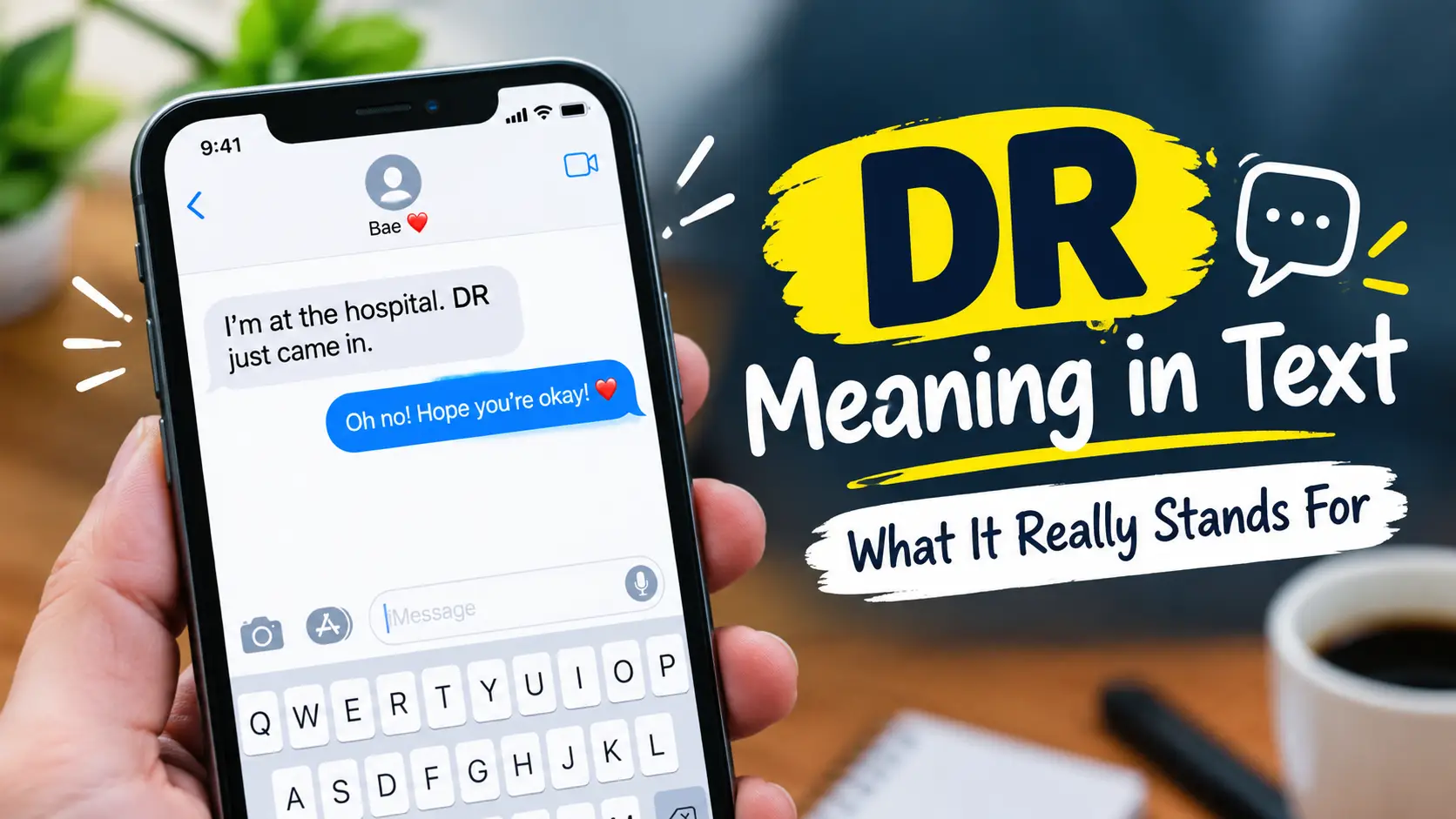
A friend sends a long, rambling paragraph about their day, and you text back a simple “dr 😅.” In a completely different conversation, someone writes, “ugh, so much dr in that group chat lately.” Same two letters, doing two very different jobs.
DR is a small, flexible abbreviation that shifts meaning depending entirely on the conversation around it. It shows up in texting, social media comments, and group chats, sometimes admitting you skipped a long message, sometimes calling out someone’s silence, and sometimes referring to plain old interpersonal drama.
Understanding DR matters because guessing wrong can genuinely change how a message lands, admitting you didn’t read something is very different from accusing someone of ignoring you. This guide breaks down the most common meanings of DR, where this kind of shorthand comes from, and how to tell them apart quickly.
Definition & Meaning
DR most commonly stands for “Didn’t Read.”
It’s used to casually admit that you skipped over a message, post, or wall of text, often because it was too long or not urgent enough to fully read.
Example:
Friend 1: [sends a five paragraph text explaining a complicated situation] Friend 2: dr 😅 can you just give me the short version?
Here, DR works as a quick, honest admission rather than an insult simply acknowledging the message was too much to get through.
DR has several other common meanings that show up depending on context:
- “Didn’t Reply” used to point out that someone saw a message but never responded, similar to “left on read.”
- “Drama” refers to unnecessary conflict, gossip, or tension between people.
- “Doctor” the standard, non slang abbreviation used as a title.
- “Don’t Remember” is a casual way to admit you’ve forgotten something.
More real life examples:
Text: did you even read my message or dr it
Group chat: so much dr happening this week, I’m exhausted
Text: wait what was the name again, dr lol
Appointment reminder: confirmed with Dr. Patel for 3pm
Context makes the intended meaning fairly clear. A message responding to a long text usually means “didn’t read.” A comment about someone’s silence usually means “didn’t reply.” A comment about conflict or gossip usually means “drama.” And a title before someone’s name, of course, simply means “doctor.”
The short version: DR is a flexible abbreviation that borrows its meaning from the situation, with “didn’t read” being its most common casual texting use today, closely followed by “didn’t reply” and “drama.”
Background & History
DR’s most well documented meaning traces back to its longer, more famous parent abbreviation: TL;DR, short for “too long; didn’t read.” According to Wikipedia and Collins Dictionary, TL;DR emerged from early internet forums and online posting culture as a way to flag that a piece of text was too long, often followed by a short summary for readers who wanted the key points without reading everything. The term gained enough mainstream recognition to be added to Oxford Dictionaries Online in 2013.
As this abbreviation spread through forums, social media, and casual texting, some users began shortening it even further, dropping the “TL” and simply using DR on its own, particularly in quick, informal texting where the full “too long” justification wasn’t necessary to spell out.
Separately, DR as “Didn’t Reply” developed alongside a broader family of texting shorthand describing being ignored or left without a response, similar in spirit to terms like “left on read.” This usage reflects how central tracking read receipts and response times has become to modern texting culture.
DR as “Drama” follows a simpler pattern: shortening a common, frequently used word for faster typing, the same logic behind countless other abbreviations. Because drama and interpersonal conflict are constant topics in group chats and social media, abbreviating the word made practical sense for quick, casual complaints or gossip.
DR as “Doctor” predates all of this internet slang entirely, functioning as a standard, long established written abbreviation used in formal and informal writing alike, completely unrelated to texting culture.
Today, DR commonly appears in:
- Texting and group chats, admitting to skipping a long message
- Social media comments, calling out unanswered messages or referencing drama
- Appointment reminders and formal writing, using its original, non slang meaning of “doctor”
- Casual conversations, occasionally used to mean “don’t remember”
Usage in Various Contexts
In texting (didn’t read):
Friend 1: [sends a long paragraph] Friend 2: dr, what’s the short version?
In texting (didn’t reply):
Friend 1: you dr my text from yesterday Friend 2: omg sorry, completely missed it
In group chats (drama):
Friend 1: there’s so much dr happening in that friend group right now Friend 2: I know, I’m staying out of it
In casual conversations (don’t remember):
Friend: What was that restaurant called again? You: dr lol, I’ll look it up
In formal contexts (doctor):
Text: appointment confirmed with Dr. Lee for Tuesday
On social media comments (didn’t read, dismissive tone):
Comment: dr, too long
Across these casual settings, DR consistently signals some kind of gap either in attention (didn’t read), responsiveness (didn’t reply), memory (don’t remember), or interpersonal peace (drama). In formal or appointment related contexts, it simply stands for the title “doctor,” unrelated to any of its casual texting meanings.
Common Misconceptions & Clarifications
Misconception 1: DR always means “didn’t read.” While this is one of its most common meanings, especially as a shortened version of TL;DR, it can just as easily mean “didn’t reply,” “drama,” or “don’t remember,” depending on context.
Misconception 2: DR and TL;DR mean different things. They’re closely related. DR is simply a shortened version of TL;DR, dropping the “too long” portion while keeping the same basic meaning.
Misconception 3: DR is always dismissive or rude. It depends on tone and context. Casually admitting “dr, can you summarize?” is usually harmless, while using it sarcastically to dismiss someone’s message can come across as more pointed.
Misconception 4: DR always refers to texting slang. Outside of casual conversation, DR remains a completely standard, non slang abbreviation for “doctor,” used constantly in appointments, formal writing, and everyday references to medical professionals.
Misconception 5: Calling out “DR” (didn’t reply) is always accusatory. It can be lighthearted teasing between friends just as easily as genuine frustration, depending on the relationship and how it’s phrased.
Clarification on context: because DR carries several possible meanings, reading the full message matters. A reply to a long text points to “didn’t read.” A comment about someone’s silence points to “didn’t reply.” A comment about conflict points to “drama.” And anything paired with a name almost always means “doctor.”
Similar Terms & Alternatives
| Term | Meaning | Typical Use |
| DR | Didn’t Read / Didn’t Reply / Drama / Doctor / Don’t Remember | Texting, social media, formal writing |
| TL;DR | Too Long; Didn’t Read | Summarizing or dismissing long text |
| LEFT ON READ | Message seen but not answered | Similar to “didn’t reply” |
| IDK | I Don’t Know | Similar to “don’t remember” in some contexts |
| SMH | Shaking My Head | Reacting to drama or frustration |
| DRAMA | Full word | Conflict, gossip, or tension |
Examples in use:
Comment: tl;dr, can someone summarize?
Friend: he left me on read again
Text: idk, I’d have to check
These related terms overlap closely with some of DR’s meanings, especially TL;DR (for “didn’t read”) and “left on read” (for “didn’t reply”).
How to Respond to This Term
How you respond to “dr” depends entirely on which meaning applies.
If it means “didn’t read” casual response:
“no worries, here’s the short version…”
If it means “didn’t reply” casual response:
“oh sorry, totally missed that, what’s up?”
If it means “drama” sympathetic response:
“ugh, that sounds exhausting, hope it settles down”
If it means “don’t remember” casual response:
“no worries, I’ll remind you”
Professional response (if it appears in a casual work chat):
“No problem, here’s a quick summary.”
General tips for responding:
- If someone admits “dr” to a long message, offering a short summary keeps the conversation moving smoothly.
- If “dr” points to unanswered messages, a quick, friendly follow up usually clears things up.
- If the meaning is unclear, it’s fine to ask directly: “wait, dr as in didn’t read, or something else? lol”
Regional or Cultural Differences
DR’s most established meaning, tied to TL;DR, is widely recognized across English speaking internet culture globally, including the US, UK, Canada, and Australia, and has even been translated and adapted into other languages as online culture spread internationally.
Its more casual, shortened uses “didn’t reply,” “drama,” “don’t remember” are most common in everyday English language texting, without strong regional variation, since they function more as practical shorthand than culturally specific slang.
DR as “doctor” is a globally recognized, standard written abbreviation wherever English is used formally, with no slang connotation at all.
Some notes worth considering:
- Non-English speaking online communities have widely adopted TL;DR (and sometimes DR) directly, since the concept of flagging overly long text is universally relatable.
- Because DR’s casual meanings depend heavily on context rather than fixed definitions, recognition can vary more by individual texting habits than by specific region.
Comparison with Similar Terms
| Term | Core Meaning | Platform | Tone |
| DR (didn’t read) | Skipped reading a message | Texting, comments | Casual, sometimes dismissive |
| DR (didn’t reply) | Message left unanswered | Texting, social media | Neutral to mildly frustrated |
| DR (drama) | Conflict or gossip | Group chats, social media | Casual, sometimes exasperated |
| DR (doctor) | Medical or academic title | Formal writing, appointments | Neutral, professional |
| TL;DR | Too long; didn’t read | Forums, long posts | Casual, summarizing |
The clearest way to separate DR’s meanings is context and setting. A long message points to “didn’t read.” A conversation about silence points to “didn’t reply.” A conversation about conflict points to “drama.” And formal writing with a name attached points to “doctor.”
Usage in Online Communities & Dating Apps
On Twitter/X and Reddit, DR (and its fuller form, TL;DR) frequently appears in replies to long posts, either summarizing the content or dismissing it for being too lengthy.
On Tinder and other dating apps, DR occasionally shows up when a message runs long:
Match: [sends a long paragraph about their weekend] You: dr 😅 but I’m sure it was a good one, tell me the highlights
Here, it keeps things lighthearted rather than dismissive.
In gaming communities, DR is less common in its casual texting sense, though “drama” might occasionally come up referencing conflict within a team or community.
Tips for responding appropriately:
- On dating apps, admitting “dr” to a long message can be done playfully, inviting a shorter follow up rather than shutting down the conversation.
- In group chats, calling out “dr” (drama) is usually understood as a casual complaint rather than a serious accusation.
- If “dr” points to someone not replying, a lighthearted check in usually works better than an accusatory tone.
Hidden or Offensive Meanings
DR does not carry any inherently offensive meaning across its common uses. Its various meanings: didn’t read, didn’t reply, drama, doctor, don’t remember are all neutral or mildly casual.
A few points are worth understanding about tone:
- “Didn’t read” can feel dismissive if used sharply. Responding “dr” to someone’s heartfelt or important message, rather than a casual update, could come across as careless depending on the relationship.
- “Didn’t reply” can carry mild accusations. Pointing out that someone ignored a message might feel confrontational depending on how it’s phrased and the existing dynamic between the people texting.
- No hidden negative meaning exists beyond these tone considerations. DR remains safe and casual in the vast majority of everyday use.
In short, DR is generally low stakes, with its main consideration being making sure the “didn’t read” or “didn’t reply” meanings don’t come across as more dismissive than intended.
Suitability for Professional Communication
DR’s casual texting meanings are not suitable for professional or formal communication, with one clear exception: its standard use as an abbreviation for “doctor.”
Where it doesn’t work well:
- Using DR to mean “didn’t read” or “didn’t reply” in a workplace email or client message would feel too casual and potentially dismissive.
Where it works professionally:
- As a title abbreviation: “Dr. Smith will see you at 2pm.”
Professional alternatives:
| Instead of “dr” (casual meaning) | Use |
| Didn’t read | “I haven’t had a chance to review this in full yet.” |
| Didn’t reply | “I don’t believe I’ve received a response to this yet.” |
| Drama | “There’s been some tension/conflict regarding this.” |
Example rewrite:
Casual: “dr, too long, can you summarize?” Professional: “Could you provide a brief summary of the key points?”
FAQs
1. What does DR mean in a text message? It most commonly means “Didn’t Read,” short for the more familiar TL;DR (“too long; didn’t read”). It can also mean “didn’t reply,” “drama,” or “doctor,” depending on context.
2. Is DR the same as TL;DR? Yes, DR is essentially a shortened version of TL;DR, dropping the “too long” portion while keeping the same core meaning.
3. What does DR mean when someone’s talking about a group chat? In that context, it usually means “drama,” referring to conflict, tension, or gossip.
4. Is DR rude to use? It depends on the tone. Casually admitting you didn’t read something is generally harmless, but using it dismissively toward an important message can come across as careless.
5. Does DR always relate to texting slang? No, it’s also a standard, non slang abbreviation for “doctor,” commonly used in formal writing and appointments.
6. Can DR mean “didn’t reply”? Yes, it’s sometimes used to point out that someone saw a message but never responded, similar to “left on read.”
7. Can I use DR in professional communication? Its casual meanings should be avoided in formal writing, but its use as an abbreviation for “doctor” is entirely standard and appropriate.
Conclusion
DR is a flexible abbreviation that borrows its meaning heavily from context. In casual texting, it most often means “Didn’t Read,” a shortened version of the well known TL;DR, though it can also mean “Didn’t Reply,” “Drama,” or “Don’t Remember“ depending on the conversation. Outside of slang entirely, it remains the standard written abbreviation for “Doctor.”
Because its meaning shifts so much depending on the situation, context is key when reading or using DR. While its casual meanings fit naturally into everyday texting and social media, they’re best avoided in professional writing, where spelling out the intended meaning remains the clearer choice except, of course, when referring to an actual doctor.

Asfan Wahab is a content creator and writer focused on text meanings, slang, abbreviations, acronyms, and internet expressions. Through Orvexale.com, he provides clear and simple explanations to help readers understand modern texting language. His goal is to make confusing terms easy to understand with practical examples and everyday context.