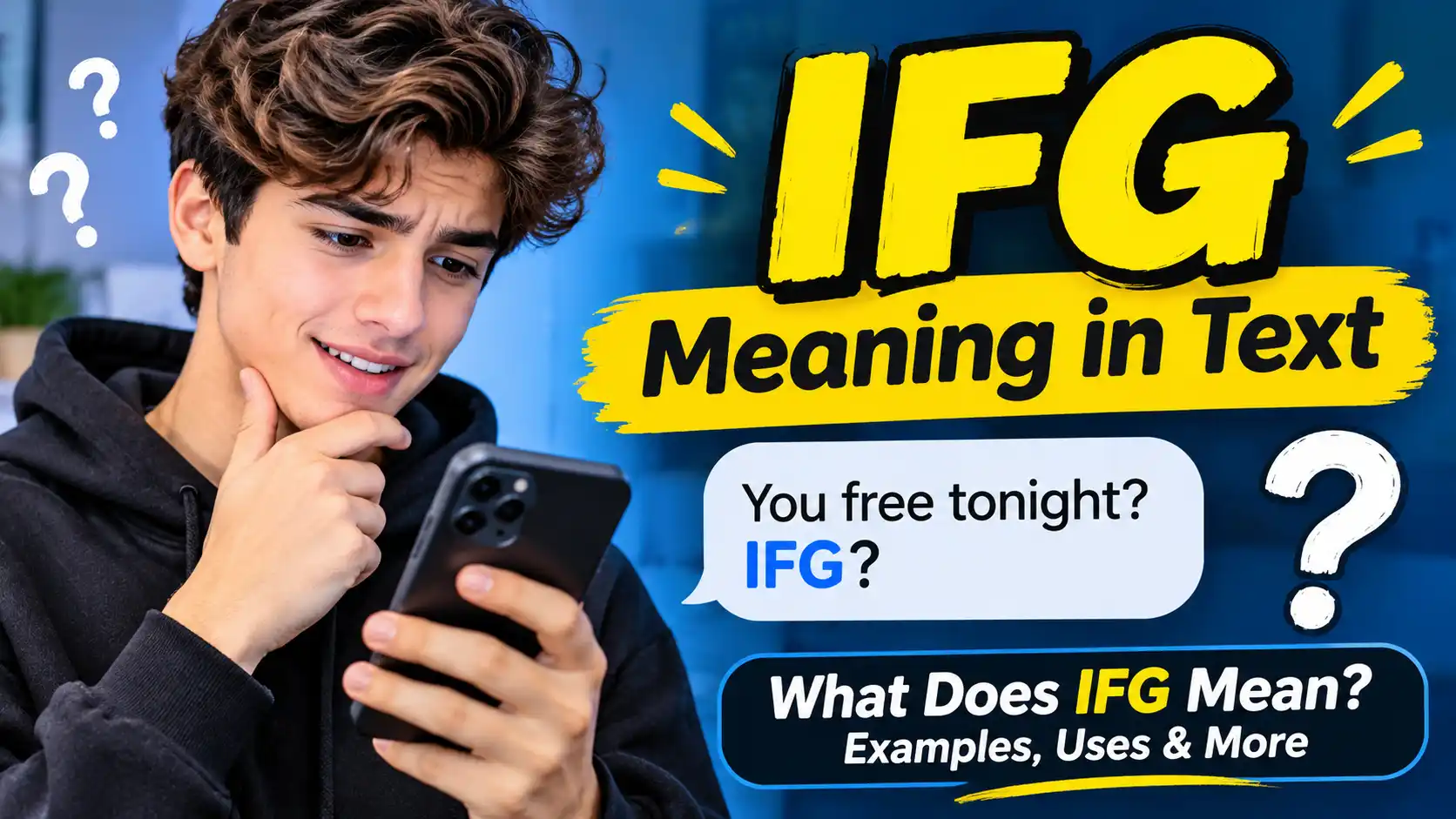
You open your phone. A message pops up. It says “IFG.” Nothing else.
You stare at it. What does it mean? Is it good? Is it bad? Should you reply?
You are not alone. Short slang like this spreads fast in texts, social media, gaming chats, and group threads. People type fast. They cut words. Soon a new acronym is born.
Here is the tricky part. IFG is not an official slang term. It has no single, fixed meaning. Different people use it in different ways. Some mean one thing. Some mean another.
That is why it pays to know the options. A wrong guess can cause an awkward moment. A right guess helps you reply with ease.
In this guide, you will learn the most likely meanings of IFG. You will see real examples. You will learn how to reply, when to avoid it, and what to say at work instead.
Let’s start.
Definition & Meaning
The short answer
There is no one official meaning of IFG in text. Context decides. Still, a few meanings come up again and again.
The most common meanings
1. IFG = “I feel good.” This is the friendliest reading. The person is telling you they are happy or doing well. It is a quick mood update.
2. IFG = “I feel guilty.” Some people use it to say they feel bad about something. Maybe they forgot a call. Maybe they canceled plans.
3. IFG = a social media shortcut. On some platforms, people use IFG in follow-swap style posts. In that case it is about trading follows, not feelings. This use is less clear, so treat it with care.
4. IFG = Impaired Fasting Glucose. This one is medical. It is not slang. Doctors use it for blood sugar levels. You will only see it in health talk.
Which one should you pick?
Look at who sent it and what came before it.
- A friend after a good day? Probably “I feel good.”
- A partner after a missed date? Maybe “I feel guilty.”
- A stranger on a social app? Could be a follow request.
- A doctor’s note? Blood sugar.
Real-life examples
Example 1: a mood check
Mia: How was your day? Jake: IFG. Got the job!
Jake feels good. He is happy.
Example 2: an apology
Sam: You forgot my birthday dinner. Lee: IFG. I’m so sorry.
Lee feels guilty. He is saying sorry.
The golden rule: When unsure, ask. A simple “IFG as in feel good or feel guilty?” saves a lot of trouble.
Background & History
Where did IFG come from?
Here is the honest truth. Nobody can point to a clear first use of IFG. There is no famous tweet. There is no known first message. It seems to have grown on its own.
How slang like this grows
Texting has always loved shortcuts. Think of LOL, BRB, IDK, and IDC. Early phones made typing slow. People cut words to save time. The habit stuck.
Then social media arrived. Snapchat, Instagram, TikTok, and WhatsApp made chats fast and casual. Short forms fit right in.
New acronyms often follow a pattern. Take a common phrase. Use the first letters. Share it. If enough people copy it, it spreads.
IFG fits this pattern. “I feel good” and “I feel guilty” both start with the same three letters. That is why the term feels so unclear.
Why the meaning shifts
A single acronym can pick up many meanings. This happens in different groups. A gaming clan may use it one way. A school group may use it another. Friends may invent their own meaning as an inside joke.
Over time, some meanings fade. Others grow. Slang is alive. It changes with the people who use it.
Where you see IFG today
- Texting apps such as WhatsApp and iMessage
- Snapchat and Instagram chats and captions
- TikTok comments
- Group chats with friends or family
- Health settings, where IFG means a blood sugar term
What this means for you
Because the history is fuzzy, do not trust any website that claims one “true” meaning. Be careful with sites that sound too sure. Use context. Use common sense. When in doubt, ask the sender.
Usage in Various Contexts
IFG shows up in many places. Here is how it might look in each one.
Texting
Texting is the most common home for IFG. It is short and quick. It usually answers a “how are you” or follows an apology.
Anna: You okay? Ben: IFG, thanks.
Ben is fine. He is saying so in a light way.
Social media
On social apps, IFG can show up in comments, captions, or DMs. A person may post a happy photo and write “IFG today.” That means they feel good.
In other spots, IFG may be tied to follow-swap posts. People ask others to follow them back. If that is the setting, the meaning is about growth, not mood.
User1: IFG anyone? Drop your handle. User2: Dropped mine!
Here, IFG is about trading.
Gaming
Gamers love short chats. Typing in the middle of a match is hard. So acronyms are everywhere.
Player1: how’s the squad? Player2: IFG, we’re winning
Player2 is in a good mood. The team is doing well.
A gamer might also use IFG after a mistake:
Player1: you lost us the round Player2: IFG my bad
Now it means “I feel guilty.” Same letters. Different feelings.
Casual conversation with friends
Friends often use slang as a joke. They may twist the meaning. They may use it only in their own circle.
Zoe: You ate the last slice? Dan: IFG 😅
Dan feels guilty. The emoji gives it away.
Tips for reading the tone
- Look at emojis. A smile points to good. A sad face points to guilt.
- Look at the last message. Did someone ask a question or call out a mistake?
- Look at the sender. Do they use slang a lot?
Common Misconceptions & Clarifications
Misconception 1: “IFG has one official meaning.”
It does not. No dictionary or body decides slang. People do. That is why you see many meanings online.
Misconception 2: “If a website says it, it must be true.”
Be careful. Many sites repeat each other. Some give very sure answers with no proof. Others mix up IFG with other terms. Treat all of them as guides, not facts.
Misconception 3: “IFG is always rude.”
No. In most cases, it is mild and harmless. It either shares a mood or admits guilt. Neither one is rude.
Misconception 4: “IFG means the same in every app.”
It does not. The same letters can mean different things on Snapchat, in a game, or in a doctor’s office.
Alternative meanings to keep in mind
- I feel good: a happy mood
- I feel guilty: a sorry mood
- Follow-swap shorthand: used on some social platforms
- Impaired Fasting Glucose: a medical term
- A private joke: a meaning only your group knows
Can IFG be misread?
Yes. Picture this:
Chris: Did you finish the report? Pat: IFG
Is Pat happy? Or sorry? Chris cannot tell. This is why unclear slang is risky in work or serious talk.
Could it be inappropriate?
Not by itself. But some people may read extra, rude meanings into any three-letter combo. If you are unsure how it will land, spell it out. Say “I feel good” or “I feel guilty.” It takes two seconds. It prevents trouble.
Quick checklist before you reply
- Who sent it?
- What was the last thing said?
- Is there an emoji?
- Is it a friend or a stranger?
- Still unsure? Ask.
Similar Terms & Alternatives
You do not have to use IFG. Many other shortcuts say the same thing. Some are clearer.
For “I feel good”
- IFG: unclear, can have other meanings
- Vibing: a casual way to show a good mood
- All good: clear and friendly
- Doing great: simple and plain
- On cloud nine: playful
For “I feel guilty”
- My bad: casual apology
- Sorry about that: polite and clear
- I feel terrible: stronger
- That’s on me: owns the mistake
- SMH at myself: playful self-blame
Comparison table
| Term | Likely meaning | Tone | How clear is it? |
| IFG | I feel good / I feel guilty | Casual | Low |
| My bad | I made a mistake | Casual | High |
| All good | I’m fine | Friendly | High |
| IDK | I don’t know | Casual | High |
| IDC | I don’t care | Casual, can sound cold | High |
| ISTG | I swear to God | Strong, casual | Medium |
Why clear words win
Short slang is fun. But it can confuse people. Clear words build trust. If your message matters, use plain words.
When to pick which
- Quick chat with close friends? IFG is fine.
- Serious apology? Say “I’m sorry.” Skip the slang.
- Mood update? “Feeling good today!” works just as well.
How to Respond to This Term
How you reply depends on the mood. Here are a few styles.
1. Casual replies
Keep it light. Match their energy.
Them: IFG. You: Love that! What’s got you smiling?
Or for guilt:
Them: IFG about last night. You: No stress. We’re good.
2. Funny replies
Humor works with close friends.
Them: IFG You: Is that “feel good” or “feel guilty”? Please say good. 😂
Them: IFG for eating your fries You: Your guilt will cost you a new batch.
3. Professional replies
Keep it short and clear.
Them: IFG You: Just to confirm, do you mean you’re doing well? Happy to help either way.
If a coworker uses it, a calm check-in is best.
4. Privacy-conscious replies
Sometimes IFG shows up from a stranger on social media. Maybe they want a follow. You do not have to say yes.
Them: IFG? Follow back? You: Thanks, but I keep my account private.
Or just do not reply. You owe no one a follow.
5. Caring replies
If the person seems upset, be kind.
Them: IFG. I really messed up. You: Hey, it happens. Want to talk about it?
Simple rules for any reply
- Be kind.
- Ask if you are unsure.
- Do not assume the worst.
- Protect your own privacy.
Regional or Cultural Differences
Is IFG used worldwide?
IFG is mostly an English-language texting term. It is not a standard acronym in any country. So its use depends on who you talk to, not where they live.
Why English dominates
Most texting acronyms come from English phrases. LOL, BRB, and OMG travel across the world. But each language also builds its own shortcuts.
Slang in other languages
Many cultures have their own text style. Here are a few well-known examples:
- Spanish speakers often write “xq” for “porque” (because).
- French speakers may write “mdr” for a laugh, like LOL.
- Many Asian-language texters use number or character play to speed up typing.
IFG is not a known shortcut in these groups. If someone from these groups uses it, they likely learned it from English-speaking friends or apps.
Regional style differences in English
Even within English, habits vary.
- Younger users often make new slang quickly.
- Older users often spell things out.
- Gamers build their own shorthand.
- Different countries may favor different slang.
A cultural note on guilt and mood
In some cultures, people share feelings openly. In others, people stay private. So an “IFG” about guilt may be common in one place and rare in another. Keep this in mind in mixed groups.
A quick tip for global chats
If you chat with people from many places:
- Use plain words.
- Avoid unclear acronyms.
- Use emojis to help.
Lina (Spain): What is IFG? Tom (USA): I feel good! Sorry, I should’ve written it out.
That is a fine way to handle it.
Comparison with Similar Terms
Let’s compare IFG with a few terms people mix up with it.
IFG vs. IDK vs. IDC
| Term | Stands for | Feeling | Safe at work? |
| IFG | I feel good / I feel guilty | Mood | Not really |
| IDK | I don’t know | Unsure | Mostly |
| IDC | I don’t care | Cold | No |
| IMO | In my opinion | Neutral | Yes |
Key differences
IFG vs. IDK. IFG shares a feeling. IDK shares a lack of knowledge. They answer different questions.
IFG vs. IDC. IDC can sound cold or rude. IFG is usually soft. It is about how you feel, not how little you care.
IFG vs. IMO. IMO is about your view. IFG is about your mood.
IFG vs. “My bad”
“My bad” always means a mistake. IFG may mean guilt, or it may mean good. That makes “my bad” clearer.
IFG vs. “All good”
“All good” is plain and friendly. It tells people you are fine. It does not cause confusion. If you want to say “I feel good,” this is safer.
Quick takeaways
- IFG is flexible, but unclear.
- Other terms are more exact.
- Clear terms are better when it matters.
Example in action
Ava: Did you read my message? Noah: IDK Ava: Okay. And how are you? Noah: IFG
Notice the difference. IDK means “I don’t know.” IFG tells how Noah feels.
Usage in Online Communities & Dating Apps
Social platforms
On Twitter/X, Instagram, and TikTok, IFG may pop up in posts and replies. Often it is a mood note. At times it is tied to follow-swap talk.
Gaming communities
On Discord, Xbox, PlayStation, and Steam chats, short forms rule. IFG may mean “I feel good” after a win. It may mean “I feel guilty” after a loss.
Host: GG everyone! Player: IFG, great match
Dating apps (Tinder, Bumble, Hinge)
On dating apps, tone matters. IFG might show up after small talk.
Match: How’s your week? You: IFG! Finally got a day off.
It is a light, friendly line. But on a first chat, it can feel too short. Add a few more words. It shows you care.
If someone sends IFG after a mix-up, such as a late reply:
Match: IFG for taking so long to answer You: No worries at all!
Tips for responding on dating apps
- Be warm. Warm replies build trust.
- Ask a follow-up. It keeps the chat going.
- Do not assume. Ask what they mean.
- Watch for pressure. If someone pushes you to share info, step back.
Safety first
Online, protect your privacy. Do not share your phone number, address, or money details with someone you just met. If a user uses IFG to push you into follow swaps or links, do not click unknown links.
Community etiquette
- Follow each group’s rules.
- Do not spam follow requests.
- Be polite, even when you disagree.
- Report anyone who harasses you.
A simple script
Stranger: IFG? You: Hey! Do you mean “I feel good”? I’m doing well, thanks. How about you?
That reply is kind, clear, and safe.
Hidden or Offensive Meanings
Is IFG rude?
On its own, IFG is not offensive. The common readings are mild. Feeling good is fine. Feeling guilty is fine.
Why people still worry
Three-letter acronyms are easy to twist. A group may add a rude meaning as a joke. A person may use it to tease. So a harmless word can turn harsh in the wrong group.
Tone and context matter
Words carry feeling. The same letters can sound kind or cruel.
Kind use:
Sara: I’m sorry I snapped at you. IFG. Tim: It’s okay. Thanks for saying so.
Unkind use:
Rob: You failed again? Eli: IFG, you? 😏
Here, the tone is sharp. The same word does very different work.
Signs the meaning may be off
- Mocking emojis
- A harsh topic before it
- A joke at someone’s expense
- A group known for rude slang
What to do if you feel unsure
- Ask politely. “What do you mean by IFG?”
- Do not guess the worst.
- Set a boundary if needed. “Please use words I understand.”
- Block or report if the person is harassing you.
Why spelling it out helps
Plain words leave no doubt. “I feel good” cannot be twisted. “I feel guilty” cannot be twisted either.
A note on health talk
If you see “IFG” in a medical note, it is about blood sugar. It is not slang. If you are worried about your health, ask a doctor. Do not rely on a chat or blog.
Bottom line
IFG is usually harmless. Just watch the tone. And when the stakes are high, skip the slang.
Suitability for Professional Communication
Should you use IFG at work?
In most cases, no. Work messages need to be clear. IFG is not.
Why it does not fit
- It has many meanings. Your boss may guess wrong.
- It sounds casual. Formal talk needs plain words.
- It may confuse people. Not everyone knows slang.
- It can look lazy. Short forms can seem careless.
When it might be okay
A close team that chats on Slack in a loose style might use slang. Even so, check the culture first. If no one else does it, you should not either.
Professional alternatives
| Instead of IFG | Say this |
| IFG (good) | “I’m doing well, thank you.” |
| IFG (good) | “Things are going great.” |
| IFG (guilty) | “I apologize for the delay.” |
| IFG (guilty) | “I’m sorry for the mix-up.” |
| IFG (guilty) | “That’s my mistake. I’ll fix it.” |
Example in an email
Casual (avoid):
Hey, IFG about missing the meeting.
Professional (better):
I apologize for missing the meeting. I will review the notes and follow up today.
Example in chat with a client
Client: Is the file ready? You: Yes, I’m sending it now. Thank you for your patience.
Tips for clear work messages
- Use full sentences.
- Skip slang with new contacts.
- Match your boss’s tone.
- Read it once before you send.
The bottom line
At work, clarity beats cleverness. Leave IFG for friends. Use plain words for colleagues and clients.
FAQs
1. What does IFG mean in text?
There is no single official meaning. The most common readings are “I feel good” and “I feel guilty.” Context tells you which one.
2. Is IFG a real slang term?
It is used informally, but it is not a standard or well-defined acronym. Meanings differ by group, so be careful when you read sites that claim one fixed answer.
3. How do I know which meaning someone intends?
Check the sender, the last message, and any emojis. If it is still unclear, ask: “Do you mean feel good or feel guilty?”
4. Is IFG rude or inappropriate?
Not by itself. It is usually mild. But tone can change things. A sharp or mocking tone can make any word feel rude.
5. Can I use IFG at work?
It is best to avoid it. Use clear, full sentences. They prevent mix-ups and look more professional.
6. Does IFG mean something on social media?
Sometimes. On some platforms it may link to follow-swap talk. You do not have to join in. Protect your privacy.
7. Is IFG ever a medical term?
Yes. In health settings, IFG means Impaired Fasting Glucose, a blood sugar term. That is a different use from slang. For health questions, talk with a doctor.
Conclusion
IFG is a small term with a big question mark. There is no single, official meaning. Most often, people use it to say “I feel good” or “I feel guilty.” Sometimes it points to follow swaps on social media. In a doctor’s office, it is a blood sugar term.
The key is context. Look at who sent it. Look at what came before. Watch for emojis and tone.
When you are unsure, ask. It is simple and kind. When you write, choose clear words, especially at work or in serious talk.
Slang keeps changing. New terms rise. Old ones fade. But clear, kind communication never goes out of style.

Noman Hassan is a content creator and writer focused on text meanings, slang, abbreviations, acronyms, and internet expressions. Through Orvexale.com, he provides clear and simple explanations to help readers understand modern texting language. His goal is to make confusing terms easy to understand with practical examples and everyday context.