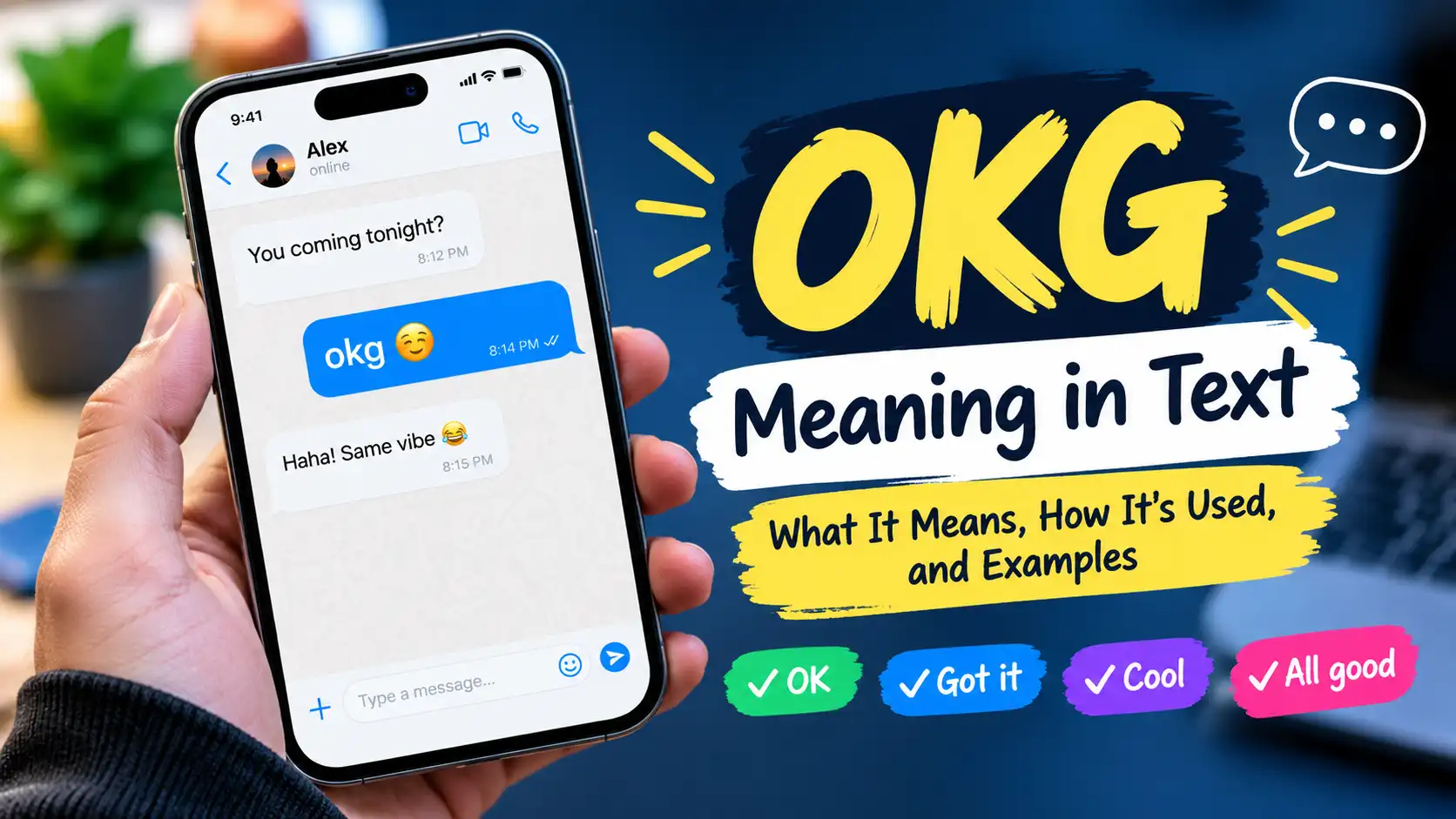
A friend texts you new weekend plans, and instead of a plain “ok,” you get back “okg!” It reads a little warmer, somehow less flat, more enthusiastic even though it’s really just one extra letter.
OKG is a small, casual abbreviation that shows up in texting, WhatsApp chats, and Instagram comments whenever someone wants to confirm something while also signaling they’re genuinely happy about it. It’s not as famous as OK or K, but it fills a specific little gap between a neutral acknowledgement and full on enthusiasm.
Understanding OKG matters because tone is everything in a short reply, and that one extra letter changes how a message lands. Knowing what it signals, and how it differs from a plain “ok,” helps you read and send a warmer confirmation without overthinking it. This guide breaks down what OKG most commonly means, where this kind of shorthand comes from, and how to use it naturally.
Definition & Meaning
OKG most commonly stands for “Okay, Good.”
People use it to quickly confirm or acknowledge something while showing mild approval or satisfaction. It feels more expressive than plain “OK” but takes less effort than writing a full sentence.
Example:
Friend 1: I’ll pick you up at 7 instead of 6:30 Friend 2: okg, works for me
Here, OKG does double duty: confirming the new time and showing that the change is genuinely fine, not just tolerated.
Another example:
Text: meeting moved to the conference room downstairs Reply: okg, see you there
It’s worth being upfront that OKG isn’t a fixed, dictionary official abbreviation the way terms like LOL or BRB are. People use OKG as newer, informal texting shorthand, and most people understand its meaning consistently without relying on a single authoritative source.The most common reading, by a wide margin, is:
- “Okay, Good” confirming something and expressing mild approval at the same time.
A couple of looser, less common readings also show up occasionally:
- “Okay, Got it” leaning more toward simple acknowledgment than approval.
- “Oh, Okay” a softer, sometimes slightly surprised acknowledgement, depending on tone.
More real life examples:
Text: dinner reservation confirmed for 8pm Reply: okg, thank you!
Group chat: we’re splitting the bill evenly, that works for everyone? Reply: okg with me
Text: running 10 minutes behind Reply: okg, no rush
The short version: OKG is a quick, warm way to say “okay, and I’m genuinely fine with that,” landing somewhere between a flat “ok” and a fuller, more enthusiastic reply.
Background & History
OKG builds directly on one of the oldest and most recognizable words in modern communication: “OK.” The word itself has a long and surprisingly debated history, with origin theories ranging from a 19th century American joke abbreviation (“oll korrect”) to a presidential campaign slogan (“Old Kinderhook”) to disputed Native American language influences. Whatever its true origin, “OK” became a universal, almost infinitely flexible word used to express agreement, acknowledgment, or mild approval.
As texting culture developed, people looked for small ways to add warmth or nuance to short, functional replies like “ok,” which can sometimes read as flat, cold, or even slightly annoyed depending on tone. Adding an extra letter to signal “good” on top of basic acknowledgment follows a pattern texting culture uses often taking a neutral word and attaching a quick modifier to shift its emotional temperature, similar to how “k” can feel colder than “ok,” which in turn feels more neutral than “okay.”
OKG appears to have emerged organically through this kind of informal texting evolution rather than from one specific platform, trend, or viral moment. It gained traction gradually across casual messaging apps like WhatsApp, Instagram DMs, and group texting, particularly among younger users looking for a quick way to sound more affirming than a bare “ok” without needing to type out a full sentence.
Because it developed informally rather than through a single clear origin point, OKG doesn’t have one authoritative, documented history the way more established slang does. It’s best understood as part of a broader, ongoing pattern in texting culture: constantly inventing small variations on common words to communicate tone more precisely in a format that otherwise strips away vocal inflection and facial expression.
Today, OKG commonly appears in:
- Texting between friends and family, confirming plans with a touch of enthusiasm
- WhatsApp and Instagram DMs, where quick, warm replies are the norm
- Group chats, confirming logistics while signaling genuine agreement
- Casual gaming or online chat, occasionally used to confirm a plan or strategy
Usage in Various Contexts
In texting between friends:
Friend 1: let’s push movie night to Saturday instead Friend 2: okg, that actually works better for me
In group chats:
1st Friend : Everyone meeting at the park entrance at noon? Friend 2: okg! Friend 3: okg, see you all then
On WhatsApp or Instagram:
Text: sent you the files you asked for Reply: okg, thank you so much
In casual planning conversations:
Friend: can we do coffee instead of lunch? You: okg, coffee sounds great actually
In slightly more personal check ins:
Friend: I’ll call you tonight once I’m home You: okg, talk soon
In gaming or casual online chat:
Teammate: let’s regroup at the base first You: okg, heading there now
Across these settings, OKG consistently signals a warmer, more affirming version of a simple “okay.” It works well specifically because it’s low effort but still conveys genuine agreement rather than flat, obligatory acknowledgment, making it a natural fit for everyday texting where tone matters but typing a full sentence feels unnecessary.
Common Misconceptions & Clarifications
Misconception 1: OKG is an official, standardized abbreviation. It isn’t, at least not in the way more established slang is. OKG developed informally through everyday texting rather than from one clear, documented source, though its meaning is understood fairly consistently across casual conversation.
Misconception 2: OKG means exactly the same thing as “OK.” Not quite. The added “G” specifically signals approval or satisfaction on top of basic acknowledgment closer to “okay, and I’m genuinely fine with that” than the more neutral, sometimes colder feeling plain “ok.”
Misconception 3: OKG always means “okay, good” with no variation. While this is by far the most common reading, it can occasionally lean toward “okay, got it” (simple acknowledgment) or “oh, okay” (a softer, sometimes surprised reaction), depending on context.
Misconception 4: OKG is rude or sarcastic. It generally isn’t. In the vast majority of casual use, it reads as warm and affirming rather than dismissive.
Misconception 5: OKG is only used by one specific age group or platform. While it’s especially common among younger texters on apps like WhatsApp and Instagram, its simple, intuitive structure makes it easy for people of various ages to pick up and understand quickly.
Clarification on tone: because OKG isn’t fully standardized, its emotional temperature depends somewhat on the relationship and conversation style between the people texting. Among friends who already text this way often, it reads as warm and natural. In a conversation where it appears unexpectedly, it might simply read as a slightly more polished version of “ok.”
Similar Terms & Alternatives
| Term | Meaning | Typical Use |
| OKG | Okay, Good | Confirming something with mild approval |
| OK | Okay | Neutral acknowledgment |
| K | Okay (very short) | Can read as flat or slightly cold |
| SOUNDS GOOD | Agreement with enthusiasm | Full phrase alternative to OKG |
| GOT IT | Acknowledgment | Confirming understanding, less about approval |
| GG | Good Game | Gaming specific agreement/closing remark |
Examples in use:
Friend: let’s meet at the usual spot You: sounds good!
Coworker: I’ll send the file by end of day You: got it, thanks
Teammate: nice round everyone, gg
These related terms all serve a similar function to OKG, confirming or acknowledging something, with slightly different levels of warmth or formality.
How to Respond to This Term
Responding to “okg” is usually simple, since it’s already a warm, low pressure confirmation.
Casual response:
“Great, see you then!”
Funny response:
“okg, noted and appreciated 😂”
Professional response (if it appears in a casual workplace chat):
“Great, thanks for confirming!”
Privacy conscious response (if you’d rather keep things brief):
“Perfect, thank you!”
General tips for responding:
- A short, friendly reply usually fits naturally, since OKG already signals agreement.
- If plans or details still need clarifying, it’s fine to follow up directly rather than assuming everything is settled.
- In professional settings, a fuller phrase like “sounds good” or “that works for me” reads as more polished.
Regional or Cultural Differences
OKG is an English language texting abbreviation, built on the globally recognized word “OK,” which is understood and used across virtually every language and culture, often without translation at all.
Because OKG developed specifically within casual, younger English language texting culture, its recognition is strongest in English speaking countries like the US, UK, Canada, and Australia, particularly among users of WhatsApp, Instagram, and similar messaging platforms.
Some notes worth considering:
- In different regions, digital culture may adopt OKG while attaching slightly different local tone or usage patterns, even while keeping the same basic structure.
- Because the word “OK” itself is so universally recognized, non English speaking communities often adopt small variations like OKG fairly easily, even if the exact abbreviation isn’t native to their own slang traditions.
- As a newer, informally developed term, OKG’s recognition still varies more by age group and platform familiarity than by any one specific region.
Comparison with Similar Terms
| Term | Core Meaning | Emotional Tone | Best Used When |
| OKG | Okay, good | Warm, affirming | Confirming plans with genuine approval |
| OK | Okay | Neutral | General, everyday acknowledgment |
| K | Okay (minimal) | Can feel flat or cold | Very quick, low effort replies |
| SOUNDS GOOD | Agreement | Warm, slightly more formal | Confirming plans enthusiastically |
| GOT IT | Acknowledgment | Neutral to positive | Confirming understanding of information |
The clearest distinction between OKG and plain “OK” or “K” is warmth. OKG adds a small but noticeable layer of approval, while K in particular can read as abrupt or even mildly annoying in certain contexts, despite meaning essentially the same thing on paper.
Usage in Online Communities & Dating Apps
On Instagram and TikTok, OKG appears in comments and DMs as a quick, upbeat way to acknowledge something, often paired with a positive emoji.
On Tinder and other dating apps, OKG can show up once plans are being finalized:
Match: how about that coffee shop at 5? You: okg, sounds perfect
Here, it adds a touch of warmth compared to a plain “ok,” which can sometimes feel a little flat in an early conversation.
In gaming communities, OKG occasionally appears in casual chat, confirming a plan or strategy with a bit more enthusiasm than a bare “ok”:
Teammate: let’s hold this position for now You: okg, I’m on it
Tips for responding appropriately:
- On dating apps, OKG can help a confirmation feel warmer and more genuine than a flat “ok,” which matters more than people expect in early conversations.
- In gaming chat, it’s a quick, low effort way to confirm agreement without sounding dismissive.
- On social media, it works well as a friendly, casual acknowledgement in comments or DMs.
Hidden or Offensive Meanings
OKG does not carry any offensive or hidden negative meaning. Nearly every source describing it agrees it’s a neutral to positive, casual acknowledgment, with no controversial or inappropriate connotation.
A few points are worth understanding about context:
- It’s rarely, if ever, used sarcastically, unlike some other short replies that can carry a sarcastic edge depending on punctuation or tone.
- Its main “risk” is being mistaken for something more complicated than it is. Because it isn’t a widely standardized term, some readers unfamiliar with it might briefly wonder if it stands for something else entirely.
- No inappropriate secondary meaning exists. OKG remains a safe, friendly piece of casual texting shorthand.
In short, OKG is considered harmless and pleasant in virtually all casual contexts, with its biggest challenge simply being unfamiliarity for readers who haven’t encountered it before.
Suitability for Professional Communication
OKG is generally not recommended for professional or formal communication. As an informal, not fully standardized abbreviation, it’s too casual for workplace emails, client messages, or official writing.
Why it doesn’t fit well:
- It’s a newer, less universally recognized term, which risks confusion in professional contexts.
- Spelling out a full phrase communicates the same warmth more clearly and professionally.
Professional alternatives:
| Instead of “okg” | Use |
| Confirming something with approval | “Sounds good, thank you.” / “That works well for me.” |
| Simple acknowledgment | “Understood.” / “Got it, thanks.” |
Example rewrite:
Casual: “okg, see you at 3!” Professional: “That works well for me. I’ll see you at 3.”
In relaxed workplace chat tools among close colleagues, OKG might occasionally slip in without much issue. For anything client facing or written formally, spelling things out fully remains the safer, more polished choice.
FAQs
1. What does OKG mean in a text message? It most commonly means “Okay, Good,” a quick way to confirm something while also expressing mild approval.
2. Is OKG an official abbreviation? Not exactly. It’s a newer, informally developed piece of texting slang rather than a term with one clear, documented origin.
3. Is OKG the same as “OK”? Not quite. OKG adds a layer of approval on top of basic acknowledgment, making it feel warmer than a plain “ok.”
4. Does OKG have other meanings? Occasionally, it can lean toward “okay, got it” or “oh, okay,” depending on context, though “okay, good” remains the dominant reading.
5. Is OKG appropriate to use with people I don’t know well? Yes, it’s a friendly, low stakes way to confirm something, suitable for most casual conversations.
6. Can I use OKG at work? It’s best avoided in formal communication. Spelling out “sounds good” or “understood” is more appropriate for professional settings.
7. Is OKG considered rude or sarcastic? No, it’s generally read as warm and affirming rather than dismissive or sarcastic.
Conclusion
OKG is a casual, warm abbreviation that most often means “Okay, Good,” used to confirm something while also signaling genuine approval or satisfaction. Though it isn’t a fully standardized, dictionary official term, its meaning is understood consistently across casual texting, sitting comfortably between a neutral “ok” and a more enthusiastic, fully spelled out reply.
It fits naturally into texting, WhatsApp chats, group messages, and dating app conversations, adding a small but meaningful layer of warmth to everyday confirmations. In professional or formal writing, though, spelling things out fully remains the clearer, safer choice.

Noman Hassan is a content creator and writer focused on text meanings, slang, abbreviations, acronyms, and internet expressions. Through Orvexale.com, he provides clear and simple explanations to help readers understand modern texting language. His goal is to make confusing terms easy to understand with practical examples and everyday context.