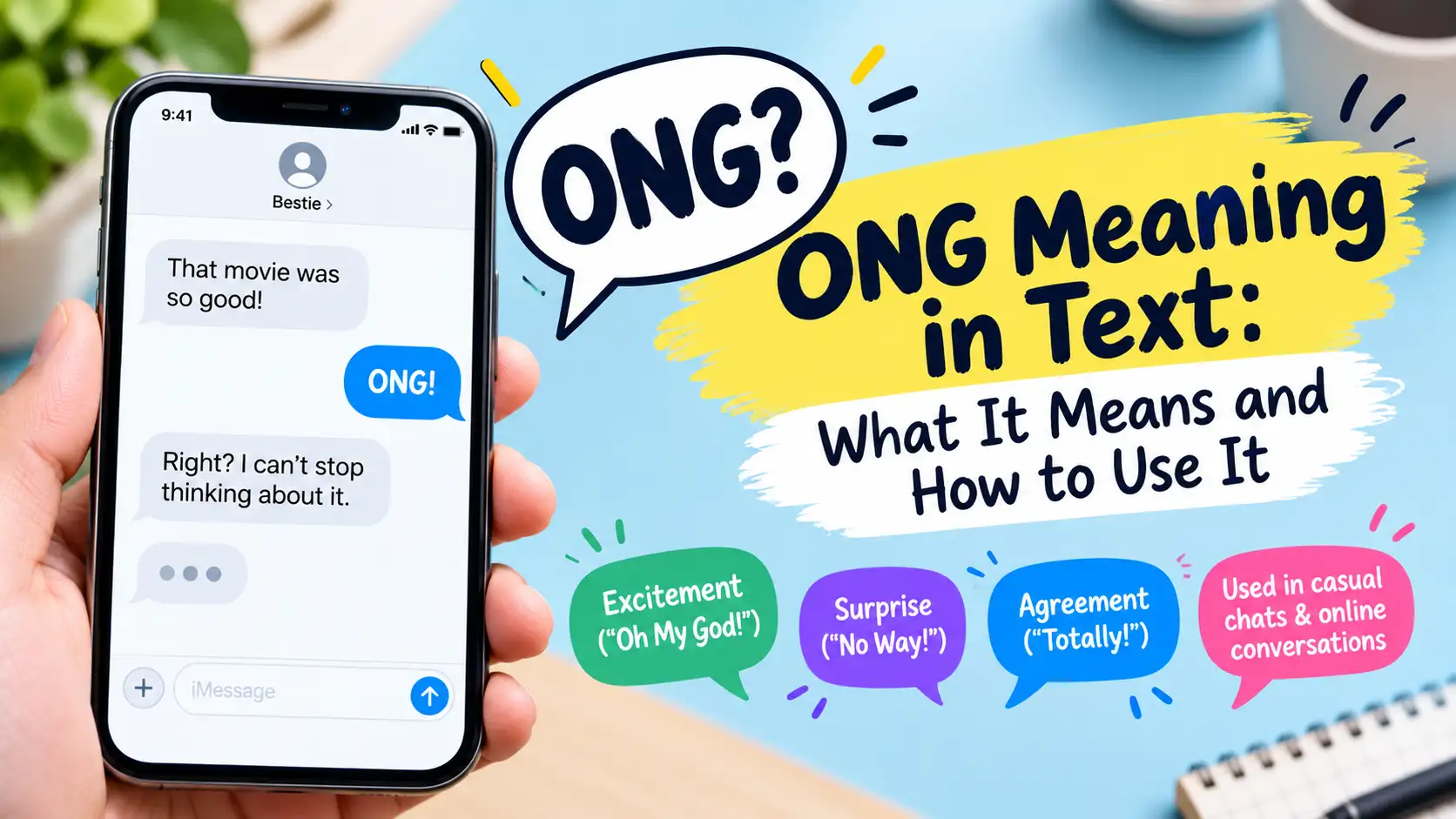
You are scrolling through your phone. A friend sends a message: “That was the best pizza ever, ong.”
Ong? Could it be a typo? Is it a name? Is it a new word you missed?
Don’t worry. ONG is slang for “on God.” It is a way to say, “I swear this is true.” People use it to make a point stronger. It is like saying “for real” or “I promise.”
You will see ONG in texts, TikTok comments, game chats, and dating apps. Teens use it a lot. Adults are starting to pick it up too.
Why does it matter? Because tone and trust matter in chats. If you read ONG the wrong way, you may think someone is joking when they are serious, or the other way around.
This guide shows you what ONG means, where it came from, and how to use it well. Let’s dive in.
Definition & Meaning
What does ONG stand for?
ONG stands for “on God.” It is a short way to say “I swear,” “I mean it,” or “This is the truth.”
Think of it as a stamp of honesty on a sentence.
How people use it
ONG has three main uses.
1. To swear something is true
Mia: Did you really finish the whole book in one night?
Zoe: Yes, ong. I couldn’t stop.
2. To show strong feeling
Sam: This song is so good.
Leo: It’s my favorite song ever, ong.
3. To agree with someone
Ana: Mondays are the worst.
Ben: Ong. Every single one.
Where it goes in a sentence
ONG can sit in different spots.
- At the end: “I’m so tired, ong.”
- At the start: “Ong, I did not take your hoodie.”
- Alone as a reply: “Ong.”
How big is the feeling?
ONG can be light or heavy.
- Light: “This pizza is so good, ong.” (a fun, casual point)
- Heavy: “I did not do it, ong.” (a serious claim)
Quick summary
Key point: ONG means “on God,” which is a way of saying “I swear it’s true.” People use it to sound honest, show strong feelings, or agree with someone.
Background & History
Where does “on God” come from?
“On God” comes from a very old idea: the oath. For hundreds of years, people have sworn to tell the truth by naming God. You may know phrases like “I swear to God” or “As God is my witness.”
“On God” is a short version of the same idea. It says, “I’m putting my word on God that this is true.”
The cultural roots
The slang use of “on God” grew out of Black American English, often called AAVE. It spread through hip hop music, where artists often use phrases like “on God,” “on my mama,” and “on everything” to show they are being real.
From there, it moved into everyday speech, then into texts and social media.
How did it go viral?
Around the late 2010s and early 2020s, short form video apps and social platforms helped slang spread fast. A word used in one group could go worldwide in weeks. “On God” became popular with young people, and people began to type it as ONG.
How has it changed?
Over time, a few things happened.
- The spelling got shorter. “On God” became “ong.”
- The meaning got lighter. At first, it was a serious oath. Now people use it for small things, like pizza.
- It spread to new groups. More people now use it, in many countries.
- Memes joined in. Posts and videos often use ONG for humor.
Where is it used today?
- Texts between friends
- Comments on social media
- Game chats
- Dating apps
- Group chats
Key point: ONG grew from an old oath and Black American English. It moved online and became a quick way to say “for real.”
Usage in Various Contexts
ONG fits many places. Here is how it works in each one.
Texting
In texts, ONG adds trust to your words.
Nina: Are you sure you locked the door?
Tom: Yes, ong. I checked twice.
Social media
On social media, ONG appears in captions and comments. It adds feeling to a post.
Post: Just ate the best burger of my life.
Comment: Ong, that place is amazing.
Gaming
Gamers use ONG for quick, strong claims.
Player 1: Did you really win with no health?
Player 2: Ong! I had one point left.
Or when they are frustrated:
Player 1: I got knocked out by a bot.
Player 2: Ong, that was so unlucky.
Casual conversations
Friends use ONG to agree or swear to something.
Jade: That test was impossible.
Rae: Ong, I almost cried.
To show you mean it
Eve: Please don’t tell anyone my secret.
Max: I won’t, ong.
To show you are surprised
Lily: I won the contest.
Dan: No way. Ong?
Lily: Ong!
Here, “ong?” is used as a question. It means “Are you swearing this is true?”
In group chats
Pat: The new cafe is open.
Kim: The coffee is so good, ong.
Lee: Ong, I’m going tomorrow.
Key point: ONG fits text, social media, games, and friend talks. It always adds a sense of “I mean it.”
Common Misconceptions & Clarifications
Mistake 1: “ONG is a name”
No. It is not a person. It is slang for “on God.”
Mistake 2: “ONG always means something serious”
Not always. It started as a serious oath. Now people often use it lightly, even for small things like snacks or songs.
Example:
Ana: That sandwich was so good.
Ben: Ong, the best.
Nobody is making a holy promise about a sandwich. It is just a strong feeling.
Mistake 3: “ONG means the same as OMG”
They are different.
- OMG means “oh my God.” It shows surprise or shock.
- ONG means “on God.” It shows the truth or strong feelings.
Example:
A: I got front row tickets!
B: OMG! (shock)
B: Ong? (Are you swearing?)
Mistake 4: “ONG is only a Gen Z word”
It is popular with young people, but anyone can use it. And the idea of swearing on something is very old.
Mistake 5: “ONG has only one meaning”
Mostly, yes, but there is one big exception. In some languages, “ONG” means something else. In French, Spanish, and Portuguese, ONG is the short form for a non profit group, like an NGO. If you see it in a news article or an email about charity work, it likely has nothing to do with slang.
Is ONG ever inappropriate?
Rarely. But a few people may feel uneasy. Some feel that using God’s name casually is disrespectful. Others feel the phrase should be used with care, because it comes from a rich cultural background.
When might ONG be misread?
- Your reader is older and does not know it.
- Someone thinks it is a typo.
- You use it in a serious or formal setting.
- You use it sarcastically, and the tone gets lost.
Key point: ONG means “on God.” If you are not sure, check the setting. It might even be a charity group in another language.
Similar Terms & Alternatives
You do not always need ONG. Here are other ways to say the same thing.
Quick list
- On God: the full phrase
- For real: a common, clear way to say it
- No cap: means “no lie”
- Fr / frfr: short for “for real” and “for real for real”
- On my mama: a stronger, more personal oath
- On my life: a very serious oath
- On everything: a broad oath
- I swear: the classic version
- Deadass: means “seriously” (more common in New York slang)
- Bet: means “okay” or “I agree”
- I promise: a plain, polite version
Comparison table
| Term | Meaning | Strength | Best For |
| ONG | I swear it’s true | Medium to strong | Friends, texts |
| No cap | No lie | Medium | Casual chats |
| Fr / frfr | For real | Light | Quick agreement |
| On my mama | A deep promise | Strong | Serious claims |
| I swear | A direct oath | Medium | Any setting |
| Deadass | Seriously | Medium | Casual talk |
| I promise | A polite oath | Medium | Work and family |
Which one should you pick?
- Want to be quick and casual? Use ong or fr.
- Want to say “I’m not lying”? Use no cap.
- Want to sound polite? Use “I promise” or “I swear.”
- Want to be very serious? Use “on my life.”
Key point: All of these say “I mean it.” Pick the one that fits your friends and setting.
How to Respond to This Term
Someone sent you “ong.” What do you say? It depends on the mood. Here are four styles.
1. Casual
Keep it simple.
Friend: I aced the exam, ong.
You: Nice! I knew you would.
More casual replies:
- “Ong? That’s amazing.”
- “Same, ong.”
- “Love that for you.”
2. Funny
Add a little humor.
Friend: I’m never eating pizza again, ong.
You: You said that last week.
Friend: This time I mean it.
You: See you at the pizza place tomorrow.
3. Professional
If a coworker says ONG and you want to stay polished, keep it kind and clear.
Coworker: I finished the report, ong.
You: Great work. Thanks for getting it done.
You do not need to copy the slang. Just respond to the meaning.
4. Privacy conscious
Maybe someone uses ONG to push you to share something. You can stay friendly and keep it short.
Acquaintance: Who are you texting, ong? Tell me!
You: Just a friend. Anyway, how was your weekend?
You stay kind, but you keep your details private.
If you want to check they are serious
Friend: I saw a bear on my street, ong.
You: Wait, ong? Are you serious?
Friend: Ong! I have a photo.
If you do not know what it means
Ask. It is fine.
You: What does ong mean?
Friend: It means “on God.” Like “I swear.”
You: Ah, got it. Thanks!
Key point: Match the mood. Be warm if they are happy, curious if they are serious, and kind always.
Regional or Cultural Differences
Is ONG used worldwide?
ONG is used mostly in English speaking places. It is very common in the US, and it is growing in the UK, Canada, Australia, and other countries thanks to social media.
How do other places say it?
Many cultures have their own oath phrases that work like ONG.
- UK: “On my life,” “on my mum,” or “I swear down”
- Spanish: “Te lo juro” (“I swear it to you”)
- French: “Je te jure” (“I swear to you”)
- Arabic speaking communities: “Wallah” (“by God”)
- Hindi and Urdu chats: “Kasam se” or “qasam” (“I swear”)
- Nigeria and Ghana: “I swear” and “by God” are common
You can see the same idea across the world: people want to prove they are telling the truth.
Different slang in English
- In the US, ONG is part of a group of oath phrases like “on my mama” and “on everything.”
- In the UK, you may hear “I swear down” instead.
- In Australia, people may say “swear to God” or “no worries” in a different way.
Cultural care
Because ONG has roots in Black American culture, it is good to use it with respect. Use it naturally and kindly. Do not use it to make fun of anyone’s way of speaking.
Also, in some cultures and faiths, using God’s name lightly is not okay. If you are chatting with someone who is very religious, you may want to choose “I swear” or “I promise” instead.
Key point: ONG is mostly English slang, but oath phrases exist around the world. Be mindful of culture and faith.
Comparison with Similar Terms
Let’s compare ONG with some close cousins. Small differences matter.
ONG vs OMG
- ONG means “I swear.”
- OMG means “I’m shocked.”
- ONG is about truth. OMG is about surprise.
ONG vs No cap
- “No cap” means “no lie.” It is lighter and trendier.
- ONG feels a bit stronger, because it adds an oath.
Example:
A: That movie was so scary.
B: No cap, I couldn’t sleep.
B: Ong, I couldn’t sleep.
The second feels more sworn and serious.
1st ONG vs Fr (for real)
- “Fr” is a quick, light agreement.
- ONG carries more weight.
2nd ONG vs On my mama
- “On my mama” is personal and heavy. You are swearing on someone you love.
- ONG is a bit softer and more common.
ONG vs I swear
- “I swear” is classic and works in any setting.
- ONG is casual and trendy.
ONG vs Deadass
- “Deadass” means “seriously.” It is often linked to New York slang.
- ONG is more widely used.
Comparison table
| Feature | ONG | OMG | No cap | Fr | On my mama |
| Main feeling | I swear | Shock | No lie | For real | Deep promise |
| Strength | Medium | Medium | Medium | Light | Strong |
| Tone | Casual | Casual | Casual | Casual | Serious |
| Best for | Friends | Surprise | Casual claims | Quick agreement | Big claims |
Key point: ONG sits in the middle: more weight than “fr,” lighter than “on my mama.”
Usage in Online Communities & Dating Apps
On Twitter / X
People use ONG to add trust or feeling to a post.
User 1: Coffee before 9 a.m. should be free, ong.
User 2: Ong, I’d pay in smiles.
It also shows up in agreement replies.
On TikTok and Instagram
Under videos and photos, ONG is a fast reaction.
Video: A dog does a backflip.
Comment: Ong, I can’t believe this is real.
In gaming communities
Gamers use ONG for quick claims and big reactions.
Player A: I just hit that shot with my eyes closed.
Player B: Ong? Show the clip.
Player A: Ong. Check my replay.
Tip: In games, trust matters. If you swear “ong” and it is false, teammates may stop believing you.
On dating apps like Tinder
On dating apps, ONG is friendly and casual.
Match: I make the best pasta in the city, ong.
You: Ong? I need proof. 😄
It can also show honesty.
Match: I’m not good at texting, ong. Don’t take it personally.
You: Thanks for telling me. I appreciate that.
Tips for responding on dating apps
- Add more words. “Ong, I love that” feels warmer than “ong” alone.
- Don’t overuse it. Too many “ongs” can feel flat.
- Ask a question. “Ong? What’s your secret recipe?” keeps the chat going.
- Be honest. If you use it, mean it.
- Read the mood. If your match uses formal language, mirror it.
Tips for online communities in general
- Read the room. Each group has its own style.
- Be kind. Do not use ONG to push or pressure people.
- Explain when asked. If someone asks, share what it means.
Key point: Online, ONG is a quick way to show you are real. Pair it with a real comment to keep the talk warm.
Hidden or Offensive Meanings
Is ONG offensive?
Not by itself. There are no swear words in it. It is not a slur. It does not target any group or person.
Where care may be needed
There are three small risks.
1. Religious feelings
Some people feel that using God’s name for small things is disrespectful. If you are not sure, choose another phrase like “I swear” or “for real.”
2. Cultural roots
ONG comes from Black American English. It is fine to use it naturally. But mocking or faking the way people speak can feel unkind. Use it as part of your normal chat, not as a joke on a culture.
3. False oaths
If you say “ong” and then lie, people may lose trust in you.
Example:
Ben: I did not eat your cake, ong.
Cal: There’s frosting on your shirt.
Oops. Now Ben’s ONG looks fake.
Other meanings
As we saw, ONG can also mean a non profit group (NGO) in French, Spanish, and Portuguese. If you see it in a formal message about charities, that is likely what it means. There is no widely known hidden or offensive meaning for ONG in texting.
Why tone and context matter
Text has no voice. So the reader fills in the tone. A sarcastic “ong” can look like a real oath, or a real oath can look like a joke.
Example:
Ana: I’m so happy about Monday, ong. 🙄
The eye roll tells us Ana is being sarcastic. Without it, we might think she means it.
How to stay safe
- Use emojis to show your real tone.
- Don’t swear to things that are false.
- Think about your reader. If they are religious, pick a different phrase.
- Respect the culture behind the term.
Key point: ONG is a clean, friendly slang word. Just use it with honesty, tone, and respect.
Suitability for Professional Communication
Is ONG okay at work?
Usually no. ONG is casual slang. Here is why:
- Many people don’t know about it.
- It names God, which may feel odd in a work setting.
- It can look unpolished in emails and formal chats.
- It may confuse clients or older coworkers.
When it might be fine
Some workplaces are very relaxed. If your team uses slang all the time, a quick “ong” in a private chat with a close coworker might be okay. Still, watch how others talk first.
Example:
Teammate: We hit the sales goal.
You: Ong, that’s huge!
When to avoid it
- Formal emails
- Messages to clients or leaders
- Serious topics, like complaints or reviews
- When you are new and unsure of the culture
Professional alternatives
Try these instead:
- “I promise.”
- “I assure you.”
- “I mean that sincerely.”
- “That is true.”
- “I completely agree.”
- “To be honest, …”
Examples in dialogue
Casual (avoid at work):
Boss: Did you send the file?
You: Yes, ong.
Professional (better):
Boss: Did you send the file?
You: Yes, I sent it this morning. I can resend it if you need.
Casual (avoid at work):
Coworker: This plan is great.
You: Ong, love it.
Professional (better):
Coworker: This plan is great.
You: I agree. It’s well thought out.
Quick rules for work chats
- Skip slang with bosses and clients.
- Use full words for important points.
- Follow your team’s style.
- Save ONG for friends.
Key point: At work, clear and polite beats are short and trendy.
FAQs
1. What does ONG mean in text?
ONG means “on God.” It is a way to say “I swear” or “I mean it.”
2. Is ONG the same as OMG?
No. OMG shows surprise. ONG shows that you are swearing something is true or feeling strongly.
3. Is ONG a swear word?
No. It has no bad words. But some people may find using God’s name casually disrespectful.
4. Can I use ONG at work?
It is best to avoid it. Use “I promise,” “I assure you,” or “I agree” instead.
5. How do I reply to ONG?
Match the mood. Say “Nice!”, “Same!”, or ask “Ong? Really?” If you do not know it, simply ask what it means.
6. Where does ONG come from?
It comes from the old idea of swearing an oath on God. The slang form grew out of Black American English and spread through hip hop and social media.
7. What can I use instead of ONG?
Try “for real,” “no cap,” “fr,” “I swear,” or “I promise.” Pick the one that fits your setting.
Conclusion
ONG is a tiny word with a big job. It lets people say “I swear this is true” in just three letters.
Here are the key points to remember:
- ONG means “on God.” It is a quick way to say “I swear.”
- It grew from an old oath and from Black American English.
- It is casual slang. It is great for friends, but not for formal work messages.
- Tone matters. Use emojis and clear words so people read you right.
- Be honest. A false ONG can cost you trust.
- Be respectful. Think about culture and faith.
- You have options. “For real,” “no cap,” and “I promise” all work too.

Asfan Wahab is a content creator and writer focused on text meanings, slang, abbreviations, acronyms, and internet expressions. Through Orvexale.com, he provides clear and simple explanations to help readers understand modern texting language. His goal is to make confusing terms easy to understand with practical examples and everyday context.