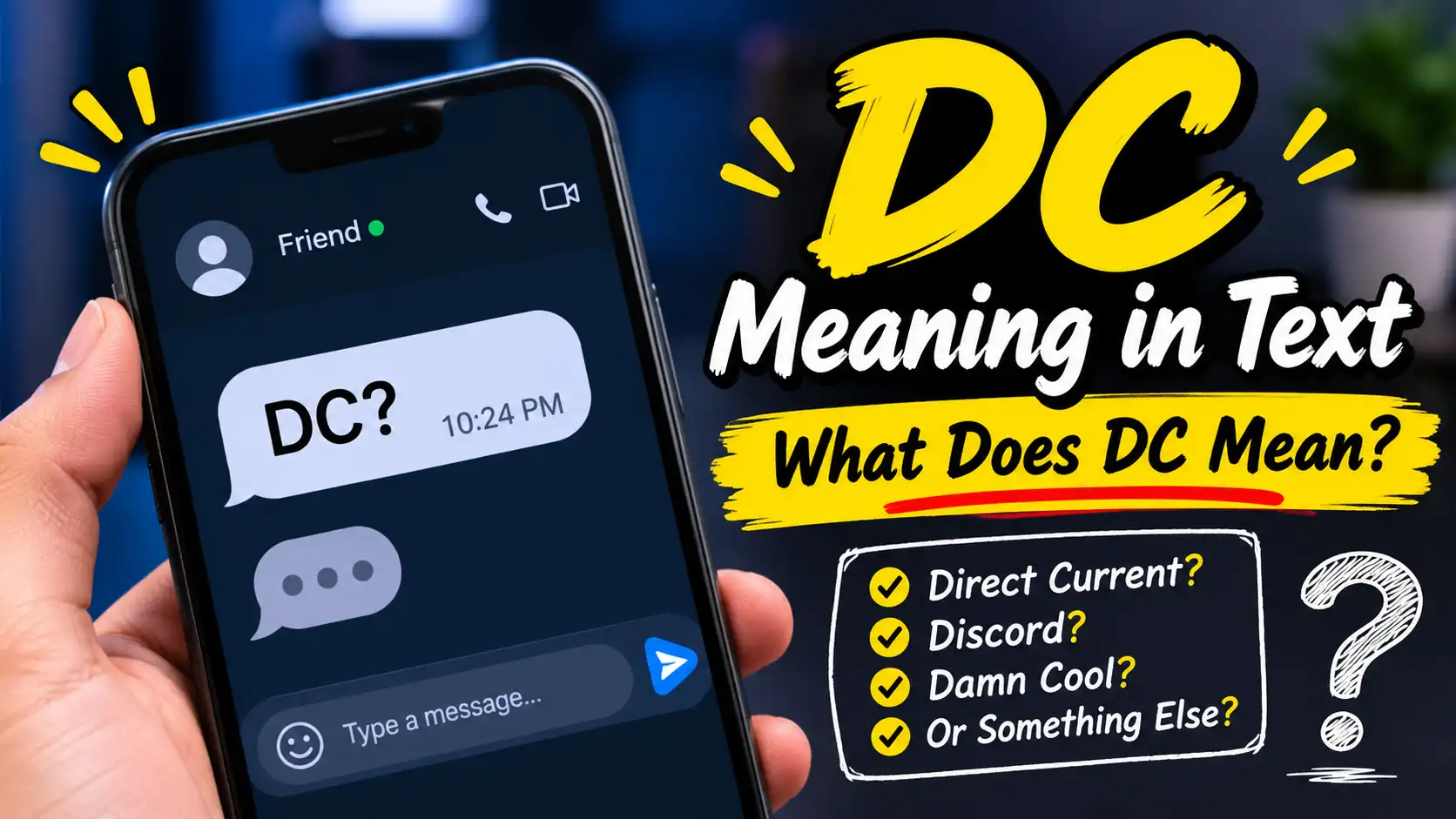
You get a text. It says “dc.” Nothing else. You stare at it. What does it mean?
You are not alone. Many people ask this. “DC” is short. It is quick. And it can mean more than one thing.
People use it in texts. Its use it in games. They use it on social media. They even use it at work. The meaning changes with the place. It also changes with the person.
This matters. A wrong guess can cause a mix up. You might think someone is rude. You might think they are sad. Or you might miss that their game just crashed.
In this post, you will learn the main meanings of DC. You will see real examples. You will learn how to reply. And you will know when to avoid it.
Let’s start.
Definition & Meaning
The Short Answer
In texting, DC most often means “don’t care.” It can also mean “disconnect” or “Discord.”
Context tells you which one.
Meaning 1: Don’t Care
This is the top meaning in casual chat. It shows a lack of interest. Sometimes it means “I am fine with anything.”
Example:
Mia: Pizza or tacos tonight?
Leo: dc, you pick
Here, Leo is not being mean. He just has no strong choice.
Meaning 2: Disconnect
Gamers use this one a lot. It means a player lost the connection.
Example:
Sam: where did you go?
Ravi: dc’d, my wifi died
The “‘d” means “disconnected.”
Meaning 3: Discord
Discord is a chat app. Many gamers use it. Some people shorten it to “DC.”
Example:
Ana: Join me on dc tonight?
Tom: Sure, give me ten minutes
Meaning 4: Washington, D.C.
This is the capital of the United States. In chat, it can just mean the city.
Example:
Zoe: I’m moving to DC next month!
Kai: That’s huge. Congrats!
Meaning 5: DC Comics
Fans use “DC” for the comic book brand. Think Batman and Superman.
Why Context Matters
Look at who sent it. Look at where you are. A gamer in a voice chat likely means “disconnect.” A friend choosing dinner likely means “don’t care.”
When in doubt, ask. A quick “DC as in what?” saves trouble.
Background & History
Where Did “DC” Come From?
Short forms are old. People have clipped words for ages. Telegrams used them. Radio operators used them. They saved time and money.
“DC” itself has many roots. In science, it stands for “direct current.” In places, it means “District of Columbia.” Those uses are older than texting.
The Rise of Text Slang
Early phones had small keypads. Typing was slow. Each text had a tight limit. So people cut words down. “See you later” became “CYL.” “Be right back” became “BRB.”
“DC” joined this trend. It was easy to type. It was only two letters.
The Gaming Boost
Online games grew fast in the 2000s. Lag was common. Connections broke often. Players needed a quick way to say “I got kicked out.” They said “DC.”
Soon, “DC” spread beyond games. It became normal slang.
The Rise of Discord
Discord launched in 2015. It grew fast. Gamers, study groups, and friends all used it. Many people started saying “hop on DC.” Others said “dis.” Both are still used.
How It Is Used Today
Today, “DC” lives in many places:
- Text messages between friends
- Gaming lobbies and voice chats
- Social media comments and replies
- Group chats for planning
Meanings can overlap. A teen might use “DC” to mean “don’t care” in one text. Then they use it to mean “Discord” in the next.
The term keeps shifting. That is how slang works. It lives as long as people use it.
Usage in Various Contexts
In Texting
Here, “DC” mostly means “don’t care”. It often shows a mood. Sometimes it means “no strong view.” Sometimes it means “I am annoyed.”
Dad: What movie do you want to watch?
Ella: dc, anything is fine
Tone matters. A bare “dc” can sound cold. Add a smiley to soften it.
Ella: dc 😊 you choose
On Social Media
On sites like X, Instagram, and TikTok, “DC” can mean many things. Its may point to Washington. It may point to comics. It may mean “don’t care.”
Post: Just landed in DC! 🛬
Reply: Have fun! Visit the museums.
Here, DC is the city. Check the post for clues.
In Gaming
This is where “DC” is strongest. It means disconnect.
Max: Why did we lose?
Jin: Our tank dc’d mid fight
Players also use it as a warning.
Lena: brb, might dc
Omar: ok, we’ll wait
On Discord
People often say “DC” for the app.
Priya: Are you on dc?
Ben: Yeah, join the voice channel
In Casual Conversation
Out loud, people rarely say “dee see” to mean “don’t care.” But they say “DC” for the city or comics.
Sara: I love DC movies.
Jake: Same. Batman is the best.
A Quick Tip
Ask yourself three things:
- Who sent it?
- Where did they send it?
- What was the topic before it?
Those clues almost always solve it.
Common Misconceptions & Clarifications
Myth 1: “DC Only Means Don’t Care”
Many people think this. It is the most common meaning in plain texting. But it is not the only one. Gamers will tell you it means “disconnect.” Fans of comics will say “DC Comics.” Always check the setting.
Myth 2: “DC Is Always Rude”
Not true. “Don’t care” can sound harsh. But often it just means “I’m easy, you pick.” Many people use it in a friendly way.
Nina: Where should we eat?
Omar: dc, I’m happy anywhere
Omar is not being rude. He is being flexible.
Myth 3: “Everyone Knows What It Means”
They don’t. Older adults may not know it. People from other countries may not know it. A person who does not play games may not know “disconnect.” Do not assume.
Myth 4: “DC Is Formal Enough for Work”
It isn’t. We cover this later. For now, know that “DC” can confuse readers. At work, clear words are best.
Can It Be Misread?
Yes. Here is a real mix up.
Boss: Can you join the call?
Intern: dc
The boss may think the intern said “I don’t care.” The intern may have meant “I’m disconnected.” That is a big difference.
How to Avoid Confusion
- Spell it out if the meaning is unclear.
- Add context. Say “dc’d from the game.”
- Ask. “Do you mean don’t care?”
One Last Point
Tone can change everything. A “dc” after a fight can mean “I’m done.” A “dc” after a fun chat can mean “no preference.” Read the mood before you reply.
Similar Terms & Alternatives
Many words say the same thing. Here are the closest ones.
1st For “Don’t Care”
- IDC: “I don’t care.” This is the most common form.
- IDGAF: A strong, rude version. Avoid it around family or work.
- Whatever: A mild, common reply.
- Meh: Shows low interest.
- Any: As in “any is fine.”
For “Disconnect”
- DC’d: Past tense, used in games.
- Lag out: Slow connection, often leading to a drop.
- Drop: As in “I dropped from the call.”
- Kicked: Removed by the game or server.
For “Discord”
- Dis: Short for Discord.
- Cord: Used by some players.
- Voice chat: A general term.
Quick Comparison Table
| Term | Main Meaning | Tone | Best Use |
| DC | Don’t care / disconnect / Discord | Varies | Casual chat, gaming |
| IDC | I don’t care | Neutral to cold | Casual chat |
| IDGAF | I really don’t care | Rude | Close friends only |
| Meh | Not excited | Mild | Casual chat |
| DC’d | Was disconnected | Neutral | Gaming |
| Dis | Discord | Friendly | Gaming, friends |
Which Should You Pick?
If you mean “don’t care,” try “I’m easy” or “no preference.” They sound kinder.
If you mean “disconnect,” say “I got disconnected.” It is clear to all.
If you mean Discord, just write “Discord.” It has only seven letters.
How to Respond to This Term
How you reply depends on the meaning. It also depends on the person. Here are four styles.
1. Casual Replies
Keep it light. Use these with friends.
Friend: dc, you choose
You: Ok, tacos it is!
Friend: dc’d, be right back
You: No worries, we’ll wait
2. Funny Replies
Humor can ease tension.
Friend: dc
You: Wow. Zero feelings. Cold. 😂
Friend: dc’d again
You: Your wifi hates us
3. Professional Replies
At work, stay calm and clear. Do not copy the slang.
Coworker: dc, any time works
You: Thanks! I’ll schedule it for 2 p.m.
Coworker: I dc’d from the call
You: No problem. I’ll resend the link now.
4. Privacy Conscious Replies
Sometimes “dc” shows up in a chat with a stranger. You may not want to share details. Keep answers short.
Stranger: dc, where do you live?
You: I’d rather not say. Let’s chat about something else.
Replying to a Cold “dc”
If the “dc” feels cold, check in.
Partner: dc
You: Everything ok? You seem a bit off.
This shows care. It also invites an honest answer.
Quick Rules
- Match the tone. Do not be harsh to someone who is joking.
- Ask when unsure. It beats guessing.
- Stay kind. Text hides faces and voices.
- Use clear words at work.
A Handy Tip
If you cannot tell what “dc” means, reply with “Do you mean don’t care or disconnected?” It is polite. It works every time.
Regional or Cultural Differences
English Speaking Countries
In the United States, “DC” often points to Washington. It can also mean comics. Among teens, “don’t care” is common.
In the UK, people also use “DC,” but less for the city. They may say “IDC” more often. Gamers there use “DC’d” the same way as in the US.
In Canada and Australia, usage is close to the US. Gaming slang crosses borders easily.
Other Languages
Many languages borrow English gaming terms. Players in Spain, Brazil, and Germany often say “DC” or “dc’d” in English while the rest of the chat is in their own language.
In Spanish, some people write “me desconecté” in full. Others just type “dc.”
In Portuguese, “caí” (I dropped) is common. “DC” shows up in gaming groups.
In Hindi and Urdu chats, people often mix English and local words. A message might say “Bhai, mera dc ho gaya,” which blends “DC” with local speech.
Other Meanings Around the World
“DC” has other uses too:
- Direct current in electricity classes
- Doctor of Chiropractic in health
- Distribution center in shipping
- District of Columbia in the US
- Dave and Charlie, or other private initials
Regional Slang Variations
- IDC is more common than “DC” in many areas.
- DK (“don’t know”) is a cousin used in some chats.
- NVM (“never mind”) often appears next to it.
- Some groups use “DGAF” for the same idea.
Culture and Tone
In some cultures, saying “I don’t care” is seen as rude. People there may prefer a polite phrase. In others, it is just normal and friendly.
What to Remember
Slang moves fast. It changes by age, place, and community. If you chat with people from other countries, keep your words plain. Avoid slang that might not travel well.
Comparison with Similar Terms
Let’s put “DC” next to its close cousins. The goal is simple. You will see the small differences.
DC vs. IDC
- DC: Short and vague. It may mean many things.
- IDC: Almost always “I don’t care.”
Example:
A: Which show should we watch?
B: IDC.
Here, “IDC” is clear. “DC” could cause a pause.
DC vs. IDGAF
- DC: Mild.
- IDGAF: Strong and rude.
A: Are you mad at me?
B: IDGAF
That feels harsh. “DC” would feel softer.
DC vs. DK
- DC: Don’t care.
- DK: Don’t know.
They look close. They mean different things. Do not mix them up.
DC vs. BRB
- DC (disconnect): You lost the link.
- BRB: You left on purpose and plan to return.
Gamer 1: brb, snack
Gamer 2: dc’d, sorry
Side by Side Table
| Term | Meaning | Intensity | Common Place |
| DC | Don’t care / disconnect | Low to medium | Texts, games |
| IDC | I don’t care | Medium | Texts |
| IDGAF | I really don’t care | High | Close friends |
| DK | Don’t know | None | Texts |
| BRB | Be right back | None | Games, chat |
| NVM | Never mind | Low | Everywhere |
Which One Is Safest?
If you want to be clear, IDC beats DC for “don’t care.” For “disconnect,” DC’d beats plain DC.
Why This Matters
Small word changes shift tone. “Meh” feels light. “IDGAF” feels sharp. “DC” sits in the middle but can be unclear.
Pick the term that fits your goal. If you want to be kind, use softer words. If you want to be fast, use short ones.
Usage in Online Communities & Dating Apps
Gaming Communities
Games are the home of “DC.” Players drop out all the time.
Team Lead: Where’s Alex?
Mia: dc’d, he’ll rejoin soon
Some teams even use “DC” as a status call. It tells others to adjust the plan.
Reddit and Forums
In forums, “DC” may mean Washington, comics, or disconnect. Threads often add context, such as “DC Universe” or “server DC.”
Twitter / X
Short posts need short words. People write “dc” for “don’t care” in jokes and rants.
Post: Monday again. dc about my inbox.
Discord Servers
Here, “DC” usually means the app itself. Members say “come to dc” to invite friends to chat.
Dating Apps like Tinder
On Tinder, Bumble, or Hinge, “dc” often shows up in two ways:
- Don’t care: “dc, you pick the place.”
- Move to Discord: “Add me on dc.”
Match: dc, you choose the cafe
You: Great! How about the one near the park?
Be careful here. Some people ask you to move to another app fast. This can be a sign of a scam. Take your time.
Tips for Responding Well
- Match their energy. If they are casual, be casual.
- Do not assume. Ask what they mean.
- Protect your privacy. Do not share your address, school, or work too soon.
- Watch for pressure. If someone rushes you, slow down.
- Be kind. A warm tone helps first chats.
Sample Safe Reply
Match: add me on dc
You: Maybe later. Let’s chat here a bit first.
That is polite and clear.
Final Thought
Online spaces move fast. “DC” adapts to each one. Use the clues around the message. And when in doubt, ask.
Hidden or Offensive Meanings
Can “DC” Be Offensive?
On its own, “DC” is not a bad word. It is not slang for anything harmful. But tone and context can make it hurtful.
When It Can Sound Rude
If someone says “dc” in reply to your feelings, it can sting.
You: I had a rough day.
Friend: dc
Ouch. That says “I don’t care about your day.” Even if it was a joke, it can hurt.
Dismissive Use
People may use “dc” to shut down a talk. It may mean “stop talking about this.” That is a quiet kind of rudeness.
In Arguments
During a fight, “dc” can fuel anger. It looks like you do not take the other person seriously.
Other Hidden Meanings
Some other uses are not bad, but they may surprise you:
- DC as initials for a person’s name
- DC as a code in a private group
- DC as a short form for “dead chat” in some servers
Rare slang may also exist in small groups. If a message feels odd, ask.
Why Tone Matters
Text has no voice. It has no face. A short message like “dc” can feel cold. Add emoji, kind words, or a longer reply.
Soft: “dc, I’m fine with anything 😊”
Harsh: “dc.”
The second one feels closed off.
How to Stay Safe and Kind
- Think before you send. Would you say it face to face?
- Add warmth when the topic is serious.
- Do not use it when someone shares pain.
- Ask if unsure. “Did you mean don’t care?”
If You Receive a Hurtful “dc”
Take a breath. Then say how you feel.
You: That felt dismissive. I wanted to share.
Friend: Sorry! I didn’t mean it that way.
Honest talk usually fixes it.
Bottom Line
“DC” is not offensive by default. Your tone makes it kind or cruel.
Suitability for Professional Communication
Is “DC” Okay at Work?
Usually, no. Work messages should be clear. “DC” is not clear. A reader may think “don’t care.” That can hurt your image.
Why It Is Risky
- Many meanings. Your boss may guess wrong.
- Casual tone. Slang can seem unserious.
- Global teams. Not everyone knows it.
Bad Example
Manager: Which date works for the meeting?
You: dc
That could seem careless.
Good Example
Manager: Which date works for the meeting?
You: I have no preference. Any day works for me.
That is polite and clear.
Professional Alternatives
1st Instead of “DC” for “don’t care,” try:
- “I have no preference.”
- “I’m flexible.”
- “Either option works for me.”
- “I’m happy with whatever the team picks.”
Instead of “DC” for “disconnect,” try:
- “I lost connection.”
- “My call dropped.”
- “I was disconnected. I’m back now.”
Instead of “DC” for Discord, try:
- “Discord” (just write it out).
When Slang Is Fine
Some workplaces are casual. Start ups and gaming firms may allow it. Even then, use it with close teammates only. Do not use it with clients.
Quick Rules
- Know your audience.
- Write full words in emails.
- Avoid slang in reports, résumés, and client notes.
- Follow company style. If your team uses it, mirror them carefully.
Sample Professional Messages
Colleague: Sorry, I dc’d.
You: No problem. I’ll recap what you missed.
Here, you understand but keep your own words formal.
A Final Tip
Clear writing builds trust. Saving two seconds is not worth a mix up. When in doubt, spell it out.
FAQs
1. What does DC mean in text?
Most often, it means “don’t care.” It can also mean “disconnect” or “Discord.” Check the context.
2. Is DC the same as IDC?
Close, but not the same. IDC clearly means “I don’t care.” DC can have other meanings, so it is less clear.
3. What does “dc’d” mean in gaming?
It means “disconnected.” A player lost their connection or was kicked out.
4. Is it rude to say DC?
It can be. If you say it to someone who shares feelings, it may seem cold. Add a friendly tone to soften it.
5. Can I use DC in an email at work?
It is best to avoid it. Use clear words like “I have no preference” or “my connection dropped.”
6. How do I know which meaning someone intends?
Look at who sent it, where they sent it, and what you were talking about. If you still can’t tell, ask.
7. Does DC mean Discord too?
Yes. Many gamers say “join me on DC.” It is common in gaming circles.
Conclusion
“DC” is small, but it carries big meaning. In texting, it usually means “don’t care.” In gaming, it means “disconnect.” On chat apps, it can mean “Discord.” It can also point to Washington or to comics.
Context is your best guide. Look at the sender. Look at the place. Saw at the topic. If you are unsure, ask a quick question. It beats a wrong guess.
Remember that tone matters. A cold “dc” can hurt. A warm one can show you are easygoing. At work, skip the slang. Use clear, kind words.

Asfan Wahab is a content creator and writer focused on text meanings, slang, abbreviations, acronyms, and internet expressions. Through Orvexale.com, he provides clear and simple explanations to help readers understand modern texting language. His goal is to make confusing terms easy to understand with practical examples and everyday context.