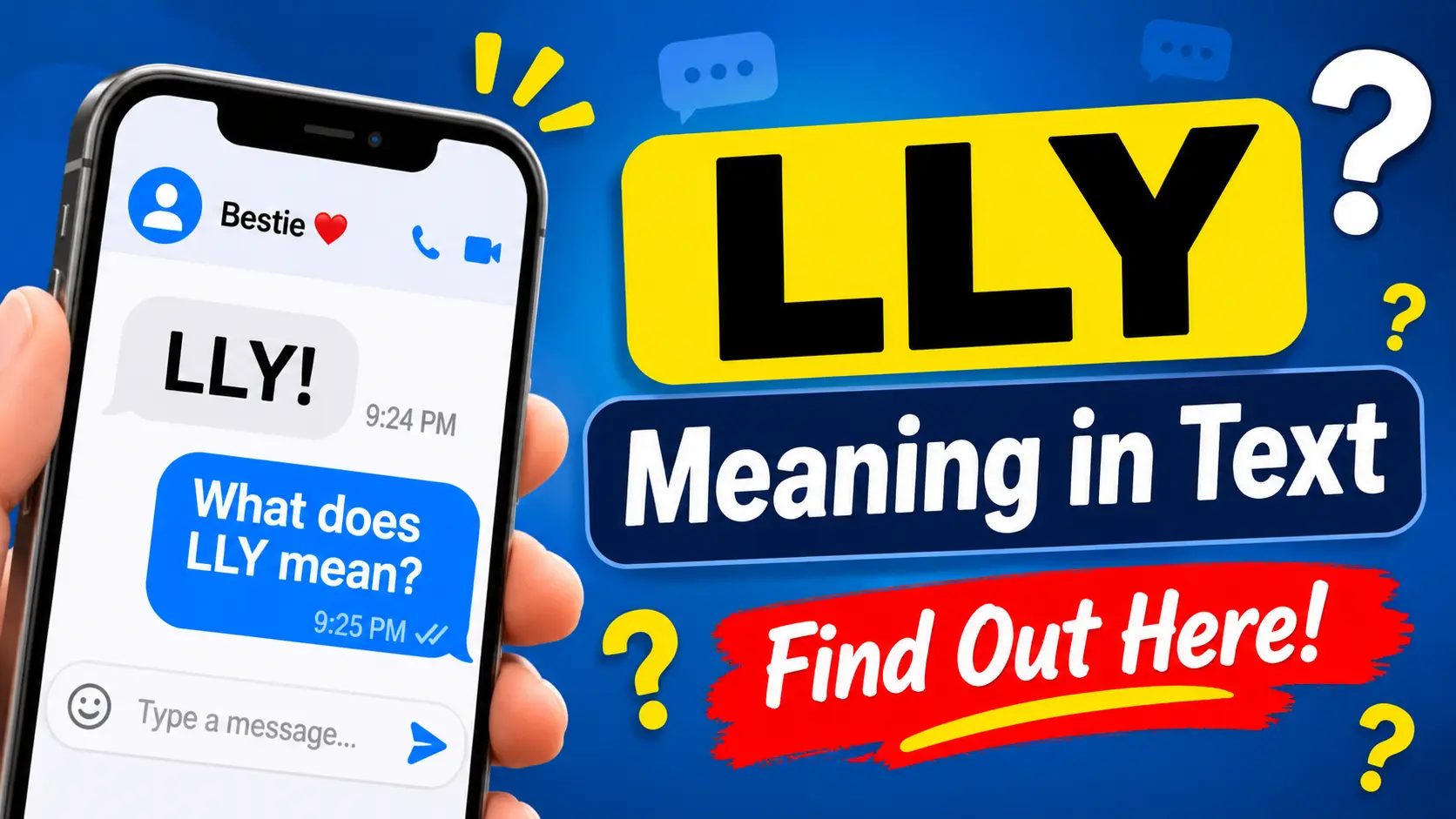
You get a text. It says “lly.” You stare at it. What does it mean?
You are not alone. Many people see “lly” and freeze. It is short. It is vague. And it is not in any dictionary.
Here is the quick answer. LLY is most often a short, warm sign off. Most people read it as “love ya” or “lots of love, yours.” It is a cousin of “LY” and “ILY,” which both mean “love you.”
You will see LLY in texts, DMs, comments, and game chats. It shows up when someone wants to sound friendly and fast.
Why does this matter? Because tone is hard in text. One wrong guess can feel awkward. You might reply too coldly. Or too warmly.
In this post, you will learn what LLY means, where it comes from, and how to reply. You will also learn when to skip it. Let’s start.
Definition & Meaning
What does LLY stand for?
LLY has no single official meaning. No dictionary lists it. People use it in a few ways. The context tells you which one.
Here are the most common readings:
- “Love ya” – A casual, friendly goodbye.
- “Lots of love, yours” – A sweet sign off, like at the end of a letter.
- “Love you lots” – A warm, extra kind version of “love you.”
- A typo or shortcut – Sometimes people just drop letters. “Lly” can be a messy “lol” or “really.”
So the best answer is this: LLY is slang for affection, and the exact words depend on the sender.
How is LLY different from LY?
“LY” is the better known short form. It means “love you.” People put it at the end of a message.
“LLY” adds one more letter. That extra “L” often stands for “lots” or “love.” It makes the message feel a bit warmer.
Real life examples
Here are a few ways people use it.
Example 1: A friend signing off
Mia: Thanks for helping me move today! Jo: Anytime. See you Friday. lly!
Example 2: A parent texting a child
Mom: Good luck on your test. Mom: lly!
Example 3: A partner in a sweet moment
Sam: Miss you already. Alex: Miss you more. lly.
In all three, LLY works like a hug in letters. It is short, soft, and kind.
Is it always about love?
No. Not always. If someone you barely know sends it, pause. Check the rest of the chat. Look at the emoji. Look at the tone. Then decide.
When in doubt, ask. A quick “lly = love ya?” costs nothing.
Background & History
Where did LLY come from?
Nobody can say for sure. LLY has no clear origin story. It did not start with one person, show, or app. Slang often grows that way. It starts small, in private chats. Then it spreads.
What we do know is the family tree. Text slang for love has a long line.
- “Luv” came first. It is an old spelling shortcut.
- “ILY” (I love you) became common as texting grew.
- “LY” (love you) followed. It is even shorter.
- “LLY” looks like a stretch of this pattern. People add or swap a letter to give it a new feel.
Why do people shorten words?
Early phones made typing slow. Each text had a tight limit. So people cut words. “Love you” became “luv u.” Then “ily.” Then “ly.”
Today, we have fast keyboards. We can type all we want. But the habit stayed. Short words now feel casual and warm. They also feel quick, which suits chat.
How has it changed?
Slang moves fast. A word can rise in one month and fade in the next. LLY is a niche, low profile term. It has not exploded like “LOL” or “OMG.” It lives in small groups: friends, families, couples, and online communities.
Because it is so small, its meaning can shift from group to group. One friend circle might use it for “love ya.” Another might use it as a typo for “really.”
Where is it used today?
You may see LLY in:
- Private texts and DMs
- Comments on social media
- Chat in video games
- Notes at the end of emails between friends or family
You will rarely see it in news, books, or formal writing. And that is fine. Slang lives where people are relaxed.
One more note. Some people also know “LLY” as a stock ticker for a large drug company. That is a totally different use. If the chat is about money or markets, that may be what the writer means. In normal texting, it is not.
Usage in Various Contexts
LLY changes a little with each place you meet it. Let’s look at the main ones.
In texting
Texting is where LLY lives. It often appears at the end of a message. It works like “xoxo” or “take care.”
Dad: Dinner is at 7. Don’t be late. Dad: lly, kiddo.
Zoe: Got the job!! Ben: So proud of you! lly!
On social media
On Instagram, TikTok, or X, LLY pops up in comments. It shows support.
Fan: Your new video is so good. Creator: Thank you!! lly all.
Here “all” means the whole audience. It is a warm thank you.
In gaming chat
Gamers type fast. They shorten everything. A player might use LLY after a good match.
Player 1: gg, that was a close one. Player 2: gg! great teamwork. lly guys.
In this setting, it is like a friendly fist bump. It is not romantic. It is team spirit.
In casual conversation
Some people say the letters out loud. Others say “love ya.” Both are common. When said in person, it sounds like a quick goodbye between friends.
Lena: Gotta run. Bus is here. Kai: Okay, bye! Love ya!
In family chats
Family group chats love short warmth. LLY fits well.
Grandma: Happy birthday, sweet girl. Grandma: lly! Nina: Thanks, Grandma! lly too!
In email or notes
Rare, but it happens. A close friend might end an email with “lly, Sam.” It feels like a handwritten sign off.
A quick tip
Always read the whole message. Saw at who sent it. Look at the mood. Look at what came before. Those three clues will almost always tell you the meaning.
Common Misconceptions & Clarifications
Short slang leads to big mix ups. Here are the most common ones.
Misconception 1: “LLY always means romantic love”
Not true. Many people use it with friends and family. A mom can send it. A teammate can send it. It can simply mean “I care about you.”
Think of it like “love ya” said at the door. It is warm, but it is not a big confession.
Misconception 2: “LLY is an official word”
It is not. You will not find it in a dictionary. There is no rulebook. Meaning comes from how people use it.
Misconception 3: “Everyone reads it the same way”
Also not true. Because it is rare, different people may guess different things. One person sees “love ya.” Another sees “lots of love, yours.” A third sees a typo.
Misconception 4: “It is a typo for ‘lol'”
Sometimes, yes. The letters “o” and “l” are close on some keyboards. A fast typer may hit the wrong one. But if the text is warm, and it ends the message, it is probably not a typo.
Misconception 5: “It is the same as ‘ly’ in words like ‘really'”
The ” ly” ending in English makes adverbs. Think “quickly” or “kindly.” In slang, some people type “ly” as a short form of “really.” That is a different use. For example:
Chris: That movie was ly good.
Here, “ly” means “really.” Context makes it clear.
Could it be misread?
Yes. Here are some risks:
- A coworker sends it. You may think it is too friendly.
- A new match on a dating app sends it. You may think they move too fast.
- A stranger sends it. That could feel odd.
In each case, do not panic. Ask what they meant. Or reply in a way that matches your comfort level.
The bottom line
LLY is flexible. That is both its charm and its problem. When you are unsure, trust context, and ask if it matters.
Similar Terms & Alternatives
LLY has many cousins. Some are far more common. Here is a guide.
Common alternatives
- LY – Love you. Short and sweet.
- ILY – I love you. A bit stronger.
- ILYSM – I love you so much. Very warm.
- ILU – I love you. A softer, friendlier spelling.
- Luv ya – A casual, playful version.
- XOXO – Hugs and kisses.
- TTYL – Talk to you later. A goodbye, not a love note.
- <3 – A heart. Often sent alone.
- Ty – Thank you. Sometimes people mix it up with “LY.”
Quick comparison table
| Term | Meaning | Warmth level | Best used with |
| LLY | Love ya / lots of love, yours | Medium to high | Friends, family, partners |
| LY | Love you | Medium | Friends, family, partners |
| ILY | I love you | High | Partners, close family |
| ILYSM | I love you so much | Very high | Partners, best friends |
| XOXO | Hugs and kisses | Medium | Friends, family, partners |
| TTYL | Talk to you later | Low | Anyone casual |
| Luv ya | Love ya | Medium | Friends, family |
Which one should you pick?
- Want to be friendly? Use LY or luv ya.
- Want to be extra sweet? Use ILYSM.
- Want to say goodbye without love? Use TTYL.
- Not sure? Write the full words. “Love you” is never confusing.
Why so many options?
People love to fit tone into a few letters. Each option sends a slightly different signal. Small changes matter. “LY” feels quick. “LLY” feels a touch warmer. “ILYSM” feels deep.
If you want to be clear, spell it out. Slang is fun, but clear words never fail.
How to Respond to This Term
How you reply depends on who sent it. It also depends on how you feel. Here are four styles.
1. Casual reply
Use this with friends and family.
Friend: See you tomorrow. lly! You: lly too! 😊
Other easy replies:
- “Love ya too!”
- “Back at ya!”
- “Aw, same here.”
2. Funny reply
Use this when you want a laugh.
Friend: lly! You: Is that “love ya” or “lunch later, yo”?
Friend: lly! You: I accept your love and I raise you one pizza. 🍕
Humor keeps things light. It is great when you feel unsure.
3. Professional reply
Use this if a coworker or boss sends it. Keep it polite and calm.
Coworker: Thanks for the help. lly! You: You’re welcome! Glad it worked out.
Notice you do not need to repeat the slang. A warm, simple reply is enough.
4. Privacy conscious reply
Use this if you do not know the sender well. Or if you feel uneasy.
Stranger: lly You: Hi! Do we know each other?
Or:
New contact: lly! You: Thanks. What did you mean by that?
It is fine to ask. It is also fine to say nothing. You never owe anyone a loving reply.
5. Romantic reply
Use this with a partner.
Partner: lly tonight. You: lly too. Can’t wait to see you. ❤️
Quick tips
- Match the sender’s tone.
- Match your comfort level.
- Ask if you are unsure.
- Stay kind, even if you choose not to echo it.
Regional or Cultural Differences
Is LLY used around the world?
Not much. LLY is mostly an English language texting habit. It does not have a strong cultural home. You will not find it listed as a common slang word in most countries.
That said, short love messages exist in many languages. People everywhere shorten kind words.
Examples of similar habits
- English: “luv ya,” “ly,” “ily”
- Spanish: “te quiero” becomes “tq” or “tk”
- Portuguese: “te amo” becomes “ta”
- French: “je t’aime” becomes “jtm”
- Urdu and Hindi chats (in Roman letters): Many people write “love u” or “luv u” in the middle of local language text. Mixing English and local words is very common.
So while LLY itself is rare, the idea behind it is global. People want to say “I care” in a few quick keys.
Differences in how love is shown
Cultures differ in how freely they say love in words.
- In some places, friends say “love you” all the time.
- In others, those words are kept for family or partners.
- In some families, love is shown by action, not text.
This means a “lly” from one person may be very casual, and from another quite meaningful.
Regional slang variations
You may see small twists, such as:
- “Lyl” – Love you lots
- “Lyt” – Love you too
- “Llu” – Love love you (a playful double)
- “Lly2” – Love ya, too
These are rare. They appear in small groups and can mean different things. Do not assume. If you see a new one, check the context.
A tip for global chats
If you chat with people from other countries, use full words. “Thank you” or “I care about you” will never be misunderstood. Slang can confuse non native speakers. Plain words are a gift.
Comparison with Similar Terms
Let’s put LLY side by side with a few close terms. This will help you choose well.
1st LLY vs. LY
- LY is the standard short form of “love you.”
- LLY is rarer and a bit warmer in feel.
- Key difference: LY is widely known. LLY might need an explanation.
2nd LLY vs. ILY
- ILY says “I love you.” It has the “I,” so it feels more direct and personal.
- LLY is softer and more casual.
- Key difference: ILY can sound romantic. LLY can sound friendly.
LLY vs. XOXO
- XOXO means hugs and kisses.
- LLY uses letters that suggest love, not symbols.
- Key difference: XOXO is flirty or sweet. LLY is a quick sign off.
LLY vs. TTYL
- TTYL means “talk to you later.” It carries no love at all.
- LLY carries warmth.
- Key difference: One is a plan. The other is a feeling.
Side by side table
| Feature | LLY | LY | ILY | XOXO |
| How common | Rare | Common | Very common | Very common |
| Tone | Warm, casual | Warm, quick | Direct, sincere | Sweet, playful |
| Romantic? | Sometimes | Sometimes | Often | Sometimes |
| Safe for friends? | Yes | Yes | Depends | Yes |
| Safe for work? | Rarely | Rarely | No | No |
| Needs explaining? | Often | Rarely | Rarely | Rarely |
What to take from this
The more common a term is, the safer it is. Everyone knows “ILY.” Few people know “LLY.” If you want to be understood, pick the one that fits your crowd.
Usage in Online Communities & Dating Apps
On dating apps like Tinder or Bumble
On dating apps, words carry extra weight. Someone who says “lly” early in a chat may be being very friendly. Or very forward.
Match: Had a great time chatting tonight. lly! You: Me too! I had fun.
Here, the match is warm but not pushy. You can reply kindly without matching it.
Match: lly already 😍 You: Haha, that’s fast! Let’s get to know each other first.
This reply is honest and polite. It sets a pace.
On X (Twitter) and other public feeds
On public feeds, LLY is a friendly tag. Fans use it for creators. Friends use it for friends. It is rarely romantic.
User A: Thanks for sharing this thread. User B: anytime! lly.
In gaming communities
In Discord, Twitch, and game lobbies, LLY is team talk. It is a thank you or a cheer.
Streamer: Thanks for the sub! Viewer: lly, you’re awesome!
In Facebook or family groups
Older users may use it as a loving close. It feels like signing a card.
Tips for responding on these platforms
- Read the room. Public chat is different from private DMs.
- Check the profile. Is this a friend, fan, or stranger?
- Do not feel pressure. On dating apps, take your time.
- Protect your privacy. Do not share your address, school, or work with someone you just met.
- Report or block anyone who keeps pushing after you say no.
Red flags
Be careful if someone:
- Says “lly” and asks for money
- Says it right away and wants to move to a private app
- Sends it again and again after you did not reply
Warm words are free. Real care shows over time.
Hidden or Offensive Meanings
Does LLY have a rude meaning?
No widely known offensive meaning exists. It is not a slur. It is not an insult. In most cases, it is meant to be kind.
That said, slang is slippery. Small groups can invent their own meanings. A word that is sweet in one chat could be a joke in another.
Possible alternative readings
- A typo for “lol” or “lil”
- A short form of “really”
- A stock ticker for a pharmaceutical company in money talk
- A private joke between friends
None of these are offensive. But they show how one tiny word can mean many things.
Why tone and context matter
Words in text have no face and no voice. Your reader cannot hear your smile. So they guess.
Compare these:
Message A: Thanks for today! lly 😊 Message B: whatever. lly.
Message A feels sweet. Message B feels sarcastic. The letters are the same. The mood is not.
Could it be unwanted?
Yes. When someone uses it to flirt, and you do not want that, it can feel uncomfortable. If a boss or a stranger uses it, it may feel too close.
If that happens:
- Stay calm.
- Set a clear limit. For example: “Thanks, but I’d like to keep things friendly.”
- Save the messages if it keeps happening.
- Tell someone you trust, or report it on the platform.
A kind reminder
If you send LLY, think about how it lands. Would you say “love ya” to this person out loud? If yes, go ahead. If not, pick a safer phrase.
Suitability for Professional Communication
Is LLY okay at work?
Usually, no. LLY is casual and personal. It does not belong in most work chats, emails, or reports.
Here is why:
- It is unclear. Not every reader will know it.
- It is too personal. Love words can feel odd between coworkers.
- It can look unprofessional. Clients and bosses expect clear language.
When might it be fine?
- In a very close team that jokes a lot
- In a private chat with a work friend
- When your company culture is relaxed and others use similar words
Even then, use it with care. What feels fine to you may not feel fine to someone else.
Professional alternatives
Swap slang for plain, polite words.
| Instead of | Try |
| “lly!” | “Thank you so much!” |
| “lly, team” | “I really appreciate you all.” |
| “lly for this” | “Many thanks for your help.” |
| “lly!!” | “Great work. I’m grateful.” |
| “lly, boss” | “Thanks for the support.” |
Example in dialogue
Manager: Great job on the report. You: Thank you! I appreciate the feedback.
Not this:
Manager: Great job on the report. You: lly!
Tips for work chats
- Keep it clear. Short and polite wins.
- Avoid slang with clients.
- Mirror your audience. If your boss uses emojis, you may use a light one.
- When unsure, go formal. You can always relax later.
Clear words build trust. That is the goal at work.
FAQs
1. What does LLY mean in text?
LLY most often means “love ya” or “lots of love, yours.” It is a friendly or affectionate sign off. It is not an official word, so context matters.
2. Is LLY the same as LY?
Close, but not the same. LY means “love you.” LLY adds an extra “L,” which often means “lots.” It feels a bit warmer, and it is less common.
3. Does LLY mean I love you?
Not exactly. It is more like “love ya.” That is lighter than a full “I love you.” Many people use it with friends and family, not only partners.
4. How should I reply to LLY?
Reply based on who sent it. With friends, try “lly too!” or “love ya!” With a coworker, say “Thank you!” With a stranger, ask what they mean, or do not reply.
5. Can I use LLY at work?
Usually, no. It is too casual and may confuse people. Use “thank you” or “I appreciate it” instead.
6. Is LLY rude or offensive?
No. It is not known as an offensive term. But tone and context matter. It can feel awkward if it comes from someone you do not know.
7. Why can’t I find LLY in a dictionary?
Because it is slang. Dictionaries list words that are widely used and stable. LLY is rare and flexible. Its meaning comes from the people who use it.
Conclusion
So, what does LLY mean in text? It is a short, warm sign off. Most often, it means “love ya” or “lots of love, yours.”
Remember the main points:
- LLY is slang, not an official word.
- It usually shows friendly or loving feelings.
- Context is the key. Check who sent it and how.
- Replies should match your comfort. You can be warm, funny, polite, or careful.
- Skip it at work. Use clear, kind words instead.
- When in doubt, ask. A quick question beats a wrong guess.
Texting is short. But feelings are big. A small word like “lly” can brighten someone’s day. Or it can confuse them.
So use it with care. Know your reader. Keep your tone kind. And when you want to be clear, just say it in full: “Love you.” It always works.

Noman Hassan is a content creator and writer focused on text meanings, slang, abbreviations, acronyms, and internet expressions. Through Orvexale.com, he provides clear and simple explanations to help readers understand modern texting language. His goal is to make confusing terms easy to understand with practical examples and everyday context.