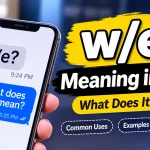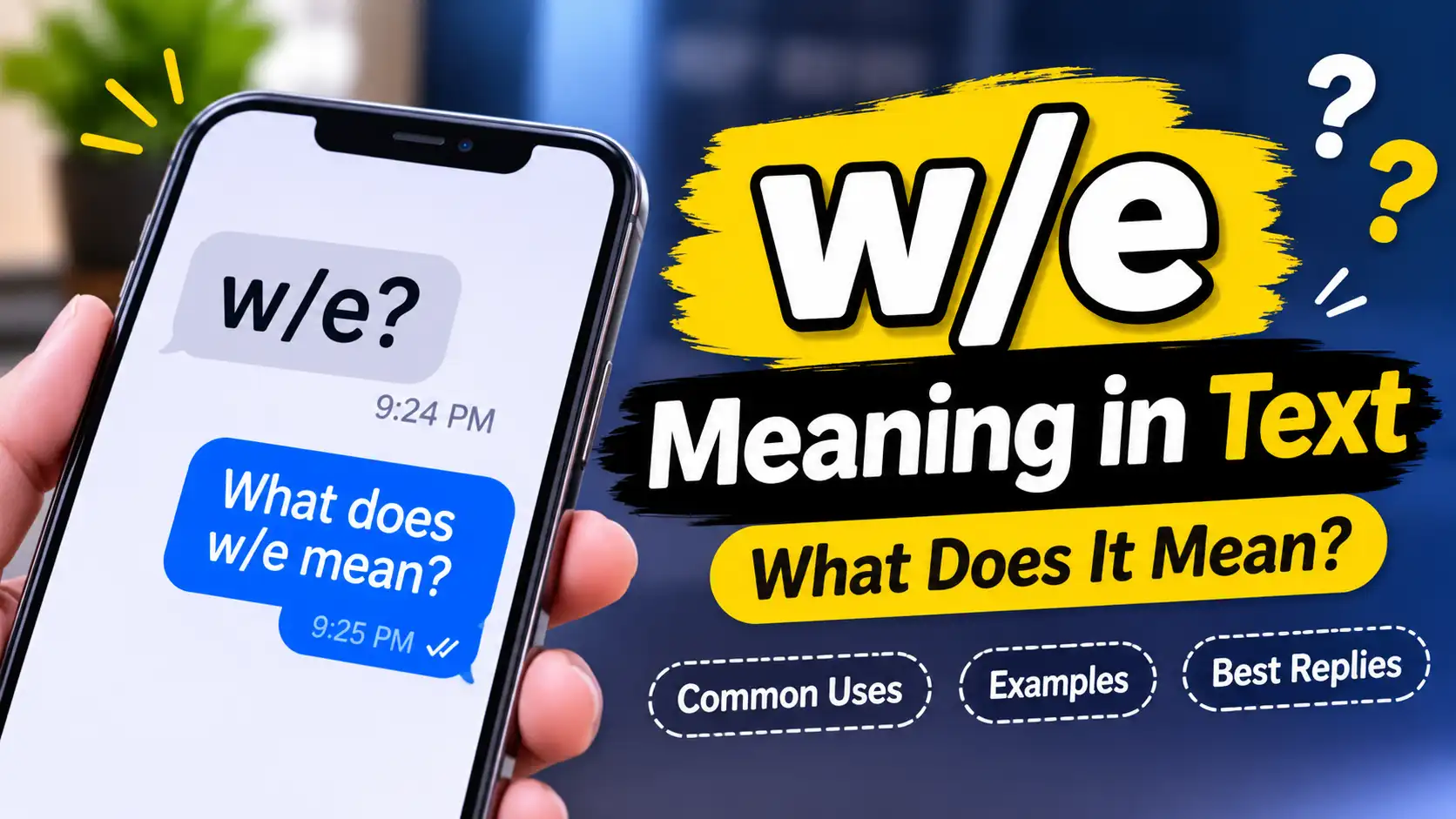
You get a text. It says, “w/e.”
You stop. What does that mean? Is the person mad? Bored? Just relaxed?
“W/e” is short for “whatever.” People use it in texts, chats, games, and posts. It is quick to type. It is also easy to misread.
You will see it in daily talk. A friend picks a movie. You say, “w/e is fine.” A teammate asks who goes first in a game. Someone types, “w/e.” It shows up on social media, in group chats, and sometimes at work.
Why does this matter? Because tone is hard in text. You cannot hear a voice. You cannot see a face. One small word can sound kind or cold.
In this post, you will learn what “w/e” means. You will see where it came from. You will get real examples. And you will know how to answer it with confidence.
Let’s start.
Definition & Meaning
What does “w/e” stand for?
“W/e” stands for “whatever.” That is the main meaning. The “w” is for the start of the word. The slash and the “e” stand in for the rest.
What does “whatever” mean in a text?
It can mean three things.
1. “I don’t mind.” You are easy. You have no strong pick.
Sam: Pizza or tacos? Lee: w/e, you choose.
2. “I don’t care.” You are bored or tired of the topic.
Mia: We have to clean the room today. Jo: w/e.
3. “I’m upset, but I won’t say it.” This one is sharp. It can end a conversation.
Ava: You forgot my birthday again. Ben: I said sorry. Ava: w/e.
How can you tell which one?
Look at the clues:
- Words around it. “w/e is fine” is warm. A lone “w/e.” is cold.
- Punctuation. A period often adds a hard edge.
- Emojis. A smile makes it soft. No emoji can feel flat.
- History. Think about how this person usually types.
Quick examples
- “w/e works for me” = I am happy with any choice.
- “w/e lol” = Not a big deal. Light mood.
- “w/e.” = I am done with this talk.
- “do w/e you want” = It is your call. (Sometimes said with a sigh.)
Key point: The word is small. The feeling behind it can be big.
Background & History
Where did “whatever” come from?
The word “whatever” is old. It grew from older English words that meant “anything at all.” People have used it for hundreds of years.
How did it get shorter?
In the late 1990s and early 2000s, many people used SMS text messages. Each message had a small size limit. Phones had tiny keys. Typing was slow. So people cut words short.
“Be right back” became “brb.” “Laugh out loud” became “lol.” And “whatever” became “w/e.”
The slash was a handy tool. It was already used in writing. “w/” meant “with.” “w/o” meant “without.” So “w/e” fit right in.
The attitude of “whatever”
In the 1990s, “whatever” also became a teen attitude word. People said it with a shrug or an eye roll. It meant, “I don’t care, and I don’t buy it.” Movies and TV helped spread that tone.
When the word moved to text, the tone came along.
How it changed over time
- Early texting: Used to save space.
- Chat apps and forums: Used to sound casual and fast.
- Social media: Used for humor, shrugs, and replies.
- Today: Phones have fast keyboards. We do not need to save space. But people still use “w/e” for speed and style.
Where it is common now
You will often see “w/e” in:
- Text messages
- Group chats
- Gaming chat
- Social media comments
- Short notes between friends
Some workplaces also use “w/e” in another way. It can mean “week ending.” For example, “Sales report w/e 3 Nov.” That is a fixed business use. Context tells you which one is meant.
Usage in Various Contexts
“W/e” changes shape in each place. Here is how.
In texting
Texting is the main home of “w/e.” It is quick. It is casual.
Dad: Where do you want to eat? Zoe: w/e is good. Surprise me.
Kai: Can you pick me up at 5 or 6? Nia: w/e works. Text me.
On social media
People use it to show a shrug. Or to end a debate.
User A: This show is so overrated. User B: w/e, I still love it.
It can also be playful. “Monday again. w/e. Coffee time.”
In gaming
Gamers type fast. Every second counts. “W/e” is common in match chat.
1st Player: Should we go left or right? 2nd Player: w/e, just move!
Player 3: You took my loot. Player 4: w/e lol, we won.
Be careful here. In a heated game, “w/e” can sound rude. It may start a fight.
In casual talk with friends
Friends know each other. They read the tone better.
Ella: I’ll be ten minutes late. Max: w/e, no rush.
In group chats
When many people decide, “w/e” can mean “I’m flexible.”
Group: Beach or park on Saturday? Rui: w/e is fine by me.
Key point: The same word can be kind in one chat and cold in another. Read the room.
Common Misconceptions & Clarifications
Misconception 1: “W/e always means anger.”
Not true. Many people use it to say, “I’m easy.” It can be friendly and calm.
Tom: Which seat do you want? Ana: w/e, you pick!
Misconception 2: “W/e always means ‘I don’t care about you.'”
Also not true. “I don’t care” often means “I don’t care which one.” It is about the choice, not the person.
Misconception 3: “W/e is rude.”
It can be rude. But it is not rude by default. Tone, timing, and who you are talking to all matter.
Other meanings
- Week ending. Used in business and finance.
- “Whenever.” Some people type “w/e” and mean “whenever,” like, “Come over w/e you want.” This is less common. Context makes it clear.
- “Whoever.” Rare, but it happens.
Can it be misread?
Yes. Often. This is the big problem.
Lena: Can we talk about last night? Cole: w/e.
Cole may be tired. Lena may think he is angry. Neither knows. That is how small fights start.
How to clear things up
If you are not sure, ask. Keep it kind.
- “Do you mean you’re okay with either one?”
- “Did that sound upset? I want to check.”
Key point: When in doubt, ask. Do not guess.
Similar Terms & Alternatives
Many words say the same thing. Here are some you may see.
Common alternatives
- “Whatever” – The full word. Clear and plain.
- “Idc” – “I don’t care.” Direct. Can sound cold.
- “Idk” – “I don’t know.” Not the same, but often near.
- “Np” – “No problem.” Warm and easy.
- “Fine” – Short. Can be calm or bitter.
- “Sure” – Agreeing, often with ease.
- “Meh” – Not excited. Flat.
- “Ok” / “K” – “K” alone can feel cold.
- “Anything works” – Kind and open.
Comparison table
| Term | Usual Meaning | Tone |
| w/e | Whatever | Casual, can be cold |
| idc | I don’t care | Blunt |
| np | No problem | Warm |
| meh | Not excited | Flat, light |
| k | Okay | Short, can seem cold |
| sure | Okay, yes | Calm, friendly |
| anything works | I’m flexible | Kind |
Which one should you use?
- Want to sound warm? Use “anything works” or “np.”
- Want to sound light? Use “w/e lol.”
- Want to sound clear? Type “I don’t mind.”
How to Respond to This Term
How you reply depends on what you think the sender means. Here are four styles.
1. Casual reply
Use this with friends when the mood is easy.
Friend: w/e is fine. You: Cool, pizza it is!
Friend: w/e you choose. You: Bet. I’m picking the best spot in town.
2. Funny reply
Add a little humor. This works when the mood is light.
Friend: w/e. You: Whatever? That’s my middle name. Okay, I’ll decide then.
Friend: w/e, you pick the movie. You: Bold move. Prepare for a cartoon night.
3. Professional reply
Use this at work or with people you don’t know well.
Coworker: w/e work for the meeting time. You: Thank you. I’ll set it for 2 p.m. and send an invite.
Keep it calm. Keep it clear. Do not copy the slang.
4. Privacy conscious reply
Sometimes “w/e” ends a talk that you want to keep going. But you may not want to share too much.
Person: w/e. You: I sense this may not be a good time. We can talk later if that’s okay.
This lets you step back without giving personal details.
5. Caring reply (when “w/e” feels upset)
Friend: w/e. You: Hey, are you okay? I’m here if you want to talk.
Key point: A kind question beats a sharp comeback every time.
Regional or Cultural Differences
Is “w/e” used worldwide?
It is most common in English speaking places. You will see it in the US, Canada, the UK, Australia, and more. Wherever people text in English, “w/e” can pop up.
Other languages
Many languages have their own short forms for “whatever.” They follow local texting habits. The slash style short form “w/e” is mostly English.
Here are some ideas of how the same feeling shows up elsewhere:
- Some people use the English “whatever” itself, even in other languages.
- Some use local words for “doesn’t matter” or “as you like.”
- Some use emojis, like a shrug.
Regional slang in English
- US: “Whatever” has a strong teen attitude history. “W/e” can sound sharp.
- UK: People may say “whatever” or “don’t mind.” The tone can be dry and light.
- Australia: Casual talk is common. “W/e” may sound relaxed.
These are broad patterns. Every person is different.
Cultural tone
In some cultures, being direct is normal. A short reply is fine. In others, a short reply can seem rude. Politeness rules change.
If you text with people from other cultures, add a bit of warmth. A smile or a “thanks” can help.
You: Is Friday okay for the call? Partner: w/e works. Thanks!
Age differences
Younger people tend to use “w/e” more. Older people may type “whatever” in full. Some older people may not know “w/e” at all.
Tip: If you text someone older, spell it out.
Comparison with Similar Terms
Let’s look closer. How is “w/e” different from other short replies?
W/e vs. idc
- w/e can mean “any choice is fine.”
- idc means “I don’t care.” It is sharper.
“w/e, you pick” = relaxed. “idc” = may sound cold.
W/e vs. k
- k is “okay” in its shortest form.
- w/e is “whatever.”
“K” ends a talk. “W/e” may give a shrug.
1st W/e vs. fine
- fine can be kind or angry.
- w/e leans more casual or dismissive.
W/e vs. np
- np means “no problem.” It is kind.
- w/e can be kind, but not always.
W/e vs. meh
- meh shows low interest.
- w/e shows low interest or easy agreement.
Summary list
- Most friendly: np, anything works
- Most neutral: sure, ok
- Most casual: w/e, meh
- Most blunt: idc, k
Usage in Online Communities & Dating Apps
Gaming communities
Gamers use “w/e” all the time. It is fast. It fits the pace of play.
Squad leader: Do we push or wait? Teammate: w/e, your call.
Some players use it to brush off mistakes. “W/e, next round.”
Tip: Do not use “w/e” when a teammate is upset. It can feel like you don’t care. Try, “My bad, let’s reset.”
Twitter (X) and other social platforms
People use “w/e” to end a point or shrug off hate.
“Some people hate this song. w/e. I’m playing it on repeat.”
It also shows up in replies. It keeps things short. Posts have limits, so brevity helps.
Dating apps (like Tinder)
On dating apps, “w/e” can make a big impression.
Match: Where should we meet? You: w/e works. You choose!
That reads as easy and open. But watch out:
Match: Do you want to meet this weekend? You: w/e.
That can read as no interest. It may end the chat.
Tips for dating apps
- Add warmth. “w/e works! Excited to meet you” is far better.
- Avoid it for big questions. If someone asks something important, use full words.
- Use emojis. A smile changes the whole feel.
- If you get “w/e,” ask a simple question: “Are you free this weekend, or is another time better?”
How to reply in these places
- Games: Keep it short and kind. “All good, let’s go.”
- Social media: Ignore or reply with humor if it’s friendly.
- Dating apps: Stay polite. If the person seems cold, you can step away.
Hidden or Offensive Meanings
Is “w/e” a bad word?
No. It is not a swear word. It is a short form of a normal word.
Can it be offensive?
It can be, depending on how it is used.
- It can say, “Your feelings don’t matter.”
- It can end a talk in a harsh way.
- It can seem to mock someone who is sharing something serious.
Friend: I got bad news about my job. You: w/e.
That would hurt. Do not do this.
Hidden meanings
- Passive aggressive. Someone may say “w/e” to show anger without saying it.
- Dismissal. Someone may use it to wave off your idea.
- Defense. Some people use it to protect themselves when they feel hurt.
Why tone and context matter
Words in text have no sound. So the reader fills in the tone. If the reader is already upset, they may hear anger.
Ask yourself:
- Who is sending it?
- What was the last thing said?
- Is there an emoji?
- How does this person usually text?
How to avoid harm
- Be clear. Say what you mean.
- Add a signal. A smile or “lol” can soften it.
- Do not use it for serious talks.
Key point: The word is neutral. Your tone makes it kind or cruel.
Suitability for Professional Communication
Is “w/e” okay at work?
Usually no. Most workplaces want clear, polite words. “W/e” can seem lazy, rude, or unclear.
Why avoid it?
- It may sound like you don’t care.
- It can confuse readers. (Does it mean “whatever” or “week ending”?)
- It may harm your image with bosses or clients.
When might it be okay?
- With close coworkers in a very casual chat.
- In internal notes where “w/e” means “week ending” and everyone knows it.
Even then, be careful. Spell out words in anything formal.
Professional alternatives
Instead of “w/e,” try:
- “I’m flexible. Either option works for me.”
- “I have no strong preference.”
- “I’m happy with whichever you choose.”
- “Either works. Please let me know.”
- “That’s fine with me.”
Examples
Casual (not for work):
Boss: Should we meet at 2 or 3? You: w/e.
Professional (better):
Boss: Should we meet at 2 or 3? You: Either time works for me. Which do you prefer?
Writing “week ending” at work
If you use “w/e” to mean “week ending,” write it clearly the first time: “Week ending (w/e) 3 November.” After that, “w/e” is fine.
Key point: At work, clear and kind wins.
FAQs
1. What does “w/e” mean in a text?
It means “whatever.” It can show that you are flexible, bored, or upset. Tone and context tell you which.
2. Is “w/e” rude?
Not always. It can be rude if it is used to brush someone off. It is fine when you use it to say, “Any choice is okay.”
3. What is the difference between “w/e” and “idc”?
“W/e” can mean “I’m easy.” “Idc” means “I don’t care” and sounds sharper.
4. Can “w/e” mean something else?
Yes. In business it can mean “week ending.” In rare cases, people type it for “whenever” or “whoever.”
5. Should I use “w/e” in an email?
No, not in a formal email. Use full words like “Either option works for me.”
6. How should I reply if someone texts me “w/e”?
First, read the mood. If it’s friendly, reply in kind. If it feels upset, ask, “Are you okay?” A caring question can fix a lot.
7. Is “w/e” okay on a dating app?
Sometimes. It is fine for small choices, like where to eat. For big questions, use full words and a warm tone so you don’t seem uninterested.
Conclusion
“W/e” is a small word with a big range. Its means “whatever.” It can say, “I’m easy.” It can say, “I’m bored.” Its can even say, “I’m hurt.”
Here are the key takeaways:
- It started as a texting shortcut and is still used for speed.
- Tone is everything. Read the words around it and the mood.
- It can be misread, so ask if you are unsure.
- Reply with care. Be casual, funny, or professional as needed.
- Avoid it at work and in serious talks.
- Use warmer words when you want to be clear and kind.

Asfan Wahab is a content creator and writer focused on text meanings, slang, abbreviations, acronyms, and internet expressions. Through Orvexale.com, he provides clear and simple explanations to help readers understand modern texting language. His goal is to make confusing terms easy to understand with practical examples and everyday context.