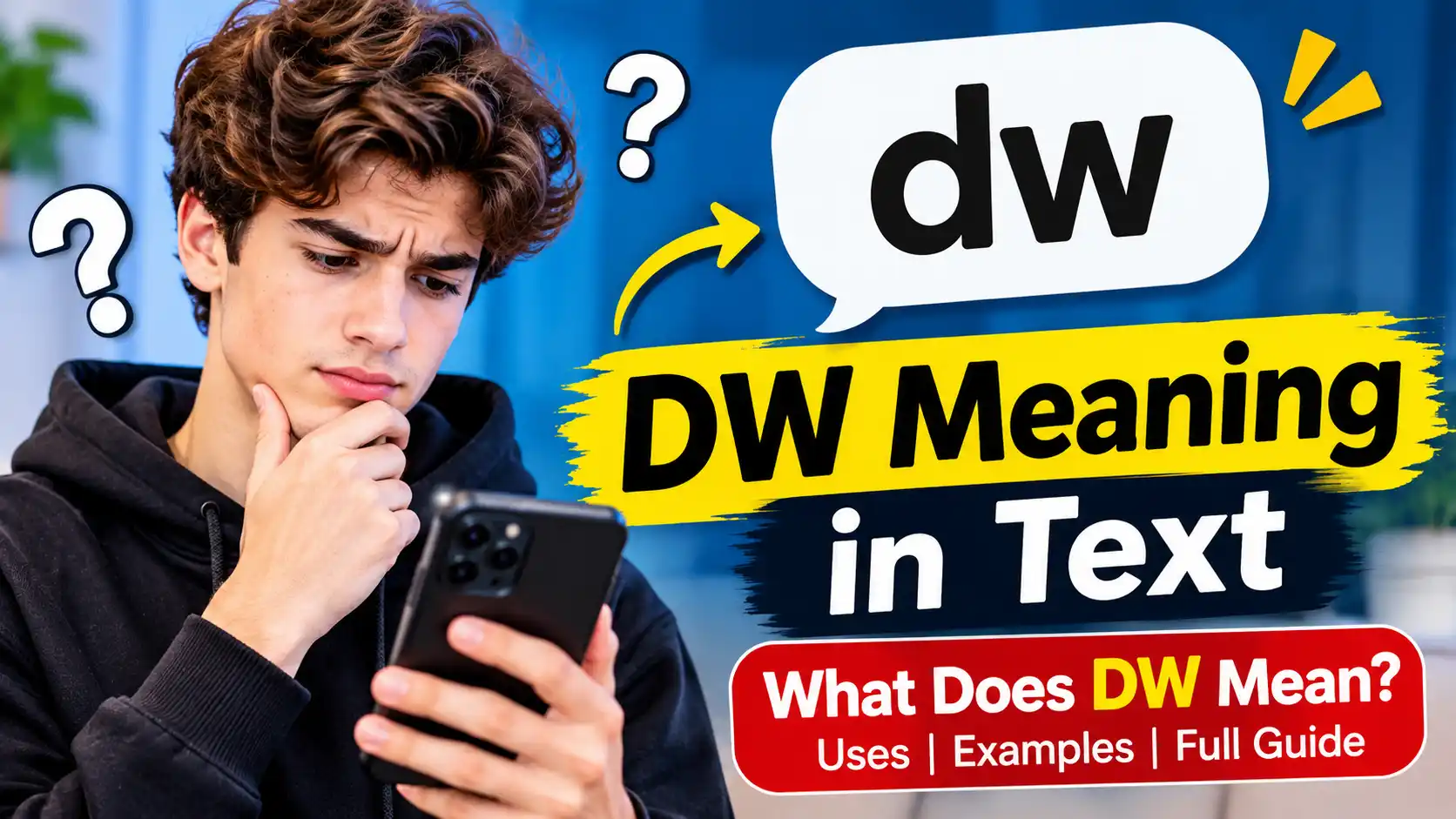
You get a text. It says, “dw.” Two letters. No more. What does it mean?
Most of the time, DW means “don’t worry.” That’s it. Simple. Friendly. Fast.
People use it every day. Friends use it in texts. Gamers type it in chat. Teens drop it in comments on TikTok and Instagram. Some people even use it in quick work messages.
Why does it matter? Because short slang can cause mix-ups. If you don’t know it, you may feel lost. Or you may reply the wrong way. Worse, you may think someone is upset when they are just being kind.
In this guide, you will learn what DW means. You will see where it came from. You will see how to use it, how to reply, and when to skip it. We will also cover other meanings, so you never get confused.
Let’s start.
Definition & Meaning
What Does DW Stand For?
DW stands for “don’t worry.”
People type it to calm someone down. It says, “It’s fine. No stress. I’ve got this.”
You will also see longer forms:
- DW about it = don’t worry about it
- DW abt it = don’t worry about it (even shorter)
- DWW = don’t worry, whatever (rare)
- DW bout it = don’t worry about it (casual)
Simple Examples
Example 1: Running late
Sam: Sorry, I’m 10 minutes late! Jo: dw, I just got here too.
Example 2: A small mistake
Mia: I forgot to bring your book. Lee: dw about it. Bring it Monday.
Example 3: Offering help
Ali: I can’t find my charger! Zed: dw, you can use mine.
Example 4: In gaming
Player 1: I died again. My bad. Player 2: dw, we’ll win the next round.
The Feeling Behind DW
DW is a soft phrase. It is kind. It tells the other person, “You’re okay.”
But tone matters. Say it with a smile emoji, and it feels warm. Say it with nothing else, and it can feel short or cold. We will talk more about that later.
Quick Facts
- Full form: Don’t worry
- Type: Text slang / abbreviation
- Tone: Friendly, calm, casual
- Best for: Texts, chats, social media, games
- Works in capitals? Yes. “DW” and “dw” mean the same thing.
Background & History
Where Did DW Come From?
Short forms are not new. People have always cut words short. Think of telegrams. Every word costs money. So people wrote less.
Then came SMS text messages. Early phones had tiny keypads. You had to press a key many times to type one letter. Each text also had a size limit. So people shrank phrases. “Be right back” became “BRB.” “Talk to you later” became “TTYL.” “Don’t worry” became “DW.”
Online Chat Rooms
In the late 1990s and 2000s, chat rooms and instant messengers grew fast. People typed quickly. They wanted to keep up with the flow. Short slang helped. DW fit right in.
Social Media and Gaming
Next came Facebook, Twitter (now X), Instagram, and Snapchat. Then mobile games and voice-and-text chat in team games. Speed mattered again. If you are in a match, you can’t write a long sentence. You type “dw” and move on.
How It Changed
At first, DW was mostly lowercase and plain. Today, people add style:
- dw 😊 (warm)
- dw fr (don’t worry, for real)
- dw abt it (casual and relaxed)
- dw I got u (I’ll handle it)
Where It’s Used Today
You will see DW mostly in:
- Private texts
- Group chats
- Comments on social posts
- Online games
- Casual workplace chats (like Slack), between close coworkers
It is not “new” slang. It has quietly stayed alive for years because it is so useful.
Usage in Various Contexts
DW changes a little depending on where you use it. Here is how it looks in real life.
1. Texting Friends and Family
This is the most common place. You use it to ease worry or say sorry is not needed.
Mom: Did you get home safe? You: Yep! dw 😊
Friend: I might miss your party. Sorry! You: dw, we’ll hang out another day.
2. Social Media
On Instagram, X, or TikTok, people use it in replies and DMs.
Fan: Did you see my message? Sorry to spam you. Creator: dw, I saw it. Thank you!
Or in a comment:
“Your video didn’t upload? dw, try again in a bit.”
3. Gaming
Gamers love short chat. DW is a team-spirit phrase.
Teammate: I messed up the last play. You: dw, shake it off.
Squad Leader: Low on health! You: dw, I’ll cover you.
4. Casual Conversations
Even in speech, some people say “D. W.” out loud. But it is rare. It lives mostly in writing.
Dan: I spilled coffee on your desk. Eva: dw, it’s just water-proof paper.
5. Work Chats
In relaxed offices, DW can appear in quick messages.
Teammate: I’ll be five minutes late to the call. You: dw, we’ll wait.
But be careful. We cover this more in the professional section.
Quick Tip
Match the mood. If the other person is upset, add a kind word or emoji. “dw, it’s okay” feels warmer than “dw” alone.
Common Misconceptions & Clarifications
Misconception 1: “DW is rude”
Not usually. DW is meant to comfort. But a bare “dw” with no emoji can feel short or cold, especially if someone is truly worried.
Example:
Anna: I think I failed the test. I’m so scared. Ben: dw.
That reply is too small. Anna wanted care. Better:
Ben: dw, you studied hard. It will be okay.
Misconception 2: “DW always means don’t worry”
Mostly yes. But not always. DW can mean other things depending on context. We will list those in a later section.
Misconception 3: “DW means the person doesn’t care”
Some people think “dw” means “I don’t want to deal with it.” That is not the usual meaning. It means “no problem.”
Still, tone is key. If a person has been annoyed before, “dw” could read as “forget it.” Look at the chat history.
Misconception 4: “DW is only for kids”
Adults use it too. Teachers, parents, and coworkers send it in quick notes. It is just not formal.
Misconception 5: “DW and DWI are the same”
They are not. DWI can mean “driving while intoxicated” in law. That has nothing to do with the text slang.
Can DW Be Misread?
Yes. Here are a few ways:
- Cold tone: “dw” alone after a big problem.
- Dismissive tone: “dw about it” when the other person does want to talk.
- Wrong meaning: If you are on a news site, DW may mean the broadcaster Deutsche Welle.
Is It Inappropriate?
No. DW is clean and safe. It has no rude meaning in normal use. The only risk is tone and context, not the word.
Similar Terms & Alternatives
Many phrases say the same thing as DW. Pick the one that fits your mood.
Common Alternatives
- NP = no problem
- NW = no worries
- NBD = no big deal
- IDC = I don’t care (careful, this is different!)
- ITS FINE = it’s fine
- JW = just wondering (not the same, but looks similar)
- NVM = never mind
- TW = trigger warning or “tell whoever” (different)
- YW = you’re welcome
Comparison Table
| Term | Full Form | Feels Like | Best Use |
| DW | Don’t worry | Calm, kind | Comforting someone |
| NP | No problem | Easy, friendly | After a favor or small error |
| NW | No worries | Relaxed | Light, casual moments |
| NBD | No big deal | Cool, casual | Small mistakes |
| NVM | Never mind | Can feel closed off | Dropping a topic |
| YW | You’re welcome | Polite | After “thanks” |
Examples
Kim: Thanks for the ride! Rae: yw!
Kim: Sorry I dropped your cup. Rae: np, it was cheap.
Kim: I’m so nervous about tomorrow. Rae: dw, you’ll do great.
A Helpful Rule
- Use DW to calm a worry.
- Use NP to say a favor was easy.
- Use YW to answer “thank you.”
They look close, but each has its own job.
How to Respond to This Term
When someone sends you “dw,” you don’t always need a long reply. A small, kind answer works best. Here are styles you can use.
1. Casual Replies
Use these with friends.
- “Thanks! 😊”
- “Okay, cool.”
- “Appreciate you.”
- “Phew, thanks!”
Friend: dw, I’ll cover the bill. You: You’re the best, thanks!
2. Funny Replies
Great when the mood is light.
- “Easy for you to say! 😂”
- “Too late, I already panicked.”
- “Worrying is my hobby.”
- “Okay, I’ll worry a little less.”
Friend: dw, it’s just a spider. You: Just a spider?! It’s the size of my hand! 😂
3. Professional Replies
Use these at work or with a boss.
- “Thank you, I appreciate it.”
- “Understood. Thank you for letting me know.”
- “Great, thanks for the update.”
- “That helps. Thank you.”
Manager: dw, we can move the deadline. You: Thank you. I appreciate the extra time.
4. Privacy-Conscious Replies
Sometimes “dw” comes from someone you don’t know well. Maybe a stranger online. You can stay safe and polite.
- “Okay, thanks.”
- “Got it.”
- “All good on my side.”
- “I’d rather not share more, but thanks.”
Stranger: dw, tell me where you live and I’ll help. You: No thanks. I’m all good.
5. Warm and Caring Replies
Use these when the topic is emotional.
- “That means a lot.”
- “I needed to hear that.”
- “Thank you for being kind.”
Quick Tip
Short is fine. A thumbs-up or simple “thanks” is often enough.
Regional or Cultural Differences
Is DW Used Everywhere?
DW is an English text shorthand. It is common in the US, UK, Canada, Australia, India, Pakistan, and anywhere English is used for texting. But how people use it can differ.
Region by Region
United States: People often say “don’t worry about it” or “no worries.” DW is common in casual texts and games.
United Kingdom: Brits often say “no worries,” “all good,” or “not to worry.” “DW” appears in texts, though “NP” and “no worries” are just as common.
Australia and New Zealand: “No worries” is a famous phrase there. You will often see “nw” or “no wories mate.” DW exists but is less iconic.
South Asia (India, Pakistan, Bangladesh): English and local languages mix. People may type “dw yaar” or “dw bhai.” Some also use phrases like “tension mat lo” or “fikar na karo” (don’t worry) in Hindi or Urdu.
Other languages:
| Language | Phrase | Meaning |
| Spanish | No te preocupes (ntp) | Don’t worry |
| French | T’inquiète | Don’t worry |
| German | Keine Sorge | No worry |
| Hindi/Urdu | Fikar mat karo | Don’t worry |
| Italian | Non ti preoccupare | Don’t worry |
Slang Variations
- dw fam (UK slang style)
- dw bro / dw bruh
- dw abt it
- dw I got u
- dw bestie (Gen Z)
Cultural Tone
In some cultures, people value being direct. Into others, softer language is preferred. In very polite cultures, a single “dw” may feel too short. Adding a kind phrase helps.
Friend: I’m sorry I missed your call. You: dw yaar, call me later.
Key Takeaway
DW is not a global word. It is English slang. But its idea, “don’t worry,” exists in every language.
Comparison with Similar Terms
Let’s compare DW with close cousins. They feel the same, but small details differ.
Side-by-Side Table
| Term | Meaning | Tone | Use When | Example |
| DW | Don’t worry | Soothing | Someone is anxious | “dw, I’ll fix it.” |
| NW | No worries | Laid-back | A small thing happened | “nw, all good.” |
| NP | No problem | Helpful | After a request or thanks | “np, happy to help.” |
| NBD | No big deal | Cool | A tiny mistake | “nbd, I have a spare.” |
| IDC | I don’t care | Cold | Showing no interest | “idc, you pick.” |
| JK | Just kidding | Playful | After a joke | “jk, I love it!” |
Key Differences
1st DW vs. NW
- DW comforts a worry. (“dw, you’ll pass.”)
- NW answers sorry. (“nw, it happens.”)
2nd DW vs. NP
- DW calms stress.
- NP says the favor was easy.
DW vs. NBD
- DW is warm.
- NBD is more “shrug.”
DW vs. IDC
These are very different! IDC can sound rude. DW does not.
Dialogue Example
Taylor: Sorry I’m late! Chris: nw.
Taylor: I’m scared I’ll fail. Chris: dw, you got this.
Taylor: Thanks for helping me. Chris: np!
See how each one fits its own moment?
Usage in Online Communities & Dating Apps
Gaming Communities
Gaming chats move fast. DW keeps the mood positive.
Player A: Sorry, I missed the shot. Player B: dw, next one.
In ranked games, kind words help the team stay calm. A quick “dw” can stop a fight.
Twitter / X
On X, people use DW in replies, mostly to support or reassure.
User 1: I think my post flopped lol. User 2: dw, the next one will pop off.
Reddit and Discord
In Discord servers and Reddit threads, DW is common when helping a newcomer.
Dating Apps (Tinder, Bumble, Hinge)
On dating apps, DW shows kindness and ease. It can also show a laid-back style.
Match: Sorry for the slow reply. Busy week! You: dw, no rush 🙂
Match: I’m nervous about meeting. You: dw, we’ll keep it simple. Coffee?
Tips for Responding Appropriately
- Read the mood. If the person seems worried, add warmth.
- Don’t overuse it. Too many “dw” messages can feel like a script.
- Add emojis. A small 🙂 or 😊 softens it.
- Stay safe. If someone uses “dw” to push you into something, such as sharing photos or meeting alone fast, pause. Real kindness does not rush you.
Red-Flag Example
Stranger: dw, just send me your number. Trust me. You: I’d rather not. Thanks.
Good Habit
If a “dw” feels pushy, trust your gut. You can say no, politely or firmly.
Hidden or Offensive Meanings
Is DW Offensive?
No. “Don’t worry” is a clean, kind phrase. It has no rude hidden meaning in normal use.
Other Meanings of DW
Because it is only two letters, DW can stand for other things. These are not rude, but they can confuse you.
- Deutsche Welle: A German international news broadcaster.
- Dynasty Warriors: A popular video game series.
- Dear Wife / Darling Wife: Used by some spouses in texts or posts.
- Dishwasher: Seen on appliances and in home lists.
- Dead Weight: Used in some fitness or business talk.
Context tells you which one it is. A sentence like “dw, I’ll be there” is “don’t worry.” But “watching DW news” is the broadcaster.
When Tone Changes Everything
The same two letters can feel very different.
Kind tone:
Sara: I’m sorry I forgot! Tom: dw 😊 it happens.
Cold tone:
Sara: We need to talk about what happened. Tom: dw.
In the second chat, Tom may look like he is brushing her off.
Passive-Aggressive Risk
Sometimes “dw” can be used with an edge:
“dw, I’ll do it myself.”
Here, “dw” is not comfortable. It is annoying. The words around it give the hint.
How to Avoid Mix-Ups
- Look at the full message. Don’t judge two letters alone.
- Check the chat history. Was the person upset before?
- Watch for emojis or punctuation. “dw!!” and “dw…” feel different.
- Ask. If unsure, say, “Are we okay?” That clears things fast.
Bottom Line
DW is safe and kind by default. Tone and context decide how it lands.
Suitability for Professional Communication
Is DW Okay at Work?
Usually not in formal settings. DW is slang. In emails to clients, bosses, or official reports, write the full words.
When It May Be Fine
- Quick chats on Slack or Teams with close teammates
- Friendly, casual workplaces
- Short replies to people you know well
Teammate: Sorry, I’ll send the file in 10 minutes. You: dw, no rush.
When to Avoid It
- Emails to clients
- Messages to senior leaders you don’t know well
- Job applications and interviews
- Formal letters, reports, or legal notes
Professional Alternatives
| Casual | Professional |
| dw | Please don’t worry. |
| dw about it | There’s no need to worry about it. |
| dw, I got this | I’ll take care of it. |
| dw, no rush | Please take your time. |
| nw | No problem at all. |
Examples
Too casual:
“dw, we’ll fix the bug soon.”
Better:
“Please don’t worry. Our team will fix the bug soon.”
Even better, with care:
“Thank you for letting us know. Our team is working on the bug and will update you shortly.”
Tips for Work Messages
- Know your audience. Casual team? Fine. Client? Write it out.
- Be clear. Short slang can hide meaning.
- Be warm. Professional does not mean cold.
- Follow the office style. Watch how others write and copy their level.
Quick Rule
If you would not say “yo” to the person, do not send “dw.”
FAQs
1. What does DW mean in text?
DW means “don’t worry.” People use it to say everything is okay.
2. Is DW the same as “no worries”?
Close, but not the same. DW calms a worry. “No worries” (NW) often replies to an apology. Both are friendly.
3. Can DW mean something else?
Yes. It can mean Deutsche Welle, Dynasty Warriors, or dear wife, depending on context. But in text chats, it almost always means “don’t worry.”
4. Is DW rude?
No. It is kind by design. But if you send it alone after a big problem, it may sound cold. Add a soft phrase or emoji to be safe.
5. Can I use DW in an email?
Not in formal emails. Use “Please don’t worry” or “There’s no need to worry.” Slang is best kept for friends and casual chats.
6. How do I reply to DW?
Keep it simple. Say “Thanks!” or “Appreciate it.” You can add humor or warmth if you like. At work, reply with “Thank you, I appreciate it.”
7. Is DW used in other languages?
DW itself is English slang. But other languages have similar phrases, like “ntp” in Spanish or “keine Sorge” in German.
Conclusion
DW means “don’t worry.” It is short, kind, and easy to use. People type it in texts, social posts, games, and dating chats to calm worries and show support.
It started as a simple shortcut in early texting and chat rooms. Today, it lives on because it is fast and friendly. Its not rude. It is not hidden. It is just a small phrase with a warm job.
Still, remember a few things. Tone matters. A bare “dw” can sound cold. Add a smile or a kind word. Context matters. DW can mean other things, like Deutsche Welle. And the audience matters. Skip it in formal emails, and use “please don’t worry” instead.

Asfan Wahab is a content creator and writer focused on text meanings, slang, abbreviations, acronyms, and internet expressions. Through Orvexale.com, he provides clear and simple explanations to help readers understand modern texting language. His goal is to make confusing terms easy to understand with practical examples and everyday context.