You send a message. Your friend writes back one word: “huh?”
What did you do wrong? Did they not hear you? Are they upset? Are they just confused?
Relax. “Huh” is one of the most common words in texting. It is short, simple, and used by almost everyone. It usually means “I don’t get it” or “Say that again.”
You will see “huh” in texts, social media comments, game chats, and dating apps. It even shows up in work messages.
Here is the tricky part. “Huh” can mean many things. It can show confusion, surprise, doubt, or even annoyance. The tone changes with the setting.
Knowing the difference helps you avoid fights and mix ups. In this guide, you will learn what “huh” means, how to use it, and how to reply. Let’s get started.
Definition & Meaning
What does “huh” mean?
“Huh” is a sound word. Grammar fans call it an interjection. It is a short word that shows a feeling or a reaction.
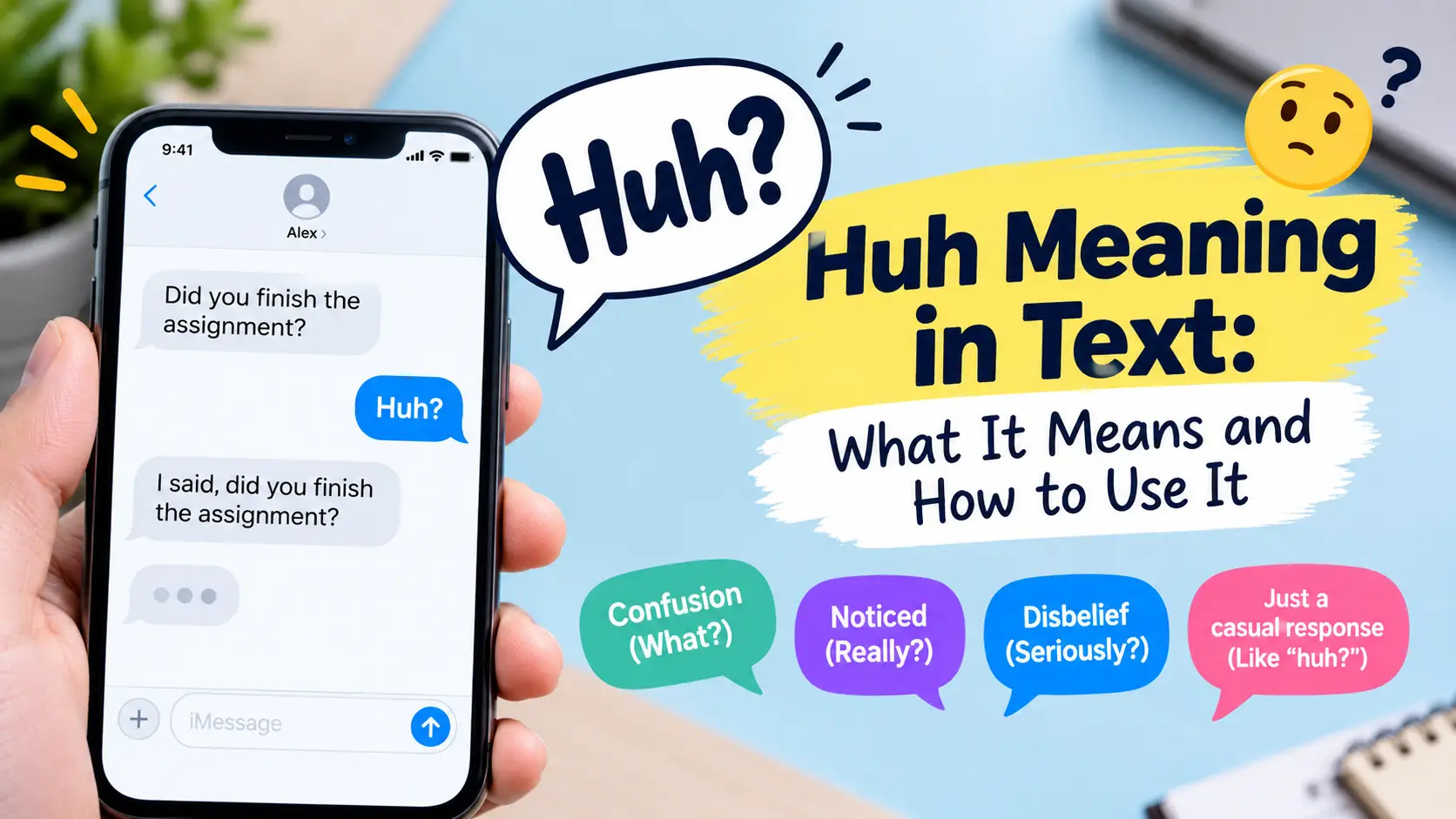
In text, “huh” has four main meanings.
1. “I don’t understand.”
Mia: The meeting moved to the blue room.
Zoe: Huh? Which blue room?
2. “I didn’t catch that. Please repeat.”
Sam: Pick up milk on your way home.
Leo: Huh? Say that again.
3. Surprise or mild shock
Ana: I just got a puppy.
Ben: Huh. I didn’t know you wanted one.
4. Checking for agreement
When it comes at the end of a sentence, “huh” asks for a reply.
Kai: Nice day, huh?
Eli: Yes, it is perfect.
Spelling changes the feeling
- Huh? A plain question. Mild confusion.
- Huh. A flat, thoughtful reaction. The person is thinking.
- Huh! A surprised or excited reaction.
- Huhhh A long, tired, or whiny feeling.
- HUH?! Strong shock or disbelief.
Quick summary
Key point: “Huh” means “What?” or “I’m confused.” Watch the punctuation and the message before it to know what the person feels.
Background & History
Where does “huh” come from?
“Huh” is far older than texting. It is a natural sound that people say when they do not understand something. We use it in speech almost without thinking.
A word found around the world
Here is something cool. Researchers once studied 31 languages from all over the world. They found that many of them have a word like “huh.” It is short. It rises in tone, like a question. And people use it the same way: to ask for a fix when they did not catch something.
That makes “huh” one of the most universal words on Earth.
How did it reach texting?
When people began to chat online, they had a problem. Text has no voice. You cannot raise your eyebrows or tilt your head. So people typed their sounds.
- “Haha!” showed laughter.
- “Hmm” showed thinking.
- “Huh” showed confusion.
How has it changed?
Over time, a few things happened.
- It made me feel good. “Huh” can now show doubt, shock, or annoyance.
- Punctuation took over. A period, question mark, or exclamation point now changes the whole meaning.
- Memes helped. Reaction images with a confused face often come with the word “huh.”
- Emojis joined in. You may see “huh 🤔” or “huh 😕.”
Where is it used today?
- Texts between friends and family
- Comments on posts and videos
- Group chats
- Game chats
- Dating apps
- Casual work messages
Key point: “Huh” is an old human sound that moved online. It is simple, quick, and understood almost everywhere.
Usage in Various Contexts
“Huh” fits many situations. Here is how it works in each one.
Texting
In texts, “huh” is a quick way to say “I’m lost.”
Nina: Meet me at the usual place at the usual time.
Tom: Huh? Which place?
Social media
In comments, “huh” can show confusion about a post.
Post: Just bought a boat. Don’t ask why.
Comment: Huh? You live in the desert.
It can also show a surprised reaction.
Post: Pineapple on pizza is the best food ever.
Comment: Huh. Okay, that’s a bold take.
Gaming
Gamers use “huh” when something strange happens in the game.
Player 1: The boss just disappeared.
Player 2: Huh? Did it glitch?
Or when a plan is unclear:
Player 1: Go left, then right, then left.
Player 2: Huh? Slow down.
Casual conversations
In chats with friends, “huh” can end a sentence to ask for agreement.
Jade: That movie was long, huh?
Rae: Yes. I almost fell asleep.
When something is weird
Eve: Our teacher wore a clown nose today.
Max: Huh. Why?
When you did not hear well
Lily: I’ll be there at six.
Dan: Huh? Six or sixteen? Typo?
Lily: Six! Sorry.
When you are thinking
Pat: I think the answer is 42.
Kim: Huh. That actually makes sense.
Key point: “Huh” fits almost any moment of confusion, surprise, or thought. Add a few extra words to make your meaning clear.
Common Misconceptions & Clarifications
Mistake 1: “Huh always means confusion”
Not always. It can also show surprise, doubt, interest, or annoyance. The message before it is your best clue.
Mistake 2: “Huh is rude”
Not by itself. “Huh?” is a normal question. But it can feel cold if you use it with no extra words. A short “Huh?” after a long, careful message may seem like you did not read it.
Example:
Ana: I worked all night on this plan. Here is the full outline, with five steps and a budget.
Ben: Huh?
Ana may feel brushed off. Ben would do better with “Sorry, I’m lost on step three. Can you explain?”
Mistake 3: “Huh and hmm are the same”
They are close, but not the same.
- Huh shows confusion or surprise.
- Hmm shows thinking or doubt.
Mistake 4: “A period changes nothing”
It changes a lot.
- “Huh?” means “What did you say?”
- “Huh.” means “Interesting. I’m thinking.”
Mistake 5: “Huh is a sign of low intelligence”
No. Smart people say “huh” all the time. It is a normal way to ask for a repeat. In fact, saying “huh” shows you want to understand clearly.
Is “huh” ever inappropriate?
Rarely. But it can be:
- Dismissive when used with a sharp tone
- Sarcastic when used to mock someone
- Too casual in very formal messages
Key point: “Huh” is a safe word. Just be careful of cold or sarcastic tone.
Similar Terms & Alternatives
You do not always need “huh.” Here are other ways to say the same thing.
Quick list
- What? The direct version
- Wait, what? Confusion with shock
- Sorry? A polite way to ask for a repeat
- Pardon? A formal way to ask for a repeat
- Come again? A casual way to ask for a repeat
- Say that again? Clear and simple
- I don’t get it. A direct admission
- Hm? A soft, curious version
- Eh? A casual, sometimes older style
- 🤔 or 😕: Emojis that show confusion
Comparison table
| Term | Feeling | Best For |
| Huh? | Confused, casual | Friends and quick chats |
| What? | Direct, may be sharp | Casual talk |
| Wait, what? | Shocked confusion | Big surprises |
| Sorry? | Polite | Mixed or work settings |
| Pardon? | Very polite | Formal settings |
| Come again? | Friendly, relaxed | Casual chats |
| I don’t get it | Honest | Any setting |
Which one should you pick?
- Want to be quick and casual? Use huh.
- Want to be polite? Sorry? or pardon?
- Want to be clear? Use “I don’t get it. Can you explain?”
- Want to show shock? Use “wait, what?”
Key point: All of these ask for help or show surprise. Pick the one that fits the person and place.
How to Respond to This Term
Someone sent you “huh?” What do you say? It depends on the mood. Here are four styles.
1. Casual
Keep it light. Repeat or explain.
Friend: Huh? What time is the party?
You: Eight tonight. At my place.
More casual replies:
- “I said we’re meeting at eight.”
- “Sorry, typo! I meant eight.”
- “Let me say it better.”
2. Funny
Add a little humor.
Friend: Huh? A llama is coming to the party?
You: Yes. He’s bringing snacks.
Friend: Finally, a guest with good manners.
3. Professional
If a coworker writes “huh?” and you want to stay polished, be clear and kind.
Coworker: Huh? Which file do you mean?
You: Sorry for the confusion. I meant the Q3 report. I will resend it now.
4. Privacy conscious
Maybe you do not want to explain. That is okay.
Acquaintance: Huh? Why are you leaving early?
You: Just a personal thing. See you tomorrow!
You stay friendly, but you keep your details to yourself.
If “huh” was a surprised reaction
Friend: Huh. You got a new job?
You: Yes! I start next week.
If “huh” felt rude
Stay calm. Ask.
You: Did my message make sense? Happy to explain.
If you feel unsure
You: Is that a confused “huh” or a surprised “huh”? 😄
Friend: Confused! Sorry.
Key point: Read the mood first. Explain if they are lost. Smile if they are surprised.
Regional or Cultural Differences
Is “huh” used worldwide?
Almost! This is one of the few words that is close to universal. As we saw, studies found similar sounds in many languages. That is rare for any word.
How do other languages say it?
- Spanish: “¿Eh?” or “¿Cómo?”
- French: “Hein?” or “Quoi?”
- German: “Hä?” or “Wie bitte?”
- Dutch: “Hè?”
- Japanese: “Eh?” or “Hā?”
- Urdu and Hindi chats: “Kya?” (meaning “what?”) or just “huh?” in English
Notice how many of them sound like “huh” or “eh.”
Small differences in English
- In the US, “huh?” is common in speech and text.
- In the UK, you may also hear “eh?” or “pardon?”
- In Canada, “eh?” can end a sentence as a friendly check, much like “huh.”
- In South Asia, people often mix “huh?” with local words like “kya?”
Cultural tone
In some cultures, a short “huh?” is just normal. In others, it may sound blunt or impolite, especially to older people or those you do not know well. Many people prefer “Sorry?” or “Could you repeat that?” in those cases.
Key point: “Huh” is nearly universal, but politeness rules differ. When in doubt, add a kind word.
Comparison with Similar Terms
Let’s compare “huh” with some close cousins. Small details matter.
Huh vs What
- “What?” is more direct and can sound sharp.
- “Huh?” is softer and more casual.
Example:
A: I’m leaving at noon.
B: What? (may sound upset)
B: Huh? (may sound confused)
Huh vs Hmm
- “Huh” shows confusion or surprise.
- “Hmm” shows thinking or doubt.
Example:
A: I think we should skip lunch.
B: Huh? (Why?)
B: Hmm. (Let me think.)
1st Huh vs Eh
- “Eh” is relaxed and a bit old school.
- It can also mean “so so,” as in “Eh, it was okay.”
- “Huh” more clearly asks for a repeat.
Huh vs Sorry?
- “Sorry?” is polite.
- “Huh?” is casual.
- Use “Sorry?” with teachers, bosses, and new people.
Huh vs Wait, what?
- “Wait, what?” shows stronger shock.
- “Huh?” shows lighter confusion.
Comparison table
| Feature | Huh | What | Hmm | Sorry? | Wait, what? |
| Main feeling | Confusion | Direct question | Thinking | Polite repeat | Shock |
| Tone | Casual | Can be sharp | Calm | Polite | Strong |
| Best for | Friends | Friends | Any chat | Work and new people | Big surprises |
| Risk of rudeness | Low | Medium | Very low | Very low | Low |
Key point: “Huh” sits in the middle: casual, soft, and flexible.
Usage in Online Communities & Dating Apps
On Twitter / X
People use “huh” to react to odd posts and bold opinions.
User 1: Cereal is a soup.
User 2: Huh. I never thought of that.
It may also show disbelief.
User 1: Breakfast is the worst meal of the day.
User 2: Huh?? Who hurt you?
On Instagram and Facebook
Under the posts, “huh?” can ask for context.
Photo: Me, my dog, and a very large pumpkin.
Comment: Huh? Where did you find that pumpkin?
In gaming communities
Gamers use it often during fast action.
Player A: The map just changed.
Player B: Huh? Is that a new update?
Tip: In games, be clear and kind. A sharp “HUH?!” a teammate can start a fight.
On dating apps like Tinder
On dating apps, “huh” has a few uses.
1. Real confusion
Match: I’m a professional bubble tea taster.
You: Huh? That’s a real job?
Match: It is now. 😄
2. Playful surprise
Match: I once rode a camel to work.
You: Huh. Okay, you win. Tell me more.
3. Awkward or cold tone
Match: I love hiking and cooking.
You: Huh.
That last reply may feel flat and kill the chat.
Tips for responding on dating apps
- Add more words. “Huh, that’s interesting. How did you start?” works much better than “huh.”
- Don’t use it alone. A lone “huh” can feel like you do not care.
- Show interest. Ask a follow up question.
- Read the mood. Playful matches can handle playful “huh.”
- Explain yourself. If someone says “huh?” to you, clarify kindly.
Tips for online communities in general
- Read the room. Each community has its own style.
- Be clear. If your post confuses people, explain it.
- Stay kind. Do not use “huh” to mock newcomers.
Key point: Online, “huh” helps you ask or react quickly. Add words, and your message feels warmer.
Hidden or Offensive Meanings
Is “huh” offensive?
No. “Huh” has no swear words and no secret slur. It does not target any group or person. It is one of the safest words in texting.
The real risk: tone
The only problem is tone. A short word can seem cold or rude.
Case 1: Friendly
Ben: I made a surprise cake for you.
Cal: Huh! Really? That’s so nice.
Cal is surprised and happy.
Case 2: Cold
Ben: I made a surprise cake for you.
Cal: Huh.
Now Cal may seem uninterested or even annoyed. The same word feels very different.
Dismissive “huh”
Sometimes “huh?” can mean “I don’t believe you” or “That’s silly.”
Example:
Ana: I think we should try a new plan.
Ben: Huh?? Why would we do that?
Ben might be just curious. But Ana may feel challenged.
Does it have hidden meanings?
No widely known secret meanings exist. Some friend groups may use “huh” as an inside joke, but that is rare.
Why tone and context matter
Text has no voice. So your reader fills in the tone. A short “huh” can look sharp, bored, or rude if the mood is serious.
How to stay safe
- Add a few words. “Huh? I’m not sure I follow.”
- Use emojis to show your real feeling.
- Match the mood. Do not use a flat “huh” after bad news.
- If someone looks hurt, explain and say sorry.
Key point: “Huh” is a clean, simple word. Tone is the only thing that can make it sting.
Suitability for Professional Communication
Is “huh” okay at work?
In casual chats, often yes. In formal messages, no.
“Huh” is not rude. But it is very casual. It can look unpolished in emails or messages to clients, bosses, or teachers.
When it is fine
- A chat with close coworkers
- A quick team message in a relaxed workplace
- A voice call or meeting (spoken “huh” is normal)
Example:
Teammate: The file name changed to “Final v3 FINAL.”
You: Huh. Okay, I’ll look for it.
When to avoid it
- Formal emails
- Messages to clients or senior leaders
- Serious topics, like complaints or mistakes
- When you are new and unsure of the culture
Professional alternatives
Try these instead:
- “I’m sorry, could you clarify?”
- “Could you repeat that, please?”
- “I’m not sure I follow. Can you explain?”
- “Pardon me, which file do you mean?”
- “That’s interesting. Could you tell me more?”
Examples in dialogue
Casual (okay with close coworkers):
Coworker: We’re moving the call to Friday.
You: Huh? I thought it was Thursday.
Professional (safer):
Coworker: We’re moving the call to Friday.
You: Thanks for the update. I thought it was Thursday. Could you confirm the new time?
See the difference? The second reply is clear, calm, and polite.
Quick rules for work chats
- Follow your team’s style.
- Use full sentences for serious topics.
- Be kind with your tone.
- When unsure, ask clearly.
Key point: At work, clear and polite beats short and casual.
FAQs
1. What does “huh” mean in text?
“Huh” means “What?” or “I’m confused.” It can also show surprise, doubt, or interest.
2. Is “huh” rude?
Not by itself. But a short, flat “huh” can feel cold. Add a few kind words to soften it.
3. What is the difference between “huh?” and “huh.”?
“Huh?” asks for a repeat or shows confusion. “Huh.” (with a period) often means the person is thinking or mildly surprised.
4. Can I use “huh” at work?
It is fine in casual chats with friendly coworkers. For formal messages, use “Could you clarify?” or “Pardon?”
5. How do I reply to “huh?”
Explain what you meant, or say it again in simpler words. If the “huh” shows surprise, share more details or smile.
6. Is “huh” used in other languages?
Yes! Researchers found similar sounds in many languages around the world. Spanish uses “¿eh?” and German uses “hä?”
7. What can I use instead of “huh”?
Try “what?”, “sorry?”, “pardon?”, “come again?”, or “I don’t get it.” Pick the one that fits your setting.
Conclusion
“Huh” is a tiny word with a big job. It helps people ask, react, and think in just three letters.
Here are the key points to remember:
- “Huh” means confusion, surprise, or “say that again.”
- Punctuation changes the meaning. “Huh?” and “huh.” feel different.
- It is nearly universal. Many languages have a similar sound.
- Tone is key. A flat “huh” can seem cold, so add a few kind words.
- It is fine in casual chats, but use polite phrases at work.
- You have options. “Sorry?”, “pardon?”, and “come again?” all work too.

Noman Hassan is a content creator and writer focused on text meanings, slang, abbreviations, acronyms, and internet expressions. Through Orvexale.com, he provides clear and simple explanations to help readers understand modern texting language. His goal is to make confusing terms easy to understand with practical examples and everyday context.