You get a text. It says “DPWM.” You stare at it. Is your friend joking? Is someone upset? Did you do something wrong?
Don’t worry. You are not alone. Short slang pops up every day. It shows up in texts, comments, DMs, game chats, and even dating apps.
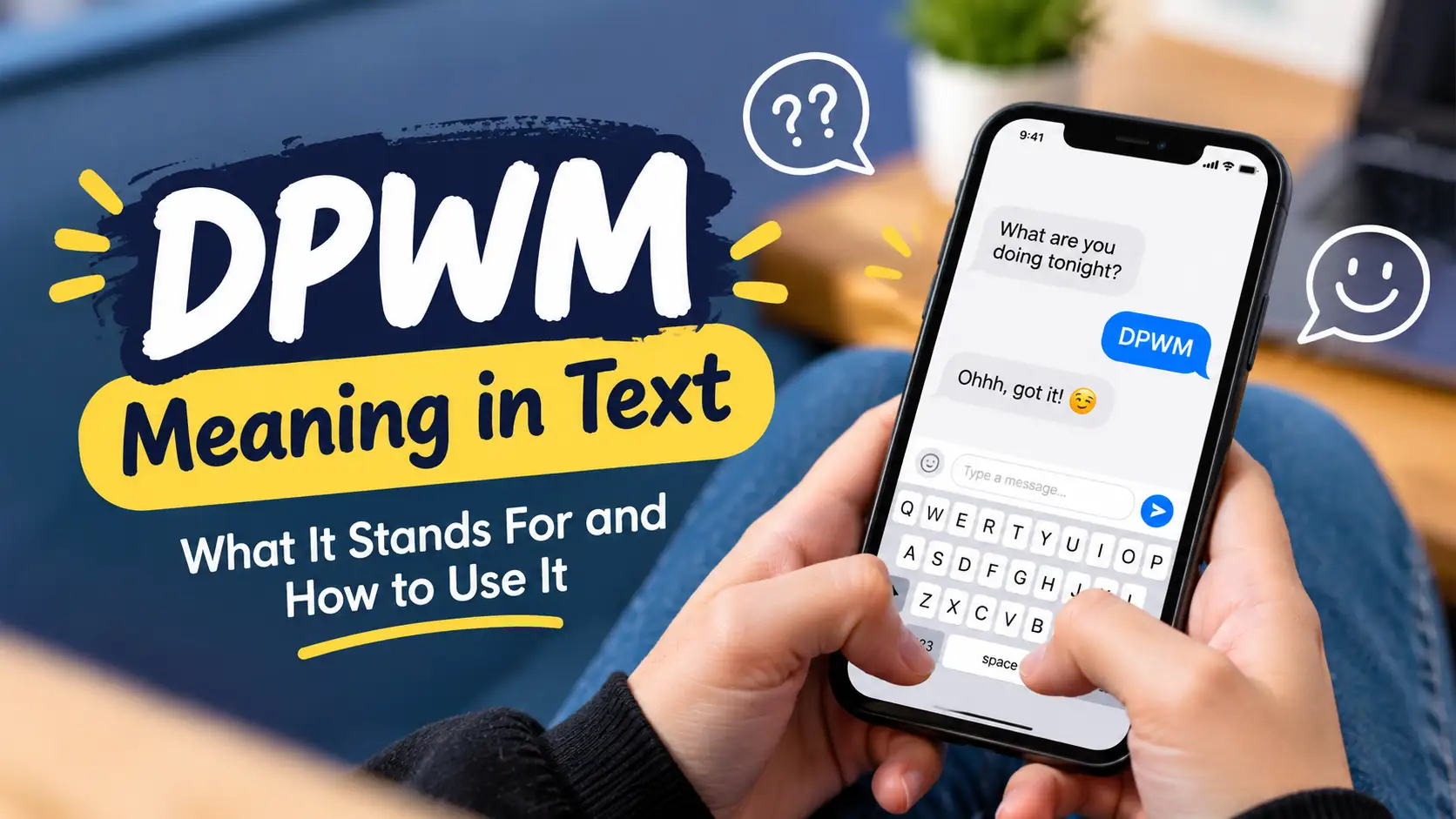
DPWM stands for “Don’t Play With Me.” It is a quick way to say, “Be serious,” or “Stop messing around.”
Why does this matter? Because tone is everything in text. You can’t hear a voice. You can’t see a face. One small slang word can sound funny or angry. If you guess wrong, you may start a fight or miss a joke.
This guide breaks it down in plain words. You will learn what DPWM means, where it came from, how to reply, and when to avoid it. By the end, you will read DPWM like a pro.
Definition & Meaning
DPWM = Don’t Play With Me.
Each letter stands for one word:
- D = Don’t
- P = Play
- W = With
- M = Me
That is the whole code. Simple.
But the meaning goes deeper than four words. When someone sends DPWM, they usually want one of these things:
- Stop joking. They want you to be serious.
- Don’t test me. They are setting a limit.
- I can’t believe it. They are shocked and want proof.
- I’m confident. They are showing off in a fun way.
So the same four letters can be a warning, a boundary, or a joke. Context decides.
Example 1: Serious
Sam: I didn’t take your charger. Ha ha.
Alex: I saw it in your bag. DPWM.
Alex is annoyed. Alex wants the truth.
Example 2: Shocked
Mia: I got the job!
Lena: DPWM 😭 Are you serious?
Lena is not angry. She is happy and amazed.
Example 3: Playful
Jay: Want to race me on the game?
Chris: DPWM, I never lose 😎
Chris is just bragging. It is a friendly dare.
Notice the emojis. A crying face or a cool face changes the mood. Always read the whole message, not just the slang.
Background & History
DPWM is a short form, also called an initialism. People make these to type faster. We have used them for years. LOL, BRB, and OMG are older examples.
The phrase “don’t play with me” is much older than texting. People have said it out loud for a long time. It means “don’t joke with me” or “don’t mess with me.” You hear it in songs, movies, and everyday talk. A parent might say it. A friend might say it. A coach might say it.
The short form DPWM came later. Online slang records show it was in use by at least 2018, though it was probably used earlier in private chats. Slang often lives in chats long before it appears in a dictionary.
Why did it spread? Three reasons:
- Speed. Four letters beat four words.
- Emotion. It packs a strong feeling into a tiny space.
- Social media. TikTok, Snapchat, Instagram, and WhatsApp help slang travel fast.
Over time, the tone changed a bit. At first, it was mostly a warning. Today it is also a joke, a reaction, and a way to show confidence. Many people now use it in memes and comment sections.
Today you will see it most in:
- Private texts between friends
- Comments and replies on social posts
- Group chats
- Casual gaming chats
You won’t see it in business emails. We’ll cover that later.
One more fact: DPWM is not an official word. No rulebook defines it. Its meaning comes from how people use it. That is why it can shift from group to group.
Usage in Various Contexts
Let’s look at where DPWM shows up and how it sounds in each place.
Texting
In texts, DPWM works as a quick warning or reaction.
Dana: Did you really eat my last slice?
Ben: Maybe.
Dana: DPWM. That was mine.
Social Media
On social apps, people use it in captions and comments. It can be funny or bold.
Comment: This singer just dropped a new song.
Reply: DPWM, I’ve been waiting all year! 🔥
Here, it means “No way, for real?”
Gaming
Gamers use it to show focus or to tease.
Player 1: Want to run a casual match?
Player 2: DPWM. I’m here to win.
It tells the other player, “I’m serious about this.”
Casual Conversation
With close friends, it can be pure humor.
Tom: I think I could beat you at chess.
Ria: DPWM 😂 I’ve played for ten years.
Emotional Chats
In a serious talk, DPWM can feel heavy.
Kim: I’m sorry, I was only kidding about the trip.
Pat: Well, DPWM. I already bought the tickets.
Pat is upset. No emoji, no laughing.
Quick tip: If there is a laughing emoji, it’s probably light. If it’s in all caps with no emoji, it may be serious. Ask if you are unsure.
Common Misconceptions & Clarifications
Slang causes mix ups. Let’s clear up the big ones.
Misconception 1: “DPWM always means someone is angry.”
Not true. Many people use it as a joke or a happy shock. A friend who types “DPWM 😭” after great news is not mad.
Misconception 2: “DPWM is a threat.”
Usually not. It sets a limit or asks for honesty. Still, in an argument, it can sound sharp. If someone says it during a fight, take it seriously. Don’t brush it off.
Misconception 3: “DPWM has one fixed meaning.”
Mostly, it means “Don’t Play With Me.” But it also appears in engineering. There, DPWM can mean Digital Pulse Width Modulation, a way of controlling power in electronic devices. If you see it in a tech manual or a circuit forum, it has nothing to do with texting.
Technical example:
Engineer 1: Which controller are you using for the power supply?
Engineer 2: One with a DPWM module.
No one is warning anyone here. It’s electronics.
Misconception 4: “It’s rude.”
It depends. Between friends, it’s fine. With a boss or a stranger, it may sound pushy.
How to avoid confusion:
- Look at who sent it.
- Look at where you are (text, work email, tech forum).
- Look at the emojis and punctuation.
- When in doubt, ask: “Do you mean you’re serious, or joking?”
A quick question beats a big misunderstanding.
Similar Terms & Alternatives
DPWM is not the only way to say it. Here are other phrases people use.
- No cap: I’m telling the truth.
- FR (for real): I’m being honest.
- Stop playing: Quit joking around.
- Don’t test me: Don’t push my limits.
- Not funny: That joke didn’t land.
- I’m serious: I mean it.
- Be real: Tell the truth.
- SMH: Shaking my head (disappointed).
| Term | Meaning | Tone |
| DPWM | Don’t Play With Me | Serious, shocked, or playful |
| No cap | No lie | Honest, casual |
| FR | For real | Friendly, direct |
| Stop playing | Quit joking | Mild to strong |
| Don’t test me | Don’t push me | Firm, warning |
| SMH | Shaking my head | Disappointed |
Which one should you pick?
- Want to sound light? Try FR or no cap.
- Want to sound firm? Try Don’t test me or I’m serious.
- Want to sound dramatic and fun? DPWM fits well.
Example:
Zoe: I think I’ll skip your party.
Max: FR? Please come.
Zoe: Just kidding, I’ll be there.
Same idea, softer tone than DPWM.
How to Respond to This Term
Got a DPWM text? Here’s how to reply based on your style.
Casual Replies
Keep it easy and friendly.
- “Okay, okay, I hear you.”
- “Got it. No games.”
- “Alright, I’m listening.”
Funny Replies
If the mood is light, joke back.
- “Who, me? I would never 😇”
- “Playing? I don’t even know the rules.”
- “DPWM? I’m shaking 😂”
Serious Replies
If the person sounds upset, be calm and honest.
- “I’m sorry. I’ll be straight with you.”
- “You’re right. Let’s talk about it.”
- “I didn’t mean to upset you. What’s wrong?”
Example:
Nina: DPWM. You said you’d call.
Omar: You’re right. I forgot, and I’m sorry. Can I call you now?
Professional Replies
If a coworker uses it (rare), stay polite.
- “Understood. I’ll take this seriously.”
- “Thanks for letting me know. I’ll follow up today.”
Privacy Conscious Replies
If someone uses DPWM to pressure you for personal info, you can say no.
- “I’m not comfortable sharing that.”
- “I’d rather not discuss this.”
- “Let’s change the subject.”
Example:
Stranger: DPWM, send me your address.
You: No. I don’t share that. Goodbye.
You never owe private details to anyone. If a message feels scary or pushy, block the person and tell a trusted adult or friend.
Regional or Cultural Differences
DPWM is an English abbreviation. It works best among English speakers. In other languages, people use their own short forms.
Still, the idea is global. Every culture has a way to say “Stop joking.”
Where DPWM is used:
- United States and Canada: Common among teens and young adults.
- United Kingdom and Ireland: Understood, but local slang often wins.
- South Asia, including Pakistan and India: Many young people text in English, so it travels easily, often mixed with local words.
- Africa and the Caribbean: English slang spreads fast online, and DPWM can blend with local phrases.
Mixing languages:
Many people text in two languages at once.
Sara: DPWM, sach batao. (Tell me the truth.)
Ali: Okay, okay, I’ll tell you.
Cultural tone:
In some cultures, direct warnings feel rude, especially toward elders. In others, they are normal between friends. Know your audience.
Regional alternatives in English:
- “Don’t mess with me” (widely used)
- “Quit playing” (common in the U.S.)
- “Stop having me on” (U.K., meaning stop teasing)
- “Don’t take me for a fool” (formal and global)
DPWM may be newer to older people everywhere. If you text a grandparent, spell it out.
Comparison with Similar Terms
Let’s compare DPWM with a few close terms to see the small differences.
| Expression | Main Idea | Feels Like | Best For |
| DPWM | Be serious with me | Warning or shock | Friends, dramatic moments |
| FR | I’m honest | Calm and direct | Everyday chat |
| No cap | No lie | Casual, trendy | Social media |
| Stop playing | Quit joking | Direct | Short arguments |
| I’m serious | I mean it | Plain and clear | Any time |
| Don’t test me | Don’t push me | Firm | Setting limits |
Key differences:
- DPWM vs. FR: DPWM carries more emotion. FR is a calmer check for honesty.
- DPWM vs. no cap: No cap says “I’m telling the truth.” DPWM says “Don’t joke with me.” One is about your honesty. The other is about the other person’s behavior.
- DPWM vs. don’t test me: “Don’t test me” is stronger and more of a warning. DPWM can be silly or shocking.
Example:
Lee: FR, I’m not going.
Kai: DPWM, you promised!
Lee shares a fact. Kai reacts with feeling.
Rule of thumb: If you want to be clear and calm, spell it out. If you want fun and drama, use DPWM.
Usage in Online Communities & Dating Apps
Dating Apps (Tinder, Bumble, Hinge)
On dating apps, DPWM often means “Be honest with me” or “Don’t waste my time.”
Match 1: I’m free tonight, maybe.
Match 2: Maybe? DPWM. Are we meeting or not?
It can also be flirty.
Match 1: I can cook better than you.
Match 2: DPWM 😏 Prove it.
Tips for dating apps:
- Check the emoji and tone before you reply.
- If it feels like pressure, it’s fine to slow down.
- If someone uses it to be rude or controlling, end the chat.
- Keep private info private until you trust the person.
Twitter/X and Other Social Platforms
Here, DPWM shows up in replies and jokes.
Post: My team will win the title this year.
Reply: DPWM, you said that last year 😂
It’s a playful jab.
Gaming Communities
Players use it for confidence or teasing.
Teammate: Can you handle the final boss?
You: DPWM. I trained for this.
Tips for gaming chats:
- Match the group’s vibe.
- Don’t use it to bully someone.
- If teasing turns mean, report it.
General rule for online spaces: be kind first. Slang is fun, but real people read your words.
Hidden or Offensive Meanings
Good news: DPWM has no widely known offensive meaning. It is not a slur. It is not a secret code for something bad.
But tone can make it feel harsh.
When it can sound offensive:
- Used in all caps during an argument: “DPWM!!!”
- Sent to someone who didn’t do anything wrong
- Used to pressure someone into saying or doing something
- Used toward a boss, teacher, or elder
Example of harsh use:
Person A: I need more time on the project.
Person B: DPWM. Finish it now.
That sounds bossy and cold.
Example of friendly use:
Person A: I’ll finish my part tomorrow.
Person B: DPWM 😂 Don’t forget!
That sounds light and warm.
The other meaning:
Remember, in electronics DPWM can mean Digital Pulse Width Modulation. It isn’t offensive. It’s just a different field.
Why tone and context matter:
- Text has no voice. People fill in the mood themselves.
- Capital letters feel like shouting.
- Emojis soften or sharpen the message.
- Relationships matter. Friends can joke. Strangers may not.
Safe habit: Before you send DPWM, ask yourself, “Will they read this as a joke or a threat?” If you’re not sure, choose clearer words.
Suitability for Professional Communication
Short answer: avoid it at work.
DPWM is informal slang. In business emails, meetings, reports, and client chats, it can look unprofessional. It may also confuse people who don’t know it. Worse, someone might read it as aggressive.
Bad example:
Manager: Can you update the report?
Employee: DPWM, I already did.
That sounds rude.
Better example:
Manager: Can you update the report?
Employee: I’ve already sent it. I’ll resend it now in case it was missed.
Professional alternatives:
| Instead of DPWM | Say this |
| Stop joking | “Let’s keep this focused.” |
| Take me seriously | “This is important to me.” |
| Don’t test me | “I’d like to set a clear expectation.” |
| Are you serious? | “Could you confirm that?” |
| Don’t play with me | “Please be straightforward with me.” |
When it might be okay:
- In a casual team chat where everyone jokes and knows each other
- With close coworkers who are also friends
Even then, read the room. If your workplace is formal, skip it.
Golden rule: In professional settings, clear and polite beats are short and cool.
FAQs
1. What does DPWM stand for in text?
It stands for “Don’t Play With Me.” People use it to ask others to be serious or stop joking.
2. Is DPWM rude?
Not always. Between friends it can be funny. In a fight or at work, it can sound harsh. Tone and context decide.
3. Is DPWM the same as “no cap”?
No. “No cap” means “I’m not lying.” DPWM means “Don’t joke with me” or “Be serious.”
4. Can DPWM mean something else?
Yes. In electronics, it can mean Digital Pulse Width Modulation. In chats, it almost always means “Don’t Play With Me.”
5. How do I reply to DPWM?
Check the mood first.When it’s playful, joke back. If it’s serious, stay calm and honest. If you’re unsure, ask, “Are you joking or serious?”
6. Can I use DPWM in a work email?
It’s best not to. Use plain, polite words instead.
7. Is DPWM only for teens?
No, but teens and young adults use it most. Older people may not know it, so explain it if needed.
Conclusion
DPWM is a short slang term that packs a lot of feeling. It means “Don’t Play With Me.” People use it to be serious, set limits, show shock, or just have fun.
Here’s what to remember:
- Tone matters most. Emojis and caps change everything.
- It can be playful or serious. Read the whole message.
- It has a technical meaning too. In electronics, it’s Digital Pulse Width Modulation.
- Reply to match the mood. Be funny, calm, or firm as needed.
- Skip it at work. Use clear, polite words instead.
- When unsure, ask. One question can save a lot of confusion.

Noman Hassan is a content creator and writer focused on text meanings, slang, abbreviations, acronyms, and internet expressions. Through Orvexale.com, he provides clear and simple explanations to help readers understand modern texting language. His goal is to make confusing terms easy to understand with practical examples and everyday context.