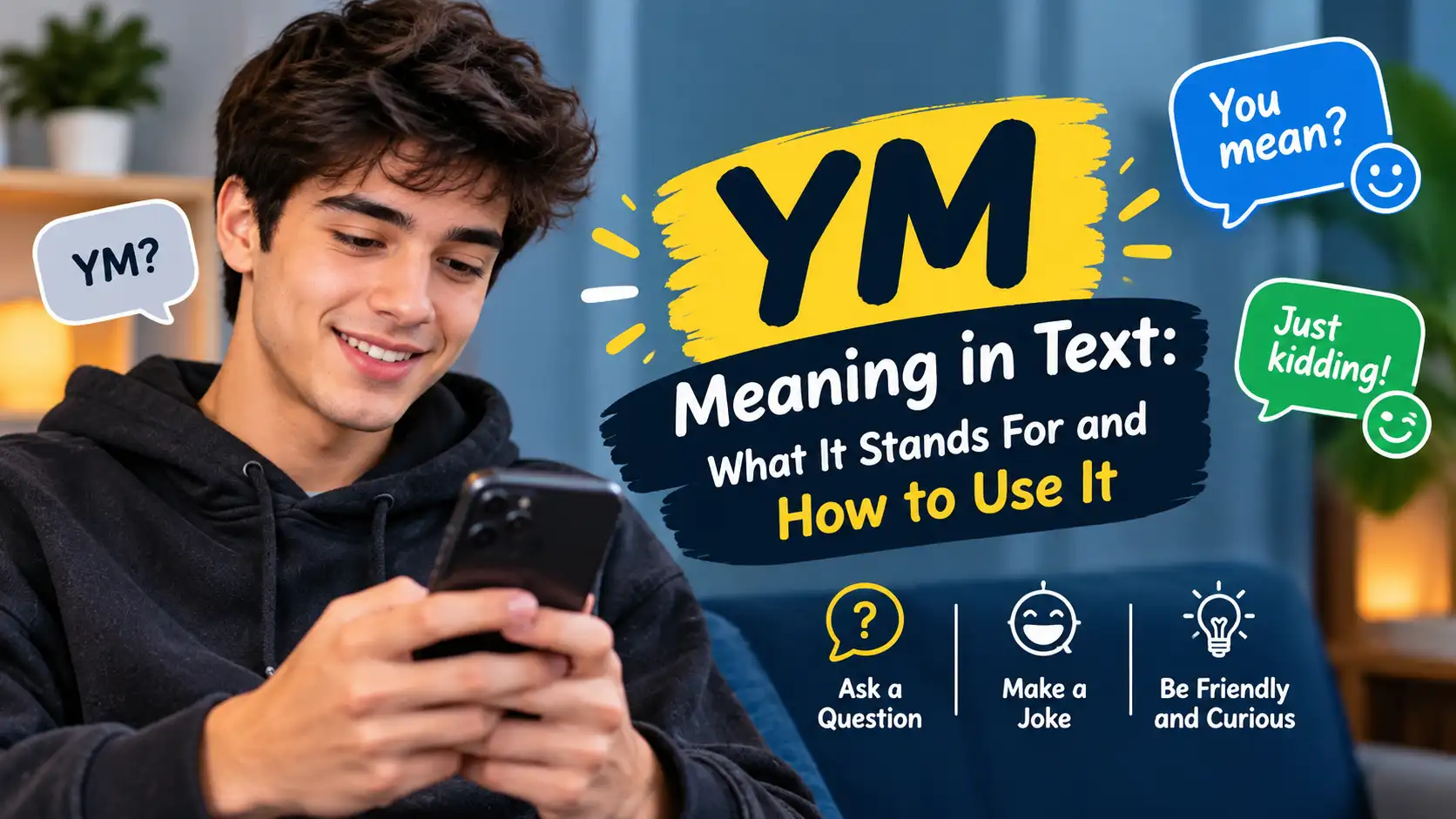
You get a text. It says “YM?” You stop and stare. What does that mean?
You are not alone. “YM” is a short code with more than one meaning. The right meaning depends on who sends it and where.
People use short codes like this all day. They show up in texts, social posts, game chats, and even work messages. Short codes save time. But they can also cause mix ups.
Think of YM like a key. One key can open more than one door. You must know which door you are standing at.
Why does this matter? A wrong guess can get awkward. You might think a friend is joking when they are not. Or you might miss a work note.
In this guide, you will learn what YM means. Here, you’ll see where it came from. You’ll see how to reply. You’ll also learn when not to use it.
Let’s start.
Definition & Meaning
YM has no single meaning. It changes with the setting. Here are the most common ones:
- You Mean – Used to check what someone said.
- Your Mom – Used in jokes and insults.
- Young Money – A famous hip hop label.
- Yahoo Messenger – An old chat app.
- Your Message – Used in support or work chats.
- Yes, Ma’am – A quick, polite reply.
The most common meaning: “You Mean”
In most texts, YM means “you mean.” It is a fast way to ask a question.
Example:
Sam: I’ll see you at the place.
Jo: YM the cafe?
Sam: Yes, the cafe.
Jo is checking. She wants to be sure.
The joking meaning: “Your Mom”
Among friends, YM can mean “your mom.” This is tied to old “yo mama” jokes.
Example:
Leo: Who ate my chips?
Max: YM.
Leo: 😂 Rude.
Max is joking. It is not meant to be deep.
The fan meaning: “Young Money”
Music fans use YM for Young Money. This is the label started by Lil Wayne.
Example:
Ava: Love this song.
Zed: YM classic!
Here, it is about music.
How to tell which one
Look at three things:
- Who sent it? A friend or a boss?
- What came before? Was it a question or a joke?
- Where are you? A chat app, a game, or a work thread?
When in doubt, ask. A quick “What do you mean by YM?” is fine.
Background & History
Short codes are not new. People used them long before phones. Telegraph workers cut words to save money. Radio fans did the same.
Then came the internet.
Early chat days
In the late 1990s, chat apps grew fast. People typed on big keyboards. Many wanted speed. So they cut words down.
One of those apps was Yahoo Messenger. It launched in 1998. Users often wrote it as YM or Y!M. If someone said “Add me on YM,” they meant Yahoo Messenger. Yahoo shut the app down in 2018. So that meaning is fading.
The “your mom” link
Jokes about someone’s mother are very old. They are part of a long tradition of playful insults. In the texting age, people cut them short. “Your mom” became YM. It stayed in casual chats, mostly among teens and young adults.
The music link
In 2005, Lil Wayne started Young Money Entertainment. The label grew popular. Fans began to write YM for short. You still see it in song captions and social posts.
The “you mean” link
This one grew with phone texting. Typing on a small screen is slow. “You mean” takes eight letters. YM takes two. So people shortened it.
Where it is used today
Today, YM mostly means “you mean” or “your mom.” The other meanings stay in small groups.
Some terms fade. Some stay. YM stays because it is short and useful. But it has never had one official meaning. That is why people still ask about it.
The lesson is simple. Slang changes with the crowd. A term can mean one thing in 2005 and another today.
Usage in Various Contexts
YM shows up in many places. Its meaning shifts in each one.
Texting
In texts, YM is usually a quick check.
Mia: Bring the thing tonight.
Ben: YM the charger?
Mia: Yes!
Or it can be a joke between friends.
Tom: Who left the lights on?
Kai: YM 😂
Social media
On social apps, YM often means “your mom” in a joking reply. It can also mean “Young Money” in music posts.
User A: This beat is fire.
User B: YM vibes.
Here, User B is talking about the label’s style.
Gaming
Gamers type fast. Every second counts. In game chat, YM might mean “you mean.”
1st Player : Go to the tower.
2nd Player : YM the red one?
1st Player : Yes, red.
But in heated matches, YM can also be a trash talk line. Players sometimes use it as an insult. That can lead to fights in chat.
Casual talk with friends
With close friends, the tone is loose. YM can be a joke or a quick check. Both are fine here.
Nina: I’m almost there.
Pat: YM you’re still home?
Nina: Okay, caught me.
Work chats
At work, YM is rare. If someone writes “YM,” it likely means “your message” or “you mean.”
Client: Got it.
Agent: Thanks for YM. We’ll reply soon.
Still, it is safer to spell it out at work.
A quick rule
Friends and games: YM is fine.
Work and school: Write the full words.
Common Misconceptions & Clarifications
Myth 1: “YM only means ‘your mom'”
This is the most common belief. It is not true. YM often just means “you mean.” Many people use it with no joke at all.
If you assume it is an insult, you may take offense for no reason.
Myth 2: “YM is always rude”
Not so. Most uses are harmless. A quick “YM?” is just a question.
But tone matters. The “your mom” meaning can be rude if the other person is not in on the joke.
Myth 3: “Everyone knows what YM means”
They do not. Some people have never seen it. Others know only one meaning. That is why mix ups happen.
Example of a mix up:
Boss: YM the report is late?
Intern: 😳 Did you just insult me?
The boss meant “you mean.” The intern read it as a joke. Both felt awkward.
Myth 4: “YM is the same as YMMV or YMCA”
No. These are different.
- YMMV = Your Mileage May Vary.
- YMCA = Young Men’s Christian Association.
- YM = its own short code.
Can it be misread?
Yes. Any short code can be misread. YM is a good example. It has a safe meaning and a joking one. The two look the same.
Is it inappropriate?
It depends. Around friends who joke, it is fine. Around a boss, a teacher, or a stranger, it can seem rude or confusing.
How to stay safe
- Read the mood before you reply.
- Ask if you are unsure.
- Spell it out when the message matters.
A clear message is almost always better than a clever one.
Similar Terms & Alternatives
If YM feels unclear, you have other options. Here are words people use instead.
For “you mean”
- “Do you mean…?” – Clear and polite.
- “Wait, you mean…?” – Casual.
- “U mean?” – Very short.
- “Meaning…?” – Quick check.
1st For “your mom”
- “Yo mama” – The classic form.
- “Ur mom” – Text version.
- “Ya mom” – Slang spelling.
2nd For “Young Money”
- “YMCMB” – Young Money Cash Money Billionaires.
- “Young Money” – Full name.
3rd For “your message”
- “Your note”
- “Your text”
- “Your email”
Quick comparison table
| Term | Meaning | Tone | Best for |
| YM | You mean / your mom | Casual | Friends |
| Do you mean? | Asking to clarify | Polite | Work, school |
| Ur mom | Joke insult | Playful or rude | Close friends |
| YMCMB | Music label group | Fan talk | Music posts |
| Your message | Reply to a note | Neutral | Support chats |
Which one to pick?
Pick based on your audience.
- Friends: YM or “U mean?”
- Family: “Do you mean…?”
- Work: “Could you clarify?”
Short codes are fun. But full words are safer when the stakes are high.
How to Respond to This Term
How you reply depends on the meaning and the person. Here are four styles.
1. Casual reply
Use this with friends. Keep it light.
Friend: YM?
You: Yep, I mean the park.
Or:
Friend: YM 😂
You: Haha, good one.
2. Funny reply
Match the joke. Do not get angry.
Friend: Who ate my snack? YM.
You: Guilty. I’ll buy you more.
Or throw it back:
Friend: YM!
You: Mine says hi. 😄
Only do this if you know they are playing.
3. Professional reply
At work, do not copy the slang. Answer clearly.
Colleague: YM the deadline?
You: Yes, I mean the Friday deadline.
If it feels odd, ask:
You: Could you clarify what you meant by “YM”?
This is polite and safe.
4. Privacy conscious reply
Maybe you do not know the sender. Maybe the text feels off. Do not share details. Keep it short.
Stranger: YM?
You: Not sure what you mean. Can you explain?
If they push, stop replying. You can block them if they keep going.
Quick tips
- Ask first if you are not sure.
- Match the tone of the sender, but stay respectful.
- Do not reply in anger. It may just be a joke or a short question.
- Save your energy for messages that matter.
A calm, clear reply ends most mix ups fast.
Regional or Cultural Differences
YM is mostly an English texting term. It is not used the same way in every place.
English speaking countries
In the US, UK, Canada, and Australia, YM is most often “you mean” or “your mom.” The “Young Money” meaning is strongest in the US, where the label is most famous.
Other languages
Other languages have their own short codes. The letters Y and M may not even match the words. For example:
- In Spanish, “you mean” is “¿o sea?” or “¿quieres decir?”
- In French, it is “tu veux dire?”
- In German, it is “meinst du?”
People who speak these languages may not know YM at all, unless they also use English online.
Regional slang for “your mom”
Jokes about mothers exist in many cultures. The wording changes:
- US: “Yo mama”
- UK: “Your mum”
- Some parts of Asia and the Middle East: These jokes can be very offensive, because family honor matters a lot.
That last point is key. A joke that is light in one place can be a serious insult in another.
Age and culture
Younger users tend to know more slang. Older users may be lost. A parent may not know YM at all.
Online culture
Gamers across the world often share English slang. So YM may appear in a game chat in any country, even if people do not speak English at home.
Tip for global chats
If you talk to people from other places, use plain words. Say “Do you mean…?” It works everywhere. It avoids insults. It avoids confusion.
Slang is like local food. It tastes great at home. But it may surprise a guest.
Comparison with Similar Terms
YM looks like many other short codes. Here is how it differs.
Comparison table
| Term | Stands for | Main use | Tone |
| YM | You mean / your mom | Clarify or joke | Casual |
| YMMV | Your mileage may vary | Warn that results differ | Neutral |
| YW | You’re welcome | Reply to thanks | Polite |
| YOLO | You only live once | Take a risk | Fun |
| IYKYK | If you know, you know | Inside joke | Playful |
| SMH | Shaking my head | Show disbelief | Mild |
| IDK | I don’t know | Show uncertainty | Neutral |
Key differences
YM vs. YMMV
YMMV is about results. “This diet worked for me, YMMV.” YM is about clarity or jokes.
YM vs. YW
YW is a polite reply to thanks. It looks close to YM, but has a different goal.
1 YM vs. SMH
SMH expresses a reaction. YM asks a question or makes a joke.
2 YM vs. IDK
IDK means you do not know. YM encourages the other person to explain.
Example side by side
Amy: Try that new diner.
Bo: YMMV, but I liked it.
Amy: YM the one on Main Street?
Bo: Yes!
Bo warns that results may vary. Amy checks which diner.
Why it matters
Many of these codes share letters. It is easy to mix them up. If you read too fast, you may miss the meaning.
The best fix is to slow down. Read the whole message. Look at the context. Then decide.
Usage in Online Communities & Dating Apps
Different places have different rules. Here is how YM shows up.
Twitter / X
On Twitter, posts are short. YM often appears as “your mom” in jokes or replies. It also pops up in music threads as “Young Money.”
User A: Who wrote this song?
User B: YM crew.
Gaming communities
On game servers and voice chats, YM may be a quick question (“you mean?”) or trash talk.
Player: Push mid!
Teammate: YM now?
Player: Yes, now!
If it is used as an insult, mute the player. Do not fight back.
Reddit and forums
On forums, YM is less common. People tend to write longer posts. You may see it in comment threads as a fast question.
Dating apps (Tinder, Bumble, Hinge)
On dating apps, YM is rare. But it can appear.
Match: I’m free on the weekend.
You: YM Saturday?
Match: Yes, Saturday.
Here it is just a check.
Tips for dating apps
- Do not assume it is an insult. Ask first.
- Avoid joking about family with someone you just met. It may land badly.
- Write full words when you plan a meet up. Clear plans keep you safe.
- Watch for pressure. If a match uses slang to rush you, slow down.
Responding well
- If it feels like a question, answer it.
- If it feels like a joke, reply lightly or ignore it.
- If it feels rude, set a boundary.
You: Not cool. Let’s keep it respectful.
General rule
Online spaces move fast. Take a breath before you reply. A short pause can save you from a long argument.
Hidden or Offensive Meanings
YM has a hidden side. In some chats, it means “your mom,” and that can be an insult.
Where the insult comes from
“Yo mama” jokes are a playful style of roasting. Friends trade them for fun. But the same joke can hurt when it comes from a stranger or a rival.
When it is harmless
- Between close friends who joke often.
- When both people laugh.
- In a playful group chat.
When it is harmful
- When a stranger says it.
- In a heated game.
- In a fight or argument.
- When the target has lost a parent.
That last case matters most. You never know what a person is going through. A joke about a mother can cut deep.
Other hidden meanings
Some people may use YM in other ways:
- A private code in a friend group.
- A short form of a name, like “Young Mike.”
- A shortened brand or team name.
There is no full list. New meanings appear all the time.
Why tone and context matter
Words on a screen have no voice. There is no smile. There is no laugh. So the reader fills in the tone.
Example:
A: YM.
B: What did you say?
Without context, B cannot tell if A is joking.
Add a hint to help:
A: YM 😂
The emoji shows the mood.
Safe habits
- Avoid it with strangers.
- Do not use it to hurt.
- Add an emoji if you mean it as a joke.
- If someone says it to you and it feels mean, you can ignore it, report it, or block it.
The best rule is simple. If it could hurt, do not send it.
Suitability for Professional Communication
YM is not good for formal settings. Here is why.
Reasons to avoid it
- It has many meanings. Your reader may guess wrong.
- It can sound like a joke. That can seem rude at work.
- It may look lazy. Clear writing shows care.
Where it might be okay
- In a very casual team chat, with people you know well.
- With a coworker who uses slang too.
Even then, use it with care.
Where it is not okay
- Emails to clients or managers.
- Reports and formal notes.
- Job applications.
- Messages to teachers or school staff.
Professional alternatives
Use plain words that say the same thing.
| Instead of | Try |
| YM? | “Do you mean…?” |
| YM? | “Could you clarify?” |
| YM? | “Just to confirm, you mean…?” |
| Thanks for YM | “Thank you for your message.” |
Examples
Weak:
You: YM the Monday meeting?
Better:
You: Just to confirm, do you mean the Monday meeting?
Weak:
You: Got YM.
Better:
You: I received your message. Thank you.
Why clear words win
Clear words build trust. They show you respect the reader’s time. They also lower the chance of a mix up.
In work settings, clarity beats speed.
Quick checklist
- Is my reader a friend? Slang is fine.
- Is my reader a boss or client? Use full words.
- Is the message important? Use full words.
When unsure, go formal. No one gets in trouble for being clear.
FAQs
1. What does YM mean in text?
YM most often means “you mean” or “your mom.” It can also mean “Young Money,” “Yahoo Messenger,” or “your message.” Check the context.
2. Is YM rude?
Not always. “You mean” is polite. “Your mom” can be rude if used as an insult. Tone and relationship matter.
3. How do I know which meaning is used?
Look at the sender, the message before it, and the platform. If you are still unsure, ask: “What do you mean by YM?”
4. Can I use YM at work?
It is best to avoid it. Use “Do you mean…?” or “Could you clarify?” instead. Clear words are safer.
5. Is YM the same as YMMV?
No. YMMV means “your mileage may vary.” YM is a separate code.
6. Is YM still used today?
Yes. It is used mostly in casual chats, games, and social media. The “Yahoo Messenger” meaning is fading, since the app closed in 2018.
7. How should I reply to YM?
Match the tone. When it sounds like a question, answer it. When it feels like a joke, respond lightly or ignore it.If it seems rude, set a boundary.
Conclusion
YM is a small code with big room for confusion. It can mean “you mean,” “your mom,” “Young Money,” “Yahoo Messenger,” or “your message.” Context tells you which one is right.
Here are the key points to remember:
- Most of the time, YM means “you mean.”
- It can also be a joke about someone’s mom. Use care.
- Avoid it at work. Write full words.
- Read the mood before you reply.
- Ask when unsure. It costs nothing.
- Culture matters. A joke in one place may hurt in another.

Noman Hassan is a content creator and writer focused on text meanings, slang, abbreviations, acronyms, and internet expressions. Through Orvexale.com, he provides clear and simple explanations to help readers understand modern texting language. His goal is to make confusing terms easy to understand with practical examples and everyday context.