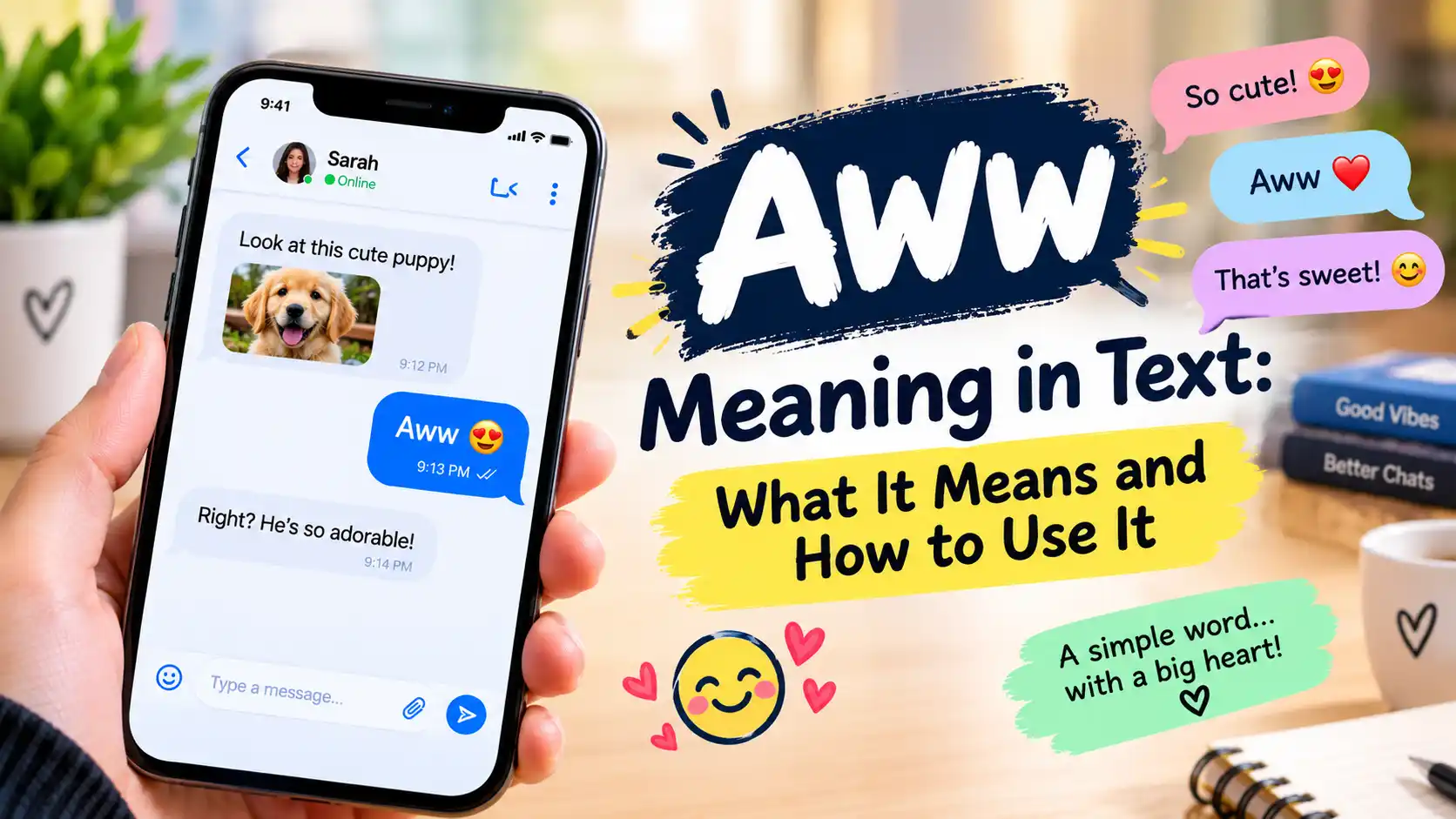
You send a photo of your new puppy. Your friend writes back one word: “aww.”
What does that mean?Could it be good? Is it sad? Is it a joke?
Good news. “Aww” is one of the friendliest words in texting. It shows warm feelings. People use it when something is cute, sweet, or kind. They also use it when they feel sorry for you.
You will see “aww” everywhere. It shows up in texts, comments, game chats, and even work messages. Kids use it. Grandparents use it.
But there is a catch. Tone changes everything. A kind “aww” feels like a hug. A sarcastic “aww” can feel like a poke.
This guide shows you what “aww” means, how to use it, and how to reply. Let’s dive in.
Definition & Meaning
What does “aww” mean?
“Aww” is a sound word. It is called an interjection. That is a short word that shows a feeling.
When you type “aww,” you are saying, “That is so sweet,” or “I feel for you.”
It has three main uses.
1. To show something is cute
Mia: Look at my baby cousin!
Zoe: Aww, those cheeks!
2. To show you care or feel touched
Sam: I made you a card for your birthday.
Leo: Aww, thank you. That means a lot.
3. To show sympathy
Ana: I missed the bus and got soaked.
Ben: Aww, that’s rough. Are you okay?
The extra letters
You may see “aww,” “awww,” or “awwww.” More letters usually mean more feeling.
- aw: a small, quick feeling
- aww: a normal, warm feeling
- awwwww: a big, gushing feeling
Example:
Kai: My grandma knitted me a sweater.
Eli: Awwwwww, that is so lovely!
Quick summary
Key point: “Aww” means “cute,” “sweet,” or “I’m sorry.” Look at the message before it to know which one.
Background & History
Where does “aww” come from?
“Aww” is not an internet invention. It is an old sound that people said out loud long before texting. English speakers have used “aw” and “aww” in speech and in print for a very long time. It was a natural sound of feeling, like “oh” or “ah.”
People used it to show:
- Sympathy (“Aw, poor thing”)
- Mild protest (“Aw, do I have to?”)
- Affection (“Aw, how sweet”)
How did it move into texting?
When people started to chat online, they wanted to show tone. Text has no voice and no face. So they typed their sounds instead. “Haha” showed laughter. “Hmm” showed thinking. And “aww” showed warm feelings.
How has it changed?
Over time, a few things happened.
- The spelling grew. People added more w’s to show more feeling.
- Emojis joined in. Now you will often see “aww 🥺” or “aww ❤️.”
- Social media made it huge. Photos of pets, babies, and sweet moments are perfect for “aww.”
- Sarcasm appeared. People started to use “aww” to tease, too.
Where is it used today?
Today, “aww” is used in:
- Texts between friends and family
- Comments on photos and videos
- Group chats
- Game chats
- Dating app chats
- Friendly work messages
Key point: “Aww” is an old sound that found a new home online. It is simple, warm, and easy to understand.
Usage in Various Contexts
“Aww” is flexible. Here is how it works in different places.
Texting
In texts, “aww” is a warm reaction.
Nina: I got the job!
Tom: Awww, congrats! I’m so happy for you!
Social media
On social media, “aww” is a favorite comment. It goes under pictures of pets, kids, and kind acts.
Post: My dog waits at the door every day for me.
Comment: Aww, loyal boy! 🐶
Gaming
Gamers use “aww” for both kindness and light teasing.
Player 1: I finally saved my team.
Player 2: Aww, our hero!
Or for sympathy:
Player 1: I lost the match by one point.
Player 2: Aww, so close. Next round!
Casual conversations
In a chat with a friend, “aww” can soften a message.
Jade: I can’t come tonight. I feel sick.
Rae: Aww, feel better! I’ll bring you soup tomorrow.
Photos and cute things
This is where “aww” shines.
Eve: sends a photo of a sleepy kitten
Max: Aww!! Can I keep him?
When someone shares good news
Lily: We are having a baby!
Dan: Awww, that’s amazing!
When someone shares sad news
Pat: My old dog passed away.
Kim: Aww, I’m so sorry. I’m here for you.
For sad news, use care. A short “aww” can work, but add more kind words.
Key point: “Aww” fits almost any warm moment. For big feelings, add a few more words so your care is clear.
Common Misconceptions & Clarifications
Mistake 1: “Aww always means cute”
Not always. It can also mean sympathy, affection, or even teasing. The message before it gives the clue.
Mistake 2: “Aww is only for babies and pets”
No. People use “aww” for kind acts, sweet notes, small wins, and sad moments. It is a wide use word.
Mistake 3: “Aww is always sweet”
Not true. Here is where it gets tricky.
Sarcastic “aww”:
Chris: I lost my homework.
Dee: Aww, poor you. rolls eyes
Here “aww” is fake. It mocks the person. This is called a sarcastic or mocking “aww.” It shows up in teasing and online fights.
How can you tell the difference?
Check these clues:
- The person. A close friend is likely kind. A rival may be teasing.
- The emojis. A heart means warmth. An eye roll means sarcasm.
- The topic. Sad news plus a flat “aww” can feel cold.
- The words after it. “Aww, that’s so sweet” is kind. “Aww, did you cry?” may be mocking.
Mistake 4: “Aww is childish”
Some think it sounds babyish. But adults use it all the time. It is natural and friendly.
Mistake 5: “More w’s is always better”
Not always. If someone shares sad news, “awwwwwww” can feel too loud. Match the size of your reaction to the size of the moment.
Is “aww” ever inappropriate?
Rarely. But it can be unkind when used to mock. It can also feel too casual for very serious or formal moments.
Key point: “Aww” is mostly kind. Watch for sarcasm, and keep your tone in check.
Similar Terms & Alternatives
You do not always need “aww.” Here are other ways to show the same feeling.
Quick list
- Aw: a shorter, softer version
- Awww: a bigger, gushier version
- Awwww: very big feeling
- So cute: a direct way to say it
- Adorable: a stronger word for cute
- That’s so sweet: for kind acts
- Ohh: a soft, caring sound
- My heart: as in “my heart!”
- I’m dying: for something too cute to handle
- Sending hugs: for sympathy
- 🥺 ❤️ 🥹: emojis for the same feeling
Comparison table
| Term | Feeling | Best For |
| Aww | Warm, caring | Cute things, kind acts |
| Awww | Extra warm | Big sweet moments |
| So cute | Clear and direct | Pets, babies, photos |
| Adorable | Strong praise | Very cute things |
| That’s so sweet | Touched | Kind words, gifts |
| Sending hugs | Sympathy | Sad news |
| 🥺 | Soft, pleading | Tender moments |
Which one should you pick?
- Want to be quick and warm? Use aww.
- Want to be extra clear? Use “that’s so sweet.”
- Want to show deep care? Use “sending hugs.”
- Want to be playful? Use awwww plus an emoji.
Key point: All of these show warm feelings. Pick the one that fits the moment.
How to Respond to This Term
Someone sent you “aww.” What do you say? It depends on the mood. Here are four styles.
1. Casual
Keep it light and friendly.
Friend: Aww, you got me flowers!
You: Of course! You deserve them.
More casual replies:
- “Thanks!”
- “Glad you like it!”
- “Anytime.”
2. Funny
Add a little humor.
Friend: Aww, your cat sleeps on your head?
You: Yep. She pays no rent, but she’s the boss.
3. Professional
If a coworker says “aww,” keep it short and kind.
Coworker: Aww, thanks for covering my shift.
You: Happy to help. Hope everything goes well.
You do not need to copy their tone. Just be warm and clear.
4. Privacy conscious
Maybe you do not want to share more. That is okay.
Acquaintance: Aww, are you seeing someone?
You: Ha, just keeping busy. How was your weekend?
You stay friendly, but you steer the talk to something else.
If the “aww” was sarcastic
Stay calm.
Rival: Aww, did you lose?
You: Yep. There’s always next time.
A calm reply takes away the sting.
If you feel unsure
Ask. It is fine.
You: Is that a nice “aww” or a teasing “aww”? 😄
Friend: Nice one! I promise.
Key point: Match the mood. If it is warm, be warm back. If it is sarcastic, stay calm.
Regional or Cultural Differences
Is “aww” used worldwide?
“Aww” is common in English speaking places like the US, UK, Canada, Australia, and more. It is also widely understood online, since so many people share English language posts.
But the feeling behind it is universal. Every culture has a way to say “how sweet” or “how sad.”
How do other languages say it?
- Spanish: “Ay, qué lindo” or just “ay” shows a similar sweet feeling.
- French: “Oh, c’est mignon” means “Oh, that’s cute.”
- Japanese: “Kawaii” means “cute,” and people say it often.
- Urdu and Hindi chat: Many people just type “aww” in English, or use words like “pyara” (sweet or dear).
Small differences in English
- In the US, people often stretch it: “awwwww.”
- In the UK, “aww” is just as common, and may come with “bless” as in “Aww, bless him.”
- In South Asia, English “aww” often mixes with local words in the same message.
Cultural tone
In some cultures, showing a lot of feeling in text is normal and friendly. In others, people prefer calm, simple messages. If you text someone from a different culture, a short “aww” with kind words is safe.
Key point: “Aww” is widely understood, but other languages have their own sweet words. The feeling is the same everywhere.
Comparison with Similar Terms
Let’s look at “aww” next to some close cousins.
Aww vs Aw
- Aw is shorter and softer.
- It can also show mild disappointment, like “Aw, man!”
- Aww is warmer and more caring.
Example:
A: The park is closed today.
B: Aw, that’s too bad.
1st Aww vs Awww
- Awww has more feeling.
- It fits big, cute moments.
- Aww fits everyday moments.
2nd Aww vs “So cute”
- “So cute” only means cute.
- “Aww” can mean cute, sweet, or sympathy.
- “Aww” is more flexible.
Aww vs “Aww, poor you”
- Plain “aww” is warm.
- “Aww, poor you” can sound caring or mocking, depending on tone.
Aww vs “Ohh”
- “Ohh” shows surprise or understanding.
- “Aww” shows warm feeling.
Example:
A: I’m moving to another city.
B: Ohh, I didn’t know! (surprise)
B: Aww, I’ll miss you! (warm feeling)
Comparison table
| Term | Main Feeling | Can Be Sarcastic? |
| Aww | Warm, caring | Yes |
| Aw | Soft or mild disappointment | Sometimes |
| Awww | Big warm feeling | Yes |
| So cute | Cute only | Rarely |
| Ohh | Surprise or realization | Rarely |
| Sending hugs | Deep sympathy | No |
Key point: “Aww” is the most flexible of the group. It covers cute, sweet, and sorry in one word.
Usage in Online Communities & Dating Apps
On Twitter / X
People use “aww” in replies to sweet or funny posts.
User 1: My little brother made me breakfast. It’s cereal. In a mug.
User 2: Aww, he tried his best!
Keep it short. The platform moves fast.
On Instagram and Facebook
“Aww” is a classic comment under photos of pets, kids, family, and special days.
Photo: Our first day at the beach.
Comment: Aww, look at those smiles! ❤️
In gaming communities
In games, “aww” can be kind or teasing.
Player A: My teammate just revived me!
Player B: Aww, teamwork!
Or:
Player A: I got knocked out first.
Player B: Aww, rough start.
Tip: In games, keep teasing friendly. A mocking “aww” after a bad loss can start a fight.
On dating apps like Tinder
On dating apps, “aww” is a flirty, friendly sign.
Match: I volunteer at an animal shelter on weekends.
You: Aww, that’s so sweet. Do you have a favorite dog?
It shows you care and are interested.
Tips for responding on dating apps
- Add a question. “Aww, that’s so sweet. What got you into it?” keeps the chat going.
- Don’t overuse it. Too many “awws” can feel flat.
- Be real. Say what you actually feel.
- Watch for sarcasm. A teasing “aww” may be flirting, or it may be a put down. Read the mood.
- Take it slow. With a new match, a simple “aww” and kind words works well.
Tips for online communities in general
- Read the room. Each group has its own style.
- Be kind. Do not use “aww” to mock people.
- Match the mood. Keep your reaction in line with the post.
Key point: Online, “aww” is a simple way to show kindness. Add a real comment, and it becomes even better.
Hidden or Offensive Meanings
Is “aww” offensive?
No. “Aww” has no swear words in it.This is not a slur. It does not target a person or group. It is one of the safest slang words around.
The one big catch: sarcasm
The only real risk is sarcasm. A fake “aww” can hurt.
Case 1: Kind
Ben: I burned the cookies.
Cal: Aww, no! Want to try again together?
Cal is caring.
Case 2: Mocking
Ben: I burned the cookies.
Cal: Aww, can’t even bake. 😂
Cal is making fun of Ben. Same word, very different feeling.
Condescending “aww”
Sometimes “aww” can sound talking down to someone. For example, saying “aww, that’s cute” to a coworker’s serious idea may sound like you think they are small or silly.
Example:
Coworker: I made a plan to save us two hours a week.
You: Aww, that’s cute.
That can sting. It sounds like you do not take the idea seriously.
Does it have hidden meanings?
No widely known secret meanings exist. Some friend groups may use it as an inside joke, but that is rare.
Why tone and context matter
Text has no voice. So your reader fills in the tone. If the topic is serious, they may read your “aww” as cold or fake.
How to stay safe
- Pair “aww” with kind words for sad news.
- Skip “aww” if you are upset or annoyed.
- Use emojis to show your real tone.
- If someone seems hurt, say sorry and explain.
Key point: “Aww” is kind by default. Only sarcasm and bad timing can make it sting.
Suitability for Professional Communication
Is “aww” okay at work?
Sometimes, yes. It depends on your workplace.
“Aww” is not rude. It is warm. In many offices, a friendly “aww” in a chat after good news is fine. But in formal emails or messages to clients, it may seem too casual.
When it is fine
- A chat with close coworkers
- A team message about good news or a sweet moment
- A relaxed workplace where people use casual language
Example:
Manager: Our new intern brought donuts for everyone.
You: Aww, that’s so thoughtful!
When to avoid it
- Formal emails
- Messages to clients or senior leaders
- Serious topics, like layoffs, mistakes, or complaints
- When you are not sure of the culture
Professional alternatives
Try these instead:
- “That’s very kind.”
- “Thank you, that means a lot.”
- “What a thoughtful gesture.”
- “I’m so sorry to hear that.”
- “That’s wonderful news.”
Examples in dialogue
Casual (okay with friends):
Teammate: I got a promotion!
You: Awww, congrats!!
Professional (safer):
Teammate: I got a promotion!
You: Congratulations! Well deserved.
For sad news (professional):
Colleague: My dad is in the hospital.
You: I’m so sorry to hear that. Please take the time you need.
Notice that for sad news, “aww” alone is too light. Use full, caring words.
Quick rules for work chats
- Follow your team’s style.
- Never use “aww” to mock.
- Use full words for serious topics.
- When in doubt, choose clear and kind.
Key point: “Aww” can work at work, but clear, kind words are always safe.
FAQs
1. What does “aww” mean in text?
“Aww” shows warm feelings. It can mean something is cute, sweet, or that you feel sorry for someone.
2. Is “aww” the same as “awww”?
Mostly yes. More w’s mean more feeling. “Awww” is a bigger, gushier version of “aww.”
3. Can “aww” be sarcastic?
Yes. A fake “aww” can tease or mock someone. Look at the context, emojis, and the person’s tone.
4. Is “aww” okay to use at work?
It can be, in casual chats with friendly coworkers. For formal emails or serious topics, use full, professional words.
5. How do I reply to “aww”?
Match the mood. Say “thanks,” share a joke, or ask a follow up. If it felt sarcastic, stay calm and kind.
6. Is “aww” used in other languages?
The sound is mostly English. But many languages have similar warm words, like “kawaii” in Japanese or “mignon” in French.
7. What can I use instead of “aww”?
Try “so cute,” “that’s so sweet,” “adorable,” “sending hugs,” or a heart emoji. Choose what fits the moment.
Conclusion
“Aww” is a small word with a big heart. It shows warmth, care, and sympathy in just three letters.
Here are the key points to remember:
- “Aww” means cute, sweet, or sorry. The context tells you which.
- More w’s mean more feeling. Match the size of the moment.
- Watch out for sarcasm. A fake “aww” can hurt.
- It is safe and friendly in most chats, from texts to dating apps.
- At work, use it with care. For serious topics, choose full, kind words.
- You have options. “So cute,” “that’s so sweet,” and “sending hugs” all work too.

Noman Hassan is a content creator and writer focused on text meanings, slang, abbreviations, acronyms, and internet expressions. Through Orvexale.com, he provides clear and simple explanations to help readers understand modern texting language. His goal is to make confusing terms easy to understand with practical examples and everyday context.