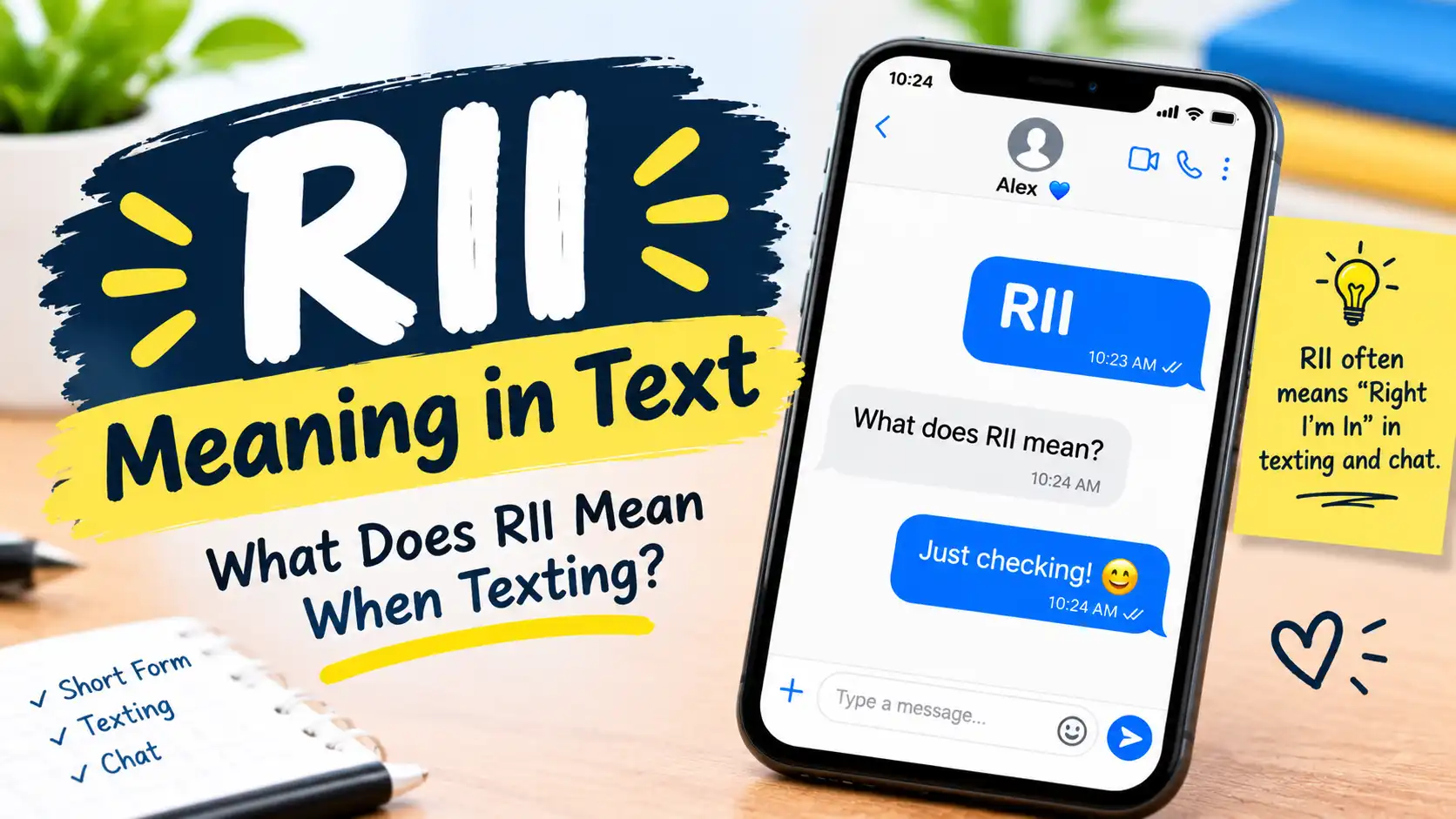
Someone texts you, “We’re meeting at 6, rii?” You stop. If that be a typo? Could it be a new slang word? Could it be a secret code?
Good news. It’s not as scary as it looks. RII is most often a casual, stretched spelling of “right.” People use it to check, agree, or react.
But RII is not a famous term like LOL. It has no official meaning. Its meaning changes with the chat, the tone, and the emoji.
You may see it in texts, DMs, TikTok comments, game chats, and group chats. It looks small, but it can carry a lot of feelings.
Why does it matter? A wrong guess can cause awkward moments. If someone says “rii?” to check a fact and you think they’re being sarcastic, a small chat can turn into an argument.
This guide makes it simple. You’ll learn what RII means, how to read it, and how to reply. Let’s start.
Definition & Meaning
RII has no fixed dictionary meaning. It is an informal chat language. People write it in different ways, and context tells you which one they mean.
1. RII = “Right?” (checking or confirming)
This is the most common use. The sender wants you to confirm something.
Example:
Mia: The party starts at eight, rii?
Tom: Yep, eight sharp.
2. RII = “Right!” (agreement)
Here, RII means “I agree” or “Exactly.”
Example:
Ava: That song is so good.
Ben: Rii! I’ve played it ten times.
3. RII = “Really?” (surprise or doubt)
With a question mark, RII can show shock or doubt.
Example:
Zoe: I finished all my homework in one hour.
Kai: Rii? 😳
4. RII = Sarcasm (“Yeah, right”)
Add an eye roll emoji, and RII can mean “I don’t believe you.”
Example:
Lena: I’m never late.
Omar: Rii 🙄
Other claimed meanings
Some websites list “Rest In Internet,” “Rest In It,” or “Right Idea Indeed.” These appear rare, and I couldn’t find strong proof they are widely used. Treat them as possible but unlikely.
Quick guide:
- A question mark often means checking or doubting.
- An exclamation mark often means agreement.
- A laughing emoji means fun.
- An eye roll emoji means sarcasm.
Remember: Always read the whole message, not just the word.
Background & History
RII is not an old acronym. It comes from a habit called stretching words online. People repeat or change letters to show tone. You can’t hear a voice in text, so you copy it with spelling.
You’ve seen this before:
- “Sooo tired” instead of “so tired”
- “Noooo” instead of “no”
- “Yeahhh” instead of “yeah”
“Right” turning into “rii” follows the same pattern. Some people shorten it to “ri.” Others stretch it to “rii” so it sounds softer, friendlier, or more playful.
Why did it spread?
- Speed. It’s short and easy to type.
- Tone. It sounds relaxed and warm.
- Social media. TikTok, Snapchat, and Instagram love casual, expressive typing.
- Gen Z habits. Younger users enjoy playing with spelling.
Because RII grew from typing habits, not a single event, it has no clear origin date. That is also why slang dictionaries rarely list it. Many writers call it a typing variation more than a true slang term.
Other meanings outside texting:
RII also names things that have nothing to do with chat. Examples include the Relative Index of Inequality (used in health and statistics) and an airline code for the defunct Air Costa Rica. These are formal uses, and you’d see them in reports or travel data, not in friendly texts.
Where RII appears today:
- Private texts
- Instagram and Snapchat DMs
- TikTok comments
- Group chats
- Casual gaming chats
Key point: Because RII is flexible, no single group owns it. Read each chat on its own terms.
Usage in Various Contexts
Let’s see RII in real life.
Texting
Sara: The movie starts at nine, rii?
Ali: Yes. See you at the door.
Social Media
Post: This pizza is the best in town 🍕
Comment: Rii! I go every week.
Gaming
Player 1: We need to defend the base first, rii?
Player 2: Rii. I’ll cover the left side.
Casual Conversation
Dan: I’m not tired at all.
Sue: Rii 😂 You yawned ten times.
Group Chats
Jay: So we all bring snacks, rii?
Kim: Rii! I’ll bring chips.
Reaction to News
Nina: They cancelled the test!
Leo: Rii?? No way!
Tip: In planning chats, RII usually means “right?” In reactions, it usually means “really?” or “I agree.” In banter, watch for sarcasm.
Common Misconceptions & Clarifications
Let’s clear up some mix ups.
Misconception 1: “RII is an official abbreviation.”
Not true. It has no standard definition. It’s a casual spelling that people use in different ways.
Misconception 2: “RII means Rest In Peace.”
Some sites say so, but that is not the usual meaning. RIP is the common short form for “rest in peace.” If someone says “RII” after bad news, ask what they mean.
Misconception 3: “RII is always sarcastic.”
No. Many people use it in a warm, friendly way.
Misconception 4: “RII is a typo.”
Sometimes it is! Fast typing can create “rii” by accident. Don’t read too much into a single message.
Example:
Mom: Dinner at six, rii?
Teen: Yes, mom.
Here, it’s just “right?” Nothing hidden.
Misconception 5: “RII is the same as IKR.”
Close, but not the same.
- IKR = “I know, right?” (strong agreement)
- RII = “right?” or “right!” (softer and more flexible)
How to avoid confusion:
- Look at the punctuation (? or !).
- Look at the emoji.
- Think about the topic.
- If unsure, ask: “Do you mean ‘right?’ or ‘really?'”
Asking costs nothing and saves a lot of trouble.
Similar Terms & Alternatives
Here are other ways to say the same thing.
1st For “right?” (checking):
- Right?
- Yeah?
- Correct?
- Isn’t it?
For “right!” (agreement):
- IKR: I know, right?
- Facts: That’s true.
- Exactly: Totally agree.
- Same: I feel that too.
For “really?” (surprise):
- Fr?: For real?
- No way: I’m shocked.
- Seriously?: I’m surprised.
| Term | Meaning | Tone |
| RII | Right / really / sarcasm | Depends on context |
| IKR | I know, right? | Strong agreement |
| Facts | That’s true | Confident |
| Fr | For real | Casual, direct |
| No way | I’m shocked | Surprised |
| Same | I feel that too | Friendly |
Which one should you use?
- Want to confirm? Try “right?”
- Want to agree strongly? Try “IKR” or “facts.”
- Want to show surprise? Try “fr?” or “no way.”
- Want to be playful? Try “rii.”
Example:
Tina: Pizza for dinner, rii?
Leo: IKR, best idea all day.
How to Respond to This Term
First figure out what the sender means. Then choose your style.
If It Means “Right?” (checking)
Casual replies:
- “Yep, that’s right.”
- “Yes, six o’clock.”
Funny replies:
- “Correct, 100%. I checked with my brain.”
- “Rii. I’d bet my snacks on it.”
Professional replies:
- “Yes, that’s correct.”
- “Confirmed. Thank you for checking.”
If It Means “Right!” (agreement)
- “Right? So good!”
- “Totally!”
- “Glad you agree.”
If It Means “Really?” (doubt)
- “Yes, really! I’m serious.”
- “I know, it’s wild.”
Example:
Kai: Rii? You ran a mile in six minutes?
Zoe: Haha, okay, seven. But close!
If It’s Sarcasm
- “Okay, okay, I get it 😅”
- “Fair, I do run late sometimes.”
Privacy Conscious Replies
Sometimes a stranger uses “rii?” to get you to confirm private details.
Stranger: You live near the park, rii?
You: I don’t share where I live. Let’s change the subject.
Safety tip: Don’t confirm your address, school, or daily routine to people you don’t know. If they keep asking, stop replying and block them.
Regional or Cultural Differences
RII is built from the English word “right,” so it works best among English speakers. Other languages stretch their own words in similar ways.
Where it shows up:
- U.S. and Canada: Common in casual texts among young people.
- U.K. and Ireland: Less common, but easy to understand.
- South Asia (including Pakistan and India): Many young people text in English. They often stretch words like this, sometimes mixed with local words.
- Australia and New Zealand: Understood in casual chat.
- Africa and the Caribbean: Stretched spellings are common in online talk.
Mixed language example:
Hina: Kal milte hain, rii? (We’ll meet tomorrow, right?)
Sara: Haan, pakka! (Yes, for sure!)
Regional alternatives:
- U.S.: “Right?” or “Am I right?”
- U.K.: “Innit?” (isn’t it?)
- Canada: “Eh?”
- Australia: “Yeah, nah” (a casual, mixed answer)
Cultural tone:
Casual spelling is fine with friends. With elders or teachers, write full words. Older people may think “rii” is a typo.
Tip: If you’re texting someone who is not a regular slang user, spell it out. It avoids confusion.
Comparison with Similar Terms
Let’s put RII next to other short replies.
| Expression | Meaning | Feels Like | Example |
| RII | Right / really | Soft, flexible | “Rii? You sure?” |
| IKR | I know, right? | Strong agreement | “IKR, it’s amazing!” |
| Fr | For real | Direct and honest | “Fr, I’m tired.” |
| Same | I feel that too | Friendly | “Same, honestly.” |
| Facts | That’s true | Confident | “Facts, no doubt.” |
Key differences:
- RII vs. IKR: IKR is a clear, strong agreement. RII is softer and can mean several things.
- RII vs. Fr: “Fr” asks for truth or stresses it. RII is gentler and more playful.
- RII vs. same: “Same” shows shared feeling. RII mostly confirms or reacts.
- RII vs. facts: “Facts” is firm. RII is relaxed.
Example:
Lee: This game is too hard.
Kim: IKR.
Lee: Rii? So it’s not just me 😅
Kim agrees strongly. Lee asks for a soft confirmation.
Usage in Online Communities & Dating Apps
Dating Apps (Tinder, Bumble, Hinge)
On dating apps, RII often shows up in friendly chat.
Match 1: We both like hiking, rii?
Match 2: Rii! Let’s go this weekend.
It can also be playful teasing.
Match 1: I make the best pasta.
Match 2: Rii 😏 Prove it.
Tips for dating apps:
- Read the emoji before you reply.
- If it feels like sarcasm, answer with humor, not anger.
- Don’t share private info just because someone asks “rii?”
- If a chat turns pushy, it’s okay to stop.
Twitter/X and Social Platforms
Post: Mondays are the worst.
Reply: Rii 😭
Gaming Communities
Teammate: We should attack together, rii?
You: Rii. On three.
Tips for online spaces:
- Match the mood of the group.
- Don’t use sarcasm to bully anyone.
- Use the report button if teasing turns mean.
General rule: Online, be kind first. Real people read your words.
Hidden or Offensive Meanings
RII is not offensive. It isn’t a slur, and it doesn’t hide a secret code. It’s a mild, casual word.
But a few things are worth knowing.
Alternative meanings:
- Relative Index of Inequality: A health and statistics term.
- Air Costa Rica code: A defunct airline code.
- Online claims like “Rest In Internet” or “Rest In It:” These show up on some sites. They look rare and not well proven.
None of these are offensive. They’re just different uses.
When RII can feel wrong:
- Sarcasm. “Rii 🙄” can feel mocking.
- Serious moments. If someone shares bad news and you reply “rii,” it may feel cold.
- With strangers. They may not know what you mean.
- At older people. They may think it’s a typo.
Example of a bad moment:
Friend: My dog is sick, and I’m worried.
You: Rii.
That feels cold. Better: “I’m so sorry. Do you want to talk?”
Example of a friendly moment:
Friend: This cake is amazing!
You: Rii! Give me the recipe 😋
Why tone and context matter:
- Text has no voice or face.
- Emojis change the mood a lot.
- Punctuation matters. “Rii?” and “Rii!” feel very different.
- Relationships matter. Friends tease. Strangers may not like it.
Safe habit: In sad or serious moments, use full, caring words.
Suitability for Professional Communication
Short answer: do not use RII in formal work messages.
RII is casual, and it has no official meaning. At work, that makes it risky. A boss or client may think it’s a typo. They may also read it as sarcasm. Clear words are always safer.
Poor example:
Manager: The report is due Friday.
Employee: Rii.
That looks careless.
Better example:
Manager: The report is due Friday.
Employee: Understood. I’ll send it by Thursday.
Professional alternatives:
| Instead of RII | Say this |
| Right? | “Is that correct?” |
| Right! | “I agree.” |
| Really? | “Could you confirm that?” |
| Yeah, right (sarcasm) | “I’m not sure that’s accurate.” |
When it might be okay:
- In a casual team chat where everyone jokes
- With close coworkers who often text in slang
Even then, read the room. If your workplace is formal, skip it.
Special note: In formal fields like health research, RII may mean the Relative Index of Inequality. Spell it out the first time, so readers don’t get lost.
Golden rule: At work, clear and polite beats short and cool.
FAQs
1. What does RII mean in text?
It has no official meaning. Most often, it’s a casual spelling of “right” used to check, agree, or react. Sometimes it means “really?”
2. Is RII a real slang word?
It’s more of a typing variation than a standard slang term. You won’t find it in most slang dictionaries.
3. Does RII mean “Rest In Peace”?
Usually not. RIP is the usual short form. Some sites list other meanings, but they appear rare.
4. Is RII the same as IKR?
No. IKR means “I know, right?” and shows strong agreement. RII is softer and more flexible.
5. Is RII rude?
No, but it can sound sarcastic with an eye roll emoji. Context decides.
6. Can I use RII at work?
It’s best not to. Use clear, polite sentences instead.
7. How do I know what the sender means?
Check the punctuation, emoji, and topic. If you’re still unsure, simply ask.
Conclusion
RII is a small word with a flexible meaning. It has no official definition. Most often, it’s a casual way to write “right,” whether checking something, agreeing, or showing surprise.
Here’s what to remember:
- Context is king. Read the whole message.
- Punctuation and emoji matter. A “?” and a “!” feel very different.
- It’s not offensive, but sarcasm can sting.
- Don’t trust rare claims like “Rest In Internet” without proof.
- Skip it in formal work messages.
- Protect your privacy with strangers.
- When unsure, ask. One question clears things up.

Noman Hassan is a content creator and writer focused on text meanings, slang, abbreviations, acronyms, and internet expressions. Through Orvexale.com, he provides clear and simple explanations to help readers understand modern texting language. His goal is to make confusing terms easy to understand with practical examples and everyday context.